Tag Archives: Pro-Life

How pro-life apologetics helps strengthen your evangelism

From Scott Klusendorf’s Life Training Institute.

Excerpt:

Beyond the obvious obligation we have as thinking human beings to clarify the status, and defend the value, of innocent, unborn human life, engaging in the pro-life project is also a way to make the case for the truth of Christianity in general. It stands to reason that if the scientific, philosophical, and moral arguments we offer in defense of the humanity of the unborn also happen to align exactly with the biblical notion of what it means to be a human being made “in the image of God,” then the Bible might also have something to say about other things of importance.

This is a point Scott makes repeatedly but it was recently driven home in a very concrete way by, of all people, a hard core atheist in the most recent issue of Salvo magazine. A secular skeptic, law school professor, renowned blogger, and mocker of deluded “Godiots,” the “Raving Atheist” attended a blogger party where he serendipitously sat next to a Catholic blogger named Benjamin. As the “Raving Atheist” explains:

At one point the conversation turned to abortion, and I asked Benjamin’s opinion of the practice. I was stunned. Here was a kind, affable, and cogently reasonable human being who nonetheless believed that abortion was murder. To the limited extent I had previously considered the issue, I believed abortion to be completely acceptable, the mere disposal of a lump of cells, perhaps akin to clipping fingernails.

This unsettling exchange spurred me to further investigate the issue on Benjamin’s blog. I noticed that pro-choice Christians did not employ scientific or rational arguments but relied on a confused set of “spiritual” platitudes. More significantly, the pro-choice atheistic blogosphere also fell short in its analysis of abortion. The supposedly “reality-based” community either dismissed abortion as a “religious issue” or paradoxically claimed that pro-life principles were contrary to religious doctrine. Having formerly equated atheism with reason, I was slowly growing uncertain of the value of godlessness in the search for truth.

Though the “Raving Atheist” continued to rave, there was now a stone in his God-rejecting shoe, placed there by a reasoned defense of the pro-life view. He couldn’t disconnect himself from it and later admitted that the “selfless dedication [of pro-life advocates] to their cause moved [him] deeply.” Later, he met a woman named Ashli whose work in pregnancy care drew him to further consider the pro-life position. Soon thereafter, the “Raving Atheist” became, in part, a pro-life blogsite …

Click here to read the astonishing conclusion. Then come back here.

Back? Ok, so what did we learn from this? Well, the moral of this story is that it is very important for Christians to have a good understanding of moral issues like abortion and same-sex marriage so that they can talk about these issues based on what they know. When someone can stake out a moral position on these kinds of issues, using science and history and other hard evidence – not just the Bible – then it helps non-Christians to take us seriously as thinkers.

Unless we demonstrate the ability to reason out there in the real world – outside the church – then we are not going to be viewed as authoritative on any subject – especially on spiritual subjects. We really need to study up on other issues, and show that we care about the unborn (abortion issue) and children (same-sex marriage issue). We have to show that there is more to us than just doing what feels good. We have to show that we are smart and that we are willing to be unpopular in order to do the right thing. That we didn’t just inherit these views from our parents, or from our culture. That we have actually thought things through more than just reading the Bible, and that it makes a difference in how we view the world, and in how we live.

And I also think that it is just as important to read about economics, because we care about the poor. Socialists don’t know anything about economics. Whenever their wealth redistribution policies are tried, people get poorer and are less likely to be employed. If we really cared about the poor, we would study economics. Entrepreneurs stop hiring workers when they think that there is no profit to be made from undertaking an enterprise.

We also need to read about military and foreign policy issues, because we care about peace. Pacifists don’t know anything about military affairs and terrorism. Whenever their appeasement policies are tried, wars start and innocent people die. If we really cared about preventing wars and terrorism, we would study military history, counter-terorism and foreign policy. Bad men become aggressive when they think there is no cost to bear for it.

Ignorance is never a good idea when you are trying to do good – and you can’t know what is really good just by your feelings and intuitions. If you want to do good, you need to be 1) convincing and 2) effective. And that takes study. Don’t choose policies based on what makes you feel good and what sounds good to others. Push for effective policies – what actually does good – and then have your arguments and evidence ready to convince people, using evidence from authorities that they accept as non-Christians. If you have the will to study a little, you can be passionate and convincing. Non-Christians respect passion and knowledge. They don’t respect fideism and mysticism. They can spot a fake a mile away.

The best book to read on Christian worldview is Wayne Grudem’s “Politics According to the Bible“.

If you want to see Scott in a good debate against an ACLU spokeswoman, click here. He is also the author of the best introductory book on pro-life apologetics, entitled “The Case for Life“.
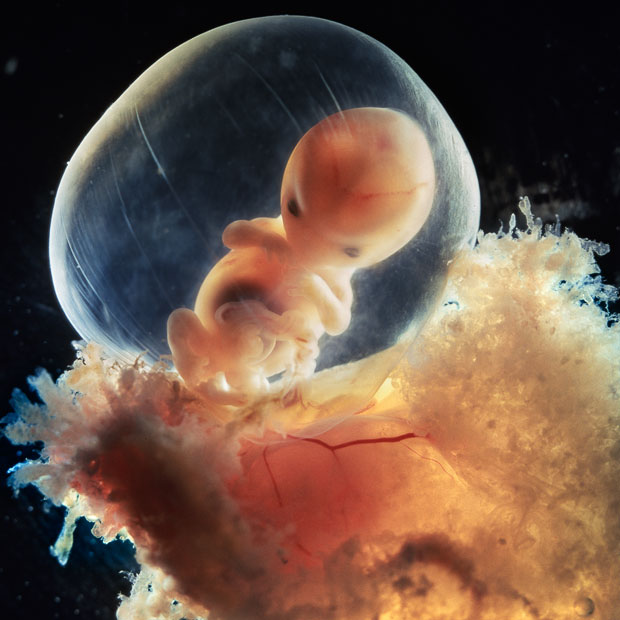
New study finds that unborn babies can recognize spoken words

Scheming unborn baby can hear what you're saying, potty-mouth
Scheming unborn baby can hear what you’re saying, potty-mouth

The study was published in the prestigious peer-reviewed journal Science.

Excerpt:

As a fetus grows inside a mother’s belly, it can hear sounds from the outside world—and can understand them well enough to retain memories of them after birth, according to new research.

It may seem implausible that fetuses can listen to speech within the womb, but the sound-processing parts of their brain become active in the last trimester of pregnancy, and sound carries fairly well through the mother’s abdomen. “If you put your hand over your mouth and speak, that’s very similar to the situation the fetus is in,” says cognitive neuroscientist Eino Partanen of the University of Helsinki. “You can hear the rhythm of speech, rhythm of music, and so on.”

A 1988 study suggested that newborns recognize the theme song from their mother’s favorite soap opera. More recent studies have expanded on the idea of fetal learning, indicating that newborns already familiarized themselves with sounds of their parent’s native language; one showed that American newborns seem to perceive Swedish vowel sounds as unfamiliar, sucking on a high-tech pacifier to hear more of the new sounds. Swedish infants showed the same response to English vowels.

But those studies were based on babies’ behaviors, which can be tricky to test. Partanen and his team decided instead to outfit babies with EEG sensors to look for neural traces of memories from the womb. “Once we learn a sound, if it’s repeated to us often enough, we form a memory of it, which is activated when we hear the sound again,” he explains. This memory speeds up recognition of sounds in the learner’s native language and can be detected as a pattern of brain waves, even in a sleeping baby.

The team gave expectant women a recording to play several times a week during their last few months of pregnancy, which included a made-up word, “tatata,” repeated many times and interspersed with music. Sometimes the middle syllable was varied, with a different pitch or vowel sound. By the time the babies were born, they had heard the made-up word, on average, more than 25,000 times. And when they were tested after birth,these infants’ brains recognized the word and its variations, while infants in a control group did not, Partanen and colleagues report online today in the Proceedings of the National Academy of Sciences.

Babies who had heard the recordings showed the neural signal for recognizing vowel and pitch changes in the pseudoword, and the signal was strongest for the infants whose mothers played the recording most often. They were also better than the control babies at detecting other differences in the syllables, such as vowel length. “This leads us to believe that the fetus can learn much more detailed information than we previously thought,” Partanen says, and that the memory traces are detectable after birth.

“This is a well-respected group and the effects are really convincing,” says Patricia Kuhl, a neuroscientist at the University of Washington in Seattle. Combined with previous work, she says, these results suggest “that language learning begins in the womb.”

More evidence that unborn babies are not just blobs of tissue. Every one is precious, and we need to be more careful with our decisions so that we welcome them into the world and look after them as they grow up. Not just giving them protection and sustenance, but a mother and a father close by, too. That’s what they need.

Brian Auten interviews pro-life debater Scott Klusendorf on pro-life apologetics

Unborn baby scheming about pro-life apologetics

Scott Klusendorf is the director of the excellent Life Training Institute, and he’s been interviewed by Brian Auten on Apologetics 315.

Details of the interview:

Today’s interview is with Scott Klusendorf, president of Life Training Institute. LTI is the first place to look for excellent resources to get better equipped to defend the pro-life position. Scott talks about defining abortion and its terms, the issue of the debate, the legal history of abortion, defending the pro-life view using science and philosophy, the four pillars of the pro-life argument, answering a litany of objections to the pro-life position, the right and wrong use of emotional appeals, taking on the right tone in the debate, how to get better equipped, and more.

Grab the MP3 file here at Apologetics 315.

The article Scott mentions “How to Defend Your Pro-Life Views in 5 Minutes or Less” is worth the read, and it’s a good summary of some of the points he makes in the lecture.

If you like this interview, please be sure and buy the best basic book on pro-life apologetics – Scott Klusendorf’s “The Case for Life“.

And there is actually a full transcript, and here’s an excerpt:

BA: Great stuff. Now I want you to go into these pillars if you will of defending the pro-life position with science and philosophy, and in your web site prolifetraining.com one of the things that you provide is sort of a four point acronym, some would say sled S-L-E-D. Can you lay out what those main pillars are and their relevance to the issue?

SK: Well as I mentioned a moment ago, pro-life advocates argue that elective abortion unjustly takes the life of a developing human being, and we defend that claim using science and philosophy. We use science to determine what kind of thing the unborn is, and we use philosophy to show that there’s no relevant deference between the embryos we once were and the adults we are today that would justify killing us at that earlier stage of development. Scientifically, as I mentioned just moments ago embryology text books worldwide indicate that from the very beginning you and I were distinct living whole human beings. You can’t see that I’m doing this right now, Brian, but at the moment I’m picking cells off the back of my hand. These cells, which we call somatic cells, contain my entire DNA and coding. But you don’t thing I just committed mass murder by sending a couple hundred of those puppies hurling to their deaths on the floor in front of me. And the reason is, you know that these cells though they contain my DNA and coding are merely part of a larger human being, me. They are not distinct whole living organisms the way that you were when you were an embryo. The way I was when I was an embryo. In other words, there is a difference in kind between each of our bodily cells and the embryonic human beings we once were. That’s what science teaches us; that’s what the science of embryology lays down for us.Philosophically, we argue using that SLED acronym that you mentioned a moment ago that there’s no difference between that embryo we once were and the adult we are today. The adults we are today that justify killing us at that earlier stage of development and as Steven Schwarz points out, the differences between that embryo and the adult that you are today are one of size, level of development, environment and degree of dependency. Think of the acronym SLED and you will remember those four differences. Size, yeah you were smaller as an embryo, but since when does body size determine the rights that you have. Shaquille O’Neal, the seven foot two basketball star with the Boston Celtics, is a foot taller than I am, but he doesn’t have a greater right to life simply because he’s bigger.

Level development? Sure, we were less developed as embryos but since when is a matter of principal does that mean we can kill you? Two-year-old girls are less developed than twenty-year-old young women. We don’t think though the two year old girl has less to a right to life simply because she can’t function at the level that the twenty year old can. Level of size, I should say level of development. What about environment; where you are located there is the letter “E” in that SLED acronym. You were once in the womb now you’re out but sense when does were you are determine what you are? When you walk from your living room into the studio to do this interview. You changed location but you didn’t stop being you. When I jump on an airplane and fly from Atlanta to London’s Heathrow airport. I get off the plane I’m in a new location, but I’m the same being as I was when I left Atlanta. If that’s true how does a journey of eight inches down the birth canal suddenly change me from non-human, non-valuable thing that we can kill? To a valuable human being that we can’t kill. And the answer is, if I wasn’t already human and valuable I’m not going to get there by changing my address. And then finally, degree of dependency—yes we depended on our mother for survival but sense when does dependency on another human being mean we can kill you? Conjoined twins depend on each other for survival and unless one of the twins is killing its partner we don’t go ahead and slit the throat of both twins simply because they can’t live independent of each other. Size, level of development, environment, degree of dependency, think “SLED” those are the only four differences between that embryo you once were and the adult you are today. And the pro-lifer would argue that not one of those four differences justifies killing you at that earlier stage.

You can see Scott in a debate about abortion right here.

And if you like that interview, I have some more things for you to read from Dr. Francis Beckwith.

Learn more by reading

Frank Beckwith is the author of “Defending Life: A Moral and Legal Case Against Abortion Choice“. He wrote that book for Cambridge University Press, a top academic press. But before Cambridge University Press, Beckwith wrote easy-to-understand essays for the Christian Research Journal.

Here are four essays that answer common arguments in favor of legalized abortion.

I have a copy of Dr. Beckwith’s previous book “Politically Correct Death”, which I read bit-by-bit on my lunch hours 10 years ago. Excellent stuff.