Tag Archives: Poverty

Why parenting is different now than when my parents were growing up

I had a talk with my parents about what it was like for them growing up in a very very poor country before coming here, and I found out some interesting challenges that I wanted to share with you. My Dad grew up in a small village and he had to walk a mile to his farm which had lots of trees and plants that his family picked to sell the produce in the market. And they hunted for animals at night with a lantern. That’s how they grew up.

So, I wanted to ask them to tell me how things have changed for raising children from that environment compared to here in the affluent West. And below is the list of some of the challenges.

Education

  • My grandparents were not really focused on monitoring my parents education in school, they were more worried about passing on skills that would help them to tend the land so they could pass it on
  • The teachers in that country were mostly males and they were focused on academic achievement and competition, especially since intelligence and scholastic aptitude was a ticket out of poverty
  • There was NO emphasis on self-esteem, compassion, sex education, drug education, leftist politics or other secular leftist ideologies in the schools – and nobody wrote to politicians or attended marches for extra credit
  • The headmaster and the vice principal (both males) lived next door and they would come over to talk to my grandfather about my father, and to play cards while talking about politics in front of the children
  • Teachers were allowed to punish children in class with spankings
  • Teachers would inspect the students for dirty fingernails, messy hair, dirty uniform, or minimum decency clothing standards, etc. and you got rapped on the knuckles with a ruler if you were bad
  • My Dad attended a Presbyterian school and all the teachers attended church on Sundays
  • There was intense competition and last-man-standing contests for prizes, and all the sports were competitive with winners and losers – some people put a lot of effort into contests to get better so they could win
  • The teachers were not unionized and there was a free choice of which school to attend
  • none of the children had money for alcohol, drugs, contraceptives, etc.

Family and Community

  • My Dad grew up with a stay-at-home mother who monitored them, and they came home for lunch
  • There was no TV or video games, so family interaction was more common – like working together on things and doing chores to help make ends meet
  • my Dad’s chore was to fetch water in the morning from half-a mile away (several times)
  • No TV and no video games also means more sports and activities with the neighbor kids
  • Food was scarce, and there was no processed food or fast food – so kids were less obese
  • Neighbors came over more to play cards and discuss things so that children learned about adult stuff by listening and watching them debate and discuss ideas, instead of from watching mainstream news media, which is somewhere to the left of Satan, politically, on social, fiscal and foreign policy
  • My grandfather would make my father volunteer in a store in order for my grandfather to get credit at the store, and he was able to work because there were no regulations on children working to help to support the family as long as they also went to school
  • My father was earning money for the family at an early age – he saw his parents working hard and that was all the motivation he needed to want to contribute – not like today when it is difficult to make children do anything
  • My father used to volunteer to help other neighborhood children learn mathematics (I later did the same thing, but for money)
  • My father learned to hunt and fish so that he could help the family to survive
  • My father had 6 young siblings so he had experience raising children and learning to cook by watching my grandmother cook

If you’re wondering how I got into this long conversation with my parents, it’s because the woman I am performing acts of love on inquired repeatedly about my parents, and I got into a long discussion with them, touching on this topic and many other things related to parenting. The net effect of this on me was to make me a little more tolerant of my parents. They came from a simpler culture where they had more support from teachers and neighbors, while facing fewer challenges from the culture and secular leftist elites. My Dad worked 3 jobs when he got here. My Mom worked too. We were incredibly poor.

Hugo Chavez confiscates private property as Venezuelan economy declines

Bad news from Investors Business Daily.

Excerpt:

Acting like Robert Mugabe on cocaine, Venezuela’s dictator went on a shopping spree over the weekend, confiscating one farm and industry after another.

[…]One taking stood out, however — a 370-acre ranch in Yaracuy state that grows oranges and coffee and raises cattle with 38 shareholding farm workers. The scenic property on an otherwise desolate stretch of highway is owned by Diego Arria, Venezuela’s former president of the U.N. Security Council. It’s been in his family since 1852.

Arria had spoken out against Chavez, so Chavez got personal. “If he wants to farm now, he will have to topple Chavez, because this now belongs to the revolution,” El Presidente pronounced.

Arria told IBD he’s been pressured for two years with acts of vandalism and the kidnapping of farmhands. A month ago, Chavista Ministry of Culture operatives approached him in Norway, demanding that he quit criticizing the Chavez regime. If he didn’t “play ball,” he’d lose the ranch, Arria was warned. “But I never negotiate with thugs,” he said.

Chavez’s red-shirts finally acted over the weekend, opening the farm to “the masses” in a show of class warfare. Chavista leaders from the National Institute of Lands headed first to Arria’s living quarters, rolling over his bed, pawing through his wife’s clothing and desecrating a chapel dedicated to the Arrias’ late daughter.

For their big photo spectacular, they hauled in 300 or 400 children to swim in Arria’s swimming pool, ride the ranch horses and tour the main house — encouraging the kids to take “souvenirs.” Chavez said it was all proof he was “socializing happiness.”

Business Week explains what happens when a socialist tyrant like Chavez destroys the right to private property and confiscate profits from business owners.

Fitch Ratings cut its Venezuelan economic growth forecast by more than half on concern this month’s currency devaluation will spur inflation and erode consumers’ purchasing power, said analyst Erich Arispe. Venezuela’s gross domestic product will expand about 0.7 percent this year, down from a previous forecast of about 2 percent, Arispe, who covers the Andean region for Fitch, said in a telephone interview from New York today. He estimates the South American nation’s economy shrank 2.5 percent in 2009.

[…]President Hugo Chavez has threatened to seize businesses that raise prices following the devaluation of the official exchange rate of as much as 50 percent. Trade Minister Eduardo Saman said yesterday the government began to expropriate six Hipermercado Exito stores after Chavez said the French-Colombian owned retailer broke the law by raising prices.

[…]Morgan Stanley said yesterday that Venezuela’s inflation rate will surge to 45 percent this year from 27 percent last year, which was the highest rate among 78 economies tracked by Bloomberg. A 45 percent increase in consumer prices would be the biggest since 1996.

[…]The devaluation comes at a time when Venezuela began rolling blackouts this month for two to four hours a day to save power as the worst drought in 50 years threatens to shut the nation’s biggest hydroelectric plant and collapse the power grid.

If you attack business like this, you lose jobs. Entrepreneurs shut their businesses down when they have to take losses because government inflates the currency. It’s madness. It’s like asking someone to make gold out of straw, and whipping them when they can’t. But that’s socialism. And Chavez isn’t any different from any other socialist. The whole system doesn’t work. And this is what you can see today in places like North Korea of Zimbabwe. Or Greece and Venezuela, if you like.

I have to post this picture of Obama and Chavez. You know the drill.

Hey Obama! I think there's a point when people who disagree with me have made enough money!

It’s coming.

Related posts

How bad is the situation in Greece?

From the UK Daily Mail. (H/T Verum Serum)

After months of dithering over how to rein in its vast deficit, the Greek government has been forced to plead for a £93billion international bail-out package and implement hugely unpopular austerity measures, to be voted on today.

Amid the rioting, the euro plunged, stock markets crashed and German Chancellor Angela Merkel admitted the very ‘future of Europe’ was at stake.

[…]In the most horrific incident, 20 terrified staff were trapped in the burning Marfin bank after it was firebombed by protesters. The mob blocked firefighters from getting to the blaze.

Two women and a man suffocated in the smoke as they tried to escape the flames. Bank officials told reporters one woman had been pregnant.

A fire department official said their lives could have been saved had ‘ crucial minutes’ not been lost getting through the rioters’ blockades.

The death toll is now up to four.

The socialists have owned Greece for most of the last 30 years

What happened in Greece? Marketwatch wrote about their recent elections in 2009.

Excerpt:

The political drama is about socialist George Papandreou’s electoral victory over the conservatives and his rise to the same position, prime minister of Greece, which his father and grandfather had held before him.

The tragedy will come if he is tempted to follow in his father’s populist footsteps, as his campaign rhetoric suggests he will. Such a choice might prove disastrous not only for Greece but for the rest of the European Union as well.

Greece’s turn left is unique, even in the wake of the economic perplexity that has gripped the world since summer 2008.

[…]Promises to raise public-sector salaries are problematic enough, but to raise wages beyond the amount eroded by inflation, as Pasok said it would, is altogether derelict. So is the thought that such spending, along with 3 billion euros in aid to small businesses, can be financed by further taxing the rich and cracking down on tax evasion.

In 1981, the Greek socialist party formed the first socialist government in Greece’s history, and subsequently governed the country for most of the 1980s, 1990s and early 2000s. They were the main opposition party between 2004 and 2009.

And here’s what happened:

Year Debt (Million € equivalent) Number of civil servants
1960 33 185,000
1970 226 280,000
1980 1,062 400,000
1985 4,828 600,000
1990 22,304 815,000
2007 234,776 1,050,000

That’s right, they had the equivalent of Barack Obama in charge, for a long, long time. Tax and spend, hope and change.

The crisis of debt in Europe

And check out this alarming analysis from RealClearMarkets: (H/T Belmont Club via ECM)

Virtually every country in the EU spends more than it takes in and has made long-term fiscal promises to an aging work force that it can’t keep. A little over a year ago, economist Jagadeesh Gokhale, writing for the National Center for Policy Analysis, produced a pithy – and scary – summation of the fiscal challenges faced by Europe. Don’t read it if you have trouble sleeping.

“The average EU country,” he concluded, “would need to have more than four times (434%) its current annual gross domestic product in the bank today, earning interest at the government’s borrowing rate, in order to fund current policies indefinitely.”

In other words, Europe would have to have the equivalent of roughly $60 trillion in the bank today to fund its very general welfare benefits in the future. Of course, it doesn’t.

Things haven’t changed much since that study was done. So suppose they don’t put aside all that money. What then? By 2035, Gokhale reckons, the EU will need an average tax rate of 57% to pay for its lavish welfare state.

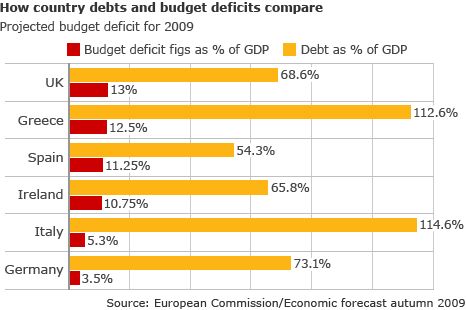
Today, Greece is only the tip of a very large iceberg. Portugal, Spain, Italy and Ireland together owe $3.9 trillion in short- and medium-term debts, an amount larger than their combined GDP, estimated last year at $3.3 trillion.

Picture:

Don’t let socialists run your country. They spend too much!