
Tag Archives: Policy

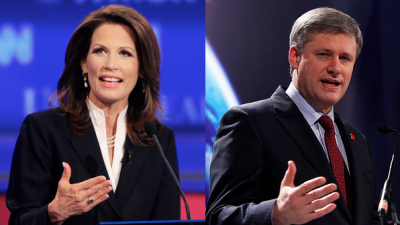
What could Stephen Harper teach Michele Bachmann about winning elections?

Michele Bachmann should adopt Stephen Harper's plan

Michele Bachmann is soliciting questions for her townhall meeting on her Facebook page. Please “like” her page and then like my question, so that it will be asked.

The post that she is asking for questions in has this text:

Excited to join Tim Scott for Congress for a town hall live on Facebook from Charleston, SC tomorrow at 7PM ET, where we’ll be taking questions from our community of constitutional conservatives. Have a question? Please ask in the comments below:

My question is reproduced below:

Mrs. Bachmann, in the 2011 Canadian federal election, Stephen Harper, a conservative, managed to win a majority in a country that is only one-third conservative. He did this by creating N-point plans that clearly laid out his plans for each term.

The reason I think this is important is because he was able to neutralize the attacks of the media and the three left-leaning political parties because they were not able to accuse him of having a “hidden agenda”. My question for you is, have you considered laying out a clean, specific N-point plan for what you would do as President of the United States? You could even have 3 plans, one for social issues, one for fiscal issues, and one for foreign policy.

If you like my question, please like the “TeamBachmann” Facebook page, and then go to her post asking for questions, and like my question.

Here are the Harper plans:

2006: (won minority)

  • Cleaning up government by passing the Federal Accountability Act
  • Cutting the GST (the national sales tax)
  • Cracking down on crime
  • Increasing financial assistance for parents
  • Working with the provinces to establish a wait-times guarantee for patients

2008: (won minority)

  • The minister of finance and the Bank of Canada will constantly monitor financial markets and the impact of developments in other countries.
  • The global financial crisis will be discussed at the Canada-European Union Summit, which Harper will attend on Friday.
  • Parliament will be summoned to meet this fall and the minister of finance will table an economic and fiscal update before the end of November.
  • Canada will be represented at the meeting of G-20 finance ministers scheduled for early November in Brazil. Canada has also called for a second meeting of G-7 finance ministers.
  • Government spending will be focused and kept under control as the strategic review of departmental spending — now in the second year of a four year review – continues.
  • Harper will hold a first ministers meeting on the economy to discuss with premiers and territorial leaders a joint approach to the global financial crisis.

2011: (won majority)

  • Creating jobs through training, trade and low taxes.
  • Supporting families through our Family Tax Cut and more support for seniors and caregivers.
  • Eliminating the deficit by 2014-2015 by controlling spending and cutting waste.
  • Making our streets safe through new laws to protect children and the elderly.
  • Standing on guard for Canada by investing in the development of Canada’s North, cracking down on human smuggling and strengthening the Canadian Armed Forces.

Actually, Canadian conservatives are much more liberal than we Republicans are – they are soft on social issues. Harper himself is an evangelical Christian, though, but his hands are tied when it comes to social issues. He tries to support stronger families as a way to reduce abortion and to ensure that children grow up with mothers and fathers. Even Stephen Harper is not able to do anything about same-sex marriage and abortion, which are both legal in Canada.

I think Michele would do well to pretend that she was running for office in Canada, and then create her plans that way. All the conservatives already know that she is a solid evangelical and a Tea party stalwart. What she needs to do is come up with a list of specific smart policies that will win over two-thirds of the independents.

Some things I would like to see: transparency in government, sensible spending cuts, tort reform, cut employer payroll tax to 0%, cut federal funding for abortion/Planned Parenthood, increased tax credits for MARRIED couples, matching grants for states that create voucher programs, etc, a federal right-to-work law, a tax credit, usable at any time in the future, for all salary income earned by young people under the age of 22. Etc.
How the Democrat worldview leads to massive debt and unemployment

Here’s an explanation of why the Democrat policies have led us so far into economic desolation.

Excerpt:

The “philosophical starting point” of today’s Democrats, as Mr. Cantor sees it, is that they “believe in a welfare state before they believe in capitalism. They promote economic programs of redistribution to close the gap of the disparity between the classes. That’s what they’re about: redistributive politics.” The Virginian’s contempt is obvious in his Tidewater drawl. “The assumption . . . is that there is some kind of perpetual engine of economic prosperity in America that is going to just continue. And therefore they are able to take from those who create and give to those who don’t. We just have a fundamentally different view.”

[…]Like Mr. Cantor, President Obama is also a man of deep and strong convictions, and perhaps that’s why they seem to dislike each other so much. Call it, to adapt Freud, the narcissism of big differences. Mr. Cantor cautions that he isn’t a “psychoanalyst”—before politics, he was a real-estate lawyer and small businessman—but he says, “It’s almost as if someone cannot have another opinion that is different from his. He becomes visibly agitated. . . . He does not like to be challenged on policy grounds.”

In a meeting with the Journal’s editorial board Wednesday, Mr. Cantor, 48, gives his side of one of his more infamous altercations with the president. In a mid-July Cabinet Room meeting, Mr. Cantor made a suggestion that Mr. Obama and other Democrats took as impertinent. “How dare I,” Mr. Cantor recalls of the liberal sentiment in the room. He was sitting between Nancy Pelosi and Steny Hoyer, “and they were in absolute agreement that [the president] was such a saint for having endured all this.”

[…]Somewhat surprisingly, Mr. Cantor was in fact prepared to bargain on about $20 billion in higher taxes on “the shiny balls of the millionaires, billionaires, jet owners and oil companies” that Mr. Obama so often mentioned in public. “If they wanted to be able to claim the win on that,” Mr. Cantor says, he wanted net revenue neutrality in return, by lowering the corporate income tax rate or perhaps enacting an even larger tax reform. In effect, he was calling Mr. Obama’s bluff on “cheap politics.”

In private, however, the debate always returned to the status of the top marginal rate for individuals earning over $200,000 and $250,000 for couples—aka the Bush tax cuts for people who do not own private aircraft. Mr. Cantor argued that some large portion of the income that flows through the top bracket comes from “pass-through entities”—that is, businesses—and “to me, that strikes at the core of what I believe should be the policy, and that is to provide incentives for entrepreneurs to grow.”

By contrast, he says, “Never was there ever an underlying economic argument” from Democrats. “It was all about social justice. Honestly, one of them said to me, ‘Some people just make too much money.'”

They think that embraces policies that make them feel good about themselves and look good in front of others will automatically be good policies. But they are disastrous policies. The numbers don’t really matter to them, it’s all about the emotions. They feel that they need to demonstrate their superiority to us all by “solving” problems. And the way they find “solutions” to problems is by choosing whatever option makes them feel good and look good. Demonizing the wealthy makes them feel good and look good. They don’t care if it increases debt and raises unemployment. It’s all about their feelings and intuitions.

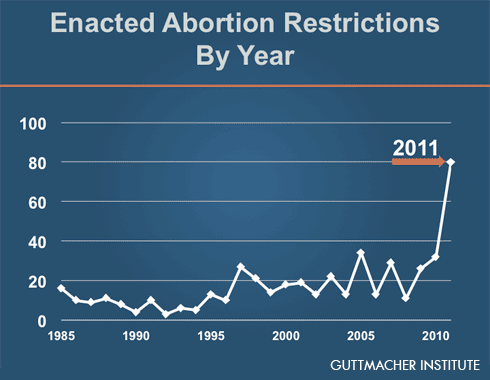
Guttmacher Institute: states enact record number of abortion restrictions

Enacted Abortion Restrictions By Year

Great news from the Guttmacher Institute, a pro-abortion think tank. (H/T John from Truth in Religion & Politics)

Excerpt:

In the first six months of 2011, states enacted 162 new provisions related to reproductive health and rights. Fully 49% of these new laws seek to restrict access to abortion services, a sharp increase from 2010, when 26% of new laws restricted abortion. The 80 abortion restrictions enacted this year are more than double the previous record of 34 abortion restrictions enacted in 2005—and more than triple the 23 enacted in 2010. All of these new provisions were enacted in just 19 states.

The post breaks down the pro-life measures by category:

  • Counseling and waiting periods
  • Gestational bans
  • “Heartbeat” bill
  • Banning abortion coverage in new insurance exchanges
  • Medication abortion
  • Cuts to abortion subsidies

All of these bills were supported by Republicans, and opposed by Democrats.

Elections have consequences. We elected a massive number of Republicans in 2010, and now we are seeing the results of that effort. I could not be more proud of the Republicans who voted in these measures to protect the unborn.

Related posts