Tag Archives: Plan

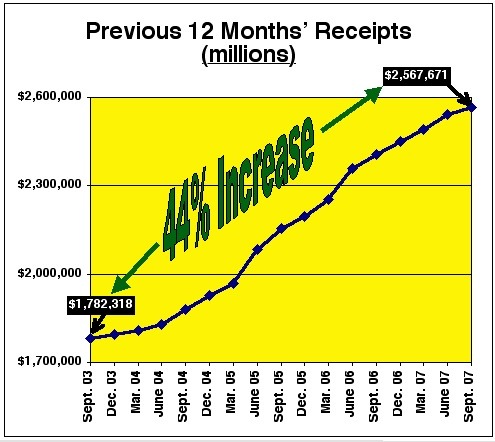
Bush’s tax cuts led to a 44% increase in revenues from 2003 to 2007

Federal Receipts 2003 through 2007

From Newsbusters. It turns out that Bush’s tax cuts in 2001 and 2003 were not responsible for adding to the deficit. They actually increased the amount of tax money being collected, as the economy grew, and more jobs were created. People pay more in taxes when they have jobs.

Excerpt:

The graph doesn’t show collections tanking, does it? Instead, the graph shows that collections increased by 44%, or almost $800 billion, in four years. Adding up the individual increments in each of the four years compared to 2003 (2004 – $98B; 2005 – $371B; 2006 – $624B; 2007 – $785B; 2008, not shown, treating IRS stimulus payments as outlays instead of negative receipts – $835B), what really happened is that in the five full fiscal years after George W. Bush got the across-the-board and investment-related tax cuts he had been pushing for since taking office in 2001, the cumulative increase in tax collections was over $2.7 trillion.

Doubtless, the static analysis crowd will claim that collections would have been even higher (I guess by a cumulative $1.6 trillion, given the AP’s Democratic Party talking point above) if the Bush cuts hadn’t been enacted. Two words, guys: Prove it. Two follow-up words: You can’t.

We can argue all day long about the how much of the increase in collections was due to the incentive effects of the tax cuts and how of the improvement might have occurred anyway, but no one can credibly act as if it’s an established fact that the Bush cuts somehow caused collections to go $1.6 trillion in the opposite direction. There is absolutely no proof for this contention, and plenty of evidence that the Bush cuts jump-started an economy and federal collections, both of which had been flat or declining during the two years leading up to mid-2003. The more reasonable conclusion to reach is that the country would already be dead in the water if the Bush tax cuts hadn’t passed in 2003. Instead, the wire service hopes that its “Bush tax cuts cost us” meme will be gullibly recited during the next several days at its subscribing newspaper, TV, and radio outlets. “Disgraceful” doesn’t even begin to describe this pathetic promotion of self-evident falsehood.

The fact is that the federal budget was one good year away from balancing after the $162 deficit reported in fiscal 2007. Unfortunately, that was the last budget passed by a Republican-controlled Congress, and it was the only year which showed a modest increase in overall spending. Beginning in 2007 with effects beginning in fiscal 2008, the House and Senate controlled by Nancy Pelosi and Harry Reid began increasing spending at rates far beyond what profligate Republicans spent earlier in the decade, and, unfortunately, Bush 43 made no real effort to stop them…

Read the whole thing.

UPDATE: Reggie sent me this article showing that the Reagan tax cuts also increased revenues.

Excerpt:

In 1980, the last year before the tax cuts, tax revenues were $956 billion (in constant 1996 dollars).

Revenues exceeded that 1980 level in eight of the next 10 years. Annual revenues over the next decade averaged $102 billion above their 1980 level (in constant 1996 dollars).

The graph is here.

When you get people to start engaging in the economy, you can collect more taxes from them. They engage when they think that they will be able to keep more of what they make from their labor.

On “Face the Nation”: Marco Rubio says the President has no plan

Marco Rubio takes on Obama spokesman Bob Schieffer on CBS’ “Face the Nation”. (H/T Mariangela)

In this speech on the floor of the Senate, he lays the whole debt problem and the solutions.

I just wish that the voters would compare Obama’s class-warfare rhetoric and his performance on job create with Marco Rubio’s clear explanation of the incentives and motives of job creators. We don’t need redistribution of wealth, we need people to have jobs. When people have jobs, they feel comfortable to investing or spend money.

Republican Allen West debates economic policy on Fox News Sunday

From Fox News Sunday with Chris Wallace.

Here’s the transcript.

Excerpt:

WALLACE: Congressman West, as we saw in the special election up in New York state this week, where the Democrat beat the Republican and Medicare was a big issue, as we see in the national polls a lot of people, especially seniors, don’t want to see Medicare changed this way.

WEST: Well, I think when you look at Paul Ryan’s plan, first of all, there is no change for anyone who is a senior 55 years and above. But as I sit here right now, I’m 50 years of age. And we already know that the board of trustee has said, you got 13 years and something very bad is going to happen with Medicare. So, what is going to be there for myself when I get 63 to 65?

So, I think the thing that we see is at least there’s a plan out there to try to have some type of reform.

And there was a great article by Mr. Stanley Druckenmiller in The Wall Street Journal back in the 15th of May that talked about the fact that the financial markets, a lot of these, you know, bond markets are looking to see: are we going to have some type of long- term viable solution and plan as we go forward?

WALLACE: But let me pick up on that, Congressman Edwards, because the knock against the Democrats is you don’t have a plan, that congressional Democrats didn’t pass a budget last year. Senate Democrats aren’t offering a budget this year — President Obama talks having an independent panel of medical experts who are going to find $20 billion of cuts somewhere. At least they’ve got a plan.

EDWARDS: Well, I think it’s not true that we don’t have a plan. And, in fact, when we passed the Affordable Care Act last year, we put in some real markers for Medicare that in fact reduced Medicare costs. We invested in preventive care for seniors because we know that the real drivers of Medicare are these long-term costs for chronic care that happens at the — you know, at the end of life.

You know, Republicans are very interesting because in their budget what they would do is repeal preventive care. Prescription drug coverage — we also closed the donut hole there, which is costing seniors a boatload of money and is not very efficient on the system.

So, to say that Democrats don’t have a plan I think is incorrect. I mean, in fact, the plan is to preserve and protect Medicare for future generations. And Republicans want to dismantle that.

WEST: Yes, but I think as you sit here and look at the two of us, one of us has voted to cut Medicare. When you look at the fact you voted for the Patient Protection and Affordable Care Act, which had $500 million of cuts of Medicare. And we also have this independent payment advisory board, these 15 bureaucrats, that are supposed to control the cost of Medicare. I mean, that’s something that really does scare seniors.

What we are talking is something that does not affect any senior, anyone 55 years and above. We’re talking about something that does put in some type of viable plan to sustain Medicare for the future, because as we know, it was put out three weeks ago, it won’t be there.

EDWARDS: Well, the congressman thinks the seniors are only interested in what’s good for them. And what we know about seniors, whether they’re in south Florida or in Maryland, is that they actually care about what happens with that next generation. They care about whether we’re going to cover preventive care and prescription drug.

WEST: But if you don’t have a plan, there is nothing for the next generation.

EDWARDS: And that they are — and that they are not sent in the private market to negotiate with insurance companies. We know that that would be a failure. And that’s exactly what the Republican plan calls for. I can’t negotiate on —

WALLACE: Let me move on to another thing, because the biggest difference, it seems to me, looking at your two positions on how to deal with the deficit is over taxes.

Congresswoman Edwards, you have a big plan to increase revenues. And let’s put it up on the screen. You would raise tax rates for the wealthy. You would raise the estate tax. You would tax capital gains and dividend as ordinary income and you would end tax subsidies for oil and gas companies.

So, raise taxes in the middle of a weak recovery?

EDWARDS: Well, let’s be clear — raise tax on the wealthiest 2 percent who have run away with the store for the last 10 years and haven’t put money back into the economy. I mean, that’s a fact, because if that trickle-down theory had worked, our economy would be in good shape right now.

And so, we do — I do subscribe to a plan that says, you know what? Middle income earners, you’ve already shared a fair burden of your taxes. But the wealthiest 2 percent have not.

And there’s no excuse whatsoever for continuing taxes for people who make over $500,000 a year.

WALLACE: Congressman West, you got something there?

WEST: Yes. I got a very interesting article which was written on the 26th of May by Steven Moore for The Wall Street Journal that talks about — we are talking about a 62 percent top tax rate and the absolutely abysmal effects that it will have on this economy.

And one of the great things he says here is, in the end, “The Tax Foundation recently noted that in 2009, U.S. collected a higher share of income and payroll taxes, 45 percent, from the richest 10 percent of tax files than any other nation, including some such socialist welfare states.”

So, I think that we are already getting a lot of the juice from those top brackets. But go back and look at history, Donna, when we looked at Coolidge and Harding. It took those marginal tax rates down to 29 percent. And the percentage of revenues for GDP grew. But after them came Hoover and Roosevelt who took it from 24 percent up to 83 percent, and the percentage of revenues decreased. Even John F. Kennedy, when he came in and saw a 91 percent marginal tax rate said that was too high. He took it down to 71 percent.

He seems to have all the facts and figures at his fingertips! Just like William Lane Craig, except he’s a former Army Lt. Colonel.