Tag Archives: Ohio

Ohio Issue 2: Should voters vote yes or vote no on Ohio State Issue 2?

In the 2010 mid-term elections, Republican John Kasich won the governorship and promised to balance the state’s budget by reining in the state’s spending on salaries and benefits for public sector union employees. To accomplish this, the Ohio legislature pass Senate Bill 5. However, an effort is on the ballot to repeal the law, and Ohio voters will get a chance to keep or scrap the law on Tuesday, November 8th, 2011.

Here’s what Ohio’s Issue 2 is all about:

Issue 2 makes some very fair and common sense requests of our government employees to give local communities the flexibility they need to get taxes and spending under control, while providing the essential services that we rely on.

  • It allows an employee’s job performance to be considered when determining compensation, rather than just awarding automatic pay increases based only on an employee’s length of service.
  • It asks that government employees pay at least 15 percent of the cost of their health insurance premium.  That’s less than half of what private sector workers are currently paying.
  • It requires that government health care benefits apply equally to all government employees, whether they work in management or non-management positions.  No special favors.
  • It asks our government employees to pay their own share of a generous pension contribution, rather than forcing taxpayers to pay both the employee and employer shares.
  • It keeps union bosses from protecting bad teachers and stops the outdated practice of laying off good teachers first just because they haven’t served long enough.
  • Finally, it preserves collective bargaining for government employees, but it also returns some basic control of our schools and services to the taxpayers who fund them, not the union bosses who thrive on their mismanagement.

Even under the reforms of State Issue 2, Ohio’s government employees will still receive better pay, better health care and better retirement benefits, on average, than the vast majority of Ohioans who work in the private sector.

There are a number of myths going around about Issue 2, and it’s important to set the record straight, so I’ll do that below.
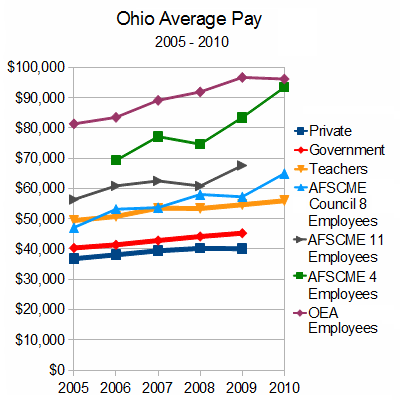
Ohio Average Pay: Public vs. Private
Ohio Average Pay: Public Unions vs. Private

Myths and truths about Ohio State Issue 2

Here’s a common myth:

State Issue 2 would “cut salaries and benefits.”

The truth:

Issue 2 would not cut salaries or benefits for any government employee. Employees would simply be asked to pay a modest share of their benefits, just like employees in the private sector do. For health care coverage, they would pay at least 15% of their overall plan. (Many local government employees currently pay less than 9% of their health care premium, while the average private sector worker pays upwards of 30%.) In addition, employees would be required to pay their personal share of a retirement plan (only 10%), rather than asking taxpayers to pay that share. That’s not too much to ask at a time when many private sector workers get no retirement benefit at all. Finally, Issue 2 requires that benefits apply equally to all public employees, so no one gets special treatment.

And another common myth:

State Issue 2 will eliminate government employee pensions.

The truth:

Government employees will still get a very generous pension benefit – an annual payment that averages their three highest annual salaries. That’s a pretty nice deal, when many private sector workers get no retirement benefit at all. State Issue 2 only ends a practice where some government union contracts require taxpayers to pick up the tab for BOTH the employer AND employee shares of a required pension contribution. In this economy, it’s simply not right to ask struggling taxpayers to foot the bill so government employees can get a free retirement. Issue 2 simply says government employees should pay their required share (10 percent) and taxpayers will contribute the employer share (14 percent).

Another myth:

State Issue 2 will cut teacher salaries.

The truth:

That’s one of the scare tactics government unions are using to turn people against these reforms. Nothing in Issue 2 determines salary levels. It only ends the practice of handing out automatic pay raises, or “step” increases, and longevity pay – or bonuses just for holding the job for a certain period of time. Issue 2 also asks that performance be added as a factor in teacher compensation, a goal President Barack Obama set out in his national education policy in 2009.

And another myth:

State Issue 2 will cost jobs

The truth:

Just the opposite is true. Ohio’s state and local tax burden ranks among the top third in the nation. As a result, companies large and small have left our state in pursuit of better tax incentives elsewhere, taking hundreds of thousands of jobs with them. If Ohio hopes to compete for new job growth, we have to make our state a more affordable place to live, work and do business. That starts with getting the cost of government under control so we can direct more of our limited resources into economic development, community revitalization and better schools.

More myths are corrected on this page.

Newspaper endorsements

So far, Issue 2 has been endorsed by several Ohio newspapers, including the biggest ones.

The Cleveland Plain Dealer:

The fiscal picture of local governments and school districts, especially, will improve as they are able to right-size their work forces and their expenditures on services. That will happen over time, not overnight, as new contracts are established.

Repeal SB 5, though, and it’s going to be awfully hard for local governments to manage their payrolls without resorting to larger-scale layoffs than would otherwise be necessary. And local governments will continue to be hamstrung by anti-merit seniority rules that lead to worker complacency and protect dead weight and time-servers.

Voting YES on Issue 2 will prevent layoffs by keeping public sector wages and benefits in line with what the private sector can afford to pay.

The Columbus Dispatch:

Despite the insistence of opponents, the effort to reform Ohio’s out-of-balance collective-bargaining law is not an expression of disrespect for or dissatisfaction with Ohio teachers, police officers, firefighters and other government employees. It is a much-needed attempt to restore control over public spending to the public officials elected to exercise that control.

It does not assert that public employees are worth less than the compensation they’re receiving, only that the compensation has grown faster than the public’s ability to pay for it.

[…]With more ability to control the escalation of salary and benefit costs, governments won’t be forced as often to impose layoffs, and might be able to afford to keep even more police and firefighters on the streets.

Again, no one is saying that public sector workers don’t matter – the question is whether we can afford to give them better wages and benefits than the private sector workers who are their customers and their employers. Public sector workers work for the public, and the public can only afford to pay so much.

Conclusion

Government employees are paid 43% more than private sector employees, in salary and benefits:

I think that people who care about the long-term prosperity of Ohio should vote “YES” on Issue 2 to make public and private salaries and benefits MORE EQUAL. Ohio is facing enormous economic pressure from the global recession, and everyone has to make sacrifices. Now is not the time for public sector workers to insist on higher wages and benefits, especially when the private sector workers who pay their salaries don’t make as much money, nor do they get the pensions, nor do they get the better job security. Ohio voters can certainly go back and renegotiate union salaries and benefits when Ohio is out of the recession.

Click here to learn more about Ohio Issue 2.
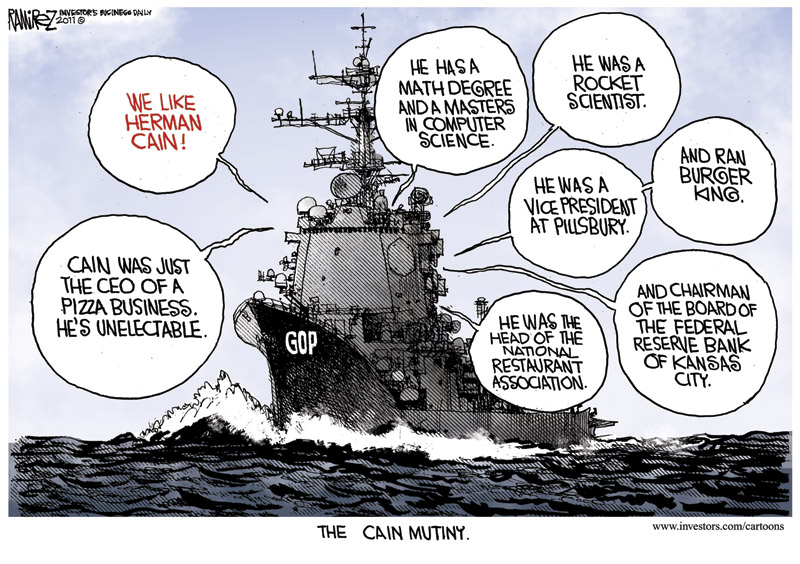
Herman Cain leads in Ohio, Hawaii, Iowa, North Carolina, Nebraska, West Virginia

The Cain Mutiny
The Cain Mutiny

From the Democrat Public Policy Polling firm.

Excerpt:

Herman Cain’s poll momentum is continuing for at least another week.  PPP surveys conducted over the weekend in Ohio and Hawaii find him with a large lead in both states.  That now makes 7 consecutive polls over the last 3 weeks- a national one and state polls in Ohio, Hawaii, Iowa, North Carolina, Nebraska, and West Virginia- that have found Cain leading the way.

[…]Tea Party voters continue to be the primary driver of Cain’s momentum. In Ohio he gets 46% of their support to 15% for Gingrich and 11% for Bachmann with Romney finishing all the way back in 4th place at 9%. It’s a similar story in Hawaii- there Cain and Romney actually tie at 30% each among non-Tea Party Republicans.  But with the Tea Pary crowd Cain gets a whooping 52% to 12% for Bachmann and 9% for Romney. These numbers represent a recurring theme in our polls- Romney doesn’t necessarily need to win Tea Pary voters but he sure needs to not lose them by 40 points if he hopes to win the nomination.

[…]The big loser in these polls is Rick Perry.  The low numbers of Republicans planning to vote for him is a concern but his even bigger issue is that GOP voters are now saying that they just flat out don’t like him. In Ohio his favorability is 40/42 with the primary electorate and in Hawaii it’s 36/40. His problem isn’t that Republican voters just like someone else better than him- it’s that at this point they don’t even like him at all.  He has some serious image rehabilitation to do to get back in this race.

[…]In addition to Cain the other candidate continuing to show some surprising momentum in Newt Gingrich. He gets a solo third in Ohio and a tie for third in Hawaii, and the numbers in the Buckeye State show the improvement in his image over the last 5 months.  When PPP last tested his favorability in May he was at 42/34 with primary voters. Now that’s improved to 56/32 and the only Republican with a better net favorability is Cain.

Results:

Poll Cain’s lead (%) Second place (%)
National 30 Romney 22
Ohio 34 Romney 19
Hawaii 36 Romney 24
Iowa 30 Romney 22
North Carolina 27 Romney/Gingrich 17
Nebraska 30 Gingrich 16
West Virginia 24 Gingrich 18

I wonder when the liberal Mitt Romney will be dropping out of the race? Perhaps he can go work for Obama, since he seems to agree so much with him.

Related posts

Ohio Senate passes John Kasich’s pro-life, pro-jobs, pro-child budget

From Life News.

Excerpt:

The Ohio state legislature today passed a state budget which includes multiple pro-life amendments ensuring the state is not involved in abortion funding with taxpayer money.

The state budget, House Bill 153, now advances to pro-life Governor John Kasich. Among other things, the state budget contains Ohio Right to Life amendments that will protect taxpayer dollars from paying for abortion.

The first amendment bans abortions from being performed in public hospitals. The second amendment prohibits abortion coverage in insurance plans of local public employees.

“These two pro-life amendments will ensure that Ohio taxpayer dollars are not funding abortion,” said Mike Gonidakis, executive director of Ohio Right to Life. “It is crystal clear that a vast majority of Ohioans oppose all forms of taxpayer funding of abortion.”

Additional pro-life amendments were also included.  One measure requires the Ohio Department of Health to apply for federal abstinence education grants to reduce the number of unplanned pregnancies. The final pro-life amendment preserves the right of student groups to use and benefit from school funds and facilities, therefore protecting the rights of pro-life groups on college campuses.

“Abstinence education taught by our pro-life educators reduces teen pregnancy. These efforts have resulted in a decrease in teen abortions in Ohio, having a dramatic impact,” Gonidakis said.

“I am pleased that the Ohio House budget bill once again places a priority on abstinence education,” added Valerie Huber, Executive Director for the National Abstinence Education Association.  “Passage of this measure assures that students in Ohio will again receive the benefits of this important risk avoidance message. We appreciate Ohio Right to Life’s support for this measure that returns a state priority on abstinence education in Ohio.”

House Bill 153 will be signed into law on June 30th by pro-life Governor John Kasich, who Ohio Right to Life fully expects to support each of these life-saving measures.

[…]The passage of the budget comes after state House passage of three pro-life bills, including an abortion ban, ban on late-term abortions, and a bill to stop abortion funding in Ohio via the state exchange created under Obamacare. http://www.lifenews.com/2011/06/28/ohio-house-passes-ban-on-abortions-late-term-abortions/

And more from National Review on some of the fiscally conservative provisions in Ohio’s budget.

Excerpt:

For conservatives, it’s a recession-era dream budget. “It balances the budget, preserves our tax cuts, and sets the stage for renewing the ability of Ohio to create jobs,” Ohio governor John Kasich tells National Review Online.

The $55.5 billion budget, which covers the next two fiscal years and fills an $8.6 billion shortfall, cuts $1.4 billion from Medicaid funding, sells five prisons to private operatorsand slashes the money sent to local governments by 25 percent next year and an additional 25 percent in the following year. That last decision has proven to be controversial already, with critics charging that Kasich is passing the deficit problems to local governments, forcing them to raise taxes or severely restrict services. Kasich sees the cuts as an opportunity — and says it would be a “huge mistake” for local government to raise taxes, thus “providing disincentives for companies to locate in their communities.”

[…]On education, over the next two years, Kasich is expanding school choice by quadrupling the numbers of vouchers available and rescinding a statewide cap on charter schools. He is capping higher-education tuition hikes at 3.5 percent, requiring that all university professors teach an extra class, and asking universities to look into ways of offering three-year bachelor’s degrees.

On the jobs front, he’s adamant about the need to forgo tax hikes, even preserving an $800 million tax cut implemented in January. “States with lower levels of taxation have faster economic growth,” Kasich observes. He’s also setting aside $100 million — the profits from the state’s liquor monopoly — to fund JobsOhio, a new initiative dedicated to attracting and retaining businesses in Ohio. With an unemployment rate of 9.2 percent and a loss of over 600,000 jobs in the last decade, Ohio could use the boost.

Both the state house and senate are Republican-controlled, and Kasich is “very optimistic” that the budget will pass. “I’ve told [state lawmakers] that if they have some better policy ideas, that’s fine — but we will not negotiate the numbers. We will have a balanced budget, and we will preserve the tax cut,” he says.

[…]But if the budget succeeds in bringing about an economic resurgence, look for Kasich to reap the benefits. In a piece headlined “Kasich’s beliefs at heart of plan,” Columbus Dispatch writer Joe Hallett commented that the “plan is as much a social budget as a fiscal one, built on ideology as much as practicality,” and said that “Ohio, at least in modern times, has never seen a state budget like [this].”

Kasich is ready to be judged on the results. “Budgets are just a means to an end. They’re not an end in themselves,” he observes. “This budget can set the stage in our state for recovery.”

And the Toledo Blade reports that the Ohio budget should please parents, as well.

Excerpt:

Some 1,100 Ohioans swarmed the grounds of the Statehouse Tuesday to demonstrate support for Gov. John Kasich’s plan to quadruple the number of school vouchers, even as overall aid for public schools is cut.

The governor’s $55.5 billion, two-year budget proposed last week also would lift the cap on the creation of charter schools, which operate with more regulatory freedom than their traditional public K-12 counterparts.

“School choice is not about doing away with public schools,” Lt. Gov. Mary Taylor told the crowd. “It’s about making them better. … Ohio’s future depends on our children being the best and the brightest in the world.”

Mr. Kasich’s spending plan would more than quad- ruple the number of vouchers to 60,000 by 2013 from roughly 14,000 now.

Suzanne Donahue of Toledo sends her 13 and 11-year-old daughters to St. Catherine of Siena School. She’s never received an Ohio EdChoice scholarship, and she’s not sure that her children would qualify under the proposed expansion. But she attended Tuesday’s rally to support that option for other children.

“We pay out of our pockets for it, and I vote for every tax situation that’s on the ballot for the kids because I hate to see the children suffer,” she said. “However, it would be nice to have some of those funds come to my own family. … I believe healthy competition will equal better schools and that better schools will survive.”

[…]The state runs two voucher programs — the statewide Ohio EdChoice Program, which caps the number of scholarships at 14,000, and a smaller, less generous program only for students in Cleveland city schools.

The EdChoice program targets students who attend a school that has been in academic emergency or watch for two out of the last three years. The grants are $4,250 for K-8 students and $5,000 for high school students, or the amount of the participating school’s tuition, whichever is less.

The budget also would lift the cap on how many bricks-and-mortar and on-line charter schools may be sponsored by one organization. The cap was imposed to slow the proliferation of such schools after a number of highly publicized failures. More than 300 charter schools in Ohio serve nearly 88,000 students.

Good news for fiscal and social conservatives. Well done, John Kasich!