BeThinking posted a new lecture featuring Dr. Simon Gathercole.
Here’s the speaker bio:
Dr Simon Gathercole is Senior Lecturer in New Testament Studies and Fellow of Fitzwilliam College, at the University of Cambridge. He is particularly fascinated by the connections between the New Testament and its contemporary literature.
Summary:
Simon Gathercole shows how the geographical information in the New Testament Gospels demonstrates their historical reliability and their basis in eyewitness sources. The illustrated lecture lasts about 60 minutes and is followed by about 20 minutes of Q&A.
BeThinking has a PDF containing all the slides used in the lecture.
The lecture is here:
Topics:
Detailed geography is difficult to fake, especially when it is far into the past
Bible authors would have to rely on eyewitness testimony if they wanted to get geographic details right
You can even cross-reference the geographic details mentioned in the New Testament with extra-Biblical sources of that time
Cities mentioned in the Bible are mentioned in other sources
Locations that are mentioned in Josephus, a Jewish historian
Locations that are mentioned in the Rabbis
22 of 27 places mentioned in the gospels are attested
If you compare the gospels with Josephus they are as good
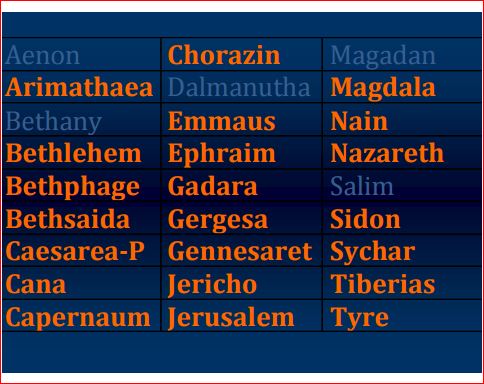
Example slide – he shows where these cities in orange are mentioned outside the Bible:
At the end of the lecture 22 out of 27 cities are attested in other sources
This lecture caught my eye because it was all about connecting the Bible to evidence outside the Bible. I like evidence. You should give it a listen.
Sherlock Holmes and John Watson: let’s take a look at the facts
Here is Dr. William Lane Craig giving a long-form argument for the historical event of the resurrection of Jesus, and taking questions from the audience.
The speaker introduction goes for 6 minutes, then Dr. Craig speaks for 35 minutes, then it’s a period of questions and answers with the audience. The total length is 93 minutes, so quite a long period of Q&A. The questions in the Q&A period are quite good.
Introduction:
Many people who are willing to accept God’s existence are not willing to accept the God of Christianity
Christians need to be ready to show that Jesus rose from the dead as a historical event
Private faith is fine for individuals, but when dealing with the public you have to have evidence
When making the case, you cannot assume that your audience accepts the Bible as inerrant
You must use the New Testament like any other ancient historical document
Most historians, Christian and not, accept the basic minimal facts supporting the resurrection of Jesus
Fact #1: the burial of Jesus following his crucifixion
Fact #1 is supported by the early creed found in Paul’s first letter to the Corinthians (1 Cor 15)
Fact #1 is supported by the early Passion narrative which was a source for Mark’s gospel
Fact #1 passes the criterion of enemy attestation, since it praises one of the Sanhedrin
Fact #1 is not opposed by any competing burial narratives
Fact #2: on the Sunday following his crucifixion, Jesus’ tomb was found empty by some women
Fact #2 is supported by the early Passion narrative which was a source for Mark’s gospel
Fact #2 is implied by the early creed found in Paul’s first letter to the Corinthians (1 Cor 15)
Fact #2 is simple and lacks legendary embellishment, which argues for an early dating
Fact #2 passes the criterion of embarrassment, because it has female, not male, witnesses
Fact #2 passes the criterion of enemy attestation, since it is reported by the Jewish leaders
Fact #3: Jesus appeared to various people in various circumstances after his death
Fact #3 is supported by the early creed found in Paul’s first letter to the Corinthians (1 Cor 15)
Fact #3 is supported by multiple, independent reports of the events from all four gospels
Fact #3 explains other historical facts, like the conversion of Jesus’ skeptical brother James
Fact #4: the earliest Christians proclaimed their belief in the resurrection of Jesus
Fact #4 explains why the earliest Christians continued to identify Jesus as the Messiah
Fact #4 explains why the earliest Christians were suddenly so unconcerned about being killed
Dr. Craig then asks which hypothesis explains all four of these facts. He surveys a number of naturalistic hypotheses, such as the hallucination theory or various conspiracy theories. All of these theories deny one or more of the minimal facts that have been established and accepted by the broad spectrum of historians. In order to reject the resurrection hypothesis, a skeptic would have to deny one of the four facts or propose an explanation that explains those facts better than the resurrection hypothesis.
I listened to the Q&A period while doing housekeeping and I heard lots of good questions. Dr. Craig gives very long answers to the questions. One person asked why we should trust the claim that the Jewish leaders really did say that the disciples stole the body. Another one asked why we should take the resurrection as proof that Jesus was divine. Another asks about the earthquake in Matthewand whether it is intended to be historical or apocalyptic imagery. Dr. Craig is also asked about the Jewish scholar Geza Vermes, and how many of the minimal facts he accepts. Another questioner asked about the ascension.
The post describes evidence for the Incarnation and the Trinity in the writings of Ignatius, who was the third Bishop of Antioch from 70 AD to 107 AD.
Here’s the raw quote from Ignatius’ “Epistle to the Ephesians”:
But our Physician is the only true God, the Father and Begetter of the only-begotten Son. We have also as a Physician the Lord our God, Jesus the Christ, the only-begotten Son and Word, before time began, but who afterwards became also man, of Mary the virgin. For “the Word was made flesh.” Being incorporeal, He was in a body; being impassible, He was in a passible body; being immortal, He was in a mortal body; being life, He became subject to corruption, that He might free our souls from death and corruption, and heal them, and might restore them to health, when they were diseased with ungodliness and wicked lusts.
And TQA discusses the passage:
There are several aspects of this passage which demonstrate that Saint Ignatius held beliefs consistent with the Doctrines of the Trinity and the Dual Nature of Christ. First, he refers to two separate Persons, God the Father and Jesus Christ, yet he calls both of them God.
[…]Second, Ignatius refers to Jesus Christ as begotten “before time began”. This is almost word for word identical to the Nicene Creed, which says, “I believe in. . . one Lord, Jesus Christ, the Son of God, the only-begotten, begotten of the Father before all ages. . .” Some today claim that the Early Church believed Christ’s being ”begotten” of the Father was in relation to His birth from Mary (specifically, this is an LDS claim). However, Ignatius’ comment here demonstrates that the Early Church’s understanding of Christ’s nature as “only-begotten” was a relationship with the Father that was “before time began” and has nothing to do with His earthly incarnation. It is interesting to note that the Greek word translated as “only-begotten” both here and in the New Testament is ”monogenes”. Monogenes literally means “one of a kind,” and to the Church Fathers it connoted Christ being of the same nature as the Father. . . something that was entirely unique to Him.
In addition to calling Christ God and claiming Him to be the “only-begotten” of the Father “before time began”, Ignatius tells us that “afterwards” Christ “became man”. Ignatius then goes on to point out some aspects that Christ’s becoming man added to His nature. He says that although Christ was incorporeal, He was in a body; although He was impassible, He was in a passible body; although He was immortal, He was in a mortal body; although He was life, He became subject to corruption. These differing aspects of Christ’s nature, aspects that are polar opposites to one another, speak to Christ having two natures, one as God and one as man, and demonstrate that Saint Ignatius understood Christ in this manner. As God, Christ was incorporeal, impassible, immortal, and life itself. However, as man He was corporeal, passible, mortal, and subject to corruption.
Now I think you can pull the Incarnation and the Trinity right out the Bible, but it’s still nice to see such a prominent church father writing about it decades after the events.




 WINTERY KNIGHT