President Obama’s budget director Jack Lew in a Sunday opinion piece outlined some off the “tough choices” Obama is willing to make to cut spending in his 2012 budget request due out on Feb. 14.
The piece details cuts that affect initiatives dear to the president: programs to help the poor and to clean up the Great Lakes near the president’s home state of Illinois.
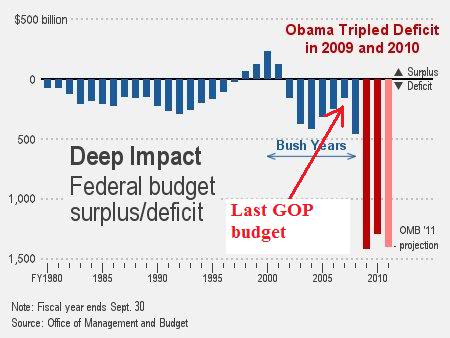
The cuts are relatively small, however, in the larger scheme of things. In total, the $775 million in detailed cuts fall far short of demands by congressional Republicans and will do little toward tackling the deficit, which is estimated to be $1.5 trillion this year by the Congressional Budget Office. The cuts are in addition to a five-year spending freeze which the administration says will save $400 billion over the next decade.
[…][Lew] said “this cut is not easy for” Obama.
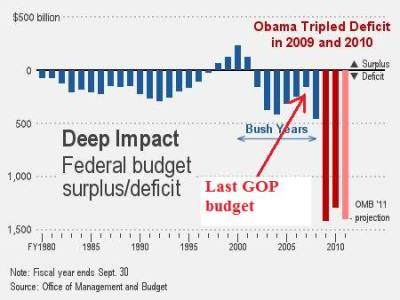
The 2012 deficit is projected to be 1,500,000 million. TWELVE TIMES what the last Republican budget was back in 2007, when unemployment was at 4.3%. Government spending means taking money away from productive workers and from the businesses that hire those productive workers.
To see a graphical representation of the cuts as a portion of the entire budget, click here. The cuts cannot be seen with the naked eye, so the there are several images in that post, each one more zoomed in than the last.
Social Security’s finances are getting worse as the economy struggles to recover and millions of baby boomers stand at the brink of retirement.
New congressional projections show Social Security running deficits every year until its trust funds are eventually drained in about 2037.
This year alone, Social Security is projected to collect $45 billion less in payroll taxes than it pays out in retirement, disability and survivor benefits, the nonpartisan Congressional Budget Office said Wednesday. That figure swells to $130 billion when a new one-year cut in payroll taxes is included, though Congress has promised to repay any lost revenue from the tax cut.
The massive retirement program has been feeling the effects of a struggling economy for several years. The program first went into deficit last year, but the CBO said at the time that Social Security would post surpluses for a few more years before permanently slipping into deficits in 2016.
The outlook, however, has grown bleaker as the nation struggles to recover from the worst economic crisis since Social Security was enacted during the Great Depression. In the short term, Social Security is suffering from a weak economy that has payroll taxes lagging and applications for benefits rising. In the long term, Social Security will be strained by the growing number of baby boomers retiring and applying for benefits.
The deficits add a sense of urgency to efforts to improve Social Security’s finances. For much of the past 30 years, Social Security has run big surpluses, which the government has borrowed to spend on other programs. Now that Social Security is running deficits, the federal government will have to find money elsewhere to help pay for retirement, disability and survivor benefits.
A number of the House GOP’s leading conservative members on Thursday will announce legislation that would cut $2.5 trillion over 10 years, which will be by far the most ambitious and far-reaching proposal by the new majority to cut federal government spending.
Jordan’s bill, which will have a companion bill introduced in the Senate by Sen. Jim DeMint, South Carolina Republican, would impose deep and broad cuts across the federal government. It includes both budget-wide cuts on non-defense discretionary spending back to 2006 levels and proposes the elimination or drastic reduction of more than 50 government programs.
Jordan’s “Spending Reduction Act” would eliminate such things as the U.S. Agency for International Development and its $1.39 billion annual budget, the $445 million annual subsidy for the Corporation for Public Broadcasting, the $1.5 billion annual subsidy for Amtrak, $2.5 billion in high speed rail grants, the $150 million subsidy for the Washington Metropolitan Area Transit Authority, and it would cut in half to $7.5 billion the federal travel budget.
But the program eliminations and reductions would account for only $330 billion of the $2.5 trillion in cuts. The bulk of the cuts would come from returning non-defense discretionary spending – which is currently $670 billion out of a $3.8 trillion budget for the 2011 fiscal year – to the 2006 level of $496.7 billion, through 2021.
Going back to 2006 levels would reduce spending by $2.3 trillion over ten years. It is a significantly more drastic cut than the one proposed by House Republican leadership in the Pledge to America last fall, which proposed moving non-defense, non-mandatory spending for the current fiscal year back to 2008 levels, which was $522.3 billion. Jordan’s proposal includes the recommendation from the Pledge for the current fiscal year, which ends in September.
The proposal would cut the federal work force by 15 percent and freeze automatic pay raises for government employees for five years.
You’ll remember that 2006 was the last year when the Republicans were in control of the House and Senate. Remember what life was like at the beginning of 2007? Unemployment was around 4% and the budget deficit was around 200 billion dollars. Then Nancy Pelosi and Harry Reid came along and the spending started. Cutting spending can be a positive thing when you take money away from unions. And think of the jobs when companies realize that there will be an end to all this spending and they won’t be on the hook for it. And children will have a standard of living that isn’t worse than the ones that their parents had.
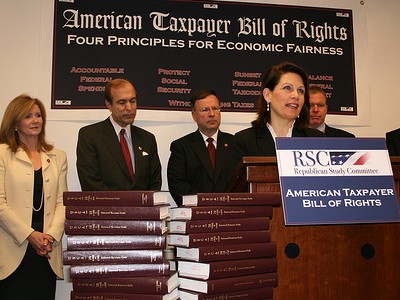
But now the Republican Study Committee wants to put a stop to all of that. The Republican Study Commitee is the conservative wing of the House Republican caucus and that’s where all the good policies come from.

 WINTERY KNIGHT