
Tag Archives: Morality

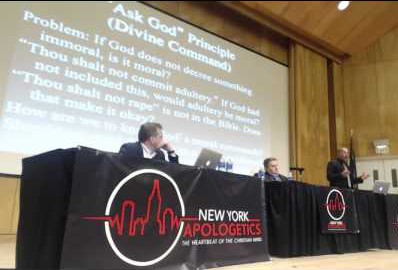
Atheist Michael Shermer tries to rationally ground morality in debate with Frank Turek

Michael Shermer debates Frank Turek: atheism and morality

The topic of the debate was on the grounding of morality – which worldview (theism or atheism) is better at grounding morality?

And here is the MP3 for the cross-examination only, which is what I will be summarizing. (12.5 Mb)

The full debate can be seen here and can be heard here.

Turek’s cross-examination period starts at 74m22s and ends at 89m20s.

Shermer’s cross-examination period starts at 89m50s and ends at 105m0s.

Topics of Turek’s cross-examination:

  • evolution produces Shermer’s moral sense and Hitler’s moral sense
  • why does Shermer think his is better than Hitler’s, since both were produced by the same evolution?
  • what makes right or wrong if evolution is the source of morality?
  • why is Stalin’s opinion of right and wrong less valuable than the herd’s opinion of right and wrong?
  • do the Founding Fathers ground inalienable rights in a Creator, or in evolution?
  • can atheism ground the existence of inalienable rights?
  • can you ground objective moral values and objective moral duties by asking people how they feel?
  • can you ground objective human rights on atheism by shouting like a madman and interrupting?
  • how can you trust your thinking if they are the result of an unguided, random process of evolution?
  • how can you have rational thoughts if materialism is true, and you are a machine made out of meat?
  • can you ground objective moral values and objective moral duties on personal preferences?
  • how do the personal preferences of some individuals create an objective moral duty for other individuals?
  • does naturalistic evolution orient human beings toward survival or truth?
  • on materialism, what is the chemical composition of justice?

Topics of Shermer’s cross-examination:

  • Radical muslims are exactly the same as evangelical Christians, and have the same God (Allah is the same as the Triune Christian God)
  • Radical muslims would assert that their God is the same as the Triune Christian God, with Jesus and the Holy Spirit also being God
  • Therefore, we can lay the blame for what radical muslims do on the backs of evangelical Christians
  • Radical muslims and evangelical Christians are the same, because “you’re enthusiastic, they’re enthusiastic”
  • The Bible’s notion of indentured servitude to pay off debt is the identical to the idea of slavery based on race
  • The Bible’s notion that masters and slaves are equal in the sight of God forms a basis for thinking they are unequal
  • The Bible teaches things that I disagree with, like the idea that marriage should provide children with a mother and a father
  • Gay marriage is solidly grounded in evolution, even though the morality that evolution produces varies by time and place
  • Atheists can ground objective moral values and objective moral duties by asking people how they feel
  • Can atheists who want to legalize gay marriage because “they’re in love” prohibit polygamy or incest as marriage?
  • Is shouting “you’re on the wrong side of history” a way to rationally ground morality in an accidental atheistic universe?
  • Is it loving for atheists to celebrate a lifestyle that exposes gay men to sickness and premature death?
  • Is it “bigotry” for the Center for Disease Control to warn men who have sex with men about higher health risks?
  • How do Christians decide what is right and wrong when they are confronted with a moral dilemma?
  • How do humans sense the objective moral standard that is required for them to make moral judgments
  • Can enlightenment philosophers who merely imagine human rights actually create those human rights?
  • If revelations change over time for Mormons, does that undermine the need for God to ground objective morality?

I apologize for the poor quality of the video and audio. The moderator was extremely ineffective, letting Shermer go on and on making speeches instead of asking questions during his questioning time. Also, Shermer apparently thought that shouting at Turek and waving his finger at Turek was a good strategy to defend against Turek’s use of logic and evidence.

My thoughts on Michael Shermer

I do want to make some general comments about what Shermer said. Shermer’s view of morality is “what is best for the greatest number of people”. There are no inalienable rights that act as a break on the will of the majority. Shermer has no objection to anything that the majority has decided in any time or in any place. If he were there, he would agree that whatever they decided was morally right.

Two hundred years ago, Shermer would have endorsed slavery. And if he were in Germany 50 years ago, he would have endorsed the Holocaust. If he lived in a Pakistan today, he would endorse stoning women for wearing the wrong clothes. Atheists always think that whatever the majority is doing in a particular time and place is right for them. There are no inalienable human rights that exist apart from human opinions, on atheism.

Another problem is that Shermer is constantly making moral judgments when his own view is that morality is constantly changing in different times and places. He condemns the moral values of other times and places without having any standard in his worldview that can decide between different moral values and duties. It is like saying that lunch is better than breakfast because lunch is here and now, and breakfast was then and there. That is literally what atheists do when they make moral judgments. They have no standard that applies to different times and places, just the ever evolving opinions of the majority of people in different times and places.

Is Michael Shermer concerned about morality?

Finally, I want people to understand what kind of person Michael Shermer is. You can read a post by PZ Myers on his blog Pharyngula to get the picture. I think it’s useful to know about Shermer’s own morality since he seems to like to make moral judgments so much during debates. In my own experience in dealing with atheists, although they will talk about slavery and the Crusades, there is nothing in an atheist’s moral system that makes things wrong for all times and all places. They bring it up to stop you from judging them about the things that they care about. When an atheist says “the Crusades! Slavery!” what they really mean is “I need to shame you for having a basis for moral judgments against me, so that you won’t say anything about me getting married women drunk then raping them”. That’s what atheistic use of moral language is really about.

What atheists really think about morality

Atheist Richard Dawkins says atheists have no objective moral standards:

In a universe of blind physical forces and genetic replication, some people are going to get hurt, other people are going to get lucky, and you won’t find any rhyme or reason in it, or any justice. The universe that we observe has precisely the properties we should expect if there is, at bottom, no design, no purpose, no evil and no good, nothing but blind, pitiless indifference… DNA neither knows nor cares. DNA just is. And we dance to its music. (Richard Dawkins, River Out of Eden: A Darwinian View of Life (1995))

So, when Shermer tries to shame Christians for behaviors in other times and places which our society here and now disagrees with, what he really means is “morality, objectively speaking, is nonsense, but I will use your moral sense that comes from your non-atheistic worldview to shame you, so that you won’t have the confidence to judge me for my immoral behavior”. And we need to get used to understanding this about atheists. Morality is nonsense to them, and their real goal is to get you off their back for their hedonism. For atheists, morality is just complying with arbitrary social customs which vary by time and place. There is nothing more to it than aping their neighbors (at least when their neighbors are watching). And they would have aped slave-owners, widow-burners and Nazi prison guards too, if they lived in that time and place. And shouted at Christians for disagreeing with them, just like Shermer did about gay marriage.

If you like the way that Frank Turek debates, then be sure and check out his new book “Stealing From God“. I highly recommend it.

Sociologist Rodney Stark discusses whether religion is good for society

Let's take a look at the data
Let’s take a look at the data

Mysterious Chris S. posted this interview with Baylor University sociologist / historian Rodney Stark.

About Rodney Stark:

Rodney Stark grew up in Jamestown, North Dakota, and began his career as a newspaper reporter. Following a tour of duty in the U.S. Army, he received his Ph.D. from the University of California, Berkeley, where he held appointments as a research sociologist at the Survey Research Center and at the Center for the Study of Law and Society. He left Berkeley to become Professor of Sociology and of Comparative Religion at the University of Washington. In 2004 he joined the faculty of Baylor University. He has published 30 books and more than 140 scholarly articles on subjects as diverse as prejudice, crime, suicide, and city life in ancient Rome. However, the greater part of his work has been on religion. He is past president of the Society for the Scientific Study of Religion and of the Association for the Sociology of Religion. He also has won a number of national and international awards for distinguished scholarship. Many of his books and articles have been translated and published in foreign languages, including Chinese, Dutch, French, German, Greek, Indonesian, Italian, Japanese, Polish, Portuguese, Romanian, Spanish, and Turkish.

Education:

  • B.A. University of Denver, 1959, Journalism.
  • M.A. University of California, Berkeley, 1965, Sociology.
  • Ph.D. University of California, Berkeley, 1971, Sociology.

I don’t count sociologists as non-STEM, since they have to know statistics, which is math. Anyway, onto the interview.

Excerpt:

Q: After examining hundreds of relevant studies, what’s the biggest misconception you’ve found about the typical religious believer?

Rodney Stark: Even some leading evangelical scholars take it for granted that religious Americans are lacking in appreciation for “high culture,” for music, art, literature, and the like. Nothing could be further from the truth. The more often Americans attend religious services, the more likely they are to read newspapers, poetry, novels, and to admire writers. The same applies to liking classical music, to attending symphony concerts, operas, and stage plays, and to dislike rock ‘n roll.

Q: Some recent books, like Christopher Hitchens’ God Is Not Great, suggest that “religion poisons everything.” But your book indicates that religious belief offers society many tangible benefits. What are some of these benefits?

Rodney Stark: Religious Americans are more law abiding, have superior mental and physical health, are far more generous vis-à-vis charities, have much better family life, are more successful, and religious couples even have more satisfactory sex lives!

Q: In the book’s Conclusion you look at religion’s effect on many areas of society—crime, schooling, health, employment, welfare—and you determine that, by a conservative estimate, religion saves America over $2.6 trillion each year. What are some of the biggest contributors to this savings?

Rodney Stark: The biggest by far has to do with the criminal justice system. If all Americans committed crimes at the same level as those who do not attend religious services, the costs of the criminal justice system would about double to, perhaps, $2 trillion annually. Second is health costs. The more often people attend religious services, the healthier they are. However, the net savings involved is reduced somewhat by the fact that religious Americans live, on average, seven years longer than those who never attend religious services.

Previously, I noted how people who attend church or synagogue have much better marriage stability than atheists.

Let’s just review that with some research done by W. Bradford Wilcox:

Married couples who attend church together tend to be happier than couples who rarely or never attend services, according to sociologist W. Bradford Wilcox of the University of Virginia.

Using three nationally representative surveys – the General Social Survey (GSS), the National Survey of Families and Households (NSFH), and the National Survey of Family Growth (NSFG) – Wilcox found that married church-going Americans across denominational and racial classifications were more likely to describe themselves as “very happy” than their non-religious counterparts.

Couples who attended church regularly were also less likely to divorce than couples who seldom attended church services, Wilcox found.

“Attending church only seems to help couples when they attend together,” Wilcox told Cybercast News Service. “But when they do, they are significantly happier in their marriages, and they are much less likely to divorce, compared to couples who do not attend church. I would say that church attendance is a beneficial component of marriage when it is done together.”

Wilcox explained that regular church attendance offers certain positive benefits to a married couple: “Churches supply moral norms like sexual fidelity and forgiveness, family-friendly social networks that lend support to couples facing the ordinary joys and challenges of married life, and a faith that helps couples make sense of the difficulties in their lives-from unemployment to illness-that can harm their marriages.”

“So, in a word, the couple that prays together stays together,” said Wilcox.

[…]”Men and women who hold a religious faith and put that faith into practice by attending church on a regular basis do look different in the marital realm,” Wilcox said.

“At least in the marriage arena, faith alone doesn’t work. You’ve got to combine faith and works to enjoy a happy and stable marriage. You need the consistent message, the accountability, and the support a church community can provide to really benefit from religious faith,” he added.

This Wall Street Journal article from a while back, entitled “Look Who’s Irrational Now” argues that atheists are less skeptical than believers.

Excerpt:

The reality is that the New Atheist campaign, by discouraging religion, won’t create a new group of intelligent, skeptical, enlightened beings. Far from it: It might actually encourage new levels of mass superstition. And that’s not a conclusion to take on faith — it’s what the empirical data tell us.

“What Americans Really Believe,” a comprehensive new study released by Baylor University yesterday, shows that traditional Christian religion greatly decreases belief in everything from the efficacy of palm readers to the usefulness of astrology. It also shows that the irreligious and the members of more liberal Protestant denominations, far from being resistant to superstition, tend to be much more likely to believe in the paranormal and in pseudoscience than evangelical Christians.

The Gallup Organization, under contract to Baylor’s Institute for Studies of Religion, asked American adults a series of questions to gauge credulity. Do dreams foretell the future? Did ancient advanced civilizations such as Atlantis exist? Can places be haunted? Is it possible to communicate with the dead? Will creatures like Bigfoot and the Loch Ness Monster someday be discovered by science?

The answers were added up to create an index of belief in occult and the paranormal. While 31% of people who never worship expressed strong belief in these things, only 8% of people who attend a house of worship more than once a week did.

Even among Christians, there were disparities. While 36% of those belonging to the United Church of Christ, Sen. Barack Obama’s former denomination, expressed strong beliefs in the paranormal, only 14% of those belonging to the Assemblies of God, Sarah Palin’s former denomination, did. In fact, the more traditional and evangelical the respondent, the less likely he was to believe in, for instance, the possibility of communicating with people who are dead.

[…]Surprisingly, while increased church attendance and membership in a conservative denomination has a powerful negative effect on paranormal beliefs, higher education doesn’t. Two years ago two professors published another study in Skeptical Inquirer showing that, while less than one-quarter of college freshmen surveyed expressed a general belief in such superstitions as ghosts, psychic healing, haunted houses, demonic possession, clairvoyance and witches, the figure jumped to 31% of college seniors and 34% of graduate students.

And naturally, studies show that religious people are both more generous than their secular counterparts.

Can atheist Louise Antony rationally ground objective morality?

A conflict of worldviews

The debate on video:

I read Dr. Craig’s report of his debate with Louise Antony on the topic of God and morality. My impression from his review was that she hadn’t prepared for the debate and didn’t understand the moral argument at all.

My impressions of her were confirmed by J.W. Wartick’s blog post.

Summary:

Recently, I listened [again] to the debate between William Lane Craig and Louise Anthony. Some have lauded this debate as a stirring victory for secular ethics. (See, for example, the comments here–one comment even goes so far as to say “I swoon when someone evokes the Euthyphro Dilemma and frown at the impotent, goal-post-moving, ‘Divine nature’ appeal.”) In reality, I think Louise Anthony did indeed present the case for secular metaethics. The problem is that this case is utterly vacuous. 

I’ll break down why this is the case by focusing upon three areas of development in secular and theistic ethics: objective moral truths, suffering, and moral facts.

Here’s the snarkiest part:

Louise Anthony seems to be just confused about the nature of objective morality. She says in response to a question from the audience, “The universe has no purpose, but I do… I have lots of purposes…. It makes a lot of difference to a lot of people and to me what I do. That gives my life significance… The only thing that would make it [sacrificing her own life] insignificant would be if my children’s lives were insignificant. And, boy you better not say that!”

Craig responded, “But Louise, on atheism, their lives are insignificant.” Anthony interjected, “Not to me!”

But then she goes on to make this confused statement, “It’s an objective fact that they [her children] are significant to me.”

Note how Anthony has confused the terms here. Yes, it is an objective fact that according to Louise Anthony, her children matter to her. We can’t question Anthony’s own beliefs–we must trust what she tells us unless we have reason to think otherwise. But that’s not enough. What Craig and other theists are trying to press is that that simple fact has nothing to do with whether her children are actually valuable. Sure, people may go around complaining that “Well, it matters to me, so it does matter!” But that doesn’t make it true. All kinds of things can matter to people, that doesn’t mean that they are ontologically objective facts.

It matters to me whether the Cubs [an American baseball team] win the World Series. That hasn’t happened in 104 years, so it looks like it doesn’t matter in the overall scheme of the universe after all. But suppose I were to, like Anthony, retort, “But the Cubs matter to me! It’s an objective fact that them winning the World Series is significant to me!” Fine! But all the Cardinals [a rival team] fans would just laugh at me and say “SO WHAT!?

Similarly, one can look at Anthony with incredulity and retort, “Who cares!?” Sure, if you can get enough people around Anthony who care about her children’s moral significance, you can develop a socially derived morality. But that’s not enough to ground objective morality. Why should we think that her values matter to the universe at large? On atheism, what reason is there for saying that her desires and purposes for her children are any better than my desires and purposes for the Cubs?

She doesn’t even understand the difference between objective and subjective morality! Sigh. For her, it’s enough that people have feelings about what they like and don’t like, and that they have the feeling that they ought to act in line with their feelings. And if you challenge her about obviously evil people, e.g. – radical Islamists blowing up innocent children for their ideology, well she has no reason to say that their feelings-based morality is any more rationally grounded than her own. The problem with atheists is that they approach morality with the goal of explaining it away. They want to avoid having to comply with objective, prescriptive morality, but they also want to justify themselves to theists  by saying “look at me, I have standards too, I’m not a sociopath!” So, they invent a subjective morality based on their need to feel good and get the praise of their peers and congratulate themselves about acting according to a subjective standard. Problem solved! The fact is that there is no way to get to an objective moral standard that applies in all times and places on atheism. Accidental universe = anything goes. Period. End of issue.