Moral relativism is the view that moral values and moral duties do not exist in reality, but only exist as opinions in people’s minds. When you ask a moral relativist where the belief that stealing is wrong comes from, he may tell you that it is his opinion, or that it is the opinion of most people in his society. But he cannot tell you that stealing is wrong independent of what people think, because morality (on moral relativism) is just personal preference.
So what’s wrong with it?
I found this list of the seven flaws of moral relativism at the Salvo magazine web site.
Here’s the summary:
Moral relativists can’t accuse others of wrongdoing.
Relativists can’t complain about the problem of evil.
Relativists can’t place blame or accept praise.
Relativists can’t make charges of unfairness or injustice.
Relativists can’t improve their morality.
Relativists can’t hold meaningful moral discussions.
Relativists can’t promote the obligation of tolerance.
Here’s my favorite flaw of relativism (#6):
Relativists can’t hold meaningful moral discussions. What’s there to talk about? If morals are entirely relative and all views are equal, then no way of thinking is better than another. No moral position can be judged as adequate or deficient, unreasonable, acceptable, or even barbaric. If ethical disputes make sense only when morals are objective, then relativism can only be consistently lived out in silence. For this reason, it is rare to meet a rational and consistent relativist, as most are quick to impose their own moral rules like “It’s wrong to push your own morality on others”. This puts relativists in an untenable position – if they speak up about moral issues, they surrender their relativism; if they do not speak up, they surrender their humanity. If the notion of moral discourse makes sense intuitively, then moral relativism is false.
I sometimes get a lot of flack from atheists who complain that I don’t let them make any moral statements without asking them first to ground morality on their worldview. And that’s because on atheism morality IS NOT rationally grounded, so they can’t answer. In an accidental universe, you can only describe people’s personal preferences or social customs, that vary by time and place. It’s all arbitrary – like having discussions about what food is best or what clothing is best. The answer is always going to be “it depends”. It depends on the person who is speaking because it’s a subjective claim, not an objective claim. There is no objective way we ought to behave.
So, practically speaking, everyone has to decide whether right and wrong are real – objectively real. If they are objectively real, that means that there is a right way for human beings to behave, and a wrong way for human beings to behave. It means that things that are really objectively wrong like rape are wrong for all times and all places, regardless of what individuals and societies might think of it. In order to rationally ground that kind of morality, you have to have a foundation for it – a cosmic Designer who decides for all times and places what the conduct of his creatures ought to be. And then our moral duties are duties that are owed to this Designer. It is like playing football or playing a boardgame – the person who invents the game decides the rules. But if there is no designer of the game, then there are no rules.
Without a designer of the universe, the question of how we ought to act is decided by people in different times and different places. It’s arbitrary and variable, and therefore it doesn’t do the job of prescribing behavior authoritatively. It’s very important not to get involved in any serious endeavor with another person or persons if they don’t have a sense of right and wrong being absolute and fixed. A belief in objective moral values is a necessary pre-requisite for integrity.
I found a video of a debate from the Reasonable Faith speaking tour in the UK, between Christian philosopher Dr. William Lane Craig and atheist chemist Dr. Peter Atkins.
Here is the video:
This is a must-see debate. It was extremely fun to watch, and I have a snarky summary of the opening speeches below.
Details:
On Wednesday 26th October 2011 William Lane Craig debated Peter Atkins on the topic: Does God Exist? This debate took place at the University of Manchester as part of the UK Reasonable Faith Tour with William Lane Craig. The debate was chaired by Christopher Whitehead, Head of Chemistry School at the University. Post-debate discussion was moderated by Peter S Williams, Philosopher in Residence at the Damaris Trust, UK.
Dr. William Lane Craig:
William Lane Craig (born August 23, 1949) is an American analytic philosopher, philosophical theologian, and Christian apologist. He is known for his work on the philosophy of time and the philosophy of religion, specifically the existence of God and the defense of Christian theism. He has authored or edited over 30 books including The Kalam Cosmological Argument (1979), Theism, Atheism and Big Bang Cosmology(co-authored with Quentin Smith, 1993), Time and Eternity: Exploring God’s Relationship to Time (2001), and Einstein, Relativity and Absolute Simultaneity (co-edited with Quentin Smith, 2007).
Craig received a Bachelor of Arts degree in communications from Wheaton College, Illinois, in 1971 and two summa cum laudemaster’s degrees from Trinity Evangelical Divinity School in Deerfield, Illinois, in 1975, in philosophy of religion and ecclesiastical history. He earned a Ph.D. in philosophy under John Hick at the University of Birmingham, England in 1977 and a Th.D. underWolfhart Pannenberg at the University of Munich in 1984.
Dr. Peter Atkins:
Peter William Atkins (born 10 August 1940) is a British chemist and former Professor of Chemistry at the University of Oxford and a Fellow of Lincoln College. He is a prolific writer of popular chemistry textbooks, including Physical Chemistry, Inorganic Chemistry, and Molecular Quantum Mechanics. Atkins is also the author of a number of science books for the general public, including Atkins’ Molecules and Galileo’s Finger: The Ten Great Ideas of Science.
Atkins studied chemistry at the University of Leicester, obtaining a bachelor’s degree in chemistry, and – in 1964 – a PhD for research into electron spin resonance spectroscopy, and other aspects of theoretical chemistry. Atkins then took a postdoctoral position at the UCLA as aHarkness Fellow of the Commonwealth fund. He returned to Oxford in 1965 as fellow and tutor of Lincoln College, and lecturer in physical chemistry (later, professor of physical chemistry).
I am happy when debates like this come out. I have friends who are Christians who doubt the importance of apologetics in evangelism, because they don’t think that apologists can prove anything or win arguments. I have friends who are skeptical of using arguments that assume a 14-billion year old universe, because they think that the Big Bang is compatible with atheism (!). I have friends who think that philosophical arguments have no persuasive force. I have friends who think that nothing can be proven from history, beyond a reasonable doubt. I have co-workers who ask me whether anyone wins these debates. I think that this debate answers all of those questions.
This debate clearly shows why Christians should not shy away from studying science, philosophy and history. We will not discover anything that harms Christian theism by thinking logically and by looking at the evidence. To the contrary, it is the atheist who makes war on the progress of science, and who is forced to resist the clear experimental evidence, and to resort to baseless speculations and blind faith. If you want to see a good debate with an intelligent atheist, I recommend watching the debate between William Lane Craig and Peter Millican instead. But if you want to see a really, really overwhelming defeat for atheism, watch this debate. It is very clear at the end of this debate why Richard Dawkins refused to debate William Lane Craig at Oxford.
SUMMARY OF THE OPENING SPEECHES
I only had time to summarize the first two speeches. Keep in mind that Dr. Craig always shines in his rebuttals, and this debate is no different. So you’ll want to watch those rebuttals. Dr. Atkins literally says in this debate in his first rebuttal “There was nothing here originally. There is nothing here now. But it is an interesting form of nothing which seems to be something.” And the audience laughs nervously. This debate is like that. You will see a clear winner and clear loser in this debate. This fight is decided by knockout.
William Lane Craig opening speech:
1. the origin of the universe
2. the moral argument
3. the resurrection of Jesus
Peter Atkins opening speech:
1. Dr. Craig is stupid, lazy and evil:
– Dr. Craig’s arguments are old: from the 11th century! Old arguments can’t be true
– Dr. Craig is just asserting that “God did it” because he is lazy
– Dr. Craig feels pressured to agree with the theistic majority
– Dr. Craig needs a psychological crutch to comfort him
– Dr. Craig is fearful of death
– Dr. Craig is just wishing for an eternal life of bliss
– Dr. Craig is driven by his heart, and not by his head
2. Origin of the universe:
– Maybe the universe is eternal and has no beginning – we don’t know
– Maybe mommy universes can give birth to daughter universes
– It is naive to think that a cause is needed to cause the creation of the universe from nothing
– Science is just about to show how it is possible that something appears out of nothing without cause
– Some scientists have already begun to speculate about about how something can come into being out of nothing
– Maybe nothing is not really nothing, but it is actually something
– It would be admitting defeat to say that God created the universe out of nothing
3. Fine-Tuning:
– It could be the case that the fundamental constants are not variable
– It could be the case that the fine-tuning of the cosmic constants is a happy accident
– It could be the case that there are billions of billions of unobservable universes that are not fine tuned
– It could be the case that the cosmic constants in these billions and billions of unobservable universes are all random so that some are fine-tuned
– Anyone who infers that an intelligence is the best explanation of a finely-tuned set of life-permitting cosmic constants is lazy
4. Purpose:
– Philosophers and theologians are stupid
– I don’t think that there is purpose in the universe
– I think that the universe is more grand if there is no purpose, so there is no purpose
5. Miracles:
– I don’t think that miracles happen
– The resurrection is a fabrication
– It could be the case that Jesus didn’t exist
– It could be the case that Jesus wasn’t really crucified
– It could be the case that Jesus didn’t really die after being crucified
– It could be the case that the disciples stole his body
– It could be the case that the women went to the wrong hole in the ground
– the gospels are political propaganda written long after the events they are reporting on
6. Theodicy:
– God has no morally sufficient reason for allowing humans to perform actions that result in suffering
– God has no morally sufficient reason for allowing nature to cause suffering
7. Morality:
– customs and conventions emerges arbitrarily in different times and places based on an awareness of the consequences of actions, as well as various anecdotes and experiences
– these customs and conventions are decided based on the goal for survival, in much the same way as politeness and manners emerge for decorum and to avoid offense
– it is childish to presume that there is an umpire God who decides moral values and duties
8. Religious believers are stupid, lazy and evil:
– the notion of God has arisen because people are stupid and want to be comforted
– there are no arguments or evidences for belief in God
– people who believe in God do not think, but instead take refuge in incomprehensible nonsense
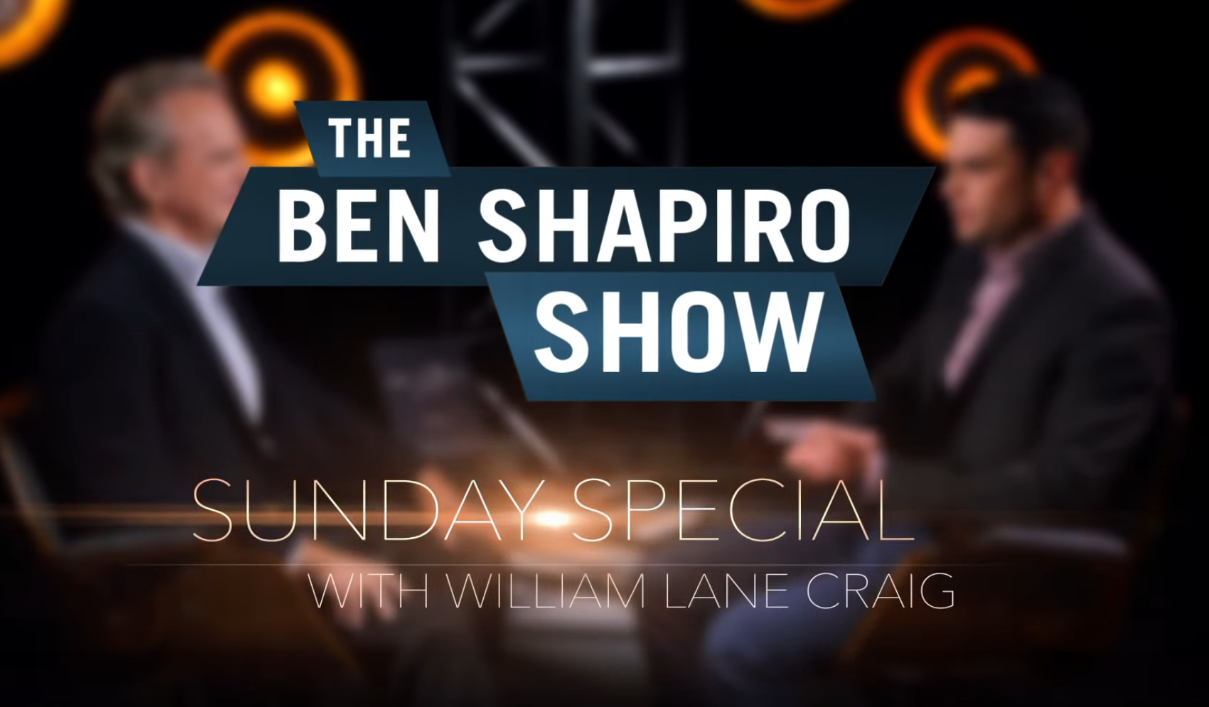
Dr. William Lane Craig on the Ben Shapiro Sunday special
I’m re-posting this old episode of the Ben Shapiro show. They discuss arguments for God’s existence in the first 25 minutes. The spend the first 26 minutes on arguments for God,and the next 16 minutes on Christian distinctives. They spend a bunch more time responding to common arguments for atheism, and finally Ben asks Dr. Craig how he became a Christian.
Summary:
William Lane Craig, philosopher, theologian, and best selling author of numerous books including “On Guard: Defending Your Faith With Reason And Precision,” joins Ben to discuss the hard sciences vs. philosophy, the cosmological and ontological arguments, Jesus, slavery, gay marriage, and much more.
Why are we seeing such a decline in religious belief in America?
Why are mainline denominations in Christianity and Judaism emptying out?
What was the driver behind the move away from religion starting in the 1960s?
Why is their a gap in the university and in the broader culture between reason and religious belief?
What is the strongest argument for God’s existence?
What is the most compelling argument for God’s existence for this culture?
Respond to Richard Dawkins’ challenge that God needs a cause.
Why does the universe have to have a cause?
Does Darwinian evolution provide grounds for our awareness of objective moral values and duties?
What is the strongest objection to the cosmological argument?
What is the strongest objection to the moral argument?
What about the objection that the existence of the universe is just a “brute fact” and doesn’t need an explanation for it’s existence?
What about David Hume’s objection to the law of causality?
What about objections to the cause of the universe from apparently uncaused events in quantum mechanics?
What is the ontological argument, and why is it frequently dismissed?
How do we get from an unmoved mover to a moral God?
Which arguments show that God is a mind?
How do you show that God is present and active in time now?
How do you move from God as Creator, Designer and moral lawgiver to a God who has revealed himself to human beings?
Who does Jesus claim to be in the gospels, and what is the evidence that his claims were correct?
From the Jewish perspective, this narrative has some problems. First, merely declaring yourself as the Messiah is not seen as a punishable offense.
Second, the real problem is that Jesus vision of himself as the Messiah is completely different than how Jews have understood the Messiah. The Messiah in Judaism has always been a political figure who is destined to restore the Kingdom of Israel, bringing more Jews back to Israel, etc. Claiming to be God, though would be blasphemy and a punishable offense.
Why is resurrection proof of divinity? Wasn’t Lazarus also raised from the dead?
The gospels were written decades after the events they claim to describe. Should we still see them as reliable enough to infer that the resurrection really happened?
Couldn’t legends have been introduced in the gap between the events and the time that the events were recorded?
Is it enough for us to have a Creator God, or is there a reason for God to reveal himself to us?
Tell us about your experience debating atheist scholars on university campuses.
Has any an atheist ever caused you to doubt your arguments?
The problem of human evil is easy to respond to, but how do you respond to the problem of natural evil, i.e. – suffering from events in the natural world, such as birth defects or natural disasters.
Atheists like to bring up specific disagreements they have with the Bible, e.g. – same-sex marriage, abortion, slavery, genocide. How would you respond to those?
Regarding slavery in the Bible, isn’t it the case that people sometimes do things that are not prescribed by God, and the Bible merely records that?
How would you respond then to people who push for same-sex marriage by arguing that this is a case where God wanted same-sex marriage, but couldn’t press for it because the people were not capable at that time and in that culture?
When discussing specific issues of morality, do you try to argue from a natural law perspective or from the morality in the Bible?
How would you respond to someone like Jordan Peterson who approaches religion teachings pragmatically, focusing on behaviors rather than the rational grounding of those behaviors?
How do you speak to young people about God without them losing interest?
How did you become a Christian?
As the influence of Judeo-Christian religion recedes, what do you see filling the void, and how do you see that affecting Western civilization going forward?


 WINTERY KNIGHT