
Tag Archives: Missions

Should Christians be motivated by the fear of missing out (FOMO)?

Bible study that hits the spot

My best friend Dina and I recently spent some time talking over some articles that we found on the culture. We specifically talked about what is motivating young people, so I wanted to write something about that.

FOMO: Fear Of Missing Out

Here’s a leftist New York Times article explaining where FOMO comes from:

It’s known as FOMO, or “fear of missing out,” and refers to the blend of anxiety, inadequacy and irritation that can flare up while skimming social media like Facebook, Twitter, Foursquare and Instagram. Billions of Twitter messages, status updates and photographs provide thrilling glimpses of the daily lives and activities of friends, “frenemies,” co-workers and peers.

[…]When we scroll through pictures and status updates, the worry that tugs at the corners of our minds is set off by the fear of regret, according to Dan Ariely, author of “Predictably Irrational” and a professor of psychology and behavioral economics at Duke University. He says we become afraid that we’ve made the wrong decision about how to spend our time.

[…]A friend who works in advertising told me that she felt fine about her life — until she opened Facebook. “Then I’m thinking, ‘I am 28, with three roommates, and oh, it looks like you have a precious baby and a mortgage,’ ” she said. “And then I wanna die.”

It’s like they want to run a race to do fun and exotic things with their peers, and not finish last.

Anyway, I want to begin this post with examples of FOMO behavior I have personally encountered.

FOMO Travel

Dina and I read and discussed this article by Alain de Botton in The European – notice the emphasis on travel and having fun, sophisticated experiences:

We’re continually being bombarded with suggestions about what we might do (go jet skiing, study in Colorado, visit the Maldives or see the Pyramids). We’re always hearing of the amazing things friends have done or are going to do: ‘there was this great bar we all went to …’; ‘she’s getting married in a little country church, then we’re having a picnic…’; ‘the sun was glinting on Sydney Harbour…’ There are endless hints of the allure of life in other places: an article about family-friendly restaurants in Brooklyn, a crime novel set in Trieste, the departure board at the airport with its list of places only a plane trip away: Moscow, Bangkok, Addis Ababa… The modern world makes sure we know at all times just how much we’re missing. It is a culture in which intense and painful doses of FOMO (Fear Of Missing Out) are almost inevitable.

What’s interesting is this – how does FOMO travel affect young, unmarried Christians?

Travel through missions work seems to be the FOMO activity of choice for at least a few young, unmarried Christians. One of my best friends who is married to another of my best friends told me about her missions trip to a European country. I asked her why she did it, since it meant lost savings, lost earnings, lost work experience, etc. (She gave up a year of earnings, and she had a great job in engineering). Her answer was that she did it for the adventure. I have a hard time hearing Jesus say that he was going to do something because he was bored and wanted an adventure. Especially when it’s $30,000 in costs, $60,000 of lost income, and lost work experience – per year. This was before the time of the Internet, though, when missionary work actually made sense. I just don’t think it’s worth spending that kind of money for the impact you make. The people I know who went on missionary trips just wanted to feel spiritual, look spiritual, and have a fun “life experience” vacation. One missionary told me that she was desperate to get away from her boring mid-Western roots.

If you really want to share Christ effectively with people in other countries, then you can start a blog and pay the tiny costs for it out of your earnings from your day job – that’s what I do. I get more people from Europe reading my blog than I could contact in a year of missionary work. I Skype with the people who are interested in Christianity from these countries (Scotland, Northern Ireland, England, Canada, etc.), as well. Meanwhile, I keep working my not-exciting job, so my savings increase, and my resume remains gap-less. This is good stewardship of finances, and self-denial prepares your character for the hard work of marriage and parenting. The Bible says that those who do not work should not eat. And Paul says that he built tents so that no one could accuse him of taking on missionary work for financial gain.

You can tell whether a person is sincere in their missionary intentions by looking at how responsible they’ve been in their decision-making. If a person has gone into debt paying for fun, thrilling activities like skydiving, ziplining, surfing, etc., then it’s FOMO travel. We must look past the spiritual smokescreen, and tell young people to grow up.

After all, if defending God’s honor was the missionary’s main goal, then the real battlefield would be the university.

Bill Craig puts it best:
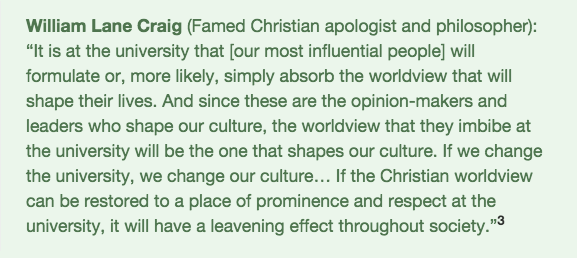
If serving God is your goal, look to the university

There is already a perfectly fine university right next door – no need to fly to Europe to find one! Remember, the university that took your faith away, or maybe the faith of someone you cared about? Yeah, it’s still sitting there in your home town! And it’s still ruining the lives of thousands of young people, by peer-pressuring them into secular, liberal views – and behaviors. It seems to me that it’s better stewardship to stay here and work, then give money to groups like Reasonable Faith. And you can start a blog, teach in church and invite scholars to the local university, too. That costs almost nothing, and it produces better results.

What about Jesus?

Sometimes, it’s a good idea to look beyond the words of the Bible and reflect on the overall message of it at a higher level. When I look in the Bible, I see that Jesus went through a lot of suffering in obedience to God in order to secure the salvation of people who did not even like him. And it’s from this sacrifice on our behalf that his claim on our obedience comes. There are things that I don’t like to do that I do anyway because they work to serve God. Jesus life’s ambition was not to do things that were easy, or that made him happy. Experienced Christians do things that are not fun, because these things are right and because they solve the real problem.

Who suffers the most from the trend of extended adolescence?

Marriage and family
Marriage and family

My friend Tracy sent me this interesting post. As I read it, I thought I was going to disagree with him about who is to blame for the mess he describes, but as we’ll see in a bit, I don’t.

Here’s his intro, which pretty much everyone agrees on:

The Five Traditional Milestones of Adulthood

Something magically happens between adolescence and young adulthood.  There are five traditional milestones of that mark entrance into adulthood that sociologists, psychologists, and the general population have used as a proxy to determine when someone has reached that tipping point of maturity.  It is at this time adolescence is shed and emotional maturity comes to full fruition.

These are:

  • Leaving Home
  • Becoming Financially Independent
  • Completing School
  • Marrying
  • Starting a Family

I hate not being married and not having any children, but I can’t marry a feminist and that’s all the church seems to be producing these days. The other ones I had finished by age 23 (debt-free).

He has some examples to illustrate who is and isn’t mature:

Examples of Adults:

  • A 25-year old teacher with a college degree, who works full time, is married, has a child, owns her own home, and pays for her own living expenses
  • A 65-year old janitor with a high school diploma, who works full time, is married or widowed, has children, owns his own home, and pays for his own living expenses

Examples of Extended Adolescence: 

  • A 30-year old who has part of their rent and bills covered by parents, endlessly enrolls in colleges or universities seeking additional degrees or credentials, single, without children.
  • A 45-year old high-school dropout living on social welfare programs who spends his days getting drunk in bars

OK, then he talks about who suffers the most from this, and it’s women:

What is particularly interesting is the interaction between biology and the paradigm shift that has occurred with so much of the younger generation suffering from extended adolescence. Women have a specific, limited window of time in which they can genetically reproduce and to which they are attractive to potential mates.  This so-called “biological clock”, written into the code at the very deepest core of our DNA, puts a limit on childbearing for females.

  • Fertility: Female fertility peaks at 20 to 30 years old.  After 30 years old, fertility drops by 20%.  After 35, it drops 50%.  After 40, it drops 95%.  As for in vitro fertilization, the American Society for Reproductive Medicine states that women in their early 40’s have, on average, only a 3% to 5% chance of having a baby through this method.
  • Down Syndrome: At 25, a woman has about 1 chance in 1,250 of having a baby with Down Syndrome; at age 30, a 1-in-1,000 chance; at age 35, a 1-in-400 chance; at age 40, a 1-in-100 chance; and at 45, a 1-in-30- chance.
  • Miscarriage: Only 9 percent of recognized pregnancies for women aged 20 to 24 end in miscarriage; 15 percent of women aged 25-30 miscarry; 40 percent of women over 40 do and more than 50 percent miscarry at 42 years of age.

These limitations do not apply to men (an 80 year old man can still reproduce).  Men have virtually no opportunity cost to waiting to find a mate.  If they want to spend their twenties working their way up their field, putting money in the bank, playing video games, and hanging out with friends, they can always wake up one morning and decide they are ready to settle down, get married, and have kids.  As such, the biological cost of extended adolescence is significantly and substantially higher for women than it is for men.  Females suffer from a Mother Nature-induced “use it or lose it” policy.

I don’t think that a Down syndrome child is insurmountable, but it’s more challenging.

So, should men be expected to ride to the rescue at the last minute, to make things “work out” for women who refused to marry when they were in their 20s, when they were fertile and attractive?

Nope:

This fear was encapsulated by Kay Hymowitz in a book called Manning Up: How the Rise of Women Has Turned Men Into Boys.

[…]As one reviewer somewhat critically noted of the book, “Hymowitz wants the child-men [those suffering from extended adolescence] to man up so that women don’t have to become spinsters or “choice mothers” at the expense of their careers. Might women alter their own behavior? “[T]he economic and cultural changes are too embedded, and, for women especially, too beneficial to reverse.” So the answer is no. Although it is women who are becoming disenchanted with the way things are, and although it is women who have created this situation, it is [in her opinion] men who ought to change.  And they are to change precisely when women are ready.”

The reviewer is correct because men are acting rationally within the confines the new paradigm.  In today’s world, men are presented no social, financial, emotional, or reproductive advantage by adjusting their own life to the ticking of a potential mate’s biological clock.  It is for the woman, to borrow a phrase, “too damn bad”.  It may not be fair, but in a finite world, there is an opportunity cost to every decision we make.  That has always been one of the central themes of this blog.  Incentive systems drive nearly everything in civilization from the type of people we attract into certain industries to the kind of behavior we reward.  The incentive system for men has changed and society now reflects this reality.

I actually blame the pastors and parents for this. Pastors and parents don’t challenge women’s feelings with the truth about what she ought to be doing in order to grow up and be well-positioned in the future. They want to let women decide what to do at every point in their lives, based on their feelings in the moment. The refusal to make judgments leads to women having delusions like “I can have children when I’m 35” and “I can change a bad man into a good man after I marry him” and “a degree in English is as worthwhile as a degree in computer science”.

Feminism has a lot to do with it. Women used to be taught by pastors and parents that they should choose chaste men with good jobs, work histories and savings. But feminism says that men don’t have any special provider role, and now the main things that women look for in a man is that he is attractive, fun, and lets her do whatever she feels like doing – no matter how crazy and irrational it is.

One woman recently told me that a friend of ours who is dating a penniless 28-year-old student who has never worked a day in his life need not worry, because “if they marry, he’ll drop out of school and start to work and provide for her”. She is 33, and she thinks that marrying a full-time student is a good idea, because he enthusiastically supports her crazy plans to pursue fun, thrills and travel into her mid-30s. She tells him that God is telling her (through her feelings) to pursue fun and thrills through travel – a position she held when she still an atheist in college, mind you. And he, in response, is both unwilling to, and incapable of, questioning her plan from a practical point of view. She likes that he lets her fly the plane, even it it means she’ll crash it and kill them both.

Pastors and parents don’t dare hurt the self-esteem of sensitive little girls by telling them to study hard things, get full-time jobs, move out of the house and focus on marrying a man who can provide during their 20s. And what happens when the “fun-thrills-travel until you’re 35” plan explodes and no one wants to marry her except losers? Well, then, all pastors and parents blame men for not wanting to marry her. But men don’t marry 35-year-old women when the value proposition of marriage has been greatly diminished by age and infertility. (Or worse: by promiscuity, cohabitation, divorce, and children from other men)

Women who think that they can play the fool through their 20s and early 30s, calling their feelings the voice of God, and being affirmed by parents and pastors in their crazy views, are in for a surprise. Men have needs and feelings too. Men respond to incentives. Marriage-minded women need to actively repudiate feminism, or they must live with the consequences of their failure to engage.

Are Campus Crusade and IVCF still Christian? Or are they just leftists?

Eagle eggs are protected, unborn babies are not

The latest news is about IVCF’s rejection of the pro-life cause.

Here is an article from Touchstone magazine.

It says:

Happy New Year, Everyone! Urbana 2015 ended on January 1, 2016. Urbana is a triennial major Christian (mostly Evangelical) student missions conference in St. Louis, Missouri, sponsored by InterVarsity Christian Fellowship (“InterVarsity”), primarily for college and graduate students.

[…][O]ne of the speakers prominently featured at Urbana was the “Rev.” Michelle Higgins. “Rev.” Higgins is the director of Faith for Justice, an advocacy group in St. Louis (she also serves as worship director at South City Church). Ms. Higgins is active in the #BlackLivesMatter movement in the St. Louis area.

[…]“Rev.” Higgins… described the pro-life movement as merely “a big spectacle.” In her remarks, she said:

We could end the adoption crisis tomorrow. But we’re too busy arguing to have abortion banned. We’re too busy arguing to defund Planned Parenthood. We are too busy withholding mercy from the living so that we might display a big spectacle of how much we want mercy to be shown to the unborn. Where is your mercy? What is your goal and only doing activism that is comfortable?

[…]Government statistics estimate that more than 16 million black babies have been murdered in the womb since the Supreme Court’s Roe v. Wade decision of 1973, a number quite a bit larger than the number of unarmed black men killed by police.

Not to mention the racist origins of Planned Parenthood, which was born out of the eugenics movement. Keep in mind that Christians are supposed to speak out against premarital sex, and for taking in unwanted children – that’s what the early church did. But at IVCF, we have women telling us that Planned Parenthood’s views on premarital sex and abortion are not to be challenged. The Bible is wrong, and Planned Parenthood is right. Because feelings.

Its often the case that the pro-abortion activists like to slander pro-lifers for not caring about women and not caring about children after they are born. But it’s not true of course, and you can read the reasons why in this Public Discourse post.

Campus Crusade, too

Previously, I wrote about how conservative professor Mike Adams is annoyed with Campus Crusade, let’s see why.

He wrote his first article to complain that campus clubs like Crusade don’t take stands on obvious moral issues like abortion.

He wrote:

Several years ago, a good friend of mine named Dave Sterrett gave a pro-life speech to a Campus Crusade chapter at a state university in North Texas. He was invited to speak by a student. During the middle of his speech, he was arguing that the unborn are fully human and have souls by quoting from the Gospel of Luke. His talk was clearly Biblical and not political in nature.

Nonetheless, when the Campus Crusade director arrived, he rudely shut the speech down.

The Campus Crusade director told Dave to come out in the hall after he shut down his talk. The Crusade leader then began to yell at Dave and told him, “I don’t know what your deal is talking about this issue. Get your books and get out of here.” He went even further calling the headquarters of Crusade, which then demanded an apology from Sterrett.

Shortly after I wrote about the incident, several members of Campus Crusade contacted me – but not to apologize for their mistreatment of Dave. They emailed to admonish me for writing about the incident – even though I did not call out the university or the chapter director by name. The fallout from the incident was revealing. It shows how far some campus ministries will go to avoid controversy – and that they often consider themselves to be above reproach.

The original incident was also revealing. The censored speech was not political so the problem cannot be that Campus Crusade is not a “politically-based” organization. The speech was morally and Biblically based. Does the rejection of the speech mean that Campus Crusade is not a “morally-based” organization? Or does it mean they are not a “Biblically-based” organization?

Of course it doesn’t. The incident merely shows that Campus Crusade has become a “comfort-based” organization. In other words, an over-riding priority is avoiding topics that might make people feel uncomfortable.

Here is the second article. He writes about how Crusade made a deal to remove Christian elements from a gathering in order to get government funding, then writes about this lady who stood up for free speech:

Subsequently, at the very school where Campus Crusade traded its religious freedom for student government funding, there was a lawsuit over a campus speech code. One of the plaintiffs was a fine Christian woman who fought to overturn a speech code that was being used to suppress conservative speech and which also posed a grave threat to religious organizations.

After she sued, homosexual groups erupted in anger – falsely claiming that she was defending “hate speech” by opposing the speech code. They defamed her, physically threatened her, and verbally abused her –all in the name of tolerance and diversity.

This time, Campus Crusade did not remain neutral. They weighed in. But, unbelievably, they weighed in against the Christian woman and in favor of those defending the speech codes.

This is the part I really think is important:

Right after these unfortunate events unfolded I became embroiled in my own First Amendment lawsuit. In part, because I stood in unity with Christians and defended them against illegal policies, I was denied a promotion at my school.

With the support of numerous Christian organizations, I eventually won the seven-year legal battle. Two Christian legal firms paid my legal bills and countless other Christian ministry and policy groups publicly backed me. But one Christian organization remained conspicuously silent. Of course, I am speaking of… the Crusade formerly named after Christ.

For seven long years I heard not a single word of public support from a single member of Campus Crusade. When I won the case, I was deluged with calls and emails and handwritten letters from Christian leaders all across America.

But I heard not a word from Campus Crusade for months in the wake of the verdict.

Then, in mid-July, the final terms of my settlement were reached. It was reported in the local news that I would get a raise and a check for back pay while may attorneys would get a sum of $615,000. On August 1, 2014, I received the check from the State of North Carolina. On August 2, just 24 hours later, one of the local directors for Campus Crusade wrote me the following:

“Hey Mike. I hope your summer is going well. Would you be interested in having coffee with me next week so I could talk to you about joining my ministry support team?”

After I received that audacious email, I searched through my archives and read every single email correspondence I had received from that director over the course of seven years. There was no offer of prayer support in any of those emails. Nor was there any mention of the legal ordeal I was going through. He simply ignored the suit until the terms of the settlement became public.

In other words, your ministry and its leaders were never interested in unity. They never offered support in public or even in private. They only sought to profit financially from those who win battles Campus Crusade chooses to avoid.

The reason I am linking to this is because I experienced this kind of behavior from IVCF and Campus Crusade as an undergraduate and later as a graduate student. They opposed the introduction of apologetics at every point, and they were both anxious to embrace the secular left, especially radical feminism, global warming alarmism, gay rights and socialism. It was depressing. If I were a student today, I’d head straight for the College Republicans and Ratio Christi if I wanted to get anything useful done. In fact, I started this blog partly as a way of discussing issues from a Christian point of view because I could not get anything done in IVCF and Campus Crusade.

I would not give money to IVCF or Crusade or any Christian missionary / relief organization  right now. I would only give to individual chapters of Ratio Christi, and then only for specific lectures or debates. You have to watch your money like a hawk, because a lot of these leftist Christian do-gooder organizations have no Christian worldview based in the Bible.