Tag Archives: Misandry

Should we “automatically believe rape claims” even if they are proven false?

There was a story about an alleged gang rape published in the Rolling Stone, which is an ultra-left wing magazine, which came under scrutiny from left-wing news sources like The New Republic and The Washington Post because it was not fact-checked and disagreed with known facts.

Yahoo News reports:

Rolling Stone has clarified its apology over a story that had reported a female student was gang-raped at a University of Virginia fraternity, telling readers the mistakes were the magazine’s fault, not the alleged victim’s.

[…]The magazine said that it shouldn’t have agreed to Jackie’s request not to contact the alleged assailants to get their side of the story, out of sensitivity to her. “These mistakes are on Rolling Stone, not on Jackie,” wrote the magazine’s managing editor, Will Dana. “We apologize to anyone who was affected by the story and we will continue to investigate the events of that evening.” The decision not to contact the alleged rapists prompted criticism from other news organizations.

[…]The allegations rocked the campus and elevated the issue of sexual assault, leading to protests, a suspension of fraternity activities and an emergency Board of Visitors meeting.

Dana’s updated message added some details calling into question the magazine’s original story. He noted that Phi Kappa Psi has denied the assault, and said it didn’t host an event on the night Jackie alleged she was raped. And Dana said that Jackie is now unsure that the man who allegedly lured her into a room to be gang-raped by seven men, identified as “Drew,” was a member of Phi Kappa Psi.

“According to the Washington Post, ‘Drew’ actually belongs to a different fraternity and when contacted by the paper, he denied knowing Jackie,” Dana wrote in the new note. “Jackie told Rolling Stone that after she was assaulted, she ran into ‘Drew’ at a UVA pool where they both worked as lifeguards. In its statement, the Phi Psi says none of its members worked at the pool in the fall of 2012.” Dana also cited the Post’s account of several of Jackie’s friends doubting her “narrative,” although Jackie told the Post she stood by the account she gave to Rolling Stone.

False rape charges actually occur quite frequently – remember the Duke University rape hoax or the Lehigh University rape hoax or the Hofstra University rape hoax? The left-wing media loves to cover them because it makes men look bad, and makes women think that they need to vote for bigger government in order to protect them from dangerous men.

But what’s been fascinating is the reaction of feminists on the left to the Rolling Stone’s apology. Do they care about fact-checking rape charges, or do they think that all rape charges are “automatically” true?

Here’s a story from the Washington Post with the title “No matter what Jackie said, we should automatically believe rape claims”. (archived here, H/T Mackenzie)

Tweet by the author captured: (H/T The Right Scoop)
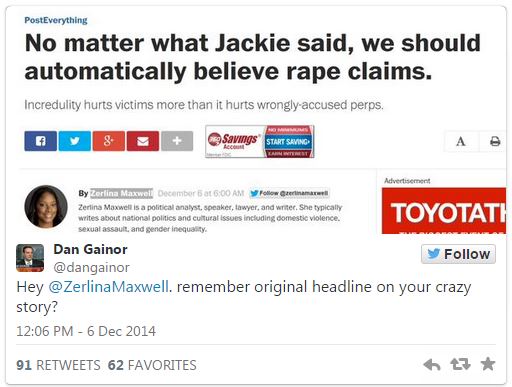
Zerlina Maxwell "automatically believe rape claims"
Zerlina Maxwell “automatically believe rape claims”

She later changed the title of the article, but the URL still contains the word “automatically”. Automatically – believe the charge before checking the facts.

She writes:

Many people (not least UVA administrators) will be tempted to see this as a reminder that officials, reporters, and the general public should hear both sides of the story and collect all the evidence before coming to a conclusion in rape cases. This is what we mean in America when we say someone is “innocent until proven guilty.” After all, look what happened to the Duke lacrosse players.

In important ways, this is wrong. We should believe, as a matter of default, what an accuser says. Ultimately, the costs of wrongly disbelieving a survivor far outweigh the costs of calling someone a rapist. Even if Jackie fabricated her account, UVA should have taken her word for it during the period while they endeavored to prove or disprove the accusation.

The author’s bio:

Zerlina Maxwell is a political analyst, speaker, lawyer, and writer. She typically writes about national politics and cultural issues including domestic violence, sexual assault, and gender inequality.

This is how people on the left form their beliefs in college. They listen to what professors tell them, and insult anyone who questions what they believe by calling them names like “racist”, “sexist”, “homophobe” or “Islamophobe”. This is a college education – at least in non-STEM fields. People pay money to be indoctrinated like this. Lots of money.

Well, maybe this is just a lone outlier, though. One bad feminist who doesn’t care about truth.

Nope! Here’s famous feminist Jessica Valenti, tweeting this:
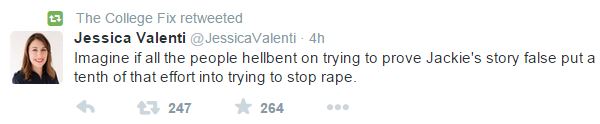
Jessica Valenti: fake but accurate

Here’s another from Julia Horowitz, reported by Newsbusters: (links removed)

In a Politico magazine article on the UVA rape accusation debacle, in which the accuser’s allegations have unraveled, Julia Horowitz, an assistant managing editor at the college paper The Daily Cavalier, claimed “to let fact checking define the narrative would be a huge mistake.”

[I]t is becoming increasingly clear that the story that blew the lid off campus sexual assault has some major, major holes. Ultimately, though, from where I sit in Charlottesville, to let fact checking define the narrative would be a huge mistake….

It is no accident that the article came out, and it became apparent almost immediately that there were very tangible things we needed to discuss.

Yes, the story was sensational. But even the most sensational story, it seems, can contain frightening elements of truth.

Of course!  Facts can be so, well, inconvenient. Viva the “narrative.” We’re with the Alice in Wonderland Queen: “sentence first — verdict afterwards.”

And another one named Melissa McEwan tweeted this:

Something false can be true if I want it to be.
Something false can be true if a feminist says it’s true.

and this:

If you insist on fact-based inquiries, you are a rapist.

…before deleting her Twitter account once her craziness was discovered.

Mainstream media

Meanwhile in the mainstream media, the Rolling Stone apology was not news, even though the unretracted story was news:

When the now-retracted article by the Rolling Stone magazine was published on November 19 about a brutal gang rape of a first-year student at the Phi Kappa Psi fraternity house at the University of Virginia (UVA), the major broadcast networks rushed to the story and devoted multiple segments to both the article and reaction on the school’s campus.

[…]The “big three” of ABC, CBS and NBC offered coverage on their evening newscasts over the course of November 23 and 24, with ABC’s World News Tonight and NBC Nightly News covering it on the 23rd. The following night, an additional report was filed by ABC and NBC each to go along with the first from the CBS Evening News with Scott Pelley. On those two evenings alone, the total network coverage was 11 minutes and 14 seconds.

While the three programs combined for just under 8 minutes of thorough coverage on Friday night, that does little to excuse their inability to investigate the story independently or even check the facts of the Rolling Stone piece on their own.

[…]On NBC Nightly News, anchor Brian Williams was the sole anchor to admit that his program had filed stories based off of the very article that he and NBC’s Kristen Welker would now report had major “discrepancies.”

Still, the networks had pitfalls in their coverage of the retraction. As suggested two sentences prior, ABC and CBS failed to join with NBC in not admitting to having previously blindly covered this subject.

Also, CBS and NBC fell short in only interviewing students who, respectively, suggested pieces like this are why victims hesitate coming forward and dismissed the fact that the story is now in severe doubt because the issue of sexual assault is “still a problem” on college campuses “even if it’s not real.”

Now, I thought that people who go to journalism school did nothing but learn how to discover the truth about a story. I thought that it was like police detective work – interviewing witnesses, checking facts, corroborating testimony, digging through records. How wrong I was. But I think I’ll be right about something else – I think a lot of people who read the original story will believe it based on intuitions and emotions, even now after significant portions of the story conflict with known facts. They’ll believe it because that’s what they’ve been brainwashed in non-STEM programs to believe. They’ve become incapable of critical thinking, incapable of updating their views according to evidence and incapable of respectful dialog with those who disagree with them.

Related posts

What’s stopping young adults from getting married?

Before we get to the study, I wanted to share something that a Christian male friend shared with me about yesterday’s post on the crazy feminist mommy porn author.

He writes:

I saw your post about the woman who “fell in love” with her fantasy character she created. I’m a victim of this.

My ex-wife is a succeeding indie author. She jets off and hangs with NYT best-selling authors, rubs elbows with a lot of fantasy romance and erotica authors. She reads, oh, roughly 200 +/- smut books per year.

This area is the flip side of the porn coin, and it’s not getting the attention it should. If I told my story and part of the reason for the marriage destruction, it would be an “easy sell” to those who understand that women who fantasize about these fictional characters (even the images on the covers) are doing the exact thing men are doing when they fantasize over airbrushed skin images and other skin porn.

Many will argue it’s not the same thing, but that is preposterous. Husbands are competing with fantasy novel cover art and fantasy characters. It’s every bit the same as wives competing with unreal images or even real ones where they compete with younger, more fit, kinkier, etc., etc.

Men get cheated on all the time. Through this stuff. My ex developed an online romance through it all. Exchanged erotic pictures, emails, texts, Skype, on and on and on.

I discovered travel plans, fake email accounts, it was awful.

This is the third time that I have been sent divorce stories like this by conservative, Christian male apologists on Facebook.

The first time, the wife hit a certain age then just went nuts and started working out a ton and trying to look younger and younger. Then as she got success as a personal trainer and attention for all the photos she posted, she just divorced her husband outright to focus on her business and more glamorous photos. And they had children. The second time, the wife just went nuts into new age beliefs and yoga and divorced her husband, and they had children too. So we are talking real destructive craziness here.

This is why I put so much emphasis on building up a woman first by leading her to learn apologetics, conservative politics and economics, and so on. If she is not willing to learn and grow in things that are good for her and that help her to be a better wife and mother, then you know that her heart is not in the difficult realities of married life and the roles of wife and mother. She will be one of these women who wants to be happy and thinks that happiness means getting rid of family obligations and responsibilities to her man and her kids. Men should ensure that their prospective mates reject the Disney princess perception that relationships should be all about them and their needs – living happily ever after with no hard work or effort. Helping a woman to think logically and argue using evidence is one way to insulate her from the foolish, emotion-driven culture that threatens marriage.

Anyway, with that said, here is the new article from Family Studies.

Here’s the introduction:

In interviews we conducted with working-class young adults, my wife and I were surprised by the strength of their desires to have a long-lasting marriage and stable family life. But many of them were far from realizing those aspirations. Why?  The wide-ranging challenges that frustrate their aspirations, which we must understand in order to find effective solutions, fall into four rough categories: family-of-origin, philosophical, psychological, and financial.

[…]Conflicted about marriage. This crisis of trust, in turn, informs young adults’ conflicted thinking about marriage. As Amber and I described in a previous post, their experiences of family fragmentation sharpen their desire to get and stay married, on the one hand, but on the other hand it also shakes their confidence in the durability of marriage. As a result, many young adults find themselves in tenuous cohabiting relationships, wanting to say “I do” eventually but too uncertain to do so now.

[…]The fixed love mindset. As Amber discussed here, the philosophy of love that young adults inherit from cultural scripts, like Hollywood chick flicks, works against their own aspirations for committed, permanent love. Instead of a “growth mindset” about love that focuses on working through possible differences, these stories about love transmit a “fixed mindset” that focuses on immediate and perpetual compatibility—the absence of which probably indicates that a couple is no longer meant for each other. Young adults with a fixed mindset about love tend to say things like “love is effortless,” or, as one separated spouse put it, “I love him, but I’m not in love with him. I love him as a friend, as the father, but I don’t feel that connection as I used to.”

[…]Extreme individualism. Despite the common challenges that confront working-class young adults, the idea that “my relationship is no one else’s business” prevents them from thinking about marriage and family life as a public issue that demands our common efforts.

For instance, Anthony knows first-hand the painful effects of divorce—his parents divorced when he was ten—and he speaks eloquently about how divorce imposed burdens on him and his other friends from divorced families. So what does he believe we can do about the rising number of children raised in fragmented families?

“I don’t think there’s a thing we can do about it,” Anthony told us. “And that’s kind of the American way—this is a free country, and free this and free that. But it’s your life, and not too many people care about other people’s lives. As long as it’s not theirs, they don’t care.” The result of that attitude, however, is loneliness and helplessness in the face of an urgent social problem.

One of the questions I sometimes discuss with my male friends is “what is the female equivalent of pornography”? It has to be something that teaches women to have unrealistic expectations of men. My answer is that it is this culture that praises irrationality, thrill-seeking, travel and emotionalism over planning, morality and hard work.  Many women today seem to really believe that men are there to provide them with fun, thrills and dreams, instead of with long-term achievements that take planning, sacrifice, problem-solving and hard work. The mommy-porn novels that so many women find attractive just feeds these marriage-destroying delusions. There is even a Christian version of the emotional craziness where women are urged to follow their hearts, and somehow, God will make their bad choices and risky plans work out.

As the story above from my friend shows, mommy porn is also an affair-creator and a marriage-killer. About 70% of divorces are initiated by women, and lesbian couples have the highest rates of relationship breakdown. Feministy women need to be taught (hopefully by their fathers) that entering into a relationship means an opportunity to commit to serve the other person self-sacrificially in order to build something that lasts – it’s not about getting your own way and feeling good. Many women today seem to enjoy choosing the wrong men in their teens and 20s, and then when the right man comes along later, they want to back away from the demands of a serious relationship with him and go on their merry way.

This is why I tell everyone to stay away from premarital sex and cohabitation – it has a huge impact on a person’s willingness to commit. Many women today seem to think that they can choose any man based on superficial criteria (he is fun and handsome and funny) and then make him commit by giving him sex. WRONG. You have to choose the right man by carefully evaluating him for marriage-related responsibilities. A man who can do husband tasks, (e.g. – providing, loving over the long-term, teaching others to defend their faith), is a man who is capable of marriage commitment. The experience of investing in the wrong men and then failing ruins a woman’s ability to trust and commit. They mentally and emotionally check out of subsequent relationships and start looking for excuses to get away from commitment. It creates an attitude of wanting to sabotage the relationship. They focus on scanning for the exits instead of on investing, communicating and problem solving.

UPDATE: The friend who wrote me had this in response to the post:

I carried her physically after her surgery, disciplined her children effectively, managed academics (got one through high school who wouldn’t have made it without me), was at her side for weeks praying for her son who nearly died in an accident, supported her in her accounting career and her writing, served all of her physical needs (yeah, THAT way!), sacrificed rural life and property for the castle she wanted . . .

You get the idea. None of it mattered. What mattered in the end was her chasing a dream.

I’m left with the castle I don’t want or need, and kids I love have been spirited off to a new life.

Sad.

Top 5 myths that old feminists pass on to young women

Christina Hoff Sommers writing in the ultra-leftist Time magazine of all places.

The list:

  1. MYTH 1: Women are half the world’s population, working two-thirds of the world’s working hours, receiving 10% of the world’s income, owning less than 1% of the world’s property.
  2. MYTH 2: Between 100,000 and 300,000 girls are pressed into sexual slavery each year in the United States.
  3. MYTH 3: In the United States, 22%–35% of women who visit hospital emergency rooms do so because of domestic violence.
  4. MYTH 4: One in five in college women will be sexually assaulted.
  5. MYTH 5: Women earn 77 cents for every dollar a man earns—for doing the same work.

I’m posting 4 and 5 below, since they were mentioned in the video above (that’s not Christina Hoff Sommers):

MYTH 4: One in five in college women will be sexually assaulted.

FACTS: This incendiary figure is everywhere in the media today. Journalists, senators and even President Obama cite it routinely. Can it be true that the American college campus is one of the most dangerous places on earth for women?

The one-in-five figure is based on the Campus Sexual Assault Study, commissioned by the National Institute of Justice and conducted from 2005 to 2007. Two prominent criminologists, Northeastern University’s James Alan Fox and Mount Holyoke College’s Richard Moran, have noted its weaknesses:

“The estimated 19% sexual assault rate among college women is based on a survey at two large four-year universities, which might not accurately reflect our nation’s colleges overall. In addition, the survey had a large non-response rate, with the clear possibility that those who had been victimized were more apt to have completed the questionnaire, resulting in an inflated prevalence figure.”

Fox and Moran also point out that the study used an overly broad definition of sexual assault. Respondents were counted as sexual assault victims if they had been subject to “attempted forced kissing” or engaged in intimate encounters while intoxicated.

Defenders of the one-in-five figure will reply that the finding has been replicated by other studies. But these studies suffer from some or all of the same flaws. Campus sexual assault is a serious problem and will not be solved by statistical hijinks.

MYTH 5: Women earn 77 cents for every dollar a man earns—for doing the same work.

FACTS: No matter how many times this wage gap claim is decisively refuted by economists, it always comes back. The bottom line: the 23-cent gender pay gap is simply the difference between the average earnings of all men and women working full-time. It does not account for differences in occupations, positions, education, job tenure or hours worked per week. When such relevant factors are considered, the wage gap narrows to the point of vanishing.

Wage gap activists say women with identical backgrounds and jobs as men still earn less. But they always fail to take into account critical variables. Activist groups like the National Organization for Women have a fallback position: that women’s education and career choices are not truly free—they are driven by powerful sexist stereotypes. In this view, women’s tendency to retreat from the workplace to raise children or to enter fields like early childhood education and psychology, rather than better paying professions like petroleum engineering, is evidence of continued social coercion. Here is the problem: American women are among the best informed and most self-determining human beings in the world. To say that they are manipulated into their life choices by forces beyond their control is divorced from reality and demeaning, to boot.

Her conclusion:

Why do these reckless claims have so much appeal and staying power? For one thing, there is a lot of statistical illiteracy among journalists, feminist academics and political leaders. There is also an admirable human tendency to be protective of women—stories of female exploitation are readily believed, and vocal skeptics risk appearing indifferent to women’s suffering. Finally, armies of advocates depend on “killer stats” to galvanize their cause. But killer stats obliterate distinctions between more and less serious problems and send scarce resources in the wrong directions. They also promote bigotry. The idea that American men are annually enslaving more than 100,000 girls, sending millions of women to emergency rooms, sustaining a rape culture and cheating women out of their rightful salary creates rancor in true believers and disdain in those who would otherwise be sympathetic allies.

But if young women learn this for four years in college, what hope is there for any kind of trust and vulnerability with men? What hope is there for marriage? They are always going to be trying to find meaning in life on their own, apart from any kind of loving partnership with a man. And the more hooking up and cohabitating they do, the less they are going to value marriage and take practical steps towards it. That is the real problem – the wasting of time and the lack of seriousness, as if getting married can be left to age 35 with no preparation and no planning. As if careers and missionary work and traveling can fill the same hole that a family fills. Yet if no one tells these young women and pushes them to be sensible and discerning, they will mess up the most important decision of their lives.

This might be a good article to share and bookmark.