Tag Archives: Minimum Wage

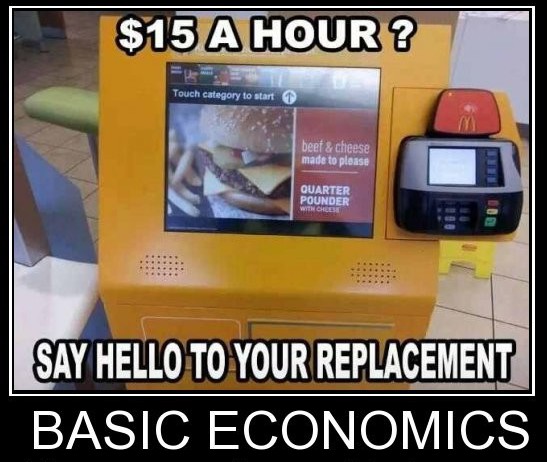
Proposed minimum wage increases will lead to increased automation in restaurants

Basic economics: when you raise the price of something, people buy less of it

This is from the leftist Washington Post, of all places. Not the place you would normally look for knowledge of basic economics.

Excerpt:

The [restaurant / fast food] industry could be ready for another jolt as a ballot initiative to raise the minimum wage to $15 an hour nears in the District and as other campaigns to boost wages gain traction around the country. About 30 percent of the restaurant industry’s costs come from salaries, so burger-flipping robots — or at least super-fast ovens that expedite the process — become that much more cost-competitive if the current federal minimum wage of $7.25 an hour is doubled.

[…]Many chains are already at work looking for ingenious ways to take humans out of the picture, threatening workers in an industry that employs 2.4 million wait staffers, nearly 3 million cooks and food preparers and many of the nation’s 3.3 million cashiers.

[…]Labor isn’t the only ingredient that factors into the price of a Big Mac: There’s also real estate, which has been getting more expensive, especially in the hot urban markets where restaurants are seeking to locate. Wholesale food costs, meanwhile, have escalated 25 percent over the past five years.

The avalanche of rising costs is why franchisers are aggressively looking for technology that can allow them to produce more food faster with higher quality and lower waste. Dave Brewer is chief operating officer with Middleby Corp., which owns dozens of kitchen equipment brands, and is constantly developing new ways to optimize performance and minimize cost.

“The miracle is, the wage increase is driving the interest,” Brewer said. “But the innovation and the automation, they’re going after it even before the wages go up. Why wait?”

All that innovation helps restaurants streamline other parts of their operations — and draw more customers. Electronic menus can be constantly updated so that items that are out of stock can be removed. Connecting the point of the sale to the oven’s operating system allows precise amounts of food to be cooked, which helps cut down on costs. Other inventions save energy, reduce maintenance and better dispose of grease. On the digital side, restaurants are working on apps that include reward systems and location tracking that prompt customers to eat with them more frequently.

[…]The labor-saving technology that has so far been rolled out most extensively — kiosk and ­tablet-based ordering — could be used to replace cashiers and the part of the wait staff’s job that involves taking orders and bringing checks. Olive Garden said earlier this year that it would roll out the Ziosk system at all its restaurants, which means that all a server has to do is bring out the food.

Robots can even help cut down on the need for high-skilled workers such as sushi chefs. A number of high-end restaurants use machines for rolling rice out on sheets of nori, a relatively menial task that takes lots of time. Even though sushi chefs tend to make more than $15 an hour, they could be on the chopping block if servers need to make $15 an hour, too.

“For our operation, we’re not buying entry-level labor, but if entry-level labor goes up a huge amount, everything goes up,” said Robert Bleu, the president of True World Group, a seafood distributor and consultant that also owns a sushi restaurant in Chicago. “I don’t consider rice-forming a high art. You can escape some of the drudgery.”

Let’s review the facts on minimum wage.

Abstract from new National Bureau of Economic Research study:

We estimate the minimum wage’s effects on low-skilled workers’ employment and income trajectories. Our approach exploits two dimensions of the data we analyze. First, we compare workers in states that were bound by recent increases in the federal minimum wage to workers in states that were not. Second, we use 12 months of baseline data to divide low-skilled workers into a “target” group, whose baseline wage rates were directly affected, and a “within-state control” group with slightly higher baseline wage rates. Over three subsequent years, we find that binding minimum wage increases had significant, negative effects on the employment and income growth of targeted workers.

[…]Over the late 2000s, the average effective minimum wage rose by 30 percent across the United States. We estimate that these minimum wage increases reduced the national employment-to-population ratio by 0.7 percentage point.

That comes out to 1.4 million workers who lost their jobs, thanks to minimum wage mandates. And those are primarily young, unskilled workers who are affected – people trying to get a start in the workplace and build their resumes, so they can move up.

Harvard economist Greg Mankiw explains the top 14 views that a majority professional economists agree on, and here’s #12:

12. A minimum wage increases unemployment among young and unskilled workers. (79%)

And these facts affect more than the restaurant / fast food business. Here’s an example from ABC News of another business that is having to shut its doors: independent bookstores. It always seems that the people on the lowest “start” rungs of the economic-independence ladder are most affected by bad liberal economic policies.

Should blacks vote for Democrats? Do liberal policies help young black men?

I want to quote from two black economists – my two favorite economists – to answer some questions.

First, Thomas Sowell.

Economist Thomas Sowell

Is minimum wage good for young blacks?

He writes:

Low-income minorities are often hardest-hit by the unemployment that follows in the wake of minimum wage laws. The last year when the black unemployment rate was lower than the white unemployment rate was 1930, the year before there was a federal minimum wage law.

The following year, the Davis-Bacon Act of 1931 was passed, requiring minimum wages in the construction industry. This was in response to complaints that construction companies with non-union black construction workers were able to underbid construction companies with unionized white workers (whose unions would not admit blacks).

Looking back over my own life, I realize now how lucky I was when I left home in 1948, at the age of 17, to become self-supporting. The unemployment rate for 16- and 17-year-old blacks at that time was under 10%. Inflation had made the minimum wage law, passed 10 years earlier, irrelevant.

But it was only a matter of time before liberal compassion led to repeated increases in the minimum wage to keep up with inflation. The annual unemployment rate for black teenagers has never been less than 20% in the past 50 years, and has ranged as high as over 50%.

You can check these numbers in a table of official government statistics on page 42 of professor Walter Williams’ book “Race and Economics.”

Incidentally, the black-white gap in unemployment rates for 16-year-olds and 17-year-olds was virtually nonexistent back in 1948. But the black teenage unemployment rate has been more than double that for white teenagers for every year since 1971.

Second, Walter Williams.

Economist Walter Williams

Is voting for black leaders good for blacks?

He writes:

Black leaders stress the importance of political power and getting out the vote, but we might ask how important political power is to the ordinary black person. As a start toward answering that question, we might examine black life in cities where blacks hold considerable political power.

Detroit is the nation’s most dangerous city. Rounding out Forbes magazine’s 2013 list of the 10 most dangerous cities are Oakland, Calif.; St. Louis; Memphis, Tenn.; Stockton, Calif.; Birmingham, Ala.; Baltimore; Cleveland; Atlanta; and Milwaukee.

According to a recent American Community Survey by the U.S. Census Bureau, the 10 poorest cities with populations of more than 250,000 are Detroit, with 33% of its residents below the poverty line; Buffalo, N.Y., 30%; Cincinnati, 28%; Cleveland, 27%; Miami, 27%; St. Louis, 27%; El Paso, Texas, 26%; Milwaukee, 26%; Philadelphia, 25%; and Newark, N.J., 24%.

In addition to poverty, there is grossly inferior education and high welfare dependency in these cities.

The most common feature of these cities is that for decades, all of them have had Democratic administrations. Some cities — such as Detroit, Buffalo, Newark and Philadelphia — haven’t elected a Republican mayor for more than a half-century.

What’s more is that in most of these cities, blacks have been mayors, chiefs of police, school superintendents and principals, and have dominated city councils.

[…]Let’s be clear about what I am saying and not saying. I am not suggesting that there’s a causal relationship between crime, poverty and squalor on the one hand and Democratic and black political power on the other. Nor am I suggesting that blacks ought to vote Republican.

What I am saying is that if one is strategizing on how to improve the lives of ordinary — and particularly the poorest — black people, he wants to leave off his high-priority to-do list the election of Democrats and black politicians. Also to be left off the to-do list is a civil rights agenda.

Perhaps the biggest roadblock to finding solutions is the widely held vision that the major problem confronting blacks is discrimination. I am not arguing that every vestige of discrimination has been eliminated. I am arguing that the devastating problems facing a large proportion of the black community are not civil rights problems. The solutions will not be found in the political or civil rights arena.

And third, more Walter Williams.

Is focusing on the few cases where a white police officer shoots a black man good for blacks?

He writes:

Excerpt:

Each year, roughly 7,000 blacks are murdered. Ninety-four percent of the time, the murderer is another black person.

According to the Bureau of Justice Statistics, between 1976 and 2011, there were 279,384 black murder victims. Using the 94-percent figure means that 262,621 were murdered by other blacks.

Though blacks are 13 percent of the nation’s population, they account for more than 50 percent of homicide victims. Nationally, the black homicide victimization rate is six times that of whites, and in some cities, it’s 22 times that of whites.

Coupled with being most of the nation’s homicide victims, blacks are most of the victims of violent personal crimes, such as assault and robbery.

The magnitude of this tragic mayhem can be viewed in another light. According to a Tuskegee Institute study, between 1882 and 1968, 3,446 blacks were lynched at the hands of whites. Black fatalities during the Korean War (3,075), Vietnam War (7,243) and all wars since 1980 (8,197) come to 18,515, a number that pales in comparison with black loss of life at home.

It’s a tragic commentary to be able to say that young black males have a greater chance of reaching maturity on the battlefields of Iraq and Afghanistan than on the streets of Philadelphia, Chicago, Detroit, Oakland, Newark and other cities.

Not everyone who runs around crying “racism, racism” is interested in helping blacks to do as well as other racial groups.

Blacks will do well, just as they used to do, when the political parties in power embrace free-market capitalist policies, such as lowering the minimum wage, or scrapping it entirely. Blacks will do well, just as they used to do, when we strengthen and subsidize natural marriage – by repealing no-fault divorce and reforming welfare for single mothers. Blacks will do well, just as they used to do, when we make public schools more responsive to parents, and less responsive to teacher unions. And so on.

San Francisco book store closes after minimum wage increase

Important story from the most leftist city in America.

ABC News:

Independent bookstores have faced tough times for quite a while. In San Francisco, neighborhood businesses have been passionately protected, so it’s hard to believe that an initiative passed by voters to raise the minimum wage is driving a Mission District bookstore out of business.

San Francisco’s minimum wage is currently $11.05 an hour. By July of 2018, the minimum wage in San Francisco will be $15 an hour. That increase is forcing Borderlands Bookstore to write its last chapter now.

[…]Borderlands was turning a small profit, about $3,000 last year. Then voters approved a hike in the minimum wage, a gradual rise from $10.75 up to $15 an hour.

“And by 2018 we’ll be losing about $25,000 a year,” he said.

It’s an unexpected plot twist for loyal customers.

“You know, I voted for the measure as well, the minimum wage measure,” customer Edward Vallecillo said. “It’s not something that I thought would affect certain specific small businesses. I feel sad.”

Though it’s caught a lot of people off guard, one group that wasn’t completely surprised was the Board of Supervisors. In fact, they say they debated this very topic before sending the minimum wage to the voters.

“I know that bookstores are in a tough position, and this did come up in the discussions on minimum wage,” San Francisco supervisor Scott Wiener said.

Wiener knows a lot of merchants will pass the wage increases on to their customers, but not bookstores.

“I can’t increase the prices of my products because books, unlike many other things, have a price printed on them,”

Wiener says it’s the will of the voters. Seventy-seven percent of them voted for this latest wage hike.

Unexpected!

Let’s review the facts on minimum wage, and then I can make fun of one of my friends in my conclusion.

Abstract from new National Bureau of Economic Research study:

We estimate the minimum wage’s effects on low-skilled workers’ employment and income trajectories. Our approach exploits two dimensions of the data we analyze. First, we compare workers in states that were bound by recent increases in the federal minimum wage to workers in states that were not. Second, we use 12 months of baseline data to divide low-skilled workers into a “target” group, whose baseline wage rates were directly affected, and a “within-state control” group with slightly higher baseline wage rates. Over three subsequent years, we find that binding minimum wage increases had significant, negative effects on the employment and income growth of targeted workers. Lost income reflects contributions from employment declines, increased probabilities of working without pay (i.e., an “internship” effect), and lost wage growth associated with reductions in experience accumulation. Methodologically, we show that our approach identifies targeted workers more precisely than the demographic and industrial proxies used regularly in the literature. Additionally, because we identify targeted workers on a population-wide basis, our approach is relatively well suited for extrapolating to estimates of the minimum wage’s effects on aggregate employment. Over the late 2000s, the average effective minimum wage rose by 30 percent across the United States. We estimate that these minimum wage increases reduced the national employment-to-population ratio by 0.7 percentage point.

That comes out to 1.4 million workers.

Harvard economist Greg Mankiw explains the top 14 views that a majority professional economists agree on, and here’s #12:

12. A minimum wage increases unemployment among young and unskilled workers. (79%)

OK, now the funny part.

I know someone who is a fairly committed Christian. He is also an unemployed graduate student. He doesn’t understand anything about politics or economics. He is also single, and looking for a girlfriend. He messages me periodically about new girls he is interested in, and he asks me “is she pretty?”. He asks that for each new girl. I try to tell him that there is more to women than just appearances, but this guy looked at my list of courting questions on Christian worldview and he thought it was a joke. Appearance is everything – he wants Barbie with a Bible.

He asked me what I thought of this one lady he liked. I went on her Facebook page, and I found out that she was in favor of minimum wage hikes. So I messaged her and linked her to some peer-reviewed studies by economists showing that minimum wage hikes hurt young, minority workers most – they can’t get an entry-level job to start themselves off. And she said, and I quote: “oh, that appeal to authority doesn’t work on me at all xD”. She is in high school, but wants to study philosophy. I hope she doesn’t borrow money for that, but I think that she probably will.

She writes:

it has barely effected (sic) price ranges at all for corporations who’ve been required to raise the wage. the fact is, corporations have never been trustworthy with voluntarily treating their workers well. our best years were ones where banks and corporations were very heavily regulated.

No evidence was provided for that statement, of course. The money comes from… magic beans! Or something.

I think my friend just likes attention from women, and that they like that he doesn’t ask them hard questions, or tell them when they are wrong about anything. He’s a good student, but I wouldn’t take his advice on anything real-world until he grows up. But I think his tendency to affirm anything a woman says to him will make him very popular with a certain subset of women.