
Tag Archives: Michael Behe

Intelligent Design conference in Oklahoma, March 25-26

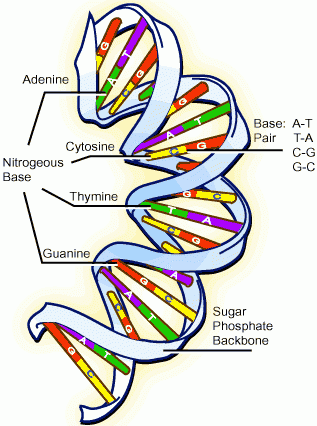
Structure of DNA
Structure of DNA

Information here at Evolution News. (H/T Apologetics 315)

Excerpt:

During the past decade, an increasing number of so-called “new atheists” have argued that human beings and the rest of nature are the products of chance and necessity rather than intelligent design. These “new atheists” typically base their ideas on Darwinian evolution, arguing that Darwin proved that nature is the product of a blind and unguided evolutionary process.

The message of the new atheists has spread far and wide. Just two years ago, thousands of students flocked to a lecture by leading new atheist Richard Dawkins at the University of Oklahoma. Dawkins famously contends that “Darwin made it possible to be an intellectually fulfilled atheist.” He received cheers and applause from the audience at OU.

The Darwinian view of nature has had a powerful impact on nearly every area of our culture. In public policy, it has encouraged the devaluation of human life. Among Christians, it has led some leading theologians and scientists to argue that God Himself doesn’t know how the history of life will turn out. And in science, Darwinian theory has encouraged the censorship of new scientific data as well as discrimination against scientists and students who think nature supplies evidence of intelligent design.

The good news is that the new atheists are wrong. Far from establishing a blind and purposeless universe, the findings of science increasingly provide powerful evidence that we live in a purpose-driven universe of incredible beauty and design.

On March 25-26 Oklahomans will have the chance to explore this evidence for themselves as four national experts come to Oklahoma to address the growing intersection between science and faith. Dr. Michael Behe, renowned biochemist and author of the books Darwin’s Black Box and The Edge of Evolution, will speak about the incredible design in the nanotechnology of the cell. Dr. Jay Richards, co-author of The Privileged Planet, will talk about how earth itself was intelligently designed for life and for scientific discovery. Dr. John West, author of Darwin Day in America and co-editor of The C.S. Lewis Readers’ Encyclopedia, will document the widespread impact of Darwin’s theory on society and faith. And lawyer Casey Luskin, co-author of Traipsing into Evolution: Intelligent Design and the Kitzmiller v. Dover Decision will outline positive steps you can take to stand for truth for you and your family.

Visit the event page here for more details.

If you don’t usually read Apologetics 315, you really need to check out the Friday round-up of all the week’s news.

Other conferences

Is there a smooth pathway from micro-evolution to macro-evolution?

From Luke Nix. (H/T Apologetics 315)

Excerpt:

Macroevolutionary changes are a lot of microevolutionary changes, but they are in a specific series that follow a specific pathway. The missing premise in this argument is that the pathway from ancestor to claimed offspring (many generations down the road) is clear of obstacles.

In his book, “The Edge of Evolution” Michael Behe shows that scientists have observed such an obstacle in the lab. The obstacle was not time, it is in the genetic pathway that must be traversed if macroevolutionary changes are to take place in reality. Since an obstacle has been observed, we now have a false premise in the argument. Since there is a false premise, the argument fails. There is a difference between micro- and macro-evolutionary changes. A lot of microevolutionary changes are necessary for macroevolution, but they are not sufficient. The other sufficient condition (a clear genetic pathway) still has yet to be met. Since both sufficient conditions for macroevolution have not been met, it has not been demonstrated. And since changes over time has been demonstrated, there is a need to distinguish between the two. To prevent confusion about what we know to be true and what we don’t, this distinction must be made.

There is only one way that this can be overcome by the naturalist: find a pathway that would be clear by default in nature. Notice that I have added one more piece to the missing premise above: “…clear by default in nature“. I have to add that last qualification because as scientists are looking for a way to overcome this obstacle, they are introducing their own intelligence- fine-tuning the process, then “allowing nature to take its course”. Their conclusion of naturalistic macroevolution will depend on a premise that is founded on intelligence. That would undermine the whole argument for naturalistic (macro)evolution.

This is one of the ways to show that evolution is true – by showing a pathway to macro-evolutionary change in the lab. If people expect me to believe in the grandiose claims of fully naturalistic evolution through a stepwise process, then why can’t I see the pathway myself? Why do I have to take it on faith?

Related posts

New peer-reviewed article argues for irreducible complexity in birds

From Evolution News.

Excerpt:

In a peer-reviewed paper titled “Evidence of Design in Bird Feathers and Avian Respiration,” in International Journal of Design & Nature and Ecodynamics, Leeds University professor Andy McIntosh argues that two systems vital to bird flight–feathers and the avian respiratory system–exhibit “irreducible complexity.” The paper describes these systems using the exact sort of definitions that Michael Behe uses to describe irreducible complexity:

[F]unctional systems, in order to operate as working machines, must have all the required parts in place in order to be effective. If one part is missing, then the whole system is useless. The inference of design is the most natural step when presented with evidence such as in this paper, that is evidence concerning avian feathers and respiration.

He further notes that many evolutionary authors “look for evidence that true feathers developed first in small non-flying dinosaurs before the advent of flight, possibly as a means of increasing insulation for the warm-blooded species that were emerging.” However, he finds that when it comes to fossil evidence for the evolution of feathers, “[n]one of the fossil evidence shows any evidence of such transitions.”

Regarding the avian respiratory system, McIntosh contends that a functional transition from a purported reptilian respiratory system to the avian design would lead to non-functional intermediate stages. He quotes John Ruben stating, “The earliest stages in the derivation of the avian abdominal air sac system from a diaphragm-ventilating ancestor would have necessitated selection for a diaphragmatic hernia in taxa transitional between theropods and birds. Such a debilitating condition would have immedi¬ately compromised the entire pulmonary ventilatory apparatus and seems unlikely to have been of any selective advantage.” With such unique constraints in mind, McIntosh argues that the “even if one does take the fossil evidence as the record of development, the evidence is in fact much more consistent with an ab initio design position – that the breathing mechanism of birds is in fact the product of intelligent design.”

Let’s take a step back and ask what counts as evidence for (macro) evolution for people who actually care about evidence.

Here’s what counts as evidence:

  1. A smooth sequence of fossils showing the gradual emergence of different body body features across a wide spectrum of body plans. Not just horses and whales, not just micro-evolution. Major changes in body structure, which properly dated fossils, from a wide range of body plans.
  2. A lab experiment that derives a new organ type or body plan from an unmodified organism, like the Lenski experiments tried to do on a smaller scale.
  3. A computer simulation that shows a string of mutations that occur on one organism that would give it a new feature or organ within a reasonable amount of time (less than 4 billion years). The mutations must be probable, and the organism must have improved functionality at each stage of its development. And a calculation would have to be done to show that each beneficial mutation would spread to the rest of the population and survive in the next generation, which is a separate question.

Do we have that evidence in the case of bird evolution (feathers and lungs)? Of course not.

Do we have that evidence in the case of evolution as a whole? Of course not.

People who embrace evolution embrace it on the basis of non-rational, non-evidential factors.