
Tag Archives: Mental Health

New study: brain of child neglected by mother is smaller and underdeveloped

Dina sent me this article from the UK Daily Mail.

Here is the scan:
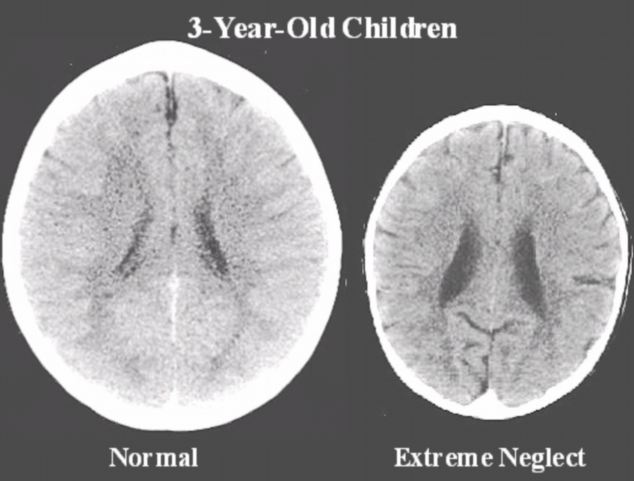
Brain scans of 3-year old children: normal vs neglected

Excerpt:

Both of these images are brain scans of a two three-year-old children, but the brain on the left is considerably larger, has fewer spots and less dark areas, compared to the one on the right.

According to neurologists this sizeable difference has one primary cause – the way each child was treated by their mothers.

The child with the larger and more fully developed brain was looked after by its mother – she was constantly responsive to her baby, reported The Sunday Telegraph.

But the child with the shrunken brain was the victim of severe neglect and abuse.

According to research reported by the newspaper, the brain on the right worryingly lacks some of the most fundamental areas present in the image on the left.

The consequences of these deficits are pronounced – the child on the left with the larger brain will be more intelligent and more likely to develop the social ability to empathise with others.

But in contrast, the child with the shrunken brain will be more likely to become addicted to drugs and involved in violent crimes, much more likely to be unemployed and to be dependent on state benefits.

The child is also more likely to develop mental and other serious health problems.

Professor Allan Schore, of UCLA, told The Sunday Telegraph that if a baby is not treated properly in the first two years of life, it can have a fundamental impact on development.

He pointed out that the genes for several aspects of brain function, including intelligence, cannot function.

[…]The study correlates with research released earlier this year that found that children who are given love and affection from their mothers early in life are smarter with a better ability to learn.

The study by child psychiatrists and neuroscientists at Washington University School of Medicine in St. Louis, found school-aged children whose mothers nurtured them early in life have brains with a larger hippocampus, a key structure important to learning, memory and response to stress.

The research was the first to show that changes in this critical region of children’s brain anatomy are linked to a mother’s nurturing, Neurosciencenews.com reports.

The research is published online in the Proceedings of the National Academy of Sciences Early Edition.

Lead author Joan L. Luby, MD, professor of child psychiatry, said the study reinforces how important nurturing parents are to a child’s development.

I have a very good feminist non-Christian friend who sometimes comments here. I once asked her about marriage and she said that her skills would be wasting on raising children. I explained to her my view that a mother needs to stay at home with the children, and that is more important work. I expect my future wife to read all kinds of books on child care and to give the child attention, nutrition, exercise and play so that the child will grow up to be an effective Christian. Maybe I need to be clear. I am not going to spend hundreds of thousands per child with just any woman. I need a woman who can produce influential and effective Christians who will engage in the public square. And we do not entrust that job to just anyone – we want a Michele Bachmann or a Jennifer Roback Morse. Professional women who are willing to be stay-at-home moms when it’s necessary to do that.

I expect the woman I marry (if I marry) to have a college degree, and preferably a graduate degree, and a couple of years of employment. Then she has to stay home and invest in those children through the first five years at least. After that she can stay home or work as much as she thinks is beneficial to the family goals of impacting the university, the church and the public square – as well as continuing to raise those children. It’s not a waste of her talent to make the next William Lane Craig, the next Marsha Blackburn, the next Doug Axe, or the next Edith Jones.

Read Theodore Dalrymple’s “Life at the Bottom” online for free

I want to recommend that you read a book that is available online for free.

The author  is a psychiatrist in a British hospital that deals with a lot of criminals and victims of crime. So he gets to see the worldview of the “underclass” up close, and to understand how the policies of the compassionate secular left are really working at the street level. The theme of the book is that the left advances policies in order to feel good about themselves, even though the policies actually hurt the poor and vulnerable far more than they help them. And the solution of the elites is more of the same.

The whole book is available ONLINE for free! From City Journal!

Table of Contents

The Knife Went In 5
Goodbye, Cruel World 15
Reader, She Married Him–Alas 26
Tough Love 36
It Hurts, Therefore I Am 48
Festivity, and Menace 58
We Don’t Want No Education 68
Uncouth Chic 78
The Heart of a Heartless World 89
There’s No Damned Merit in It 102
Choosing to Fail 114
Free to Choose 124
What Is Poverty? 134
Do Sties Make Pigs? 144
Lost in the Ghetto 155
And Dying Thus Around Us Every Day 167
The Rush from Judgment 181
What Causes Crime? 195
How Criminologists Foster Crime 208
Policemen in Wonderland 221
Zero Intolerance 233
Seeing Is Not Believing 244

Lots more essays are here, all from City Journal.

My favorite passage

The only bad thing about reading it online is that you miss one of the best quotes from the introduction. But I’ll type it out for you.

The disastrous pattern of human relationships that exists in the underclass is also becoming common higher up the social scale. With increasing frequency I am consulted by nurses, who for the most part come from and were themselves traditionally members of (at least after Florence Nightingale) the respectable lower middle class, who have illegitimate children by men who first abuse and then abandon them. This abuse and later abandonment is usually all too predictable from the man’s previous history and character; but the nurses who have been treated in this way say they refrained from making a judgment about him because it is wrong to make judgments. But if they do not make a judgment about the man with whom they are going to live and by whom they are going to have a child, about what are they ever going to make a judgment?

“It just didn’t work out,” they say, the “it” in question being the relationship that they conceive of having an existence independent of the two people who form it, and that exerts an influence on their on their lives rather like an astral projection. Life is fate.

This is something I run into myself. I think that young people today prefer moral relativists as mates, because they are afraid of being judged and rejected by people who are too serious about religion and morality. The problem is that if you choose someone who doesn’t take religion and morality seriously, then you can’t rely on them to behave morally and exercise spiritual leadership when raising children. And being sexually involved with someone who doesn’t take morality seriously causes a lot of damage.

An excerpt

Here’s one of my favorite passages from “Tough Love”, in which he describes how easily he can detect whether a particular man has violent tendencies on sight, whereas female victims of domestic violence – and even the hospital nurses – will not recognize the same signs.

All the more surprising is it to me, therefore, that the nurses perceive things differently. They do not see a man’s violence in his face, his gestures, his deportment, and his bodily adornments, even though they have the same experience of the patients as I. They hear the same stories, they see the same signs, but they do not make the same judgments. What’s more, they seem never to learn; for experience—like chance, in the famous dictum of Louis Pasteur—favors only the mind prepared. And when I guess at a glance that a man is an inveterate wife beater (I use the term “wife” loosely), they are appalled at the harshness of my judgment, even when it proves right once more.

This is not a matter of merely theoretical interest to the nurses, for many of them in their private lives have themselves been the compliant victims of violent men. For example, the lover of one of the senior nurses, an attractive and lively young woman, recently held her at gunpoint and threatened her with death, after having repeatedly blacked her eye during the previous months. I met him once when he came looking for her in the hospital: he was just the kind of ferocious young egotist to whom I would give a wide berth in the broadest daylight.

Why are the nurses so reluctant to come to the most inescapable of conclusions? Their training tells them, quite rightly, that it is their duty to care for everyone without regard for personal merit or deserts; but for them, there is no difference between suspending judgment for certain restricted purposes and making no judgment at all in any circumstances whatsoever. It is as if they were more afraid of passing an adverse verdict on someone than of getting a punch in the face—a likely enough consequence, incidentally, of their failure of discernment. Since it is scarcely possible to recognize a wife beater without inwardly condemning him, it is safer not to recognize him as one in the first place.

This failure of recognition is almost universal among my violently abused women patients, but its function for them is somewhat different from what it is for the nurses. The nurses need to retain a certain positive regard for their patients in order to do their job. But for the abused women, the failure to perceive in advance the violence of their chosen men serves to absolve them of all responsibility for whatever happens thereafter, allowing them to think of themselves as victims alone rather than the victims and accomplices they are. Moreover, it licenses them to obey their impulses and whims, allowing them to suppose that sexual attractiveness is the measure of all things and that prudence in the selection of a male companion is neither possible nor desirable.

Often, their imprudence would be laughable, were it not tragic: many times in my ward I’ve watched liaisons form between an abused female patient and an abusing male patient within half an hour of their striking up an acquaintance. By now, I can often predict the formation of such a liaison—and predict that it will as certainly end in violence as that the sun will rise tomorrow.

At first, of course, my female patients deny that the violence of their men was foreseeable. But when I ask them whether they think I would have recognized it in advance, the great majority—nine out of ten—reply, yes, of course. And when asked how they think I would have done so, they enumerate precisely the factors that would have led me to that conclusion. So their blindness is willful.

Go read the rest!

Book reviews

24-year old woman dies during abortion at Planned Parenthood clinic

Dina sent me this article from CBS News.

Excerpt:

The family of a Chicago woman who died after an abortion at Planned Parenthood says it wants answers about her death.

Tonya Reaves, 24, died late Friday night from a hemorrhage, with a cervical dilation and evacuation, as well as an intrauterine pregnancy as contributing causes, according to the medical examiner’s office.

She died after she’d had an abortion at Planned Parenthood at 18 S. Michigan Av, according to the medical examiner’s office.

Her death was ruled an accident, but the Reaves family wants to know more, especially Tonya’s twin sister Toni.

“We were born the same day. She was my other half,” Toni said.

Toni Reaves said the family is trying to get through this.

“It happened so fast. She was just fine one day and then the next day she was gone. We’re just trying to figure out what happened… what happened,” she said.

Toni Reaves said her sister was engaged to be married and had one son – Alvin – who just had his first birthday.

In a written statement, Planned Parenthood of Illinois CEO Carole Brite said “We were shocked and saddened upon learning of a tragic development at a nearby hospital. Our hearts go out to the loved ones of this patient.

It’s stories like this that confirm to me that sex is something that really should be reserved for marriage. It is just horribly unnatural to get pregnant and then kill your own child. That’s not what people do when they get pregnant. It’s remarkable to me that so many people could honestly believe that killing an innocent human being could somehow be a legitimate way to end a pregnancy.

And if the risk of dying  isn’t bad enough  – there are other complications, too.

Abortion isn’t safe for babies or mothers

Life News talks about a study from the British Journal of Psychiatry.

Excerpt:

A new study published in the British Journal of Psychiatry by leading American researcher Dr. Priscilla Coleman of Bowling Green State University finds women who have an abortion face almost double the risk of mental health problems as women who have their baby.

Consider this article in the UK Daily Mail, which talks about a study published the journal Cancer Epidemiology.

Excerpt:

An abortion can triple a woman’s risk of developing breast cancer in later life, researchers say. A team of scientists made the claim while carrying out research into how breastfeeding can protect women from developing the killer disease. While concluding that breastfeeding offered significant protection from cancer, they also noted that the highest reported risk factor in developing the disease was abortion. Other factors included the onset of the menopause and smoking. The findings, published in the journal Cancer Epidemiology, are the latest research to show a link between abortion and breast cancer. The research was carried out by scientists at the University of Colombo in Sri Lanka. It is the fourth epidemiological study to report such a link in the past 14 months, with research in China, Turkey and the U.S. showing similar conclusions.

[…]There has been an 80 per cent increase in the rate of breast cancer since 1971, when in the wake of the Abortion Act, the number of abortions rose from 18,000 to nearly 200,000 a year.

Note that there were only 300 people in the new study, so it is a small study. But it confirms the Turkey study that I blogged on before, and the China study that I blogged about before, and the American study that I blogged about before.

The right time to think about a pregnancy is before you have it. My advice is to avoid sex altogether before you are married. You’ll make a better match, and you’ll avoid causing grievous harm to others and to yourself. Don’t put yourself in a position where a decision like that has to be made. Draw the line before you have to draw the line.

Relate posts