Tag Archives: Medicaid

Can we fix poverty by redistributing money, or is the problem something else?

This little blurb by a doctor is making the rounds on Facebook:

Dear Mr. President:

During my shift in the Emergency Room last night, I had the pleasure of evaluating a patient whose smile revealed an expensive Shiny gold tooth, whose body was adorned with a wide assortment of elaborate and costly tattoos, who wore a very expensive brand of tennis shoes and who chatted on a new cellular telephone equipped with a popular R&B ringtone.

While glancing over her Patient chart, I happened to notice that her payer status was listed as “Medicaid”! During my examination of her, the patient informed me that she smokes more than one costly pack of cigarettes every day and somehow still has money to buy pretzels and beer.

And, you and our Congress expect me to pay for this woman’s health care?

I contend that our nation’s “health care crisis” is not the result of a shortage of quality hospitals, doctors or nurses. Rather, it is the result of a “crisis of culture”, a culture in which it is perfectly acceptable to spend money on luxuries and vices while refusing to take care of one’s self or, heaven forbid, purchase health insurance.

It is a culture based on the irresponsible credo that “I can do whatever I want to because someone else will always take care of me”. Once you fix this “culture crisis” that rewards irresponsibility and dependency, you’ll be amazed at how quickly our nation’s health care difficulties will disappear.

Respectfully,
STARNER JONES, MD

My first reaction to this thing was HOAX, but Snopes says it’s not a hoax. In fact, it was a letter published in a newspaper.

And there was even a follow-up letter by the same doctor:

I continue to receive numerous phone calls, letters, emails and face-to-face comments about my letter (“Why Pay For the Care of the Careless”) which appeared in your newspaper a few months ago.

Most people express highest approval for the opinion set forth. Indeed, the truth has an illuminating quality all its own.

However, a few have disagreed and all of them falsely assume that a person who holds the views which I espouse must have been raised in a privileged home. Nothing could be further from the truth.

I grew up in a lower middle class, single parent home in the rural hill country of Pontotoc, Mississippi. While attending public schools, I paid attention in class and did my homework. I ran with the right crowd and stayed out of trouble. My dedication in school resulted in a full-paid scholarship to the prestigious University of the South in Sewanee, TN. After college, I left to go to medical school with everything I owned in three bags. The rest is history.

Motivation, not entitlement, is the key to personal success and happiness in life.

The fact of the matter is that it is often people who have come out of poverty themselves who most disagree with those who want to keep people in poverty by subsidizing their poor decision making. I come from a background where my parents were immigrants and my father worked 3 jobs and my mother worked one. We saw people around us who were poor like us, making these irresponsible spending decisions and they were encouraged to persist in it by welfare programs like Medicaid. They were getting tens of thousands of dollars in benefits, and they would lose those benefits if they worked their way out of poverty.

The fact of the matter is that we are doing the able-bodied non-working poor no favors by allowing them to persist in the worldview of poverty, which is encourages dependence, recklessness, consumption and waste. Eventually, the state runs out of other people’s money to subsidize the able-bodied non-working poor in their perpetual childhood, and then where will they be? We are already $16.5 trillion in debt, and this level of welfare spending is not sustainable. Eventually, they will have to fend for themselves. We will be leaving them uneducated, with no resume, and a host of addictions ranging from the lottery and cigarettes up to drugs and alcohol.

Instead of fretting over feelings, and worrying about being judgmental, we should be fretting about enacting policies that promote marriage, school choice, entrepreneurship, work and so on. Strengthening the family and rewarding hard work. If the concern is that health care costs too much, there are ways to lower the cost of health care with market-oriented reforms. We should be studying the economics of health care and promoting consumer choice, ownership and competition among health care providers. Government is not the answer.

I really recommend that everyone read a book by British doctor Theodore Dalrymple, who gives a close-up view of what government programs actually do to the people we would all like to help. I have linked to all the chapters here, so there is no excuse not to read it and get informed. Then we can read other books on consumer-driven health care in order to learn about how to reduce the cost of health care without growing government.
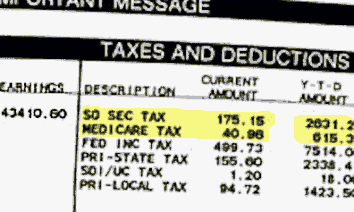
Young workers pay into entitlements that will be bankrupt when they retire

Payroll taxes for Social Security and Medicare

Doug Ross from Director Blue has a public service announcement for young people. Even if they are able to find jobs, they can look forward to paying a large chunk of their income to the government for retirement programs, Social Security and Medicare, that will be bankrupt by the time they are ready to retire.

Excerpt:

Ever seen these numbers on your pay stub? The numbers I’ve highlighted?

That money is being taken from you — or, more properly, it’s being stolen from you — to fund a myth. A mirage.

You’re never going to see a dime of that “Social Security Retirement Insurance” you’re paying for.

You’ll never a see a nickel of that “Medicare Health Care Insurance” either.

That money is being taken from your pay — your livelihood — to fund a system that will be bankrupt in less than a dozen years.

Oh, and it’s not me saying that: Medicare’s own actuary, Richard Foster, is. Social Security is in a similar situation, according to Treasury Secretary Timothy F. Geithner, who serves as the system’s senior trustee.

Suffice it to say that these systems will actually go broke far sooner than anyone’s really admitting because the economy remains poor and appears to be slowing down even further.

My public service message is this: this money is being taken from your pay in exchange for a promise that will be broken in just a few years. You’ll never see that money again. And it is the government — the government, not “the rich”, not the Koch brothers, not the oil companies — that is ripping you off.

It is the government, not corporations, spending untold billions on “green energy” scams like Solyndra. It is the government, not “the rich”, slathering EBT-welfare cards around like confetti. And it is the government, not “the Tea Party”, that is promoting illegal immigration and offering huge financial benefits to those in the country illegally. All with your money.

Medicare is the one that is really in trouble, as Forbes magazine explains:

The Trustees of the Medicare program have released their annual report on the solvency of the program. They calculate that the program is “expected to remain solvent until 2024, the same as last year’s estimate.” But what that headline obfuscates is that Obamacare’s tax increases and spending cuts are counted towards the program’s alleged “deficit-neutrality,” Medicare is to go bankrupt in 2016. And if you listen to Medicare’s own actuary, Richard Foster, the program’s bankruptcy could come even sooner than that.

See, the funny, funny thing about young people is that they are almost complete uninformed about basic economics. They don’t know where jobs come from. They don’t know where the money that the government spends come from. They don’t know how much the government spends. They don’t know about our debt-to-gdp ratio. Their view of economics is all determined by socialist public schools and socialist Hollywood and socialist mainstream media. It’s all emotional for them. They have feelings that the rich are greedy, and must be taxed, and that the government is Santa Claus, helping the poor with money from the rich. It’s the ultimate system of slavery, except the slaves want to be enslaved.

Who pays the bill for handing out $2.2 trillion of entitlements per year?

This article by Nicholas Eberstadt is the most popular article on the Wall Street Journal right now. I found it through Doug Ross’ links.

First, a quick review of the entitlement situation:

What is monumentally new about the American state today is the vast empire of entitlement payments that it protects, manages and finances. Within living memory, the federal government has become an entitlements machine. As a day-to-day operation, it devotes more attention and resources to the public transfer of money, goods and services to individual citizens than to any other objective, spending more than for all other ends combined.

The growth of entitlement payments over the past half-century has been breathtaking. In 1960, U.S. government transfers to individuals totaled about $24 billion in current dollars, according to the Bureau of Economic Analysis. By 2010 that total was almost 100 times as large. Even after adjusting for inflation and population growth, entitlement transfers to individuals have grown 727% over the past half-century, rising at an average rate of about 4% a year.

In 2010 alone, government at all levels oversaw a transfer of over $2.2 trillion in money, goods and services. The burden of these entitlements came to slightly more than $7,200 for every person in America. Scaled against a notional family of four, the average entitlements burden for that year alone approached $29,000.

Government’s job used to be to handle responsibilities like roads and bridges or like defending us at home and to defending our national interests abroad. But now government seems to be more interested in redistributing money taken from job creating businesses and their workers to those don’t create jobs and those who don’t work. What happens when you punish people for trying to succeed and reward people who don’t even try?

This is the result of wealth redistribution:

The proud self-reliance that struck Alexis de Tocqueville in his visit to the U.S. in the early 1830s extended to personal finances. The American “individualism” about which he wrote did not exclude social cooperation—the young nation was a hotbed of civic associations and voluntary organizations. But in an environment bursting with opportunity, American men and women viewed themselves as accountable for their own situation through their own achievements—a novel outlook at that time, markedly different from the prevailing attitudes of the Old World (or at least the Continent).

The corollaries of this American ethos were, on the one hand, an affinity for personal enterprise and industry and, on the other, a horror of dependency and contempt for anything that smacked of a mendicant mentality. Although many Americans in earlier times were poor, even people in fairly desperate circumstances were known to refuse help or handouts as an affront to their dignity and independence. People who subsisted on public resources were known as “paupers,” and provision for them was a local undertaking. Neither beneficiaries nor recipients held the condition of pauperism in high regard.

Overcoming America’s historic cultural resistance to government entitlements has been a long and formidable endeavor. But as we know today, this resistance did not ultimately prove an insurmountable obstacle to establishing mass public entitlements and normalizing the entitlement lifestyle. The U.S. is now on the verge of a symbolic threshold: the point at which more than half of all American households receive and accept transfer benefits from the government. From cradle to grave, a treasure chest of government-supplied benefits is there for the taking for every American citizen—and exercising one’s legal rights to these many blandishments is now part of the American way of life.

As Americans opt to reward themselves ever more lavishly with entitlement benefits, the question of how to pay for these government transfers inescapably comes to the fore. Citizens have become ever more broad-minded about the propriety of tapping new sources of finance for supporting their appetite for more entitlements. The taker mentality has thus ineluctably gravitated toward taking from a pool of citizens who can offer no resistance to such schemes: the unborn descendants of today’s entitlement-seeking population.

We used to want to earn our own success. Now we want to live on the backs of children not yet born. Slavery is a horrible crime, no matter where it is practiced. Isn’t it a kind of slavery to live it up now and then pass the bill for it on to generations not even born yet? It strikes me as a kind of slavery – taking an unfair portion of the income of others so that we can live at a higher standard than what we can afford through our own choices and labor.