Tag Archives: Marxism

Has increased education spending in schools improved student performance in test scores?

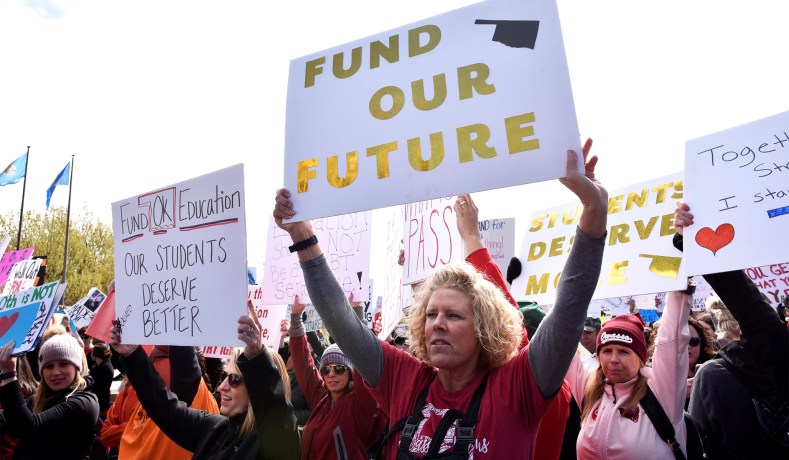
When I want a raise, I work harder, but these teachers hold up signs
When I want a raise, I work harder, but lazy teachers quit working to hold signs

One of my friends has been having a debate with one of his former teachers about whether spending more money on government-run education improves tests scores. He tried posting some evidence, but she just dismissed that by claiming:

  1. If we hadn’t spent more money, then the student test scores would have gone down instead of staying the same.
  2. Most of the money that government spends on education goes to vouchers and private schools, not public schools
  3. Economists at prestigious think tanks like that Cato Institute, the Heritage Foundation, and the American Enterprise Institute cannot be trusted to accurately cite the Bureau of Labor Statistics and the National Center for Education Statistics because of the Koch Brothers
  4. You can’t compare the test scores of American students with the test scores of Asian students who outperform them, (for less government spending), because math is different in Asia compared to America

Let’s look at some data and see if her arguments are correct.

Does more spending mean higher student performance?

National Review reported on data collected in the National Assessment of Educational Progress, which spans all 50 states.

Look:

Comparing educational achievement with per-pupil spending among states also calls into question the value of increasing expenditures. While high-spending Massachusetts had the nation’s highest proficiency scores on the National Assessment of Educational Progress, low-spending Idaho did very well, too. South Dakota ranks 42nd in per-pupil expenditures but eighth in math performance and ninth in reading. The District of Columbia, meanwhile, with the nation’s highest per-pupil expenditures ($15,511 in 2007), scores dead last in achievement.

The student test scores are dead last, but National Review notes that “according to the National Center for Education Statistics, Washington, D.C. was spending an average of $27,460 per pupil in 2014, the most recent year for which data are available.” They are spending the most per-pupil, but their test scores are dead last.

CBS News reported on another recent study confirming this:

Decades of increased taxpayer spending per student in U.S. public schools has not improved student or school outcomes from that education, and a new study finds that throwing money at the system is simply not tied to academic improvements.

The study from the CATO Institute shows that American student performance has remained poor, and has actually declined in mathematics and verbal skills, despite per-student spending tripling nationwide over the same 40-year period.

“The takeaway from this study is that what we’ve done over the past 40 years hasn’t worked,” Andrew Coulson, director of the Center For Educational Freedom at the CATO Institute, told Watchdog.org. “The average performance change nationwide has declined 3 percent in mathematical and verbal skills. Moreover, there’s been no relationship, effectively, between spending and academic outcomes.”

The study, “State Education Trends: Academic Performance and Spending over the Past 40 Years,” analyzed how billions of increased taxpayer dollars, combined with the number of school employees nearly doubling since 1970, to produce stagnant or declining academic results.

“The performance of 17-year-olds has been essentially stagnant across all subjects despite a near tripling of the inflation-adjusted cost of putting a child through the K-12 system,” writes Coulson.

Where did the numbers come from? The Koch Brothers? No:

Data from the U.S. Department of Education incorporating public school costs, number of employees, student enrollment and SAT scores was analyzed to explore the disparity between increased spending and decreasing or stagnant academic results.

Well, at least government-run monopoly schools outperform private private schools, right? No:

[…][P]rivate schools, where students excel over public school peers, …manage to operate at budgets about 34 percent lower than taxpayer-funded schools, US Finance Post reports.

Public schools spend, on average, $11,000 per student, per year.

Coulson noted an Arizona study he conducted which showed that the average per-pupil spending at private schools was only about 66 percent of the cost of public schools.

A more recent state-specific study from 2016 found that this is still the case.

This problem gets even worse when you look at test scores from other countries, where even less is spent on education.

As the Washington Post reported at the end of 2016:

When it comes to math, U.S. high school students are falling further behind their international counterparts, according to results released Tuesday of an ongoing study that compares academic achievement in 73 countries. And the news is not much better in reading and science literacy, where U.S. high schoolers have not gained any ground and continue to trail students in a slew of developed countries around the globe.

In the latest Program for International Student Assessment (PISA) measuring math literacy in 2015, U.S. students ranked 40th in the world. The U.S. average math score of 470 represents the second decline in the past two assessments — down from 482 in 2012 and 488 in 2009. The U.S. score in 2015 was 23 points lower than the average of all of the nations taking part in the survey.

More money is being spent, but the scores are DECREASING.

Now, why is it that increased government spending in the public school monopoly doesn’t improve student performance? Well, one reason is that very little of the money makes it to the classroom.

Where does all the money go?

Let’s look at four places where the money spent on the government-run public school monopoly ends up.

Administration

First, a lot of it gets paid to administrations who implement politically correct programs designed to turn the impressionable young people into little secular socialists.

Here’s a helpful chart from the American Enterprise Institute:
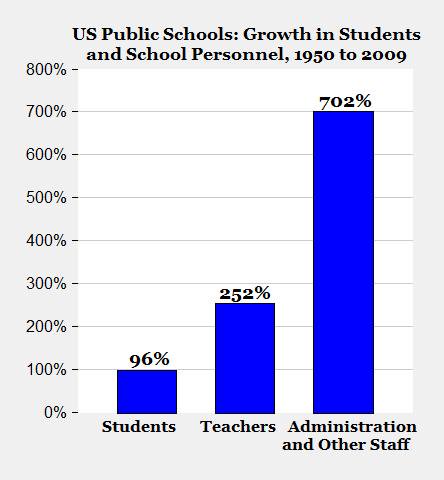
Where does taxpayer money spent on the public school monopoly go?

I guess if a school wants to make things like Planned Parenthood sex education and LGBT indoctrination into priorities, then they would need more administrators.

Pensions

Second, education employees get enormous pensions, which are paid by taxpayers and negotiated by their unions. You would never see pensions this large in the private sector.

This is from the leftist Brookings Institute, from 2014:

This figure shows we now spend nearly $1,100 per student on retirement benefits. The average public school student teacher ratio is 16 to 1. So we are spending about $17,000 per year per teacher in pension contributions.

[…]The National Council on Teacher Quality writes,

In 2014 teacher pension systems had a total of a half trillion dollars in unfunded liabilities—a debt load that climbed more than $100 billion in just the last two years. Across the states, an average of 70 cents of every dollar contributed to state teacher pension systems goes toward paying off the ever-increasing pension debt, not to future teacher benefits (p. iii).

While we are spending a huge amount to fund teacher pensions, most of that spending doesn’t go to attracting the best teachers. It’s paying off past debts.

We can’t hire good teachers, because all the education spending of today is paying for the gold-plated pensions of yesterday.

That was 2014. The numbers are even worse today. Teachers contribute very, very little to their pensions, but the benefits are enormous compared to what the private sector taxpayers get in Social Security. (Which is going to be bankrupt by 2034, as reported by the far-left PBS)

Teacher training

Third, a lot of it is spent on teacher training, because apparently teaching multiplication, Shakespeare or geography changes every year, so the teachers need tens of thousands of dollars in annual training.

The Washington Post reports on a recent study:

A new study of 10,000 teachers found that professional development — the teacher workshops and training that cost taxpayers billions of dollars each year — is largely a waste.

The study released Tuesday by TNTP, a nonprofit organization, found no evidence that any particular approach or amount of professional development consistently helps teachers improve in the classroom.

[…]The school districts that participated in the study spent an average of $18,000 per teacher annually on professional development. Based on that figure, TNTP estimates that the 50 largest school districts spend an estimated $8 billion on teacher development annually. That is far larger than previous estimates.

And teachers spend a good deal of time in training, the study found. The 10,000 teachers surveyed were in training an average of 19 school days a year, or almost 10 percent of a typical school year, according to TNTP.

Maybe if more of the money spent on education were spent directly on hiring teachers, then we would see an improvement. Unfortunately, a lot of the money meant for teachers goes to the teacher unions. How do they spend that money?

Political Contributions

Finally, this is from OpenSecrets.org, concerning political contributions made in the most recent election cycle:

Top Political Contributors in 2016 election cycle

The two largest teacher unions came in at #9 and #11. Most of their donations go to Democrat Party. Democrats believe (against the evidence) that spending more money in the government-run public school monopoly will improve student performance on tests.

So, what’s the solution?

The solution is that we abolish the federal Department of Education, which has done nothing to improve the quality of education for students. We need to push the education of children back down to the state and local levels. We need to empower parents to choose the schools that work best for their children by giving parents vouchers. We need to increase tax-free education savings accounts to help parents with school expenses. We should also give free college tuition to homeschooled students who are admitted to STEM programs at any college or university. We can take the money from the pensions of the union administrators, after we abolish ever single public sector teacher union in the country, and seize all their assets and pensions. If that’s not enough money, then we can seize all the pensions of Department of Education employees – a just punishment for their failure to produce results while still taking taxpayer money.

Finally, we should allow people who already have private sector experience doing things like STEM to become teachers. Let’s face it: the departments that grant Education degrees have the lowest entrance requirements, and produce the least competent adults. People with years of private sector work experience teach better than people with Education degrees. Let’s open up teaching to people who have experience in the private sector doing software engineering, statistics, nursing, etc. and then we’ll have qualified teachers.

Mainstream media celebrates mass starvation and political prisons in North Korea

CNN raves about North Korea's brutal regime, yay communism!
CNN raves about North Korea’s brutal regime: Pretty! Glamorous! Stylish!

I’m sure everyone has heard about the mainstream media’s embrace of North Korea’s charming smiles at the Olympics. I like to listen to the Ben Shapiro podcast, the Andrew Klavan podcast, and the Daily Signal podcast and they ALL talked about it. But I wanted to tell people the truth, and remind people that this isn’t the first time that mainstream media types have covered up atrocities in order to make their heroes look good.

The Daily Signal posted celebratory tweets from seven different mainstream media sources: CNN, ThinkProgress, The New York Times, Politico, Reuters, and a bureau chief of the Washington Post.

The New York Times tweeted: “Without a word, only flashing smiles, Kim Jong-un’s sister outflanked Vice President Mike Pence in diplomacy” and Reuters tweeted: “North Korea judged winner of diplomatic gold at Olympics”.

Before we go any further, let’s learn a bit about starvation in North Korea from a radically leftist source: Newsweek.

Excerpt:

Roughly 18 million people in North Korea are not getting enough food, a United Nations report released this week found. That means 70 percent of the isolated nation’s population relies on food assistance to get by, including 1.3 million children under the age of five.

“Amidst political tensions, an estimated 18 million people across DPRK [North Korea] continue to suffer from food insecurity and undernutrition, as well as a lack of access to basic services,” the U.N. report said. “Furthermore, 10.5 million people, or 41 percent of the total population, are undernourished.”

North Koreans also need basic healthcare and sanitation, the U.N. report determined. Without safe water or better sanitation and hygiene, diarrhea and pneumonia have become the leading cause of death for children under five, the report said.

The radically-leftist NBC News reports on the concentration camps:

Atrocities committed by North Korea against its own people are “strikingly similar” to those perpetrated by the Nazis during World War II, the head of a United Nations panel said Monday after publishing an unprecedented report.

The year-long investigation called for urgent action by the international community to stop allleged crimes against humanity committed by Kim Jong Un and his regime.

[…]But the report also shed new light on the country’s darkest side – its labor camps.

As many as 120,000 North Koreans are thought to be imprisoned across the country, many of them in four large camps. This number may have shrunk in recent years, according to the report, but only because many of the inmates have been murdered or starved to death.

People and their families are held for arbitrary crimes such as “gossiping” about the state.

[…]The U.N. report contains more of this harrowing testimony, which it says is tantamount to “extermination, murder, enslavement, torture, imprisonment, rape, forced abortions and other sexual violence.” It compared conditions to camps run by the Nazis during World War II and gulags set up in Soviet Russia.

This is what the mainstream media declined to mention while they were praising a woman smiling and Mike Pence frowning as some great evidence of moral equivalence between North Korea and the United States of America.

Atheism in action: a satellite photo of North Korea at night
One big concentration camp: a satellite photo of North Korea at night

This is not the first time that the mainstream media has covered up for forced starvation, imprisonment and mass murders.

Here’s another case written about in The Weekly Standard.

Excerpt:

AT LONG LAST a Pulitzer Prize committee is looking into the possibility that the Pulitzer awarded to Walter Duranty, the New York Times Moscow correspondent whose dispatches covered up Stalin’s infamies, might be revoked.In order to assist in their researches, I am downloading here some of the lies contained in those dispatches, lies which the New York Times has never repudiated with the same splash as it accorded Jayson Blair’s comparatively trivial lies:

“There is no famine or actual starvation nor is there likely to be.”
–New York Times, Nov. 15, 1931, page 1

“Any report of a famine in Russia is today an exaggeration or malignant propaganda.”
–New York Times, August 23, 1933

“Enemies and foreign critics can say what they please. Weaklings and despondents at home may groan under the burden, but the youth and strength of the Russian people is essentially at one with the Kremlin’s program, believes it worthwhile and supports it, however hard be the sledding.”
–New York Times, December 9, 1932, page 6

“You can’t make an omelet without breaking eggs.”
–New York Times, May 14, 1933, page 18

“There is no actual starvation or deaths from starvation but there is widespread mortality from diseases due to malnutrition.”
–New York Times, March 31, 1933, page 13

I would like to add another Duranty quote, not in his dispatches, which is reported in a memoir by Zara Witkin, a Los Angeles architect, who lived in the Soviet Union during the 1930s. (“An American Engineer in Stalin’s Russia: The Memoirs of Zara Witkin, 1932-1934,” University of California Press ). The memoirist describes an evening during which the Moscow correspondents were discussing how to get out the story about the Stalin-made Russian famine. To get around the censorship, the UP’s Eugene Lyons was telephoning the dire news of the famine to his New York office but the was ordered to stop because it was antagonizing the Kremlin. Ralph Barnes, the New York Herald Tribune reporter, turned to Duranty and asked him what he was going to write. Duranty replied:

Nothing. What are a few million dead Russians in a situation like this? Quite unimportant. This is just an incident in the sweeping historical changes here. I think the entire matter is exaggerated.

And this was at a time when peasants in Ukraine were dying of starvation at the rate of 25,000 a day.

And that is how mainstream media journalists think about the people who are harmed by their leftist policies – whether it be the unborn, children raised without one or more biological parents, families who cannot get make ends meet, innocent people murdered by terrorists and other criminals, etc. Kill them all, as long as big government is in control, making everyone “equal”. Journalists want to call evil “good”, and good “evil”, until the people are so confused that they lose the ability to judge the crimes of Marxist regimes.

You can get the facts about the forced starvation of Ukrainian civilians – in this article from the center-left The Atlantic, written by historian Anne Applebaum.

Here’s one quote:

In the years 1932 and 1933, a catastrophic famine swept across the Soviet Union. It began in the chaos of collectivization, when millions of peasants were forced off their land and made to join state farms. It was then exacerbated, in the autumn of 1932, when the Soviet Politburo, the elite leadership of the Soviet Communist Party, took a series of decisions that deepened the famine in the Ukrainian countryside. Despite the shortages, the state demanded not just grain, but all available food. At the height of the crisis, organized teams of policemen and local Party activists, motivated by hunger, fear, and a decade of hateful propaganda, entered peasant households and took everything edible: potatoes, beets, squash, beans, peas, and farm animals. At the same time, a cordon was drawn around the Ukrainian republic to prevent escape. The result was a catastrophe: At least 5 million people perished of hunger all across the Soviet Union. Among them were nearly 4 million Ukrainians who died not because of neglect or crop failure, but because they had been deliberately deprived of food.

Neither the Ukrainian famine nor the broader Soviet famine were ever officially recognized by the USSR. Inside the country the famine was never mentioned. All discussion was actively repressed; statistics were altered to hide it. The terror was so overwhelming that the silence was complete. Outside the country, however, the cover-up required different, subtler tactics. These are beautifully illustrated by the parallel stories of Walter Duranty and Gareth Jones.

Collectivization: that’s what the mainstream media loves. Everyone the same and equal, and no differences. Cogs in a machine, with no dissent from our watchful government above. When you look at North Korea, or Cuba or Venezuela, you’re looking at the Marxist atheist ideal. Free people are so unpredictable, they say, that we need a big government if we want to avoid catastrophes like global warming and overpopulation. This is how leftists think – or should I say, this is how leftists feel. They don’t think.

Leftism starts with a feeling of superiority over one’s neighbor, and the desire to be delivered from these inferior people by an infallible government. Those stupid neighbors with their religion and their values – they are wasting food and electricity on their large families. They should be thrown into a concentration camp, so that they don’t teach their children their mistaken values, e.g. – chastity, sobriety and natural marriage. Who can stop them from having views different from mine? The government can, if we enlightened people vote to make it big enough to control them.

It’s very important for people to understand what it is that they are consuming when they turn on television shows on CNN, or pick up a New York Times newspaper.

How did Obama’s plan to let government run student loans work out?

Obama nationalized student loan administration in 2010

I’m a free-market capitalist, so I believe that economic decision-making is best done by the people it concerns, not the people in government. If it is a decision that affects the family, let the family decide. If it’s a decision that affects the business, let the business owner decide. Obama has a different view – he thinks that government should make all of the decisions, even though government earns none of the money.

Here is an article in Investor’s Business Daily about his policy of letting the government take over student loan decision-making.

Excerpt:

A report from the Department of Education notes that the net cost of the federal government’s direct loan program is quickly heading into the red. This program, mind you, was supposed to be a moneymaker for the government, as students paid back federal loans with interest.

But as it turns out, borrowers have been flocking toward various loan forgiveness programs, by which the government will lose money, erasing gains from other loans. The report shows that the direct loan program went from a $25 billion surplus in 2012 to less than $5 billion by 2015.

A separate report says that this program ran a $36 billion deficit last year, up from $8.4 billion in 2016.

This is not how this federal loan program was supposed to work when President Obama launched it eight years ago.

In 2010, President Obama effectively nationalized student lending by cutting banks — which had been offering government-backed loans to students — out of the equation and having the government make the loans itself.

“By cutting out the middleman, we’ll save the American taxpayers $68 billion in the coming years,” Obama said when he signed this change into law. “That’s real money.”

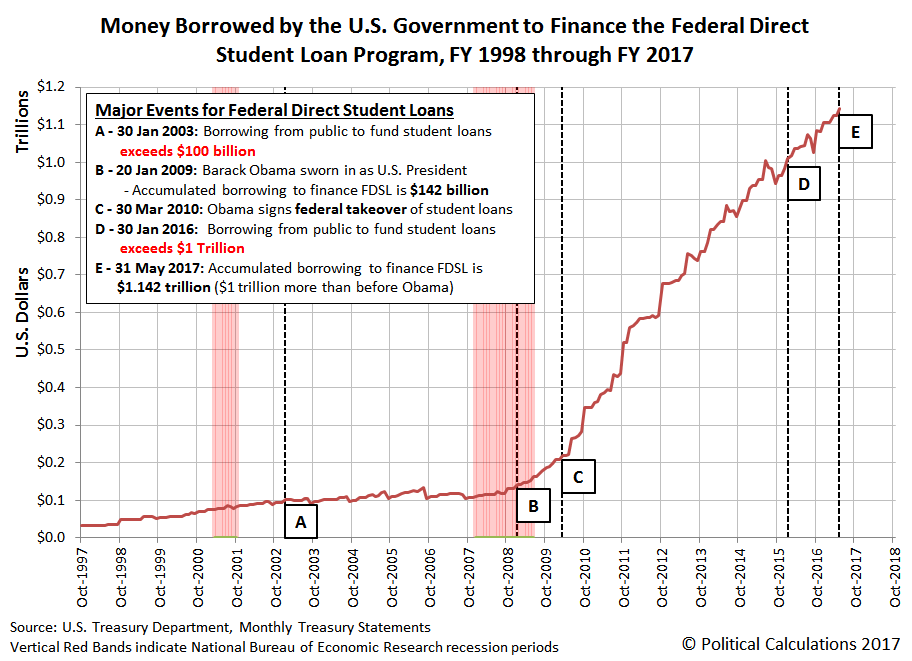
As a result, federal student loan debt shot up from $154.9 billion in 2009 to $1.1 trillion by the end of 2017.

As everyone knows, under Obama’s big government leadership, the national debt skyrocketed from $10 trillion to $20 trillion in only 8 years. Obama ran up as much debt in his 8 years as ALL the other presidents, combined. Why? It’s simple. Because government isn’t as careful with other people’s money as people are careful with their own money. People make better decisions than government because they care about the money more – they earned it. The right people to solve an economic problem are the people in the families, and the people at the local bank branches nearby. When government takes over economic decision-making, they use other people’s money to buy the votes of people who make poor decisions.

We shouldn’t be allowing students to take 4-year vacations at taxpayer expense, so that they can learn English or Women’s Studies and then stick taxpayers with the bill. Some of those taxpayers had to study hard things like engineering and pay their own way. Some of those taxpayers had to get jobs in the trades as electricians and plumbers to pay for the bad decisions of these spoiled brats. Student loan administration should not be something for big government to control. When government decides who gets loans, students feel no pressure to study subjects and get credentials that will allow them to pay back what they borrowed. I want the banks to make the lending decisions and loan out their own money, so that they can deny people who are studying nonsense that won’t get a return.

That’s why we should never have elected a big-government liberal to be president. They make a lot of promises about how great they are with money, but it never works out. Big government is never the answer to problems that are outside of what the Constitution describes as the boundaries of government.

(Image Source)