Tag Archives: Marriage

Fertility and pregnancy: how long can a woman wait before having a baby?

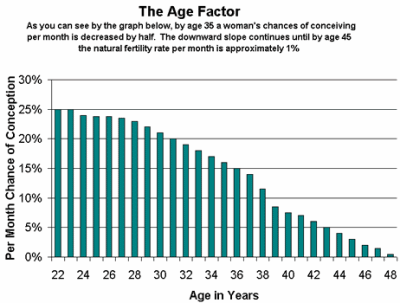
Woman's fertility by age
Woman’s fertility by age

This is from Aeon magazine. The author writes for several ultra-leftist publications, including the New York Times, the Los Angeles Times, Salon and Slate.

She writes:

Many studies show that women are not only woefully ignorant when it comes to fertility, conception and the efficacy of assisted reproductive technologies (ART) – but they overestimate their knowledge about the subject. For instance, a 2011 study in Fertility and Sterility surveyed 3,345 childless women in Canada between the ages of 20 and 50; despite the fact that the women initially assessed their own fertility knowledge as high, the researchers found only half of them answered six of the 16 questions correctly. 72.9 per cent of women thought that: ‘For women over 30, overall health and fitness level is a better indicator of fertility than age.’ (False.) And 90.9 per cent felt that: ‘Prior to menopause, assisted reproductive technologies (such as IVF) can help most women to have a baby using their own eggs.’ (Also false.) Many falsely believed that by not smoking and not being obese they could improve their fertility, rather than the fact that those factors simply negatively affect fertility.

Fertility fog infects cultures and nations worldwide, even those that place more of a premium on reproduction than we do in the West. A global study published for World Fertility Awareness Month in 2006 surveyed 17,500 people (most of childbearing age) from 10 countries in Europe, Africa, the Middle East and South America, revealing very poor knowledge about fertility and the biology of reproduction. Take Israel, a country that puts such a premium on children that they offer free IVF to citizens up to age 45 for their first two children. According to a 2011 study in Human Reproduction, which surveyed 410 undergraduate students, most overestimated a women’s chances of spontaneous pregnancy in all age groups, but particularly after receiving IVF beyond age 40. Only 11 per cent of the students knew that genetic motherhood is unlikely to be achieved from the mid-40s onward, unless using oocytes or egg cells frozen in advance. ‘This can be explained by technological “hype” and favourable media coverage of very late pregnancies,’ the authors concluded.

[…]For a woman over 42, there’s only a 3.9 per cent chance that a live birth will result from an IVF cycle using her own, fresh eggs, according to the American Society of Reproductive Medicine (ASRM). A woman over 44 has just a 1.8 per cent chance of a live birth under the same scenario, according to the US National Center for Chronic Disease Prevention and Health Promotion. Women using fresh donor eggs have about a 56.6 per cent chance of success per round for all ages.

Indeed, according to research from the Fertility Authority in New York, 51 per cent of women aged between 35 and 40 wait a year or more before consulting a specialist, in hopes of conceiving naturally first. ‘It’s ironic, considering that the wait of two years will coincide with diminished fertility,’ the group says.

[…]‘No one talks about fertility,’ said [reproductive endocrinologist Janelle Luk, medical director of Neway Fertility in New York City], who does not believe women are really open to hearing about it. ‘I don’t think women know that there’s a limit: the message is equal, equal, equal. Women say: “We want to go to college, we want to work on our careers, we want to be equal to men.” But our biological clock is not.’

[…]Another way women might even out the fertility playing field is by focussing on the so-called male biological clock. But is there one? Although there have been recent news stories about how advanced age in men (over 40 or 50) increases time to conception and the incidence of autism and schizophrenia, the absolute risk is negligible. ‘When you look at the numbers, you have to separate what the absolute risk and the increased risk is,’ said Natan Bar-Chama, director of male reproductive medicine and surgery at Mount Sinai Medical Center in New York. ‘The absolute risk is still really very small.’

I think if I ever have a daughter, I will be sure to urge her to be skeptical of her emotions and intuitions, to learn how to assess probabilities, to disregard exceptional cases when making plans, to resist the feminism in the culture, to get wisdom from older married women with children instead of young unmarried childless women, to accept that she is not so special that laws and rules don’t apply to her, and to accept that the universe is not malleable according to her needs and desires. I hope my wife will see the value of reining our daughter in before the catastrophes like infertility happen.

Where does the organized opposition to educating young women about fertility facts come from?

‘We feel that women should be able to talk to their ob/gyn about fertility,’ said Sandra Carson, ACOG’s vice president for education. ‘We certainly want to remind women gently that, as they get older, fertility is compromised, but we don’t want to do it in such a way that they feel that it might interfere with their career plans or make them nervous about losing their fertility.’ In other words, there are no guidelines for talking to a woman about her fertility unless she herself brings it up.

All this talk of ‘gentle’ reminders and ‘appropriate’ counselling has a history – a political one. Back in 2001, the ASRM devoted a six-figure sum to a fertility awareness campaign, whose goal was to show the effects of age, obesity, smoking and sexually transmitted diseases on fertility. Surprisingly, the US National Organization for Women (NOW) came out against it. ‘Certainly women are well aware of the so-called biological clock. And I don’t think that we need any more pressure to have kids,’ said Kim Gandy, then president of NOW. In a 2002 op-ed in USA Today, she wrote that NOW ‘commended’ doctors for ‘attempting’ to educate women about their health, but thought they were going about it the wrong way by making women feel ‘anxious about their bodies and guilty about their choices’.

We don’t want women to feel bad, so it’s best to let them follow their hearts. That view is not helpful to women! If we want to help women, we must tell them the truth, and take the consequences.

All this talk about fertility could be accompanied by a discussion of the hard fact that a woman’s attractiveness will decline as she ages. This is a troubling lesson that countless women have had to learn the hard way. When you are young, you stand a much better chance of finding a successful male with good values and who is willing to commit to marriage and parenting. Many women will testify that, as you get older, this convenience deteriorates quickly. The good men will be claimed by the responsible women who don’t waste their youthful years seeking thrills.  Men who are contemplating marriage value a woman’s appearance, fertility, vulnerability and submissiveness to his leadership. Women need to be careful not to embark on a course that will reduce their ability in any of these areas that are important to men, e.g. – careerism, premarital promiscuity, etc.

Related posts

New study: father absence is a strong predictor of depression for young girls

Does government provide incentives for people to get married?
If you want your children to grow up happy, commit yourself to marriage

The study is here on PubMed.

And here’s an article about it posted at The Family in America, a public policy journal.

Excerpt:

Who has benefitted from the war radical feminists have waged against marriage? Certainly not young women. A very large new Canadian study concludes that one of the strongest predictors of depression among young women is the loss of a biological parent. And it is the easy divorces that feminists have pushed for that have typically occasioned such a loss.

Conducted by researchers at the University of Northern British Columbia, this new study isolates the factors predicting depression among Canadians ages 16 to 20. The researchers limn these factors by scrutinizing data collected between 1994 and 2007 from a nationally representative sample of 1,715 individuals tracked during this 13-year period.

Predictably, the researchers adduce evidence that such things as parental rejection and childhood anxiety predict depression between a young person’s 16th birthday and his or her 21st.  But gender makes a difference: consistent with other inquiries, this study finds that “girls reported more [depression] than boys.” However, not all girls are equally vulnerable: the data reveal that “The loss of a parent by the ages of 4 to 8 years predicted depression at ages 16 to 20 years for girls [p = 0.008] but not for boys.”

Of course, a girl can lose a parent through death. But the researchers realize that such tragedy occurs far less often than the trauma of parental divorce. Consequently, they know how to interpret parental loss as a predictor of girls’ depression at the threshold between adolescence and young adulthood. This is a finding, they realize, that fits hand-in-glove with the results of a 2008 study establishing that “the effects of parental divorce . . . differ between genders in respect to the development of depression with risk increasing for girls but not for boys.” They further realize that their study harmonizes with a 1997 study concluding that “young women whose parents had divorced reported higher levels of depression compared to young men from divorced families.”

Given the paralyzing effects of depression as “a leading cause of disability worldwide,” the researchers hope their study will lead to “targeted, specific and personalized intervention” that will curb such depression. More particularly, they hope that “girls may benefit from interventions designed to address parental loss due to death, divorce, and other causes.”

But since nothing takes a parent away from a daughter more often in the 21st century than does parental divorce, it is very clear that the kind of intervention girls most need is the kind that will keep their parents together. Just how quickly that intervention comes will depend heavily on how much reality can puncture feminist ideology.

This study makes me think of the problems that we have these days getting married and staying married. I think that there are three kinds of challenges. The first challenge is ideology, e.g. – radical feminism. The second challenge is cultural, e.g. – the hook-up culture on campus. The third challenge is political, e.g. – no-fault divorce. It seems likes the odds are really stacked against marriage-minded people.

Most people like the idea of having someone of the opposite sex commit to them for life. I write a lot about what people should be looking for in a mate. Factors that predict a person’s ability to commit, what their worldview should be, etc. But we also have to remember that we have to be turning ourselves into people who are suited to a lifetime commitment, involving self-denial and self-sacrifice.

A lot of people seem to think that if they meet the right person – the person who makes them feel good – then they won’t have to do any self-denying or any self-sacrificing. But that’s not true. Feelings change. It’s possible for two serial killers to feel good about each other, and to having things in common, but marriage isn’t about whether you “like” the other person and whether they “like” you. Marriage works when you have two people who are comfortable making commitments. Two people who are comfortable with responsibilities, expectations and obligations.

The point I am trying to make here is that not only must we be looking for someone who can be faithful, loyal, commitment through thick and thin, but we must also prepare to become a person like that. If we make choices for our own happiness every day – fun and thrills – then we are not making ourselves into the kind of people who take responsibility and make commitments.

The strange thing is that those who choose fun over and over and over again seem to make the worst decisions when it comes to choosing mates. Of course it’s easier to pick someone who is not too moral and not too religious. Then they won’t be able to judge you. They’ll just let you do whatever you want and never shame you for anything.

The problem is that marriage works best when two people are comfortable with moral obligations to others. You have to be someone who is comfortable with obligations over the long term. And you have to choose someone who has a strong sense of morality, otherwise they won’t honor their moral obligations to others. Commitment means doing what is right regardless of how you feel about it, It means giving up on the pursuit of fun, in order to build something strong that will take you into your old age.

Pre-marriage counseling is good, and pre-engagement counseling is even better


Painting: "Courtship", by Edmund Blair Leighton (1888)
Painting: “Courtship”, by Edmund Blair Leighton (1888)

OK, I was chatting with my friend McKenzie who recently got married to an amazing Christian man. She and I are both big believers in asking questions during the courtship. She sent me this article from Verily magazine that has a nice story, and lots of questions.

The article starts like this:

When you know, you know. And with Zach, I knew. Just eleven months into dating, I knew this was the man I wanted to marry. Zach felt the same about me. But instead of putting a ring on it then and there, we decided to seek out a pastor for pre-engagement counseling. You read it right, pre-engagement.

It might sound intense or premature at first, but I am here to tell you that it has been an awesome experience. Sure, the deal isn’t sealed until you say “I do,” but engagement is a huge decision, too. I don’t want to get engaged and then deal with our baggage. When Zach proposes marriage to me, I want my “Yes!” to be with eyes wide open, and pre-engagement counseling has really helped us move in that direction.

What has been so great about pre-marriage preparation? It’s a structured way for us to explore the most important ideas that will be the foundation of our marriage. We have a session once every two weeks for about an hour and a half, during which we’re working through the book Preparing for Marriage by Dennis Rainey with our pastor through homework assignments and discussing together. Of course, pre-marriage counseling can take many forms, but no matter where you might go to get pre-marriage counseling, there are certain things I think any couple should consider before truly committing. Whether you work through them pre-marriage or pre-engagement, like us, is up to you.

She has 4 sections and here they are:

  1. PERSONAL HISTORY
  2. FAMILY
  3. EXPECTATIONS
  4. MONEY MATTERS

The whole essay is very practical, but let me just quote the one that stood out to me:

Few people enjoy talking about money, and Zach certainly did not look forward to this conversation. But money, how we think about it and what we do with it, plays a big part in marital happiness. In our pre-engagement sessions we were posed with great questions when talking about finances. Here are a few of the important questions to cover in a conversation about money:

  • Who will be the primary financial provider in the family?
  • How will you decide on major purchases?
  • Who will pay the bills, balance the checkbook, and keep track of expenses?
  • What is your philosophy of giving (charitable donations to your church or other organizations), and how will you make decisions about giving?
  • What is your conviction about debt and the use of credit cards?

These were just a handful of the financial questions we were asked to think about. We also discussed how we want to handle our finances as a couple and individually (joint or separate bank accounts). It’s a lot to think about, but the goal was to get on the same page.

What I am seeing a lot of these days – I am literally seeing this everywhere – is when older women prefer to date and marry younger men who do not have jobs and who either never did some sort of post-high-school job training or are still students into their mid-20s. And I know why they do that. Younger men who are not serious about providing are very, very easy for older women to manipulate. She can throw out pretty much any crazy plan she wants – and maybe say “God told me” – and he will have no authority from his own life experiences to second guess her. Because he is not responsible or disciplined himself. Young women not only struggle enormously with respecting men, they also prefer men who they do not have to respect, so they can run the relationship based on their own feelings and intuitions.

I have also encountered a very strange attitude among young women where they think that hard work in an area that doesn’t pay is as “promising” as hard work in an area that does. Actually, this isn’t true. Some people work very hard at things that don’t pay, and some people just choose things that do pay and don’t work as hard at them. What matters is not how hard you work, it’s what is in demand. An engineer working a 40 hour week is probably going to make a lot more than a graduate student working 80 hour weeks. Or an assistant professor working 80 hour weeks. The important thing is not to just be busy and organized. It’s much safer to choose a field where you can earn a good salary without killing yourself. Work stress is a stress on the marriage, especially if both spouses have to work because the male provider isn’t making enough.

There is no substitute for earning and saving money. You can’t run a marriage without money – somebody has to pay the bills. Pre-engagement counseling is useful to find out whether one or both people has a proven record of being able to earn, save, and invest. If both people have never earned, saved, or invested, that’s a pretty bad sign. Especially the way things are going with the economy and the national debt. Marriage poses serious financial challenges, and they cannot be wished away. If your plan for prosperity is to discern God’s mysterious will through your feelings and intuitions, then you should make a new plan.