Tag Archives: Logic

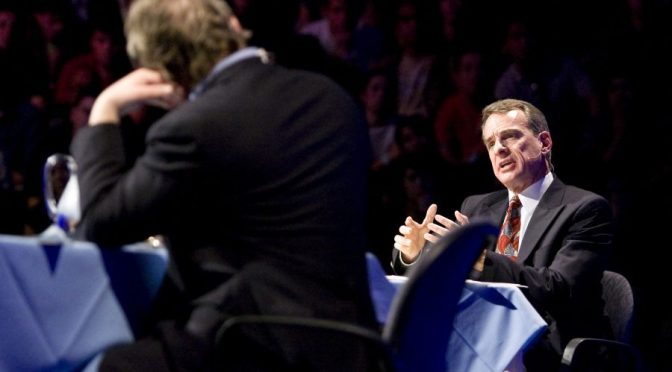
What got me started on apologetics? William Lane Craig debate transcripts

Yes, William Lane Craig debate transcripts. In fact, I still read them from time to time to keep up my skills.

Here’s one of my favorites, the Craig-Nielsen debate on grounding morality without God

Summary:

THE CRAIG-NIELSEN DEBATE: GOD, MORALITY, AND EVIL
William Lane Craig and Kai Nielsen
with annotations by William Lane Craig
February 1991, University of Western Ontario

Best part:

Finally, he raises the issue of immortality and says, “Death doesn’t undermine moral values. In fact, things that we value become all the more precious.” Well, in one sense he’s right. It’s the absence of God that undermines the objectivity of moral values, not death. But let’s suppose that there are objective moral values. What would be undermined by the lack of immortality? I think two things.

First, I think there would be no reason to adopt the moral point of view. Since you’re going to die, everyone ends up the same. It doesn’t make any difference whether you live as a Hitler or a Mother Teresa. There is no relationship between your moral living and your ultimate fate. And so in that sense, death undermines the reason for adopting the moral point of view rather that just being an egoist and living for self.

Second, there’s no basis for self-sacrifice on this point of view. Why should an atheist, who knows everything is going to end in death, do things that are morally right that go against self-interest? For example, a few years ago there was a terrible mid-winter air disaster in Washington, DC, as a plane crashed into a bridge spanning the Potomac River, spilling its passengers into the icy waters. And as the helicopters came to rescue these people, attention focused on one man who again and again passed by the rope ladder rather than be pulled to safety himself. Seven times he did this, and when they came again, he was gone. The whole nation turned its eyes to this man in respect and admiration for the noble act of self-sacrifice that he did. And yet on the atheistic view, that man wasn’t noble. He did the stupidest thing possible. He should have gone for the rope ladder first, pushed others away, if necessary, in order to survive! But to give up all the brief existence he will ever have for others he didn’t even know? Why? It seems to me, then, that it’s not simply the absence of God that undermines objective moral values, but ethical living is also undermined by the atheistic point of view because you then have no reason to adopt the moral point of view and you have no basis for acts of self-sacrifice.

By contrast, on the Christian view, where you have both God and immortality, you have the necessary presuppositions for the affirmation of objective moral values and for consistent living of the ethical life.

And another of my favorites, the Craig-Taylor debate on the ontological grounding of morality.

Summary:

Is The Basis Of Morality Natural Or Supernatural?
Richard Taylor and William Lane Craig
October 1993, Union College, Schenectady, New York

Sample Craig:

(2) I argued that moral accountability also exists under the supernaturalist view, and Professor Taylor didn’t deny the point.

(II) What about my critique, then, of naturalism? I said that naturalism doesn’t provide a sound foundation for morality, and here I made two points:

(1) On the naturalist view, objective right and wrong do not exist. Again, Professor Taylor doesn’t deny this point; he just says, “Well, to say that they’re conventional doesn’t mean they’re contemptible.” Well, granted; but it does mean they’re arbitrary, they’re non–objective. There’s no more difference between moral right and wrong than driving on the right–hand side of the road versus the left–hand side of the road. It’s simply a societal convention. And the modern evolutionist thinks these conventions are just based in socio–biological evolution. According to Michael Ruse, a professor of the philosophy of science,

The position of the modern evolutionist…is that humans have an awareness of morality…because such an awareness is of biological worth. Morality is a biological adaptation, no less than are hands and feet and teeth…. Considered as a rationally justifiable set of claims about an objective something, [ethics] is illusory. I appreciate that when somebody says, ‘Love thy neighbor as thyself,’ they think they are referring above and beyond themselves…. Nevertheless…such reference is truly without foundation. Morality is just an aid to survival and reproduction and…any deeper meaning is illusory….{26}

This is essentially the same view as Professor Taylor’s. Moral values are simply rooted in socio–biological evolution, that have passed down as certain taboos and certain commands, but they have no objective validity in terms of their moral rightness or wrongness. Professor Taylor says, “But I have a high regard for people who are truly moral and decent.” I don’t deny that. Of course he does! But the point is that in his ethics, in his philosophy, he has no basis for that affirmation. What I bring is not a new set of values—I think we pretty much hold those in common—but I’m offering a secure foundation for those values that we all want to hold dear.

You see, on Professor Taylor’s view, there really isn’t any objective morality. I think every one of us here tonight would agree that it’s wrong to kill babies and that the holocaust was morally wrong. But in his book Professor Taylor says, “The infanticide practiced by the Greeks of antiquity did not violate their customs. If we say it was nevertheless wrong, we are only saying that it is forbidden by our ethical and legal rules. And the abominations practiced by the Nazis…are forbidden by our rules, and not, obviously, by theirs.”{27} I submit that that is simply a patently false view of moral values and that naturalism, therefore, can’t provide any objective basis for right and wrong.

And another of my favorites, the Craig-Tooley debate on the problem of evil.

Summary:

A Classic Debate on the Existence of God
Dr. William Lane Craig & Dr. Michael Tooley
November 1994, University of Colorado at Boulder

Sample Craig:

(2) Christian doctrines increase the probability of the coexistence of God and the evils in the world. Let me just mention a couple of these.

(i) On the Christian view, the purpose of life is not happiness as such in this life. Rather it is the knowledge of God—which will ultimately produce true and everlasting happiness. What that means is that many evils occur in this life which might be utterly pointless with respect to producing human happiness. But they might not be pointless with respect to producing the knowledge of God. Dr. Tooley assumes when he talks about changes that would make this world a better place, that the purpose of life is basically to be happy in this life. And I certainly admit that you could make changes that might appear to make this life a better place, make it happier. But that’s not God’s purpose. So if you understand that the purpose of life is not happiness as such, I think that you can see that the existence of evil doesn’t necessarily cast any improbability upon God’s existence.

(ii) It’s also the Christian view that God’s purpose spills over into eternal life. In the afterlife God will bestow a glory and happiness upon us that is incomparable to what we’ve suffered here on earth. And the longer we spend in eternity with Him, the more the sufferings in this life shrink by comparison to an infinitesimal instant. Dr. Tooley admits in his article that it is possible that immortality could justify such evils. But, he says, it’s “very unlikely” that there is life after death. Well, I have two comments. First, I’d like him to prove that it’s unlikely that there is life after death.{26} Second, I suggest that the resurrection of Jesus gives us grounds for hoping in life after death, and I’ve attempted to justify that historically. So given these Christian doctrines, I think you can see that the existence of God and evil is not so improbable after all.

[…]

(4) Finally, I think that there is actually an argument for God from evil. It would go like this:

(i) If God does not exist, objective moral values do not exist. If there is no God, moral values are either socio-biological by-products or just expressions of personal preference.

(ii) Evil exists. That’s the premise of the atheist. There is real evil in the world.

(iii) Therefore, objective values do exist. Some things are really wrong.

(iv) Therefore, God exists.

Thus the presence of evil in the world actually demonstrates God’s existence because in the absence of God, there wouldn’t be any distinction objectively between good and evil, between right and wrong. So although evil in one sense calls into question God’s existence, in a much deeper sense, I think, it actually requires God’s existence.

So in the light of these four responses, I think that the argument from evil, as difficult and emotionally pressing as it might be, in the end doesn’t constitute a good argument against the existence of God. So I think the four arguments given against the existence of God by Dr. Tooley are inconclusive. You’ve still got my six arguments for God’s existence, and therefore I still think that on balance the evidence favors theism as the more rational worldview.

There are more debate transcripts on Craig’s Reasonable Faith web site.

Atheist Jerry Coyne explains why morality is impossible for atheists

Let’s review what you need in your worldview in order to have a rationally grounded system of morality.

You need 5 things:

1) Objective moral values

There needs to be a way to distinguish what is good from what is bad. For example, the moral standard might specify that being kind to children is good, but torturing them for fun is bad. If the standard is purely subjective, then people could believe anything and each person would be justified in doing right in their own eyes. Even a “social contract” is just based on people’s opinions. So we need a standard that applies regardless of what people’s individual and collective opinions are.

2) Objective moral duties

Moral duties (moral obligations) refer to the actions that are obligatory based on the moral values defined in 1). Suppose we spot you 1) as an atheist. Why are you obligated to do the good thing, rather than the bad thing? To whom is this obligation owed? Why is rational for you to limit your actions based upon this obligation when it is against your self-interest? Why let other people’s expectations decide what is good for you, especially if you can avoid the consequences of their disapproval?

3) Moral accountability

Suppose we spot you 1) and 2) as an atheist. What difference does it make to you if you just go ahead and disregard your moral obligations to whomever? Is there any reward or punishment for your choice to do right or do wrong? What’s in it for you?

4) Free will

In order for agents to make free moral choices, they must be able to act or abstain from acting by exercising their free will. If there is no free will, then moral choices are impossible. If there are no moral choices, then no one can be held responsible for anything they do. If there is no moral responsibility, then there can be no praise and blame. But then it becomes impossible to praise any action as good or evil.

5) Ultimate significance

Finally, beyond the concept of reward and punishment in 3), we can also ask the question “what does it matter?”. Suppose you do live a good life and you get a reward: 1000 chocolate sundaes. And when you’ve finished eating them, you die for real and that’s the end. In other words, the reward is satisfying, but not really meaningful, ultimately. It’s hard to see how moral actions can be meaningful, ultimately, unless their consequences last on into the future.

Theism rationally grounds all 5 of these. Atheism cannot ground any of them.

Let’s take a look at #4: free will and see how atheism deals with that.

Atheism and free will?

Here’s prominent atheist Jerry Coyne’s editorial in USA Today to explain why atheists can’t ground free will.

Excerpt:

And that’s what neurobiology is telling us: Our brains are simply meat computers that, like real computers, are programmed by our genes and experiences to convert an array of inputs into a predetermined output. Recent experiments involving brain scans show that when a subject “decides” to push a button on the left or right side of a computer, the choice can be predicted by brain activity at least seven seconds before the subject is consciously aware of having made it. (These studies use crude imaging techniques based on blood flow, and I suspect that future understanding of the brain will allow us to predict many of our decisions far earlier than seven seconds in advance.) “Decisions” made like that aren’t conscious ones. And if our choices are unconscious, with some determined well before the moment we think we’ve made them, then we don’t have free will in any meaningful sense.

If you don’t have free will, then you can’t make moral choices, and you can’t be held morally responsible. No free will means no morality.

Here are some more atheists to explain how atheists view morality.

William Provine says atheists have no free will, no moral accountability and no moral significance:

Let me summarize my views on what modern evolutionary biology tells us loud and clear — and these are basically Darwin’s views. There are no gods, no purposes, and no goal-directed forces of any kind. There is no life after death. When I die, I am absolutely certain that I am going to be dead. That’s the end of me. There is no ultimate foundation for ethics, no ultimate meaning in life, and no free will for humans, either.

Richard Dawkins says atheists have no objective moral standards:

In a universe of blind physical forces and genetic replication, some people are going to get hurt, other people are going to get lucky, and you won’t find any rhyme or reason in it, or any justice. The universe that we observe has precisely the properties we should expect if there is, at bottom, no design, no purpose, no evil and no good, nothing but blind, pitiless indifference… DNA neither knows nor cares. DNA just is. And we dance to its music. (Richard Dawkins, River Out of Eden: A Darwinian View of Life (1995))

When village atheists talk about how they can be moral without God, it’s important to ask them to justify the minimum requirements for rational morality. Atheists may act inconsistently with their worldview, believing in free will, expecting praise and blame for complying with the arbitrary standards of their peer group, etc. But there is nothing more to morality on atheism that imitating the herd – at least when the herd is around to watch them. And when the herd loses its Judeo-Christian foundation – watch out. That’s when the real atheism comes out – the atheism that we’ve seen before in countries that turned their backs on God, and the moral law. When God disappears from a society, anything is permissible.

Theologian R.C. Sproul asks: “If there’s a God, why are there atheists?”

Brian Auten has a book review posted up at Apologetics 315.

The book is “If There’s A God, Why Are There Atheists?”, by theologian R.C. Sproul. R.C. Sproul is one of my favorite theologians. The book in question has a very, very special place in my heart, because I think that it is one of the major reasons why I was able to resist pernicious ideas like religious pluralism and postmodernism for so long. Once you put on the glasses of Romans 1 and see for the first time what man is really doing with respect to God, you can never see things the same again. I’ll say more about this at the end, but let’s see what Brian wrote first.

The review

So often, you hear atheists complaining about religion is nothing but wish-fulfillment or some sort of crutch for people who are frightened by a variety of things. They think that God is invented to solve several problems. 1) how does the world work?, 2) is there meaning to suffering and evil?, 3) why should I be moral?, and 4) what will happen to me and my loved ones when I die?. On the atheistic view, God is just a crutch that people cling to out of weakness and ignorance. But is this really the case?

Sproul starts the book by investigating three atheists who sought to explain religious belief as a result of psychological factors.

Brian writes:

Before tackling the psychology of atheism, Sproul spends a chapter on the psychology of theism, from the perspective of Freud’s question “If there is no God, why is there religion?” What follows is an overview of various psychological explanations of theistic belief: Feuerbach’s “religion is a dream of the human mind.” Marx’s belief that religion is “due to the devious imagination of particular segment of mankind.” And Nietzche’s idea that “religion endures because weak men need it.” The author properly reiterates: “We must be careful to note that the above arguments can never be used as proof for the nonexistence of God. They can be useful for atheists who hear theists state that the only possible explanation for religion is the existence of God.” That being said, Sproul also reveals what these arguments presume:

Their arguments already presupposed the nonexistence of God. They were not dealing with the question, Is there a God? They were dealing with the question, Since there is no God, why is there religion?16

Sproul points out the weaknesses of each of these approaches and says “there are just as many arguments showing that unbelief has its roots in the psychological needs of man.”

Wow, could that really be true? What are the real reasons why people reject God? Does the Bible have anything to say about what those reasons are?

Brian cites Sproul’s contention:

The New Testament maintains that unbelief is generated not so much by intellectual causes as by moral and psychological ones. The problem is not that there is insufficient evidence to convince rational beings that there is a God, but that rational beings have a natural hostility to the being of God.

[…]Man’s desire is not that the omnipotent, personal Judeo-Christian God exist, but that He not exist.

In Romans 1:18-23, the apostle Paul explains what is really going on:

18The wrath of God is being revealed from heaven against all the godlessness and wickedness of men who suppress the truth by their wickedness,

19since what may be known about God is plain to them, because God has made it plain to them.

20For since the creation of the world God’s invisible qualities—his eternal power and divine nature—have been clearly seen, being understood from what has been made, so that men are without excuse.

21For although they knew God, they neither glorified him as God nor gave thanks to him, but their thinking became futile and their foolish hearts were darkened.

22Although they claimed to be wise, they became fools

23and exchanged the glory of the immortal God for images made to look like mortal man and birds and animals and reptiles.

On this blog, I regularly present many, many arguments for theism in general, and Christian theism in particular:

Sproul explains why atheists cannot allow themselves to live according to the evidence that is presented to them:

The cumulative effect of this knowledge that is clearly seen is to leave men ‘without excuse.’ Herein lies the basis of the universal guilt of man. No one can claim ignorance of the knowledge of God. No one can cite insufficient evidence for not believing in God. Though people are not persuaded by the evidence, this does not indicate an insufficiency in the evidence, but rather an insufficiency in man.

[…]The basic stages of man’s reaction to God can be formulated by means of the categories of trauma, repression, and substitution.

[…]If God exists, man cannot be a law unto himself. If God exists, man’s will-to-power is destined to run head-on into the will of God.

And this is the force that is animating atheists today. They don’t want to be accountable to God in a relationship, no matter what the evidence is. They have to deny it, so that they can be free to get the benefits of a universe designed for them, without having to give any recognition or acknowledgement back. If they have to lie to themselves to deny the evidence, they will do it. Anything to insulate themselves from the Creator and Designer who reveals himself in Jesus Christ.

The rest of the book review, and the book, deals with explaining in detail how atheists respond to an all-good, all-powerful, all-knowing Creator/Designer. I encourage you to click through and read the whole book review. You can read the review, and the book, and then investigate for yourself whether atheists really are like that.