
Tag Archives: Logic

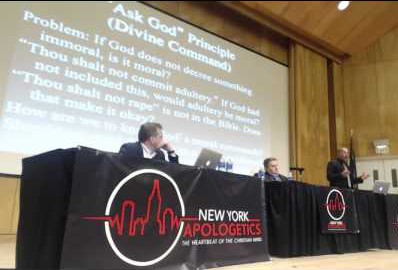
Atheist Michael Shermer tries to rationally ground morality in debate with Frank Turek

Michael Shermer debates Frank Turek: atheism and morality

The topic of the debate was on the grounding of morality – which worldview (theism or atheism) is better at grounding morality?

And here is the MP3 for the cross-examination only, which is what I will be summarizing. (12.5 Mb)

The full debate can be seen here and can be heard here.

Turek’s cross-examination period starts at 74m22s and ends at 89m20s.

Shermer’s cross-examination period starts at 89m50s and ends at 105m0s.

Topics of Turek’s cross-examination:

  • evolution produces Shermer’s moral sense and Hitler’s moral sense
  • why does Shermer think his is better than Hitler’s, since both were produced by the same evolution?
  • what makes right or wrong if evolution is the source of morality?
  • why is Stalin’s opinion of right and wrong less valuable than the herd’s opinion of right and wrong?
  • do the Founding Fathers ground inalienable rights in a Creator, or in evolution?
  • can atheism ground the existence of inalienable rights?
  • can you ground objective moral values and objective moral duties by asking people how they feel?
  • can you ground objective human rights on atheism by shouting like a madman and interrupting?
  • how can you trust your thinking if they are the result of an unguided, random process of evolution?
  • how can you have rational thoughts if materialism is true, and you are a machine made out of meat?
  • can you ground objective moral values and objective moral duties on personal preferences?
  • how do the personal preferences of some individuals create an objective moral duty for other individuals?
  • does naturalistic evolution orient human beings toward survival or truth?
  • on materialism, what is the chemical composition of justice?

Topics of Shermer’s cross-examination:

  • Radical muslims are exactly the same as evangelical Christians, and have the same God (Allah is the same as the Triune Christian God)
  • Radical muslims would assert that their God is the same as the Triune Christian God, with Jesus and the Holy Spirit also being God
  • Therefore, we can lay the blame for what radical muslims do on the backs of evangelical Christians
  • Radical muslims and evangelical Christians are the same, because “you’re enthusiastic, they’re enthusiastic”
  • The Bible’s notion of indentured servitude to pay off debt is the identical to the idea of slavery based on race
  • The Bible’s notion that masters and slaves are equal in the sight of God forms a basis for thinking they are unequal
  • The Bible teaches things that I disagree with, like the idea that marriage should provide children with a mother and a father
  • Gay marriage is solidly grounded in evolution, even though the morality that evolution produces varies by time and place
  • Atheists can ground objective moral values and objective moral duties by asking people how they feel
  • Can atheists who want to legalize gay marriage because “they’re in love” prohibit polygamy or incest as marriage?
  • Is shouting “you’re on the wrong side of history” a way to rationally ground morality in an accidental atheistic universe?
  • Is it loving for atheists to celebrate a lifestyle that exposes gay men to sickness and premature death?
  • Is it “bigotry” for the Center for Disease Control to warn men who have sex with men about higher health risks?
  • How do Christians decide what is right and wrong when they are confronted with a moral dilemma?
  • How do humans sense the objective moral standard that is required for them to make moral judgments
  • Can enlightenment philosophers who merely imagine human rights actually create those human rights?
  • If revelations change over time for Mormons, does that undermine the need for God to ground objective morality?

I apologize for the poor quality of the video and audio. The moderator was extremely ineffective, letting Shermer go on and on making speeches instead of asking questions during his questioning time. Also, Shermer apparently thought that shouting at Turek and waving his finger at Turek was a good strategy to defend against Turek’s use of logic and evidence.

My thoughts on Michael Shermer

I do want to make some general comments about what Shermer said. Shermer’s view of morality is “what is best for the greatest number of people”. There are no inalienable rights that act as a break on the will of the majority. Shermer has no objection to anything that the majority has decided in any time or in any place. If he were there, he would agree that whatever they decided was morally right.

Two hundred years ago, Shermer would have endorsed slavery. And if he were in Germany 50 years ago, he would have endorsed the Holocaust. If he lived in a Pakistan today, he would endorse stoning women for wearing the wrong clothes. Atheists always think that whatever the majority is doing in a particular time and place is right for them. There are no inalienable human rights that exist apart from human opinions, on atheism.

Another problem is that Shermer is constantly making moral judgments when his own view is that morality is constantly changing in different times and places. He condemns the moral values of other times and places without having any standard in his worldview that can decide between different moral values and duties. It is like saying that lunch is better than breakfast because lunch is here and now, and breakfast was then and there. That is literally what atheists do when they make moral judgments. They have no standard that applies to different times and places, just the ever evolving opinions of the majority of people in different times and places.

Is Michael Shermer concerned about morality?

Finally, I want people to understand what kind of person Michael Shermer is. You can read a post by PZ Myers on his blog Pharyngula to get the picture. I think it’s useful to know about Shermer’s own morality since he seems to like to make moral judgments so much during debates. In my own experience in dealing with atheists, although they will talk about slavery and the Crusades, there is nothing in an atheist’s moral system that makes things wrong for all times and all places. They bring it up to stop you from judging them about the things that they care about. When an atheist says “the Crusades! Slavery!” what they really mean is “I need to shame you for having a basis for moral judgments against me, so that you won’t say anything about me getting married women drunk then raping them”. That’s what atheistic use of moral language is really about.

What atheists really think about morality

Atheist Richard Dawkins says atheists have no objective moral standards:

In a universe of blind physical forces and genetic replication, some people are going to get hurt, other people are going to get lucky, and you won’t find any rhyme or reason in it, or any justice. The universe that we observe has precisely the properties we should expect if there is, at bottom, no design, no purpose, no evil and no good, nothing but blind, pitiless indifference… DNA neither knows nor cares. DNA just is. And we dance to its music. (Richard Dawkins, River Out of Eden: A Darwinian View of Life (1995))

So, when Shermer tries to shame Christians for behaviors in other times and places which our society here and now disagrees with, what he really means is “morality, objectively speaking, is nonsense, but I will use your moral sense that comes from your non-atheistic worldview to shame you, so that you won’t have the confidence to judge me for my immoral behavior”. And we need to get used to understanding this about atheists. Morality is nonsense to them, and their real goal is to get you off their back for their hedonism. For atheists, morality is just complying with arbitrary social customs which vary by time and place. There is nothing more to it than aping their neighbors (at least when their neighbors are watching). And they would have aped slave-owners, widow-burners and Nazi prison guards too, if they lived in that time and place. And shouted at Christians for disagreeing with them, just like Shermer did about gay marriage.

If you like the way that Frank Turek debates, then be sure and check out his new book “Stealing From God“. I highly recommend it.

William Lane Craig debates Alex Rosenberg: Does God Exist? Video, audio and summary

Below, please find my summary of the Craig-Rosenberg debate, which occurred on February 1st, 2013 at Purdue University.

Brian Auten has posted the MP3 audio of the debate at Apologetics 315.

The debaters

Below is the summary.

Dr. Craig’s opening speech:

The topic: What are the arguments that make belief in God reasonable or unreasonable?
First speech: arguments for reasonableness of belief in God
Second speech: respond to arguments against reasonableness of belief in God

Eight arguments:

  1. Contingency argument: God – a transcendent, personal being – is the explanation of why a contingent universe exists.
  2. Cosmological argument: God is the cause of the beginning of the universe, which is attested by physics and cosmology.
  3. Applicability of mathematics to nature: God is the best explanation for the applicability of mathematics to nature.
  4. Fine-tuning argument: God is the best explanation of the fine-tuning of the universe to permit life.
  5. Intentionality of conscious states: God is the best explanation of the intentionality of our mental states.
  6. The moral argument: God is the best explanation for the existence of objective moral values and duties.
  7. The resurrection of Jesus: God is the best explanation for the core of historical facts accepted by most ancient historians across the ideological spectrum.
  8. Religious experience: God is the best explanation of our immediate experience and knowledge of his existence.

Dr. Rosenberg’s opening speech

First argument: The fallacy of ad hominem

  • I don’t know whether to laugh or to cry
  • Dr. Craig has said all of that before in other debates
  • You didn’t need to come out on this cold night
  • Craig’s arguments have all been refuted
  • Dr. Craig just doesn’t listen
  • Dr. Craig is not interested in getting at the truth
  • Dr. Craig is just interested in scoring debate points
  • The adversarial system is the wrong approach to decide truth
  • Dr. Craig is very confident about his take of physics

Second argument: The fallacy of arguing from authority

  • 95% of members of the NAS are atheists
  • Therefore Dr. Craig cannot use science

Third argument: Effects don’t require causes

  • I am going to pretend that Craig said that “every effect requires a cause”
  • Quantum mechanics shows that some effects occur without causes
  • A particle of uranium (which is not nothing, it is something) decays without a cause
  • This uncaused effect is the same as the universe coming into being out of nothing uncaused
  • Therefore the principle of sufficient reason is false

Fourth argument: Silicon-based life and the multiverse

  • If these constants had been different, maybe we would have other kinds of intelligent life, like silicon-based life
  • Carbon-based life is not the only kind of life, maybe you can have other kinds of life, none of which have been observed
  • There could be different kinds of life in other areas of the universe that we can’t see
  • There are things we can’t see that disprove the current physics that we can see
  • Quantum foam is evidence that a multiverse exists
  • The multiverse would solve the problem of fine-tuning

Fifth argument: The Euthyphro dilemma

  • The moral argument is refuted by Euthyphro dilemma
  • Dr. Craig is such a moron that he has never heard of the Euthyphro dilemma ever before
  • This is found in the first and simplest of Plato’s dialogs
  • Why is Dr. Craig so stupid that he has not read this simple dialog ever before?
  • Evolution explains why humans evolve arbitrary customs and conventions that vary by time and place
  • Alternative moral theories: utilitarianism, social contract, etc. that don’t require God

Sixth argument: Mormonism undermines Dr. Craig’s three minimal facts about Jesus

  • Why is Dr. Craig so stupid and ignorant to persist in pushing such an ignorant, stupid argument?
  • Mormonism is a silly religion that is not historically well founded
  • Therefore, Jesus was not buried
  • Islam is a silly religion that is not historically grounded
  • Therefore, the tomb was not found empty
  • Scientology is a silly religion that is not historically grounded
  • Therefore, the eyewitnesses didn’t have post-mortem appearances
  • Eyewitness testimony is unreliable in some cases
  • Therefore, eyewitness testimony was unreliable in this case
  • Apparitions of Mary are bizarre
  • Therefore, the majority of historians are wrong to think that the disciples saw post-mortem appearances

Seventh argument: Deductive problem of evil

  • Evil and suffering are logically incompatible with an all good, all powerful God

Eight argument: God is not just to allow evil and suffering

  • God cannot make the evils of this life right in the afterlife

Dr. Craig’s first rebuttal

Dr. Rosenberg sketched the deductive argument from evil.

Dr. Rosenberg presupposes naturalism. Naturalism is a false theory of knowledge:

1. It’s too restrictive: There are truths that cannot be proved by natural science.
2. It’s self-refuting: no scientific proof for naturalism exists.

That’s why epistemological naturalism is considered false by most philosophers of science.

But more importantly than that: Epistemological naturalism does not imply metaphysical naturalism. (E.g. – W. Quine)

Dr. Rosenberg has to present arguments in favor of (metaphysical) naturalism, not just assume that (metaphysical) naturalism is true.

Dr. Craig presented eight arguments against metaphysical naturalism taken from Rosenberg’s own book:

1. The argument from the intentionality (aboutness) of mental states implies non-physical minds (dualism), which is incompatible with naturalism
2. The existence of meaning in language is incompatible with naturalism, Rosenberg even says that all the sentences in his own book are meaningless
3. The existence of truth is incompatible with naturalism
4. The argument from moral praise and blame is incompatible with naturalism
5. Libertarian freedom (free will) is incompatible with naturalism
6. Purpose is incompatible with naturalism
7. The enduring concept of self is incompatible with naturalism
8. The experience of first-person subjectivity (“I”) is incompatible with naturalism

Metaphysical naturalism is false: it is irrational and it contradicts our experience of ourselves.

And epistemological naturalism is compatible with theism.

Rebutting Dr. Rosenberg’s responses:

1. Contingency: no response

2. Cosmological: he mis-states the first premise to say every effect… when it is whatever begins to exist…, the origin of the universe was not from a vacuum, virtual particles come from a vacuum not nothing, there are interpretations of QM that are compatible with determinism. Rosenberg has to believe that the entire universe popped into being from non-being.

3. Mathematics: no response

4. Fine-tuning: the multiverse is refuted by empirical observations of the universe. Without fine-tuning, it’s not that we still have silicon to make life out of. It’s that we lose basic minimal things like chemical diversity, matter, stars, planets, etc. No life of any kind, not just no carbon-based life.

5. Intentionality: no response.

6. Moral argument: the answer to the dilemma is that you split the dilemma: God is the standard of good, and the commands flow from his unchanging moral nature. The commands are not arbitrary, and the standard is not external to God. Dr. Rosenberg is a nihilist and he cannot ground good and evil on his nihilistic view.

7. Resurrection: The Gospels are early eyewitness testimony. Mormonism and Islam have nothing to do with the minimal set of historical facts about Jesus agreed to by the majority of ancient historians across the ideological spectrum, general statements against eyewitnesses do not refute the specific eyewitness testimony in this case.

8. Religious experience: No response.

Dr. Rosenberg’s first rebuttal

I wrote a book and you should buy it, because it got me invited to this debate. Let me repeat the title a few times for you. Please buy it.

Dr. Craig is right, there are multiple interpretations of QM, not just the one I presented, including deterministic ones.

All the disturbing implications of naturalism that Dr. Craig stated follow from metaphysical naturalism, and metaphysical naturalism is true. (Note: he equates science with metaphysical naturalism)

Science proves that metaphysical naturalism is true, but I won’t say what specific scientific tests prove my philosophical assumption of metaphysical naturalism.

I’ll pretend that the Big Bang (science) doesn’t disprove naturalism, like Dr. Craig said. Again. (covers ears) La la la, there is no Big Bang.

We didn’t come here to debate epistemological naturalism and metaphysical naturalism.

Let me explain the problem of intentionality since I’m so smart and no one knows what it means.

There are many answers to this problem of intentionality.

My answer is that most scientists are naturalists, therefore naturalism is true, regardless of the argument from intentionality of mental states.

That’s how I would respond to one of the eight problems with naturalism that Dr. Craig raised. I won’t answer the other seven problems.

It is an argument from ignorance to argue that the applicability of mathematics to the universe requires a designer, because there are non-Euclidean geometries. Craig’s argument, which he gets from people like respected physicists like Eugene Wigner, is bizarre. It is bizarre, therefore I refute Eugene Wigner and all the other scholars who make that argument. It is bizarre! Bizarre!

Deductive problem of evil: there is no response to this argument, certainly not Alvin Plantinga’s free will defense. The deductive argument from evil has not been entirely abandoned at all! It’s not like arch-atheist J.L. Mackie himself admits that the deductive problem of evil doesn’t lead to a logical inconsistency between evil and God.

Dr. Craig has to tell me why God allows evil or God doesn’t exist.

It is offensive that Dr. Craig cannot tell me why God allows every evil and suffering that occurs.

He literally said this: “I will become a Christian if Dr. Craig can tell me why God allowed EVERY EVIL THAT OCCURRED IN THE LAST 3.5 BILLION YEARS”

Dr. Craig’s second rebuttal

We are not in a position to know why God allows specific instances of evil and suffering.

God cannot force people to freely do anything – freedom is not compatible with determinism. Freedom is a good, but freedom opens up the possibility of moral evil. You cannot have the good of free will without allowing people to choose to do morally evil things.

God can permit evil and suffering in order to bring more people into a relationship with him.

The atheist has to show that God could allow less evil and achieve more knowledge of God in order to say there is too much evil.

The purpose of life is not happiness, but knowledge of God.

Dr. Craig quotes agnostic Paul Draper (Purdue) and Peter Van Inwagen (Notre Dame) to state that the deductive problem of evil is dead because of free will and morally sufficient reasons for permitting evil.

1. Contingency: no response.

2. Cosmological: QM does not apply, because the universe came from nothing, not a vacuum, and QM only works in a vacuum.

3. Mathematics: He mentions alternatives like non-Euclidean geometry, but we have to explain the structure of THIS universe.

4. Fine-tuning: ???

5. Intentional states: intentional mental states proves that minds exist, which fits with theism better than it fits with atheism.

6. Moral argument: You need God to ground morality, and Dr. Rosenberg believes in morality. He needs God to ground objective moral values and duties.

7. Historical argument: He has to respond to the minimal facts supported by the consensus of ancient historians across the ideological spectrum.

8. The problems of naturalism: He says that you can’t have science without naturalism, but you can have science with EPISTEMOLOGICAL NATURALISM, and theists accept science and methodological naturalism. We don’t accept METAPHYSCIAL NATURALISM because of the eight problems Craig presented, like intentionality, first-person, persistence of self, etc. You can believe in both science and theism, by embracing epistemological naturalism, while rejecting methaphysical naturalism.

Dr. Rosenberg’s second rebuttal

Dr. Craig hasn’t answered many of my points, I won’t say which ones though.

Debates don’t work as a way of deciding what’s true, so we should overturn the entire criminal justice system.

The principle of sufficient reason is false because it is disconfirmed by quantum mechanics. And quantum mechanics (vacuum and virtual particles that exist for a short time) is similar to the origin of the universe (nothing and entire universe and 14 billion years).

We know that alpha particles come into being without cause all the time from a quantum vacuum for a tiny sub-second duration before going out of existence, so we can say that the entire physical universe came into being for 14 billion years from absolute nothing which is not a quantum vacuum.

Peter Van Inwagen is the best metaphysician working today, and he says that my deductive argument from evil is not decisive, it’s not a successful argument. (Why is he undermining his own problem of evil argument????!)

Dr. Craig invoked Plantinga’s free will defense to the deductive POE. Freedom allows us to do evil. God could have given us free will without evil and suffering. I won’t show how, but I’ll just assert it, because debates are such a bad forum for supplying evidence for my speculative assertions.

If you answer the question 3 + 5 as being 8, then you don’t have free will – you are biologically determined if you answer 8, because everyone answers 8, and that means everyone is biologically determined with no free will.

Why can’t God give us free will and then prevent us from making a free choice?

No scholars date the gospels earlier than 60-70 AD, especially not atheists like James Crossley who dates Mark to 40 AD. Therefore Jesus’ burial isn’t historical, like the majority of scholars across the broad spectrum of scholarship agree it is.

The original New Testament documents were written in Aramaic.

All New Testament scholars are orthodox Christians, like atheist Robert Funk for example.

Dr. Craig’s concluding speech

In order to sustain the deductive argument from evil, Dr. Rosenberg must show that God could create a world of free creatures with less evil.

Principle of Sufficient Reason: not using the general principle of sufficient reason, but a more modest version of this states that contingent things should have an explanation for their existence. And we know that the universe is a contingent.

The New Testament was not written in Aramaic, they were written in Greek. Dr. Rosenberg is wrong there too.

(Dr. Craig spends the rest of his concluding speech giving his testimony and urging people to investigate the New testament).

Dr. Rosenberg’s concluding speech

Some long-dead French guy named Laplace said that he has no need of that (God) hypothesis. He did not know about any of Dr. Craig’s arguments made in this debate tonight when he said that, though.

There is no need to explain how the universe began or how the universe is finely-tuned if you just assume metaphysical naturalism on faith.

The Easter Bunny, therefore atheism.

Most scientists are atheists, therefore atheism.

You can do a lot of science without God, just don’t look at the origin of the universe, the fine-tuning of the universe, or the other parts of science that Craig mentioned, as well as the origin of life, the Cambrian explosion, the habitability argument, and so on.

You can be a Christian, but good Christians should not use arguments and evidence.

Good Christians should be irrational and ignorant. Bad Christians look for arguments and evidence from science and history.

Good Christians should embrace the absurd. Bad Christians want to search for truth and use logic and evidence.

What got me started on apologetics? William Lane Craig debate transcripts

To have informed views, listen to both sides
To have informed views, you should listen to both sides

Yes, William Lane Craig debate transcripts. In fact, I still read them from time to time to keep up my skills.

Here’s one of my favorites, the Craig-Nielsen debate on grounding morality without God

Summary:

THE CRAIG-NIELSEN DEBATE: GOD, MORALITY, AND EVIL
William Lane Craig and Kai Nielsen
with annotations by William Lane Craig
February 1991, University of Western Ontario

Best part:

Finally, he raises the issue of immortality and says, “Death doesn’t undermine moral values. In fact, things that we value become all the more precious.” Well, in one sense he’s right. It’s the absence of God that undermines the objectivity of moral values, not death. But let’s suppose that there are objective moral values. What would be undermined by the lack of immortality? I think two things.

First, I think there would be no reason to adopt the moral point of view. Since you’re going to die, everyone ends up the same. It doesn’t make any difference whether you live as a Hitler or a Mother Teresa. There is no relationship between your moral living and your ultimate fate. And so in that sense, death undermines the reason for adopting the moral point of view rather that just being an egoist and living for self.

Second, there’s no basis for self-sacrifice on this point of view. Why should an atheist, who knows everything is going to end in death, do things that are morally right that go against self-interest? For example, a few years ago there was a terrible mid-winter air disaster in Washington, DC, as a plane crashed into a bridge spanning the Potomac River, spilling its passengers into the icy waters. And as the helicopters came to rescue these people, attention focused on one man who again and again passed by the rope ladder rather than be pulled to safety himself. Seven times he did this, and when they came again, he was gone. The whole nation turned its eyes to this man in respect and admiration for the noble act of self-sacrifice that he did. And yet on the atheistic view, that man wasn’t noble. He did the stupidest thing possible. He should have gone for the rope ladder first, pushed others away, if necessary, in order to survive! But to give up all the brief existence he will ever have for others he didn’t even know? Why? It seems to me, then, that it’s not simply the absence of God that undermines objective moral values, but ethical living is also undermined by the atheistic point of view because you then have no reason to adopt the moral point of view and you have no basis for acts of self-sacrifice.

By contrast, on the Christian view, where you have both God and immortality, you have the necessary presuppositions for the affirmation of objective moral values and for consistent living of the ethical life.

And another of my favorites, the Craig-Taylor debate on the ontological grounding of morality.

Summary:

Is The Basis Of Morality Natural Or Supernatural?
Richard Taylor and William Lane Craig
October 1993, Union College, Schenectady, New York

Sample Craig:

(2) I argued that moral accountability also exists under the supernaturalist view, and Professor Taylor didn’t deny the point.

(II) What about my critique, then, of naturalism? I said that naturalism doesn’t provide a sound foundation for morality, and here I made two points:

(1) On the naturalist view, objective right and wrong do not exist. Again, Professor Taylor doesn’t deny this point; he just says, “Well, to say that they’re conventional doesn’t mean they’re contemptible.” Well, granted; but it does mean they’re arbitrary, they’re non–objective. There’s no more difference between moral right and wrong than driving on the right–hand side of the road versus the left–hand side of the road. It’s simply a societal convention. And the modern evolutionist thinks these conventions are just based in socio–biological evolution. According to Michael Ruse, a professor of the philosophy of science,

The position of the modern evolutionist…is that humans have an awareness of morality…because such an awareness is of biological worth. Morality is a biological adaptation, no less than are hands and feet and teeth…. Considered as a rationally justifiable set of claims about an objective something, [ethics] is illusory. I appreciate that when somebody says, ‘Love thy neighbor as thyself,’ they think they are referring above and beyond themselves…. Nevertheless…such reference is truly without foundation. Morality is just an aid to survival and reproduction and…any deeper meaning is illusory….{26}

This is essentially the same view as Professor Taylor’s. Moral values are simply rooted in socio–biological evolution, that have passed down as certain taboos and certain commands, but they have no objective validity in terms of their moral rightness or wrongness. Professor Taylor says, “But I have a high regard for people who are truly moral and decent.” I don’t deny that. Of course he does! But the point is that in his ethics, in his philosophy, he has no basis for that affirmation. What I bring is not a new set of values—I think we pretty much hold those in common—but I’m offering a secure foundation for those values that we all want to hold dear.

You see, on Professor Taylor’s view, there really isn’t any objective morality. I think every one of us here tonight would agree that it’s wrong to kill babies and that the holocaust was morally wrong. But in his book Professor Taylor says, “The infanticide practiced by the Greeks of antiquity did not violate their customs. If we say it was nevertheless wrong, we are only saying that it is forbidden by our ethical and legal rules. And the abominations practiced by the Nazis…are forbidden by our rules, and not, obviously, by theirs.”{27} I submit that that is simply a patently false view of moral values and that naturalism, therefore, can’t provide any objective basis for right and wrong.

And another of my favorites, the Craig-Tooley debate on the problem of evil.

Summary:

A Classic Debate on the Existence of God
Dr. William Lane Craig & Dr. Michael Tooley
November 1994, University of Colorado at Boulder

Sample Craig:

(2) Christian doctrines increase the probability of the coexistence of God and the evils in the world. Let me just mention a couple of these.

(i) On the Christian view, the purpose of life is not happiness as such in this life. Rather it is the knowledge of God—which will ultimately produce true and everlasting happiness. What that means is that many evils occur in this life which might be utterly pointless with respect to producing human happiness. But they might not be pointless with respect to producing the knowledge of God. Dr. Tooley assumes when he talks about changes that would make this world a better place, that the purpose of life is basically to be happy in this life. And I certainly admit that you could make changes that might appear to make this life a better place, make it happier. But that’s not God’s purpose. So if you understand that the purpose of life is not happiness as such, I think that you can see that the existence of evil doesn’t necessarily cast any improbability upon God’s existence.

(ii) It’s also the Christian view that God’s purpose spills over into eternal life. In the afterlife God will bestow a glory and happiness upon us that is incomparable to what we’ve suffered here on earth. And the longer we spend in eternity with Him, the more the sufferings in this life shrink by comparison to an infinitesimal instant. Dr. Tooley admits in his article that it is possible that immortality could justify such evils. But, he says, it’s “very unlikely” that there is life after death. Well, I have two comments. First, I’d like him to prove that it’s unlikely that there is life after death.{26} Second, I suggest that the resurrection of Jesus gives us grounds for hoping in life after death, and I’ve attempted to justify that historically. So given these Christian doctrines, I think you can see that the existence of God and evil is not so improbable after all.

[…](4) Finally, I think that there is actually an argument for God from evil. It would go like this:

(i) If God does not exist, objective moral values do not exist. If there is no God, moral values are either socio-biological by-products or just expressions of personal preference.

(ii) Evil exists. That’s the premise of the atheist. There is real evil in the world.

(iii) Therefore, objective values do exist. Some things are really wrong.

(iv) Therefore, God exists.

Thus the presence of evil in the world actually demonstrates God’s existence because in the absence of God, there wouldn’t be any distinction objectively between good and evil, between right and wrong. So although evil in one sense calls into question God’s existence, in a much deeper sense, I think, it actually requires God’s existence.

So in the light of these four responses, I think that the argument from evil, as difficult and emotionally pressing as it might be, in the end doesn’t constitute a good argument against the existence of God. So I think the four arguments given against the existence of God by Dr. Tooley are inconclusive. You’ve still got my six arguments for God’s existence, and therefore I still think that on balance the evidence favors theism as the more rational worldview.

You can find more debates here.