Sen. Jim Inhofe, R-Okla., a senior member of the Senate Armed Services Committee, called the president’s victory lap in Afghanistan on the anniversary of the death of Osama bin Laden at the hands of the Navy SEALs “an attempt to shore up his national security credentials, because he has spent the past three years gutting our military.”
Indeed he has. “He cut the F-22, future combat system, C-17 and our ground-based interceptor in Poland, to name a few,” Inhofe noted.
[…]President Obama’s defense policies fulfill a campaign pledge he made to the far-left group Caucus for Priorities a month before the January 2008 Iowa caucuses. Caucus for Priorities is an offshoot of a bigger group, Priorities Action Fund, created by Ben Cohen, the peace activist and co-founder of Ben & Jerry’s ice cream.
In a video made for the group, Obama called for a further deterioration in our military strength.
“I will cut investments in unproven missile defense systems. I will not weaponize space. I will slow our development of future combat systems,” he said.
So far, he has kept his word.
In the video, he also vowed, “I will set a goal of a world without nuclear weapons. To seek that goal, I will not develop new nuclear weapons, I will seek a global ban on the production of fissile material and I will negotiate with Russia to take our ICBMs off hair-trigger alert, and to achieve deep cuts in our nuclear arsenals.”
He has kept that promise as well.
As the Heritage Foundation notes, since Obama took office, over 50 major weapons programs of more than $300 billion have been cut or delayed.
Obama, who betrayed Poland and Czechoslovakia on missile defense and shut down key weapon systems like the F-22 Raptor, has vowed to veto any changes to the mandated cuts, including $650 billion from defense as called for by the Budget Control Act over the next decade.
That comes on top of $460 billion in defense cuts already agreed to — a total of $1.1 trillion in defense cuts our commander in chief is OK with.
A 14-page analysis by the Republican majority staff of the House Armed Services Committee says the cumulative cuts will result in Army and Marine Corps losing 200,000 troops.
The Navy will shrink from 300 ships to 238 vessels and would lose two carrier battle groups needed to project American power and influence. Strategic bombers will fall from 153 to 101. Air Force fighters would drop by more than half, from 3,602 aircraft to 1,512 planes. These are real cuts, both in spending and in military capability.
This is not the full list of how this man has been a disaster for world peace and national security. And it is a list that is ignored by hist supporters who think with their emotions and who have their hands out for more of their share of their neighbor’s earnings.
From the ultra-liberal NewYork Times, of all places.
Excerpt:
One Saturday last fall, President Obama interrupted a White House strategy meeting to raise an issue not on the agenda. He declared, aides recalled, that the administration needed to more aggressively use executive power to govern in the face of Congressional obstructionism.
“We had been attempting to highlight the inability of Congress to do anything,” recalled William M. Daley, who was the White House chief of staff at the time. “The president expressed frustration, saying we have got to scour everything and push the envelope in finding things we can do on our own.”
For Mr. Obama, that meeting was a turning point. As a senator and presidential candidate, he had criticized George W. Bush forflouting the role of Congress. And during his first two years in the White House, when Democrats controlled Congress, Mr. Obama largely worked through the legislative process to achieve his domestic policy goals
But increasingly in recent months, the administration has been seeking ways to act without Congress.
[…]Each time, Mr. Obama has emphasized the fact that he is bypassing lawmakers. When he announced a cut in refinancing fees for federally insured mortgages last month, for example, he said: “If Congress refuses to act, I’ve said that I’ll continue to do everything in my power to act without them.”
Aides say many more such moves are coming. Not just a short-term shift in governing style and a re-election strategy, Mr. Obama’s increasingly assertive use of executive action could foreshadow pitched battles over the separation of powers in his second term, should he win and Republicans consolidate their power in Congress.
Recall that this is the same man who chastised George W. Bush for spending too much – then added more money to the national debt than all of the previous Presidents combined.
The National Debt has now increased more during President Obama’s three years and two months in office than it did during 8 years of the George W. Bush presidency.
The Debt rose $4.899 trillion during the two terms of the Bush presidency. It has now gone up $4.939 trillion since President Obama took office.
The latest posting from the Bureau of Public Debt at the Treasury Department shows the National Debt now stands at $15.566 trillion. It was $10.626 trillion on President Bush’s last day in office, which coincided with President Obama’s first day.
The National Debt also now exceeds 100% of the nation’s Gross Domestic Product, the total value of goods and services.
[…]The federal budget sent to Congress last month by Mr. Obama, projects the National Debt will continue to rise as far as the eye can see. The budget shows the Debt hitting $16.3 trillion in 2012, $17.5 trillion in 2013 and $25.9 trillion in 2022.
Wouldn’t it be terrible for our children if we got fooled again by words, instead of looking at actions? What would happen in a second term in which Obama would not have to care about being re-elected?
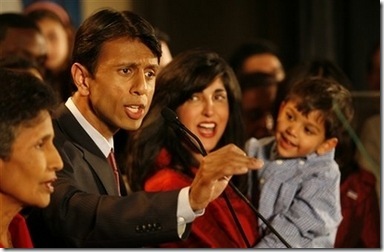
Governors of both parties have promoted education reform, but so far no one has delivered more than Louisiana’s Bobby Jindal. This week he’ll sign two bills that offer a national model for competition and parental choice.
Louisiana’s new laws will essentially give all parents an average of $8,500 to use for their child’s education as they see fit. They can keep their child in their local public school, but they can also try to get Johnny into a more demanding charter school, or a virtual school, or into special language or career-training courses, among other options.
Nearly 400,000 low-income children—a bit more than half of all students—will also be eligible for vouchers to attend private schools. State officials estimate that about 2,000 students will use vouchers this September given private-school capacity limits, but that tens of thousands will do so over time.
Louisiana is also making life easier for charter schools, with new authorizing boards, a fast-track for high-performing networks, and access to facilities equal to that of traditional public schools. The new laws seek to strengthen superintendents and principals over local school boards, which are bastions of bureaucratic and union intransigence.
Nearly as dramatic are reforms in teacher tenure. To earn tenure, teachers will now have to rate in the top 10% (measured in part by student performance) for five of six consecutive years, and any teacher who falls into the bottom 10% loses tenure. No teacher in the bottom 10% can get a raise, while layoffs will no longer hit the junior-most teachers first while ignoring performance.
Mr. Jindal made school reform a second-term priority after winning a landslide re-election last November. By then he had appointed or helped elect reformers to the state superintendent’s office and board of education.
Louisiana voters also had a preview of reform’s potential. Since Hurricane Katrina in 2005, New Orleans schools have become almost exclusively charters—with dramatic academic improvements—and the city has run a small and oversubscribed voucher program since 2008. As for tenure, the reforms attach consequences to a teacher-evaluation system enacted in 2010.
The result: the reforms attracted bipartisan legislative majorities of roughly 60%. Over four votes (two different bills, each having to pass the House and Senate), one-quarter to one-half of Democrats voted for reform, including many black representatives, especially those from New Orleans.
Teachers unions were predictably opposed and even heavier-handed than usual. Michael Walker Jones of the Louisiana Association of Educators dismissed choice on grounds that “If I’m a parent in poverty I have no clue because I’m trying to struggle and live day to day.” Unions pushed principals to cancel school—sometimes giving parents less than 24 hours notice—so teachers could protest at the state Capitol. It was a tired act.
Mr. Jindal joins Indiana’s Mitch Daniels in passing the most far-reaching school reforms, and now they’ll have to follow through to produce better student outcomes. Unions will seize on any troubles as a sign of failure, but success might catalyze similar reforms across the country that could finally improve the life prospects for all American children.
Now is a good time to compare and contrast those reforms with the record of the Obama administration:
“House and Senate Appropriators this week ignored the wishes of D.C.’s mayor, D.C.’s public schools chancellor, a majority of D.C.’s city council, and more than 70 percent of D.C. residents and have mandated the slow death of the D.C. Opportunity Scholarship Program. This successful school voucher program–for D.C.’s poorest families–has allowed more than 3,300 children to attend the best schools they have ever known.
The decision to end the program, a decision buried in a thousand-page spending bill and announced right before the holidays, destroys the hopes and dreams of thousands of D.C. families. Parents and children have rallied countless times over the past year in support of reauthorization and in favor of strengthening the OSP.
Yet, despite the clearly positive results and the proven success of this program, Sen. Dick Durbin, Rep. Jose Serrano, Del. Eleanor Holmes Norton, and Secretary Arne Duncan worked together to kill the OSP. Funding the program only for existing children shrinks the program each year, compromises the federal evaluation of the program, denies entry to the siblings of existing participants, and punishes those children waiting in line by sentencing them to failing and often unsafe schools.
What is incredibly disappointing to low-income families in Washington, D.C. has been the silence of President Barack Obama. The President, who benefited from K-12 scholarships himself, worked on behalf of low-income families in Chicago, and exercises school choice as a parent, has stood silently on the sidelines while his Secretary of Education belittled the importance of helping such a small number of children in the nation’s capital.”
Another Wall Street Journal article explains why voucher programs work for children. They don’t work for teacher unions, and that’s why Democrats oppose them.
Excerpt:
In a study published last year, Patrick Wolf of the University of Arkansas found that voucher recipients had graduation rates of 91%. That’s significantly higher than the D.C. public school average (56%) and the graduation rate for students who applied for a D.C. voucher but didn’t win the lottery (70%). In testimony before a Senate subcommittee in February, Mr. Wolf said that “we can be more than 99% confident that access to school choice through the Opportunity Scholarship Program, and not mere statistical noise, was the reason why OSP students graduated at these higher rates.”
The administration downplays these findings. But the students who attend D.C. public schools are overwhelmingly black and poor, and the achievement gap has a particularly devastating impact on their communities. High school dropouts are eight times more likely than someone with a diploma to wind up behind bars. Some 60% of black male high school dropouts in their 30s have prison records. And nearly one in four young black male dropouts is in jail or juvenile detention.
Mr. Obama says he wants to help all students—not just the lucky few who receive vouchers. But that’s an argument for offering more vouchers to those in need, not for reducing school choice. Policies ought to be weighed against available alternatives, not some unattainable ideal. The alternative to a voucher for families in D.C. ghettos and elsewhere is too often a substandard public school.
The positive effects of the D.C. voucher program are not unique. A recent study of Milwaukee’s older and larger voucher program found that 94% of students who stayed in the program throughout high school graduated, versus just 75% of students in Milwaukee’s traditional public schools. And contrary to the claim that vouchers hurt public schools, the report found that students at Milwaukee public schools “are performing at somewhat higher levels as a result of competitive pressure from the school voucher program.” Thus can vouchers benefit even the children that don’t receive them.
Research gathered by Greg Forster of the Foundation for Educational Choice also calls into question the White House assertion that vouchers are ineffective. In a paper released in March, he says that “every empirical study ever conducted in Milwaukee, Florida, Ohio, Texas, Maine and Vermont finds that voucher programs in those places improved public schools.” Mr. Forster surveyed 10 empirical studies that use “random assignment, the gold standard of social science,” to assure that the groups being compared are as similar as possible. “Nine [of the 10] studies find that vouchers improve student outcomes, six that all students benefit and three that some benefit and some are not affected,” he writes. “One study finds no visible impact. None of these studies finds a negative impact.”
Such results might influence the thinking of an objective observer primarily interested in doing right by the nation’s poor children. But they are unlikely to sway a politician focused on getting re-elected with the help of teachers unions.
There is a difference between Demcorats and Republicans, and the difference is that Republicans think that children do better when their parents can choose a school that works for their child. Republicans are the evidence-based party – they do what’s right. But Democrats do whatever it takes to please their special interest groups.

 WINTERY KNIGHT