In celebrating Ohio’s comeback, Obama is unintentionally repudiating his own policies. It turns out that, in spite of Obama, Ohio is 4th in the nation in job creation and tops in the Midwest. In the previous four years before Republican Gov. Kasich came into office, Ohio was 48th.
Even the states that are ahead of Ohio in job creation are far larger. Check out the other members of the top five job-creating states: Texas, New York, California and Florida. All are far more populous than Ohio. Florida, for instance, has 6.5 million more people, yet Ohio edged it out in job creation.
In fact, February’s BLS data showed that Ohio created more jobs than any other state. When was the last time that happened? Can’t tell, because the BLS doesn’t offer data prior to the Clinton era, so it’s been at least that long.
In short, Ohio proves that conservative fiscal policies work in spite of Barack Obama. While Obama’s “leadership” destroyed America’s pristine AAA credit rating, S&P was simultaneously upgrading Ohio’s rating.
[…]Kasich has a damn good record when it comes to fiscal policies. Bill Clinton won’t ever admit it in public, but the real architect of the much-ballyhooed ‘Clinton Surplus’ was none other than John Kasich, the Paul Ryan of Newt Gingrich’s House of Representatives.
John Kasich is one of three governors that I am watching closely. The other two really good ones are Scott Walker in Wisconsin and Bobby Jindal in Louisiana. I personally think that Kasich is the best governor in the United States of America. And Ohio has a great Senate candidate too, named Josh Mandel.
Run up spending and debt, raise taxes in the naming of balancing the budget, but then watch as deficits rise and your credit-rating falls anyway. That’s been the sad pattern in Europe, and now it’s hitting that mecca of tax-and-spend government known as Illinois.
Though too few noticed, this month Moody’s downgraded Illinois state debt to A2 from A1, the lowest among the 50 states. That’s worse even than California. The state’s cost of borrowing for $800 million of new 10-year general obligation bonds rose to 3.1%—which is 110 basis points higher than the 2% on top-rated 10-year bonds of more financially secure states.
This wasn’t supposed to happen. Only a year ago, Governor Pat Quinn and his fellow Democrats raised individual income taxes by 67% and the corporate tax rate by 46%. They did it to raise $7 billion in revenue, as the Governor put it, to “get Illinois back on fiscal sound footing” and improve the state’s credit rating.
So much for that. In its downgrade statement, Moody’s panned Illinois lawmakers for “a legislative session in which the state took no steps to implement lasting solutions to its severe pension underfunding or to its chronic bill payment delays.” An analysis by Bloomberg finds that the assets in the pension fund will only cover “45% of projected liabilities, the least of any state.” And—no surprise—in part because the tax increases have caused companies to leave Illinois, the state budget office confesses that as of this month the state still has $6.8 billion in unpaid bills and unaddressed obligations.
It’s worth contrasting this grim picture with that of Wisconsin north of the border. Last winter Madison was occupied by thousands of union protesters trying to bully legislators to defeat Republican Governor Scott Walker’s plan to require government workers to pay a larger share of their health-plan costs, and to shore up the pension system by trimming future retirement liabilities. The reforms passed anyway.
In contrast to the Illinois downgrade, Moody’s has praised Mr. Walker’s budget as “credit positive for Wisconsin,” adding that the money-saving reforms bring “the state’s finances closer to a structural budgetary balance.” As a result, Wisconsin jumped in Chief Executive magazine’s 2011 ranking of each state’s business climate—moving to 17th from 41st. Illinois dropped to 48th from 45th as ranked by the nation’s top CEOs.
Ohio’s new fiscal responsibility is getting noticed and rewarded.
Standard & Poor’s upgraded the state’s credit forecast from “negative” to “stable,” in time for a $417 million bond sale last week to refinance at a lower interest rate and restructure debt.
Ohio’s lean budget will pay off with lower costs for borrowing, saving taxpayers as much as $1 million or more over the course of a year, according to the state’s Office of Budget and Management. It’s like having a credit-card company lower its annual percentage rate: The borrower can either accelerate the payoff or spend the savings elsewhere.
So essentially, cutting state programs spared money for state programs.
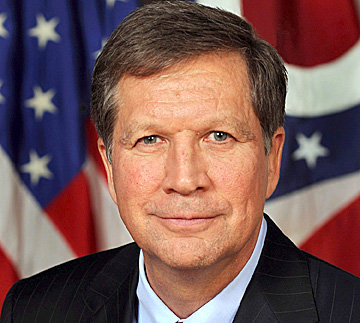
This is vindication for the Kasich administration. When Gov. John Kasich took office this year, the state was $8 billion in the hole and its rainy-day fund totaled $1.78. That’s not a typo; Ohio barely had enough in the bank to buy itself a cup of coffee. A small one.
[…]Investors pay attention to these ratings, especially since Ohio stands out as other states continue to struggle. “There are a lot of jitters in the credit market; I can’t imagine it won’t be helpful,” said Robin Prunty, primary credit analyst with Standard & Poor’s.
[…]Most states still are struggling with the economic recovery and phasing out one-time money from the federal stimulus program that Kasich’s predecessor used to paper over the deficit. S&P’s revised outlook reflects its view that Ohio’s economy “is steadily recovering.”
“The outlook revision reflects the state’s progress in moving toward structural budget balance through fiscal 2013 and the modest economic recovery under way,” its report says.
Republican tax policies work, and Democrat policies don’t. Taxing the rich sounds good, but it doesn’t help the poor. To help the poor, we need to encourage people with capital to risk it by engaging in enterprises for profit. That is what causes workers to be hired and wealth to be created – forming valuable products and services through ingenuity and labor. Workers who build skills and experience while working have more confidence and can be more productive, making them more free because they can succeed independently of government handouts.
Governor John Kasich of Ohio has signed into law a bill meant to strengthen the parental consent law in place that prohibits teens from getting an abortion without their parents’ consent is moving along in the legislative process.
House Bill 63 and Senate Bill 8 would revise Ohio’s current judicial bypass provision in the parental consent on abortion law. This bill will strengthen current law by requiring a “clear and convincing evidence” standard, require judges to specifically inquire about the minor’s understanding of the possible physical and emotional complications of an abortion, and require judges to question how much the minor has been prepped to respond to such questions.
[…]“We thank Governor Kasich, Senate President Tom Niehaus, and Speaker Bill Batchelder who continue to advance life-saving policies,” said Mike Gonidakis, Executive Director of Ohio Right to Life. “H.B. 63 strengthens parents’ ability to care for their children and prevents lawyers and others from taking mom and dad’s place when their child needs them most.”
[…]In July, Kasich signed into law a bill to ban late-term abortions in Ohio — something Gonidakis applauded.
“2011 has been a banner year for significant and responsible pro-life legislation. Ohio is witnessing the blessings of having the most pro-life Governor and General Assembly in our state’s history working together to save lives,” said Gonidakis.
This is good news for pro-lifers voters in Ohio. Ohio voters were careful to choose a pro-life candidate for governor, and now they are reaping the rewards for all of their hard work. The important thing is to choose the right candidate – someone who means business on social issues.


 WINTERY KNIGHT