
Tag Archives: Jobs

Michigan governor Rick Snyder signs right-to-work bill into law

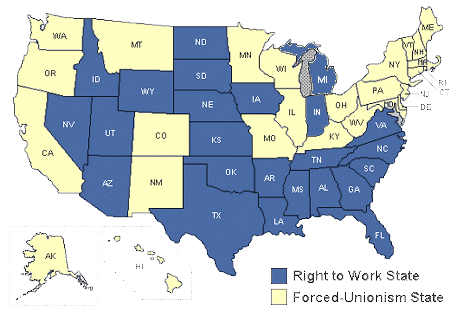
Map of right-to-work states: Michigan is #24

It’s official – Michigan has enacted a new right-to-work law that will create more jobs and free workers from having to violate their consciences by forcibly supporting pro-abortion, pro-gay marriage policies via their mandatory union dues.

Here’s an interesting article by Byron York in the Washington Examiner, discussing the political significance of this development.

Excerpt:

Republicans say the move would not only give current workers the freedom to choose whether to join a union and pay dues but would, more importantly, bring many, many new jobs to Michigan. Rep. Gov. Rick Snyder, who supports the bill, points out that Indiana enacted (after a long and bitter fight) the same kind of law earlier this year. “We’ve carefully watched what’s gone on in Indiana since they passed similar legislation back in February,” Snyder told Fox News’ Greta van Susteren last week, “and they’ve seen a significant increase in the number of companies talking about [bringing] thousands of jobs to their state.”

Of course, the move is not just economic. It’s political, too. Democrats depend on millions — actually, billions — of dollars in support from the forced dues of union members. If that money supply were to dry up, or even just decrease, the Democratic Party would be in serious trouble.

De-funding the unions is the first step to education reform. And Michigan students need education reform very badly. Even 40% of the union workers – who are much more sensible and patriotic than the union bosses – agree with the new law:

Regardless of news reports, the people of Michigan are behind this. A recent poll showed that 51 percent of Michigan voters support right-to-work. Only 41 percent are opposed. In fact, 40 percent of union households supported it. In November, Michigan voters rejected a ballot proposal that would have amended the state constitution to prevent the legislature from passing a right-to-work law and elevated union contracts above state law. The New York Times called it “a test case on enshrining the rights of unions,” and unions spent more than $23 million campaigning for the initiative. It lost by 15 points.

[…][M]aking union dues voluntary makes union organizers less aggressive—they get less financial benefit from organizing new firms, because they cannot force workers to pay them. Union organizing attempts drop 40 percent to 50 percent after states pass a right-to-work law. That in turn attracts business investment. Employers want to know unions will leave them alone if they treat their workers well. As a result, right-to-work states have lower unemployment rates—and more manufacturing jobs.

CNS News reports that only 7% of Detroit public school 8th graders can read at proficiency level.

Excerpt:

In the public schools in Detroit, Mich., according to the U.S. Department of Education, only 7 percent of the eighth graders are grade-level proficient or better in reading.

Some public school teachers in the City of Detroit and around the state of Michigan are reportedly taking a vacation or a sick day today to protest right-to-work legislation likely to be approved by the state legislature. Under current law, Michigan public school teachers must pay dues to the teachers’ union. If the right-to-work law is enacted, Michigan public-school teachers will be free to join the union and pay dues to it if they wish, but they will also be free not to join the union and not to pay it dues.

Detroit public-school eighth graders do even worse in math than they do in reading, according to the Department of Education. While only 7 percent scored highly enough on the department’s National Assessment of Educational Progress test in 2011 to be rated “proficient” or better in reading, only 4 percent scored highly enough to be rated “proficient” or better in math.

Statewide in Michigan, only 32 percent of public-school eighth graders scored grade-level proficient or better in reading, and only 31 percent scored grade-level proficient or better in math.

According to this report, over 26,000 students missed school because of the “sick day” protest by the teachers.

Here’s a video of what happens at the protests:

The actual unemployment rate of right-to-work states is 6.7%. Compare that with the 8.7% unemployment rate of forced-unionism states. Jobs are the number one priority right now, and right-to-work means more jobs.

Related posts

New York Times columnist exposes the moral hazards created by welfare programs

Ultra-leftist Nicholas Kristoff writes about the incentives created by welfare programs in the New York Times.

Excerpt:

This is what poverty sometimes looks like in America: parents here in Appalachian hill country pulling their children out of literacy classes. Moms and dads fear that if kids learn to read, they are less likely to qualify for a monthly check for having an intellectual disability.

Many people in hillside mobile homes here are poor and desperate, and a $698 monthly check per child from the Supplemental Security Income program goes a long way — and those checks continue until the child turns 18.

“The kids get taken out of the program because the parents are going to lose the check,” said Billie Oaks, who runs a literacy program here in Breathitt County, a poor part of Kentucky. “It’s heartbreaking.”

This is painful for a liberal to admit, but conservatives have a point when they suggest that America’s safety net can sometimes entangle people in a soul-crushing dependency. Our poverty programs do rescue many people, but other times they backfire.

Some young people here don’t join the military (a traditional escape route for poor, rural Americans) because it’s easier to rely on food stamps and disability payments.

Antipoverty programs also discourage marriage: In a means-tested program like S.S.I., a woman raising a child may receive a bigger check if she refrains from marrying that hard-working guy she likes. Yet marriage is one of the best forces to blunt poverty. In married couple households only one child in 10 grows up in poverty, while almost half do in single-mother households.

Most wrenching of all are the parents who think it’s best if a child stays illiterate, because then the family may be able to claim a disability check each month.

“One of the ways you get on this program is having problems in school,” notes Richard V. Burkhauser, a Cornell University economist who co-wrote a book last year about these disability programs. “If you do better in school, you threaten the income of the parents. It’s a terrible incentive.”

About four decades ago, most of the children S.S.I. covered had severe physical handicaps or mental retardation that made it difficult for parents to hold jobs — about 1 percent of all poor children. But now 55 percent of the disabilities it covers are fuzzier intellectual disabilities short of mental retardation, where the diagnosis is less clear-cut. More than 1.2 million children across America — a full 8 percent of all low-income children — are now enrolled in S.S.I. as disabled, at an annual cost of more than $9 billion.

That is a burden on taxpayers, of course, but it can be even worse for children whose families have a huge stake in their failing in school. Those kids may never recover: a 2009 study found that nearly two-thirds of these children make the transition at age 18 into S.S.I. for the adult disabled. They may never hold a job in their entire lives and are condemned to a life of poverty on the dole — and that’s the outcome of a program intended to fight poverty.

Charles Murray of the American Enterprise Institute is delighted that a leftist has finally discovered what welfare programs actually do in practice:

Several people have tagged me and Losing Ground since Nicholas Kristoff’s column on Friday about the ways that social programs can backfire. It was a praiseworthy column—all of us on both sides of the political spectrum should be as ready as Kristoff to acknowledge problems with our beliefs. But it also offers an opportunity to recall the three laws of social programs in Losing Ground, because the backfires are not idiosyncratic. They occur everywhere and always for inherent reasons.

1. The Law of Imperfect Selection. Any objective rule that defines eligibility for a social transfer program will irrationally exclude some persons.

This law accounts for the reason that programs like Food Stamps and the Supplemental Security Income program constantly expand. Whenever the people who administer the programs run into a case of a genuinely needy person who has been excluded under a current rule, they tend to redefine the rule or otherwise alter the program’s administration to be more inclusive, which in turn brings more people who don’t need the social transfer under its umbrella.

2. The Law of Unintended Rewards. Any social transfer increases the net value of being in the condition that prompted the transfer.

Kristoff referenced the increased net value of being illiterate because of the “intellectual disability” payment of $698 per month that leads parents to withdraw their children from literacy classes. But the same thing is true of every payment of any kind that requires people to demonstrate that they have a problem before they qualify for the payment. It is not a defect in program design. It is inescapable whenever you give rewards for having a problem.

3. The Law of Net Harm. The less likely it is that the unwanted behavior will change voluntarily, the more likely it is that a program to induce change will cause net harm.

This is not as obvious as the first two laws, but just as inexorable. My favorite chapter of Losing Ground is a thought experiment about a government program that uses financial rewards to reduce smoking. If the rewards are small, nothing will change. If they are large enough to induce a significant number of people to quit smoking, the program will inevitably lead to more people who take up smoking in the first place and the net number of inveterate smokers.

Fewer and fewer people are old enough to remember, but once upon a time almost all children were born to married couples and almost all young men were physically able to work and knew how to show up on time and work hard. Then, in the mid-1960s, before globalization, before manufacturing jobs disappeared, while working-class wages were still going up, we decided that compassion should be bureaucratized. The three laws of social programs explain a lot of what has happened to the working class since then.

The Daily Caller reported that food stamp usage reached a record high – now up to 47.7 million. That’s about 1 in 6 Americans. We used to be a country of independence, entrepreneurship and hard work. But things changed – we had an explosion in welfare spending. Welfare spending changed the incentives and that changed behaviors. We have to understand that having the government reward laziness gets us more laziness. Taxing people who create jobs gets us fewer jobs. It’s that simple – people respond to incentives.

73% of the new jobs created in the last 5 months were government jobs

From CNS News.

Excerpt:

In June, a total of 142,415,000 people were employed in the U.S, according to the BLS, including 19,938,000 who were employed by federal, state and local governments.

By November, according to data BLS released today, the total number of people employed had climbed to143,262,000, an overall increase of 847,000 in the six months since June.

In the same five-month period since June, the number of people employed by government increased by 621,000 to 20,559,000. These 621,000 new government jobs created in the last five months equal 73.3 percent of the 847,000 new jobs created overall.

How is it possible that the unemployment rate is going down? It’s simple. The government is borrowing over $1 trillion dollars a year from unborn and born children, and they are using that money to reduce the unemployment rate.

That explains part of the drop in unemployment, but there’s more.

Excerpt:

As for that big “drop” in the unemployment rate, all of it was due to the fact that 540,000 Americans are no longer looking for work. They either dropped out, took early disability or retired. Since the start of 2009, 9.7 million Americans have fallen into this category.

All told, more than 24 million Americans who want jobs don’t have them, driving the labor force participation rate to 63.6%, just above August’s 31-year low of 63.5%. This is the worst labor market in a recovery ever.

And it may get worse. The quarterly Wells Fargo/Gallup small-business survey found that 21% plan to cut jobs over the next six months — a surge from 10% last June and a record high.

IBD’s own research shows that small businesses account for nearly 80% of all new job creation in America. A small-business slump means no jobs. It’s that simple.

Business are already being regulated to death by Obamacare, and all this deficit spending means borrowing that has to be paid back with inflation or higher taxes. Why on Earth would anyone try to hire people now? This economy is a wreck.