Tag Archives: Job

Law schools are not preparing law students to practice law

The New York Times explains why law school may not be worth the money.

Excerpt:

 The lesson today — the ins and outs of closing a deal — seems lifted from Corporate Lawyering 101.

“How do you get a merger done?” asks Scott B. Connolly, an attorney.

There is silence from three well-dressed people in their early 20s, sitting at a conference table in a downtown building here last month.

“What steps would you need to take to accomplish a merger?” Mr. Connolly prods.

After a pause, a participant gives it a shot: “You buy all the stock of one company. Is that what you need?”

“That’s a stock acquisition,” Mr. Connolly says. “The question is, when you close a merger, how does that deal get done?”

The answer — draft a certificate of merger and file it with the secretary of state — is part of a crash course in legal training. But the three people taking notes are not students. They are associates at a law firm called Drinker Biddle & Reath, hired to handle corporate transactions. And they have each spent three years and as much as $150,000 for a legal degree.

What they did not get, for all that time and money, was much practical training. Law schools have long emphasized the theoretical over the useful, with classes that are often overstuffed with antiquated distinctions, like the variety of property law in post-feudal England. Professors are rewarded for chin-stroking scholarship, like law review articles with titles like “A Future Foretold: Neo-Aristotelian Praise of Postmodern Legal Theory.”

So, for decades, clients have essentially underwritten the training of new lawyers, paying as much as $300 an hour for the time of associates learning on the job. But the downturn in the economy, and long-running efforts to rethink legal fees, have prompted more and more of those clients to send a simple message to law firms: Teach new hires on your own dime.

“The fundamental issue is that law schools are producing people who are not capable of being counselors,” says Jeffrey W. Carr, the general counsel of FMC Technologies, a Houston company that makes oil drilling equipment. “They are lawyers in the sense that they have law degrees, but they aren’t ready to be a provider of services.”

[…]Consider, for instance, Contracts, a first-year staple. It is one of many that originated in the Langdell era and endures today. In it, students will typically encounter such classics as Hadley v. Baxendale, an 1854 dispute about financial damages caused by the late delivery of a crankshaft to a British miller.

Here is what students will rarely encounter in Contracts: actual contracts, the sort that lawyers need to draft and file. Likewise, Criminal Procedure class is normally filled with case studies about common law crimes — like murder and theft — but hardly mentions plea bargaining, even though a vast majority of criminal cases are resolved by that method.

[…]“We should be teaching what is really going on in the legal system,” says Edward L. Rubin, a professor and former dean at the Vanderbilt Law School, “not what was going on in the 1870s, when much of the legal curriculum was put in place.”

This is one of the reasons why I give the advice I do about studying STEM (science, technology, engineering and math). Universities are politicized. They are run by people who want to push a secular leftist ideology. For such people, the more isolated you can be from feedback from the real world, the better. And that is why it is often (but not always) useless to study anything that isn’t STEM. If you’re going to the university at all, study STEM areas. That is, if your goal is to actually make money so you can support a family.

So you have two choices, in my view. Trade school/apprenticeship right out of high school. Or study STEM areas in university. That’s it.

A friend of mine who is a software engineer was thinking of doing an MBA a while back, and then decided on a Masters in securities and investing. I think that’s the right way to go. Stay as far away from anything that can be politicized as possible. Don’t give people who are embarked on perpetual adolescence any of your money (than they already get through taxpayer-funded research subsidies).
How Obama’s plan to raise the minimum wage will hurt young black men

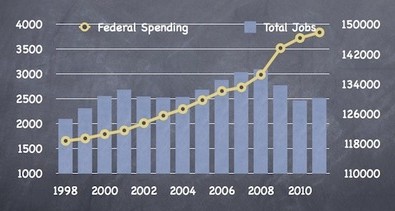
Government Spending Vs Jobs

From Investors Business Daily.

Excerpt:

How amusing to watch Democrats wring their hands over what they can do to get businesses to create jobs, when one of the biggest job killers is the minimum wage they keep hiking.

Recall that it was Democrats who raised the federal wage floor a whopping $2.10 an hour in the middle of the recession. The record 41% increase has led to record unemployment among young people, especially black teens.

Congress started ratcheting up the minimum wage from $5.15 an hour in mid-2007, arguing it would help abate poverty. But retailers looking to slash costs eliminated low-skilled, entry-level jobs rather than pay the mandated increases.

Now 1.5 million fewer teens are working. Last year’s unemployment rate for workers ages 16 to 19 shot up to 26% from 2007’s 15%.

As for black teens, their joblessness soared to a record 43% after the final raise to $7.25 took effect in mid-2009. It helped put more than half of young black men out of work — a first.

The president proposes cranking the minimum wage even higher to $9.50. Then he wants to raise it every year thereafter as a “living wage” indexed to inflation.

Yes, this is the problem that happens when you elect someone who knows nothing whatsoever about economics. And when I say nothing, I mean he is in disagreement with virtually all economists across the ideological spectrum.

Moderate economist Gregory Mankiw of Harvard University lists the policies that are accepted by virtually all economists.

Here’s Greg’s list, together with the percentage of economists who agree:

  1. A ceiling on rents reduces the quantity and quality of housing available. (93%)
  2. Tariffs and import quotas usually reduce general economic welfare. (93%)
  3. Flexible and floating exchange rates offer an effective international monetary arrangement. (90%)
  4. Fiscal policy (e.g., tax cut and/or government expenditure increase) has a significant stimulative impact on a less than fully employed economy. (90%)
  5. The United States should not restrict employers from outsourcing work to foreign countries. (90%)
  6. The United States should eliminate agricultural subsidies. (85%)
  7. Local and state governments should eliminate subsidies to professional sports franchises. (85%)
  8. If the federal budget is to be balanced, it should be done over the business cycle rather than yearly. (85%)
  9. The gap between Social Security funds and expenditures will become unsustainably large within the next fifty years if current policies remain unchanged. (85%)
  10. Cash payments increase the welfare of recipients to a greater degree than do transfers-in-kind of equal cash value. (84%)
  11. A large federal budget deficit has an adverse effect on the economy. (83%)
  12. A minimum wage increases unemployment among young and unskilled workers. (79%)
  13. The government should restructure the welfare system along the lines of a “negative income tax.” (79%)
  14. Effluent taxes and marketable pollution permits represent a better approach to pollution control than imposition of pollution ceilings. (78%)

From CNBC, we get this article showing that any increase in the minimum wage will raise the unemployment rate for young people.

Excerpt:

A quarter of teenagers were jobless in March, representing a surprising increase from February, even as the unemployment rate for the rest of the population decreased.

This figure may only get worse if budget-strapped states raise the minimum wage, and it could also be a sign of greater structural damage underlying our economy, analysts said.

The unemployment rate for 16- to 19-year olds jumped back up to 24.5 percent in March, up from 23.9 percent the prior month, according to the latest jobs data from the Labor Department.

[…]“Even when comprehending that teen employment is volatile in nature, the data that exists serves up some shock and awe,” said Brian Sozzi, a retail research analyst with Wall Street Strategies, in a note Wednesday. “If these (wage) increases do go through, the prospect for teen employment will remain grim as employers search for workers with advanced skills to fill positions.”

Twelve states, including Illinois and Pennsylvania, are considering a hike in the minimum wage. While this has been the subject of a long-running debate, many economists and analysts say raising this pay bar may cause more teen layoffs, even as it helps teens who manage to stay employed make more.

“Minimum wage increases over the past few years has definitely made it worse,” said Peter Boockvar, chief equities strategist at Miller Tabak. “In fact, there should be zero minimum wage for teenagers, or at most, something much less than the current rate.”

Teens typically are the first to be fired and the last to be hired back in a normal economic cycle, so this rate can be considered a kind of leading indicator of employment.

A new study shows that only 25% of teens will be able to find jobs this summer. And Obama thinks that this number is apparently too high. He wants to lower it by raising the price that must be paid by employers who would like to hire younger workers.

You can find out more about how raising the minimum wage increases unemployment from this comprehensive, 50-year, government study.

Excerpt:

Summary of Research on the Minimum Wage

* The minimum wage reduces employment.

Currie and Fallick (1993), Gallasch (1975), Gardner (1981), Peterson (1957), Peterson and Stewart (1969).

* The minimum wage reduces employment more among teenagers than adults.

Adie (1973); Brown, Gilroy and Kohen (1981a, 1981b); Fleisher (1981); Hammermesh (1982); Meyer and Wise (1981, 1983a); Minimum Wage Study Commission (1981); Neumark and Wascher (1992); Ragan (1977); Vandenbrink (1987); Welch (1974, 1978); Welch and Cunningham (1978).

* The minimum wage reduces employment most among black teenage males.

Al-Salam, Quester, and Welch (1981), Iden (1980), Mincer (1976), Moore (1971), Ragan (1977), Williams (1977a, 1977b).

* The minimum wage helped South African whites at the expense of blacks.

Bauer (1959).

* The minimum wage hurts blacks generally.

Behrman, Sickles and Taubman (1983); Linneman (1982).

* The minimum wage hurts the unskilled.

Krumm (1981).

* The minimum wage hurts low wage workers.

Brozen (1962), Cox and Oaxaca (1986), Gordon (1981).

* The minimum wage hurts low wage workers particularly during cyclical downturns.

Kosters and Welch (1972), Welch (1974).

* The minimum wage reduces average earnings of young workers.Meyer and Wise (1983b).

* The minimum wage reduces employment in low-wage industries, such as retailing.Cotterman (1981), Douty (1960), Fleisher (1981), Hammermesh (1981), Peterson (1981).

* The minimum wage causes employers to cut back on training.Hashimoto (1981, 1982), Leighton and Mincer (1981), Ragan (1981).

* The minimum wage encourages employers to install labor-saving devices.Trapani and Moroney (1981).

* The minimum wage increases the number of people on welfare.Brandon (1995), Leffler (1978).

* The minimum wage hurts the poor generally.

Stigler (1946).

* The minimum wage does little to reduce poverty.

Bonilla (1992), Brown (1988), Johnson and Browning (1983), Kohen and Gilroy (1981), Parsons (1980), Smith and Vavrichek (1987).

* The minimum wage helps unions.Linneman (1982), Cox and Oaxaca (1982).

* The minimum wage increases teenage crime rates.Hashimoto (1987), Phillips (1981).

* The minimum wage encourages employers to hire illegal aliens.

Beranek (1982).

* Few workers are permanently stuck at the minimum wage.

Brozen (1969), Smith and Vavrichek (1992).

* The minimum wage has reduced employment in foreign countries.Canada: Forrest (1982); Chile: Corbo (1981); Costa Rica: Gregory (1981); France: Rosa (1981).

This is why it is important for voters to understand economics. When you raise the price of labor, fewer employers will purchase labor. Supply and demand.

How Barack Obama gave top campaign donors government jobs

Left-leaning Politico reports on corruption, cronyism, nepotism and patronage appointments in the Obama administration.

Excerpt:

Telecom executive Donald H. Gips raised a big bundle of cash to help finance his friend Barack Obama’s run for the presidency.

Gips, a vice president of Colorado-based Level 3 Communications, delivered more than $500,000 in contributions for the Obama war chest, while two other company executives collected at least $150,000 more.

After the election, Gips was put in charge of hiring in the Obama White House, helping to place loyalists and fundraisers in many key positions. Then, in mid-2009, Obama named him ambassador to South Africa. Meanwhile, Level 3 Communications, in which Gips retained stock, received millions of dollars of government stimulus contracts for broadband projects in six states — though Gips said he had been “completely unaware” that the company had received the contracts.

More than two years after Obama took office vowing to banish “special interests” from his administration, nearly 200 of his biggest donors have landed plum government jobs and advisory posts, won federal contracts worth millions of dollars for their business interests or attended numerous elite White House meetings and social events, an investigation by iWatch News has found.

These “bundlers” raised at least $50,000 — and sometimes more than $500,000 — in campaign donations for Obama’s campaign. Many of those in the “Class of 2008” are now being asked to bundle contributions for Obama’s reelection, an effort that could cost $1 billion.

As a candidate, Obama spoke passionately about diminishing the clout of moneyed interests. Kicking off his presidential run on Feb. 10, 2007, he blasted “the cynics, the lobbyists, the special interests,” who had “turned our government into a game only they can afford to play.”

“We’re here today to take it back,” he said.

Say one thing in public, and do the opposite in private. Don’t believe the words of a candidate in their stump speeches. Look at their voting record, and their legislative initiatives, and their ratings from non-partisan organizations, such as the Club For Growth, Citizens Against Government Waste, and the National Taxpayer’s Union. Don’t vote based on pleasant sounding words and pleasant appearances, do the research.