Tag Archives: Job Creator

Fiscal cliff deal raises taxes by $600 billion, increases spending $330 billion

The Heritage Foundation explains.

Excerpt:

The Congressional Budget Office (CBO) just now released its score of the bill the Senate passed early this morning while everyone was celebrating the beginning of the New Year. Despite knowing for a long time that taxes would go up on all Americans today, the Senate waited until we technically went over the cliff to act. Washington’s dysfunction was even fodder for New Year’s revelers in Times Square.

Going over the cliff allows Congress to technically say that it isn’t raising taxes, but is cutting them instead. CBO’s score backs them up on this by scoring the Senate bill as a $3.6 trillion tax cut. No one should fall for this. The Senate bill is a tax hike because it allows taxes to go up from 2012 to 2013. The tax increases in the bill will reportedly raise about $600 billion over the next 10 years.

Also of note in the CBO score is that the Senate bill increases spending by around $330 billion by extending expanded unemployment benefits, a temporary “doc fix” patch to prevent cuts to Medicare, and extension of the agriculture programs.

There was some good in the Senate bill — the harmful defense sequester cuts were postponed and most tax hikes were avoided. But there was bad — tax hikes that will hurt the economy and do little to tame the deficit, especially factoring in the spending in the bill.

As I noted before, the CBO has predicted that the bill will add $4 trillion to the national debt, taking us over the $20 trillion mark.

Bloomberg:

The budget deal passed by the U.S. Senate today would raise taxes on 77.1 percent of U.S. households, mostly because of the expiration of a payroll tax cut, according to preliminary estimates from the nonpartisan Tax Policy Center in Washington.

More than 80 percent of households with incomes between $50,000 and $200,000 would pay higher taxes. Among the households facing higher taxes, the average increase would be $1,635, the policy center said. A 2 percent payroll tax cut, enacted during the economic slowdown, is being allowed to expire as of yesterday.

According to the CBO, the deal would raise taxes by $41 for every $1 cut from the budget. Have we really dodged a fiscal cliff?
 

Obama’s fiscal cliff plan would increase debt to $20 trillion by 2016

Forbes magazine explains why Obama’s plan doesn’t solve our long-term spending problem.

Excerpt:

The President, while not presenting concrete proposals, has been quite clear on what he wants: to raise taxes on the top two percent, keep the Bush tax cuts for everyone else, offer only vague promises of future spending cuts, and gain the unprecedented authority to raise the debt limit without Congressional approval. He does not plan to reform the entitlements so dear to his heart and his base’s. Instead of less spending, he would like to spend more on “stimulus” and “investments.” Obama knows that physicians will desert Medicare if he cuts their compensation by the scheduled 26.5 percent. That is simply not going to happen.

Here are Obama’s desired alternative fiscal policies to avoid the fiscal cliff in order of their effect on the five-year budget as estimated by the CBO:

1. Preserve Bush tax cuts and other tax provisions for everyone except the top 2 percent: Raises the five-year deficit by $2.0 trillion.

2. Drop the fiscal-cliff sequestration of spending and expand discretionary spending by the rate of inflation: Raises the five-year deficit by another trillion dollars.

3. Raise the tax rate on the top 2 percent:  Lowers the five-year deficit by $300 billion.

4. Extend enhanced unemployment benefits: Raises the five-year deficit by $200 billion.

5. Do not cut Medicare payment rates to physicians: Raises the five-year deficit by some $100.

Four of the five fiscal policies on Obama’s wish list raise the deficit. Only one – the vaunted tax on the rich on which he based his campaign – lowers the deficit, but only by a miniscule $300 billion ($60 billion per year). If Obama gets the tax and spending changes he wants, his 2017 successor will inherit a national debt in excess of  $20 trillion.

A warning: The 2013-2017 budget deficits could be much higher. No one knows what the costs of Obama Care will be. By 2017, the federal government will be spending more on health care than on social security. The CBO projection assumes that the costs of Obama Care come in on target. If Obama Care cannot contain health care costs, we could easily see a five-year deficit well in excess of $5 trillion, for an annual deficit of more than a trillion dollars. The CBO also uses a historically low rate of increase of discretionary non-defense spending equal to the rate of inflation. If we return to “business as usual” in Washington, the discretionary spending figure could also be blasted out of the water.

Obama based his re-election campaign on “the rich should pay their fair share” and “I killed Osama.” Well before the election, it was clear from the government’s own figures that taxing the top two percent would make only a tiny contribution to solving our deficit problems.

Why was this not pointed out by the media, who played along with the “tax the rich” fairy tale?  Why was this not the central theme of the Republican campaign?

I think that point I highlighted in bold deserves emphasis. Obama ran up over $6 trillion in new debt – pushing us to a $16.5 trillion dollar debt. His “balanced approach” will generate a measly $60 billion a year in “new revenues”, assuming that “the rich” don’t just curtail their productive activities and shift their operations elsewhere (Canada). If you generate $60 billion in revenues, there is NO WAY that this is going to pay for a trillion dollars a year in new debt. So we are on track to hit over $20 trillion in national debt in Obama’s second term, taking us into Greece-like territory.

And that is according to the official CBO numbers.

Unemployment rates are lower and wages are higher in right-to-work states

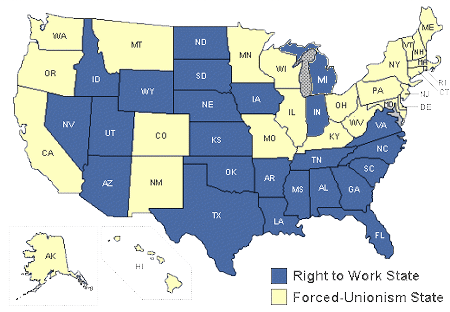
Map of right-to-work states: Michigan is #24

Previously, we saw that unemployment rates in right-to-work states were MUCH lower than in states that force workers to join unions and pay union dues in order to work.

Curtis sent me this article from Investors Business Daily, which looks at whether wages are lower in states that have right-to-work laws.

Excerpt:

The president says right-to-work laws mean “the right to work for less money.” So how does he explain the fact that incomes are up in RTW states while forced unionism is a proven job killer?

Campaigning Monday in Michigan as it stood poised to become the nation’s 24th right-to-work state, President Obama spoke the exact opposite of the truth to union workers at a Daimler Detroit Diesel plant in the birthplace of organized labor.

Is Obama telling the truth?

Let’s see:

According to Michigan’s Mackinac Center, using data taken from the Bureau of Economic Analysis and Bureau of Labor Statistics, private-sector, inflation-adjusted employee compensation in right-to-work states increased by 12% between 2001 and 2011 compared with just 3% over the same period in forced-unionization states.

These good wages came from good jobs. Employment in right-to-work states expanded 2.4% over the same stretch vs. a 3.4% decline in non-right-to-work states. Ironically, Obama is taking credit for jobs created in RTW states.

According to the National Institute for Labor Relations Research, right-to-work states (excluding Indiana, which passed a RTW law in early 2012) “were responsible for 72% of all net household job growth across the U.S. from June 2009 through September 2012.”

This is why people vote with their feet and move to these states. RTW states experienced large population gains of 15.3% from 2000 to 2010, compared to 5.9% in non-RTW states.

Obama did get one thing right, though, when he said the bills that passed both houses of the Michigan legislature “don’t have to do with economics. They have everything to do with politics.”

The president who fought Boeing’s expansion in RTW South Carolina knows it’s all about his keeping union dues flowing into Democratic coffers and maintaining the plush lifestyles of the union leaders who support him.

The right thing for Republicans to do when they get elected is to cut off all sources of funding for the Democrat Party. Right-to-work laws and school choice promote freedom and diminish the amount of power that left-wing, pro-abortion, pro-gay-marriage labor unions can exert. They will have less money, and with less money, they will have less influence on elections. Let the people decide, not the powerful, corrupt labor unions.

Related posts