
Tag Archives: Jesus

Friday Night Funny: There’s probably no Dawkins showing up to debate Craig

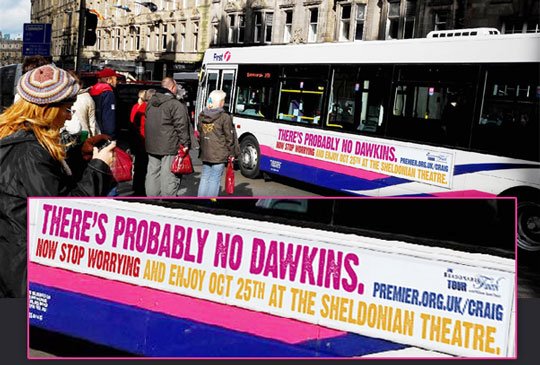
There's Probably No Dawkins

Full story here. (H/T Apologetics 315)

Excerpt:

‘THERE’S PROBABLY NO DAWKINS’ SLOGAN FOR OXFORD BUSES
‘Reasonable Faith Tour’ with William Lane Craig Responds to Dawkins Boycott

A message with a familiar ring to it will be rolling out on the side of buses in Oxford from 10th of October. ‘There’s Probably No Dawkins. Now Stop Worrying and Enjoy Oct 25th at the Sheldonian Theatre’

The advertising campaign follows Richard Dawkins’ refusal to publicly debate the existence of God with philosopher William Lane Craig when he visits the UK in October. He has an open invitation to debate Craig at Oxford’s Sheldonian Theatre on 25th October.

The Oxford bus campaign echoes the 2009 London atheist bus advertisements: ‘There’s Probably No God. Now Stop Worrying And Enjoy Your Life.’

The ‘Reasonable Faith Tour’ organisers, supported by Premier Christian Radio, commissioned the advert, which will roll out on 30 buses in Oxford from 10th October for two weeks. ‘There’s Probably No Dawkins. Now Stop Worrying and Enjoy Oct 25th at the Sheldonian Theatre’ promotes this significant event.

BACKGROUND: William Lane Craig is Research Professor of Philosophy at Talbot School of Theology, California and is arguably the world’s foremost defender of historic Christianity. Widely respected among academic philosophers, he has debated with many leading atheists across the world, including Peter Atkins, Daniel Dennett, Anthony Flew, A.C.Grayling, Christopher Hitchens, Lewis Wolpert and most recently, Sam Harris.

Harris has described him as “the one Christian apologist who has put the fear of God into many of my fellow atheists.”

THE REFUSALS: Dawkins’ refusal to debate Craig highlights the lack of leading British Humanists prepared to debate him.

Dawkins, author of The God Delusion, and outspoken atheist and critic of religion, has refused four separate invitations to debate Craig, sent from The British Humanist Association, The Cambridge Debating Union, the Oxford Christian Union and Premier Christian Radio.

Dawkins’ refusal to debate led fellow Oxford academic Dr Daniel Came, who is an atheist himself, to write a letter to Dawkins stating that,“the absence of a debate with the foremost apologist for Christian theism is a glaring omission on your CV and is of course apt to be interpreted as cowardice on your part.”

[…]The Sheldonian evening will be chaired by an Oxford Professor of Philosophy, who is himself an atheist. The stage will be set for a debate or a lecture should Dawkins not show up. Craig intends to tackle the central arguments in Dawkins book before a panel of academics who will respond to his lecture, before questions are invited from the audience.

[…]An open invitation has been sent to Richard Dawkins to change his mind and debate with Craig in Oxford’s Sheldonian Theatre on October 25th. If he does not come, an empty chair will be placed on the stage, and will remain there.

How can you get tickets to the events? Look here:

I think this is a good reminder about why Christians should care about the economy. No government will ever fund ads like this, it’s up to us to do it. We should vote conservative so that we keep more of our own money for things like this that a secular left government will never fund. Always vote conservative, and save your money.

Just one more small thing for this Friday night’s fun.

Happy Friday!

UPDATE: If you would like to see Dawkins’ opponent in action, watch this debate between William Lane Craig and Christopher Hitchens:

This is what Dawkins is afraid will happen to him.
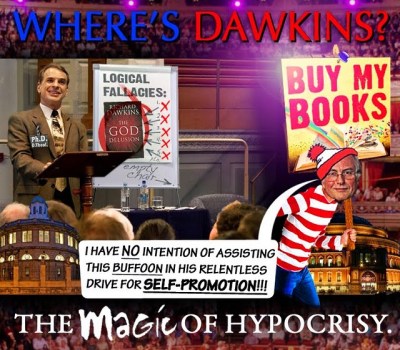
Where’s Dawkins? Debating or promoting his books to his gullible followers?

Where's Dawkins?
BirdieUpon asks: Where's Dawkins?

So the top defender of Christianity operating today is going to be doing a speaking/debating tour of the UK. The organizers have asked Richard Dawkins to come out and defend atheism, but Dawkins is not willing to discuss atheism with anyone who isn’t… already an atheist.

What is Dawkins doing instead of debating?

From BirdieUpon’s blog. (H/T Apologetics 315)

Excerpt:

Craig has not sought to debate Dawkins. He’s responded to invitations from independent organisations who have tried to set this up – in fact he’s never set up a single debate, himself, in his life!

Best of all, Dawkins will actually be spending October… self-promoting! He’ll be charging around the country and in TV studios plugging his new book The Magic of Reality: How We Know What’s Really True! In fact, Dawkins will be promoting it in the Royal Albert Hall on October 19th, while Craig is in Cambridge delivering a lecture on Stephen Hawking’s The Grand Design.

Dawkins’ calendar, on his website, indicates that October 25th (the night of Dawkins’ challenge to fill Oxford Sheldonian Theatre’s empty debating chair) is free for him. It also, however, mentions a movie-screening in New York, so one hopes Dawkins isn’t planning on fleeing the country!

William Lane Craig’s speaking and debating tour of the UK is almost upon us, and now might be a good time to review some of his debates.

Dr. Craig normally debates two topics: 1) Does God exist? and 2) Did Jesus rise from the dead?

Does God Exist?

For the question of God’s existence, he uses 5 arguments.

You can see them being used in this debate against Christopher Hitchens:

Did Jesus Rise from the dead?

For the question of Jesus’ resurrection, he uses 1 argument based on four “minimal facts”, which are all accepted by the majority of scholars.

You can see them being used in this debate against Bart Ehrman:

If you watch both of these, that should prepare you for the news of the UK debates when it comes out. The tour starts on October 17th and will go until October 26th. You can learn more about Dr. Craig from this radio interview that he just did on the Unbelievable radio show, with Justin Brierley.

What does the Bible say about capital punishment?

Note: This post has a twin post which talks about the evidence against capital punishment from science.

First, let’s take a look at what the Bible says in general about capital punishment, using this lecture featuring eminent theologian Wayne Grudem.

About Wayne Grudem:

Grudem holds a BA from Harvard University, a Master of Divinity from Westminster Theological Seminary, and a PhD from the University of Cambridge. In 2001, Grudem became Research Professor of Bible and Theology at Phoenix Seminary. Prior to that, he had taught for 20 years at Trinity Evangelical Divinity School, where he was chairman of the department of Biblical and Systematic Theology.

Grudem served on the committee overseeing the English Standard Version translation of the Bible, and in 1999 he was the president of the Evangelical Theological Society. He is a co-founder and past president of the Council on Biblical Manhood and Womanhood. He is the author of, among other books, Systematic Theology: An Introduction to Biblical Doctrine, which advocates a Calvinistic soteriology, the verbal plenary inspiration and inerrancy of the Bible, the body-soul dichotomy in the nature of man, and the complementarian (rather than egalitarian) view of gender equality.

The MP3 file is here.

A PDF sermon outline is here.

Topics:

  • what kinds of crimes might require CP?
  • what did God say to Noah about CP?
  • what does it mean that man is made in the image of God?
  • is CP just about taking revenge?
  • what does CP say about the value of human life?
  • does CP apply to animals, too?
  • could the statements supporting CP be understood as symbolic?
  • one purpose of CP is to protecting the public
  • another purpose of CP is to deter further wrongdoing
  • but the Biblical purpose of CP is to achieve justice by retribution
  • does the Pope make a good argument against CP?
  • what is the role of civil government in achieving retribution?
  • do people in Heaven who are sinless desire God to judge sinners?
  • should crimes involving property alone be subject to CP?
  • is the Mosaic law relevant for deciding which crimes are capital today?
  • should violent crimes where no one dies be subject to CP?
  • is CP widespread in the world? why or why not?
  • what are some objections to CP from the Bible?
  • how do you respond to those objections to CP?
  • should civil government also turn the other cheek for all crimes?
  • what is the “whole life ethic” and is it Biblical?
  • what do academic studies show about the deterrence effect of CP?
  • how often have innocent people been executed in the USA?
  • should there be a higher burden of proof for CP convictions?

You can find more talks by Wayne Grudem here.

What about the woman caught in adultery?

Some people like to bring up the woman caught in adultery as proof that Jesus opposed capital punishment. But that passage of the Bible was added much later after the canon was decided.

Daniel B. Wallace is an eminent New Testament scholar who also teaches at Dallas Theological Seminary, an extremely conservative seminary.

About Dr. Wallace:

Dr. Daniel B. Wallace

  • Professor of New Testament Studies
  • B.A., Biola University, 1975; Th.M., Dallas Theological Seminary, 1979; Ph.D., 1995.

Dr. Wallace influences students across the country through his textbook on intermediate Greek grammar. It is used in more than two-thirds of the nation’s schools that teach that subject. He is the senior New Testament editor of the NET Bible and coeditor of the NET-Nestle Greek-English diglot. Recently his scholarship has shifted from syntactical and text-critical issues to more specific work in John, Mark, and nascent Christology. However he still works extensively in textual criticism, and has founded The Center for the Study of New Testament Manuscripts, an institute with an initial purpose to preserve Scripture by taking digital photographs of all known Greek New Testament manuscripts. His postdoctoral work includes work on Greek grammar at Tyndale House in Cambridge and textual criticism studies at the Institut für Neutestamentliche Textforschung in Münster.

And Dr. Wallace writes about the passage in John on Bible.org.

Excerpt:

One hundred and forty years ago, conservative biblical scholar and Dean of Canterbury, Henry Alford, advocated a new translation to replace the King James Bible. One of his reasons was the inferior textual basis of the KJV. Alford argued that “a translator of Holy Scripture must be…ready to sacrifice the choicest text, and the plainest proof of doctrine, if the words are not those of what he is constrained in his conscience to receive as God’s testimony.” He was speaking about the Trinitarian formula found in the KJV rendering of 1 John 5:7–8. Twenty years later, two Cambridge scholars came to the firm conclusion that John 7:53–8:11 also was not part of the original text of scripture. But Westcott and Hort’s view has not had nearly the impact that Alford’s did.

For a long time, biblical scholars have recognized the poor textual credentials of the story of the woman caught in adultery (John 7:53–8:11). The evidence against its authenticity is overwhelming: The earliest manuscripts with substantial portions of John’s Gospel (P66 and P75) lack these verses. They skip from John 7:52 to 8:12. The oldest large codices of the Bible also lack these verses: codex Sinaiticus and Vaticanus, both from the fourth century, are normally considered to be the most important biblical manuscripts of the NT extant today. Neither of them has these verses. Codex Alexandrinus, from the fifth century, lacks several leaves in the middle of John. But because of the consistency of the letter size, width of lines, and lines per page, the evidence is conclusive that this manuscript also lacked the pericope adulterae. Codex Ephraemi Rescriptus, also from the fifth century, apparently lacked these verses as well (it is similar to Alexandrinus in that some leaves are missing). The earliest extant manuscript to have these verses is codex Bezae, an eccentric text once in the possession of Theodore Beza. He gave this manuscript to the University of Cambridge in 1581 as a gift, telling the school that he was confident that the scholars there would be able to figure out its significance. He washed his hands of the document. Bezae is indeed the most eccentric NT manuscript extant today, yet it is the chief representative of the Western text-type (the text-form that became dominant in Rome and the Latin West).

When P66, P75, Sinaiticus, and Vaticanus agree, their combined testimony is overwhelmingly strong that a particular reading is not authentic. But it is not only the early Greek manuscripts that lack this text. The great majority of Greek manuscripts through the first eight centuries lack this pericope. And except for Bezae (or codex D), virtually all of the most important Greek witnesses through the first eight centuries do not have the verses. Of the three most important early versions of the New Testament (Coptic, Latin, Syriac), two of them lack the story in their earliest and best witnesses. The Latin alone has the story in its best early witnesses.

[…]It is an important point to note that although the story of the woman caught in adultery is found in most of our printed Bibles today, the evidence suggests that the majority of Bibles during the first eight centuries of the Christian faith did not contain the story. Externally, most scholars would say that the evidence for it not being an authentic part of John’s Gospel is rock solid.But textual criticism is not based on external evidence alone; there is also the internal evidence to consider. This is comprised of two parts: intrinsic evidence has to do with what an author is likely to have written; transcriptional evidence has to do with how and why a scribe would have changed the text.

Intrinsically, the vocabulary, syntax, and style look far more like Luke than they do John. There is almost nothing in these twelve verses that has a Johannine flavor. And transcriptionally, scribes were almost always prone to add material rather than omit it—especially a big block of text such as this, rich in its description of Jesus’ mercy. One of the remarkable things about this passage, in fact, is that it is found in multiple locations. Most manuscripts that have it place it in its now traditional location: between John 7:52 and 8:12. But an entire family of manuscripts has the passage at the end of Luke 21, while another family places it at the end of John’s Gospel. Other manuscripts place it at the end of Luke or in various places in John 7.

The pericope adulterae has all the earmarks of a pericope that was looking for a home. It took up permanent residence, in the ninth century, in the middle of the fourth gospel.

As this debate between Peter Williams and Bart Ehrman shows, there are only TWO disputed passages in the entire NT that are theologically significant. The long ending of Mark and this adultery passage. A good case can be made for the long ending of Mark, but it’s best not to assume it in a debate. The adultery passage is practically impossible to defend as authentic. Dr. Wallace talks about both passages in this Parchment & Pen article. Wallace has also debated Bart Ehrman in the Greer-Heard Forum. What that debate showed is that the New Testament text is actually quite reliable except for those two passages, but it’s important to be honest about the two places that are not well supported.