Tag Archives: Interest

Young workers are paying Social Security taxes but will they ever collect benefits?

What if we had no money for anything except entitlement spending?
What if we had no money for anything except interest and entitlements?

The way Social Security taxes work is that you pay 12.4% of your salary, and another 2.9% for Medicare. That’s 15.3%, before any federal, state and local taxes. So, what are you getting for this 12.4% contribution to the Social Security welfare program? You’re supposed to be able to withdraw that money when you retire, but that money isn’t being stored in an account with your name on it. It’s being spent right now on people who are already retired. Will there be money available for you to withdraw when you retire?

If you’re a young person who retires in 2035 or later, the answer is absolutely not.

The Daily Signal has the numbers:

The American people need to know the state of finances of the Social Security program so they can better understand why reform is not only necessary, but absolutely essential. Here are five takeaways from the most recent financial report:

  • $66 Billion Cash-Flow Deficit in 2016

Social Security is still considered solvent and able to pay full benefits because it has accumulated a $2.8 trillion trust fund, but since the entirety of its trust fund consists of IOUs, cash-flow deficits must be financed by general revenue taxes or new public borrowing.

Since 2010, the Old-Age and Survivors Insurance program has taken in less money from payroll tax revenues and the taxation of benefits than it pays out in benefits, generating cash-flow deficits.

  • $14.3 Trillion in Unfunded Obligations

However, this figure assumes that the $2.8 trillion in trust fund reserves are available to be spent. The problem is that these reserves represent liabilities for the U.S. taxpayer. The payroll revenues have been spent and the trust fund was credited with U.S. bonds, which represent claims on the American taxpayer. This is why the actual unfunded obligation is $14.3 trillion.

The trustees report that Social Security’s unfunded obligation has reached $11.5 trillion. That is the difference between what the program is expected to receive in income and what is expected to spend over the 75-year horizon the program’s actuaries consider for projections.

  • Insolvent by 2035

Based on current projections, the Social Security Old-Age and Survivors Insurance trust fund will be depleted by 2035, reducing Social Security’s expenditures automatically to what the program will receive in revenues, regardless of benefits due at that time.

Social Security is only legally permitted to spend funds in excess of its revenues until its trust fund is depleted.

  • 25 Percent Automatic Benefit Cut

What this means for beneficiaries is that in the absence of congressional action, benefits could be delayed or indiscriminately reduced across the board by 25 percent.

Once the Social Security trust fund is depleted, the program will only be able to pay 75 percent of scheduled benefits, based on payroll and other Social Security tax revenues projected at that time.

  • High Costs to Delaying Reform

The trustees highlight that if Congress waits until the trust funds become exhausted, the cost of making the program solvent will be as much as 40 percent higher, meaning significantly greater benefit cuts and/or tax increases for workers and beneficiaries.

There are several key reforms Congress could pursue to preserve benefits for the most vulnerable beneficiaries without increasing the tax or debt burden on younger generations. However, the longer Congress waits the act, the larger the changes that will be necessary to address Social Security’s combined financing shortfall.

Young people working today who retire in 2035 or later will never see a dime of their Social Security contributions. What’s more likely is that the taxes on their income will go even higher. Take a good look at your paycheck, and you will see money being deducted for this entitlement program. This is money you will never see again. It is being used now, to buy the votes of elderly people who vote against reform when they vote Democrat.

The only person to try to do something about these Social Security problems was George W. Bush – a Republican. But his effort to set up private savings accounts was stopped by Democrats, who depend on the votes of the people who collect from Social Security.

These problems are even worse when you realize that Social Security is only one of the entitlement programs that is going bankrupt. There are others – as well as interest on the $20 trillion debt. ($10 trillion of which was added by Obama in his 8 years as Welfare President). Young people: you are paying taxes for programs that will not be there for you when you need them. Stop voting Democrat, because money matters!
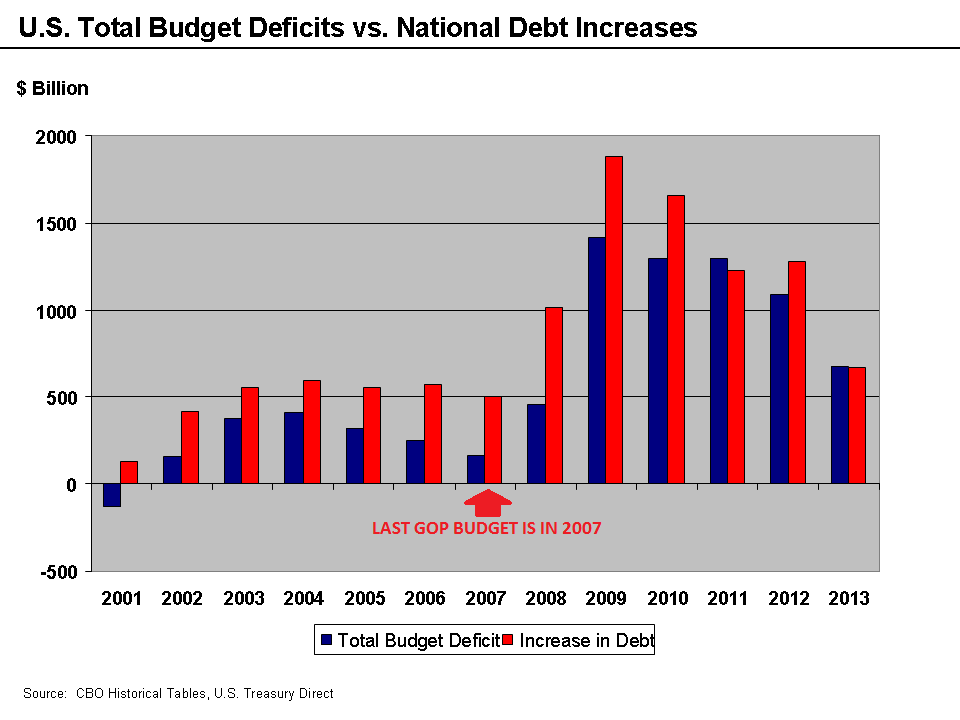
Should we care that Democrats ran up the debt from 8.5 to 18.1 trillion?

In 2007, Democrats seized control of the House and Senate after winning the 2006 mid-term elections. The last Republican budget through 2007 had a 160 billion deficit. What followed next was years and years of trillion dollar deficits under Nancy Pelosi and Harry Reid. The Republicans only gained back the House in 2011, and the Senate in 2015.

Here’s what happened to the deficit while the Democrats had control of spending:

National Debt and Deficit 2007-2013

Now let’s take a look why this is a problem going forward, especially for young people. We’ll use this article from the Wall Street Journal.

It says:

The U.S. has come a long way since the days of trillion-dollar deficits, just a few years ago. The White House projects 2016 will have the smallest budget deficit in eight years. Yet the budgetary impact of the debt that’s been accumulated–$18 trillion in total, $13 trillion of that owed to the public–will reassert itself.

Currently, the government’s interest costs are around $200 billion a year, a sum that’s low due to the era of low interest rates. Forecasters at the White House and Congressional Budget Office believe interest rates will gradually rise, and when that happens, the interest costs of the U.S. government are set to soar, from just over $200 billion to nearly $800 billion a year by decade’s end.

By 2021, the government will be spending more on interest than on all national defense. according to White House forecasts. And one year later, interest costs will exceed nondefense discretionary spending–essentially every other domestic and international government program funded annually through congressional appropriations. (The largest part of the budget is, and will remain, the mandatory spending programs of Social Security, Medicare and Medicaid. Mandatory spending is over $2 trillion and is set to double to $4 trillion by 2025.)

The advice I would give to young people just entering college is to make sure that you don’t vote for more spending and borrowing. Because you’re the ones who are going to have to pay it off!!! Also, don’t waste your money on a discipline for which there are no jobs. Stay away from anything that is not STEM – science, technology, engineering, and math. Try not to borrow money. One lady I know just completed a couple of years of community college, before heading into a computer science program at a university. That is smart – I really recommend that.

Be willing to move if a good job presents itself, because earning money now before the storm is really important. Work while it’s day, in other words. Try not to stay in school any longer than you have to, because work experience is usually worth as much or more than school, and you get paid to work – you don’t get paid to go to school. Don’t think that things are going to be as good as thy are now, or that things are good enough to take unnecessary risks. This probably isn’t the time to “follow your heart” unless your heart is telling you to take the job that pays the most, regardless of how much you like it.

It’s very important to start saving as early as possible so that you can take advantage of interest rates when they go up to earn interest. The earlier you start to save, the more you earn in interest. The key is to never miss a chance to earn and save. Always keep working, and never go to school unless you really need to and you are sure that it will produce a return on investment. Your priority has to be working and saving, and not spending money on frivolous things like travel or thrills. We are not at the right time in history for concentrating on sky-diving, zip-lining and surfing. Now is the time for saving.

Paul Ryan’s Path to Prosperity plan balances the budget without raising taxes

Americans for Tax Reform explains what’s in it.

Excerpt:

The main details are:

Revenue neutrality.  The budget calls for the House Ways and Means Committee to produce a tax reform package with a tax revenue target of between 18 and 19 percent of GDP.  This is in line with historical revenue figures.  By contrast, big government budgets like “Gang of Six,” “Simpson-Bowles,” and the Obama budget call for a long-range revenue target of over 20 percent of GDP.  The Ryan budget is a no tax hikes budget.

Six personal rates down to two.  The Ryan budget replaces the current six-rate personal income tax structure (10, 15, 25, 28, 33, and 35 percent) with a two-rate system of 10 and 25 percent.  This will result in a lower tax rate on the majority of small business profits, from 33 or 35 percent down to 25 percent.

Repeals Obamacare tax hikes.  The Ryan budget eliminates the entire Obamacare law.  This includes repealing the 20 new or higher taxes which have taken or are about to take effect from that law.

Eliminate the AMT.  The Ryan budget eliminates the AMT, instead favoring a simpler system with lower rates and a broad tax base.

Lower rates on businesses.  As said above, the Ryan budget lowers the tax rate on the majority of small business profits to 25 percent.  It also lowers the federal income tax rate on larger corporate employers from 35 percent (the highest in the developed world) to 25 percent (closer to the developed nation average).  While this makes American companies more competitive, it would still leave us with a higher corporate income tax rate than the developed nation average, Canada, and the United Kingdom.  In order to make us truly internationally-competitive, the federal rate must fall to 20 percent or less.

No more picking winners and losers in the tax code.  In order to target revenues at 18-19 percent of GDP with tax rates no higher than 25 percent, the Ways and Means Committee will have to curtail or eliminate most tax exclusions, adjustments, deductions, and credits.  That means that all consumed income will be taxed once and only once.  No longer will the tax code favor one type of economic behavior over another.

Moves tax code from “worldwide taxation” to “territoriality.”  The Ways and Means Committee is directed to shift our tax code from one which seeks to tax income earned all over the world to one which only seeks to tax income earned in America.  This is known as “territoriality,” and it’s already been adopted by and large by our trading competitors.  By retaining a worldwide tax regime, we’re exposing our own countries to double taxation–once when they pay the foreign nation’s income tax, and again when they try to bring the money home.

This is what the budget does: (Debt as % of GDP)

Paul Ryan's 2013: The Path to Prosperity

Doug Ross has three nice charts explaining the details.

Is Barack Obama going to do anything about the debt?

According to CBS News, Obama has exploded our national debt, so there is no reason to trust anything he says about reducing the debt.

Excerpt:

The National Debt has now increased more during President Obama’s three years and two months in office than it did during 8 years of the George W. Bush presidency.

The Debt rose $4.899 trillion during the two terms of the Bush presidency. It has now gone up $4.939 trillion since President Obama took office.

The latest posting from the Bureau of Public Debt at the Treasury Department shows the National Debt now stands at $15.566 trillion. It was $10.626 trillion on President Bush’s last day in office, which coincided with President Obama’s first day.

The National Debt also now exceeds 100% of the nation’s Gross Domestic Product, the total value of goods and services.

Mr. Obama has been quick to blame his predecessor for the soaring Debt, saying Mr. Bush paid for two wars and a Medicare prescription drug program with borrowed funds.

The federal budget sent to Congress last month by Mr. Obama, projects the National Debt will continue to rise as far as the eye can see. The budget shows the Debt hitting $16.3 trillion in 2012, $17.5 trillion in 2013 and $25.9 trillion in 2022.

[…]His latest budget projects a $1.3 trillion deficit this year declining to $901 billion in 2012, and then annual deficits in the range of $500 billion to $700 billion in the 10 years to come.

If Mr. Obama wins re-election, and his budget projections prove accurate, the National Debt will top $20 trillion in 2016, the final year of his second term. That would mean the Debt increased by 87 percent, or $9.34 trillion, during his two terms.

Some of Bush’s debt total can be explained by considering that Nancy Pelosi and Harry Reid raised the debt by $5 trillion dollars over 4 years when they took control of the House and Senate in January of 2007. But they’re Democrats, and that’s what Democrats do.

Related posts