Well, the news out of Oklahoma about Stephen Meyer’s intelligent design presentation at the University last night is quite encouraging. Over three hundred people reportedly turned out for the lecture and discussion following. For all the potty-mouthed bluster that local Darwin activists offered up ahead of time, almost everyone in attendance, whether for or against ID, was civil and respectful during the presentation and discussion last night.
The local daily paper, The Norman Transcript, has two stories today, one about the event last night and one about the screening of Darwin’s Dilemma this evening.
[…]Over at the OU IDEA Club’s website last night club president Josh Malone live-blogged his notes and thoughts about the event and gave a brief rundown of the Q&A session that followed. The photo here was sent in by him.
I’m pretty happy because I just received a free DVD of “Darwin’s Dilemma” in the mail from the Discovery Institute. I donate to DI to support scholars, like Stephen Meyer, in their research, speaking, and debating. Yesterday, I received a debate featuring William Lane Craig that he asked me to transcribe for his web site. (I transcribed a previous debate for him). There are lots of little ways a layman can help out the really smart guys and gals!
According to the most popular formation theory, planets coalesce from a swirling disk of gas and dust that surrounds young stars. Since the disk rotates in the same direction as the star, the planets spawned by the disk should revolve in the same direction. But in an overcrowded planetary system, where a gravitational game of billiards is all but inevitable, orbits can get scrambled. A close encounter between planetary siblings can push one body outward while flinging the other inward, elongating and tilting the inner planet’s orbit.
In this scenario, the solar system may have been unusually lucky. Either it avoided catastrophic gravitational encounters between massive planets or it suffered such interactions so long ago that most of the planets had the chance to resettle into nearly circular orbits with little or no tilt, says Frédéric Pont of the University of Exeter in England.
“The presence of advanced life on Earth may be contingent on our planetary system having avoided the brunt of planet-planet scatter,” keeping Earth on a circular, Goldilocks-style orbit—neither too hot nor too cold for life as we know it, he speculates.
The circularity of the orbit is crucial for maintaining liquid water at the surface. If the the planet’s orbit is too eccentric, then the temperature variations will either freeze the water, or evaporate it into the atmosphere. Either condition is fatal to complex life.
First, let’s re-cap the challenge to evolution from the phenomenon of the Cambrian explosion.
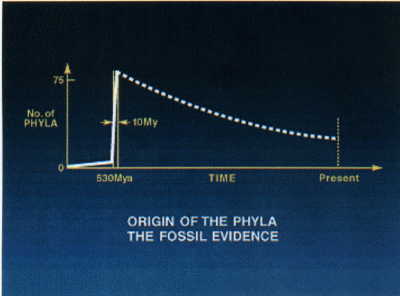
The newly released film “Darwin’s Dilemma” argues that the geologically abrupt appearance of the major groups of animals (the “phyla”) in the Cambrian Explosion posed a serious problem for Charles Darwin’s theory of evolution (as he himself knew), and that subsequent fossil discoveries—far from solving the problem—have made it worse.
Basically, all the major body plans we have today appear in the fossil record in a 2-3 million period about 543 million years ago. There are no precursors in the fossil record showing the gradual evolution of these major body plans.
The Cambrian Explosion: 0 to 60 in a few million years
Darwin expected to discover lots and lots of fossils leading up to the Cambrian explosion period that would show how all these phyla came into existence slowly over time. Unfortunately for the naturalistic evolutionists, the discoveries we’ve been making haven’t shown any hint of precursor fossils leading up the Cambrian explosion.
Since 1859, however, many Precambrian fossils have been found, including microfossils of single-celled bacteria in rocks more than three billion years old. In addition, multicellular Precambrian fossils have been found in the Ediacara Hills of Australia, though there is continuing debate over whether any—or how many—of the Ediacaran fossils were animals, or what relationship—if any—they had to the Cambrian phyla. In 1998, Cambridge University paleobiologist Simon Conway Morris (who is featured in the film “Darwin’s Dilemma”) wrote, “Apart from the few Ediacaran survivors… there seems to be a sharp demarcation between the strange world of Ediacaran life and the relatively familiar Cambrian fossils” (Crucible of Creation, 30).
But wait! Maybe we can’t find the precusor fossils required by Darwinism because they are too small or too soft to have survived for so long?
Since 1859, however, many Precambrian fossils have been found, including microfossils of single-celled bacteria in rocks more than three billion years old. In addition, multicellular Precambrian fossils have been found in the Ediacara Hills of Australia… In 1998, Cambridge University paleobiologist Simon Conway Morris… wrote, “Apart from the few Ediacaran survivors… there seems to be a sharp demarcation between the strange world of Ediacaran life and the relatively familiar Cambrian fossils” (Crucible of Creation, 30).
So there is now no shortage of Precambrian fossils. Not only do we have fossils of bacteria, but we also have many fossils of soft-bodied Multicellular organisms. “In the Ediacaran organisms there is no evidence for any skeletal hard parts,” wrote Conway Morris in 1998. “Ediacaran fossils look as if they were effectively soft-bodied” (Crucible of Creation, 28). The same is true of many of the organisms fossilized in the Cambrian explosion.
But wait! Scientists have discovered lots of exceptionally preserved microbes just before the Cambrian explosion. Don’t microbes count as precursors to the Cambrian explosion phyla?
Richard Callow and Martin Brasier reported in the January 2009 issue of the Journal of the Geological Society, London “a variety of exceptionally preserved microbes” from late Precambrian rocks in England that address “the paradox known as ‘“Darwin’s dilemma’.”
[…]Callow and Brasier didn’t solve Darwin’s dilemma. Instead, they put one more nail in the coffin of Darwin’s attempt to salvage his theory from it. The truth is that “exceptionally preserved microbes” from the late Precambrian actually deepen Darwin’s dilemma, because they suggest that if there had been ancestors to the Cambrian phyla they would have been preserved.
I am willing to believe in evolution. But in order to get me to believe it, I insist on seeing a fossil record that shows the gradual emergence of phyla, one or two at a time, over hundreds of millions of years. That is what Darwinism predicts. We now have a solid record of what came before the Cambrian explosion. So where are the precursors? Where is the record of gradual emergence? Where is my evidence?


 WINTERY KNIGHT