
Tag Archives: India

Indian auto sales surge 71.9% while free trade vaults Chile into the first world

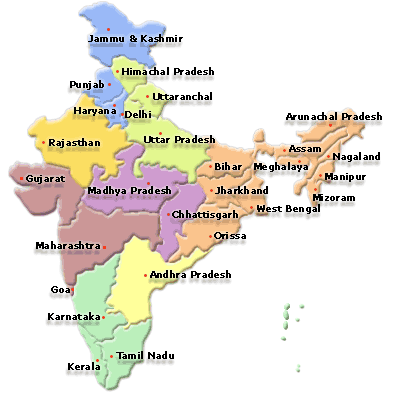
Map of India
Map of India

Before, I wrote about India’s election results and the decision of the ruling Congress Party to drastically cut income taxes. And I also wrote about China’s decision to cut taxes on purchases of new automobiles. So did those tax cuts work out for India and China?

Story from the Associated Press

Excerpt:

China extended its lead over the U.S. as the world’s biggest auto market in November, with production and sales both surpassing 1 million vehicles, and India saw sales jump 71.9-percent.

[…]China’s auto market is sizzling, thanks largely to tax cuts and subsidies aimed at supporting the industry and encouraging use of more fuel-efficient vehicles. The boom has clinched China’s status as the world’s biggest vehicle market due to languishing sales in the U.S.

[…]The surge is also a sign of how the Indian consumer — encouraged by government tax cuts, a big disbursement of back pay for government employees and falling interest rates — is fueling economic growth in Asia’s third-largest economy.

As everyone knows, the Democrats chose to bail out auto companies with taxpayer money and reward people with taxpayer money for destroying fully functional vehicles. And we all know how well that has worked out.

Chile poised to jump from the third world to the first world

Check out this editorial from Investors Business Daily. (podcast here)

Excerpt:

Chile is expected to win entry to OECD’s club of developed countries by Dec. 15 — a great affirmation for a once-poor nation that pulled itself up by trusting markets. One thing that stands out here is free trade.

[…]It’s not like Chile was born lucky. Only 30 years ago, it was an impoverished country with per capita GDP of $1,300. Its distant geography, irresponsible neighbors and tiny population were significant obstacles to investment and growth. And its economy, dominated by labor unions, wasn’t just closed, but sealed tight.

In the Cato Institute’s 1975 Economic Freedom of the World Report it ranked a wretched 71 out of 72 countries evaluated.

Today it’s a different country altogether. Embracing markets has made it one of the most open economies in the world, ranking third on Cato’s index, just behind Hong Kong and Singapore. Per capita GDP has soared to $15,000.

Besides its embrace of free trade, other reforms — including pension privatization, tax cuts, respect for property rights and cutting of red tape helped the country grow not only richer but more democratic, says Cato Institute trade expert Daniel Griswold.

But the main thing, Griswold says, is that the country didn’t shift course. “Chile’s economy is set apart from its neighbors, because they have pursued market policies consistently over a long period,” he said. “Free trade has been a central part of Chile’s success.”

Democrats oppose free trade, and their hostility to free trade angers many other countries in the world.

What does it take for a country to succeed?

I gave my Dad my copy of “Money, Greed and God” by Jay Richards, and although he thought that it started out slow, he’s warmed up to it. He calls me on the phone at least twice a day, and last night he alerted me to this web site, where you can track each countries average citizen’s life span and per-capita GDP over time. My Dad was pretty liberal on economics before, so naturally I’ve been working on him with lots of introductory books on economics. He’s read about a dozen now, and Thomas Sowell is his favorite.

Anyway, my Dad says that this is what a country needs to succeed:

  • free trade with other nations
  • the rule of law
  • low judicial activism
  • low tax rates
  • private property protections
  • currency not threatened by inflation
  • low government spending
  • minimal regulation of commerce

And at that web site, you can track the success of countries like Singapore and Hong Kong, which embrace conservative small government free market fiscal policies, and compare them with countries like Zimbabwe and North Korea, which embrace big government protectionist fiscal policies. Countries fail because they adopt the wrong policies. They succeed when they adopt the right policies. It doesn’t matter how poor they start, if they have the right policies, they grow rich over time.

Why are the Democrats so incompetent on economic policy?

Well, it’s because there is almost no one in the Obama socialist regime who has ever run a business or worked in a business. Check out this graphic. (H/T Flopping Aces)
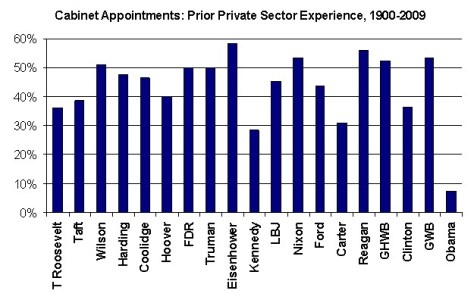
You can read more about the Obama administration’s ignorance of business and economics here in Forbes magazine.

This Reuters article discusses the price of economic ignorance: (H/T Gateway Pundit)

Excerpt:

Hunger is spreading while the number of homeless families is increasing as a result of the recession and other factors, according to a report on Tuesday.

The U.S. Conference of Mayors said cities reported a 26 percent jump in demand for hunger assistance over the past year, the largest average increase since 1991.

Middle-class families as well as the uninsured, elderly, working poor and homeless increasingly looked for help with hunger, which was mainly fueled by unemployment, high housing costs and low wages.

Democrats really don’t know what they are doing. It’s like putting pre-schoolers in charge of Amazon.com. It doesn’t work. Their ivory tower, silver-spoon worldview cannot comprehend real-world, grown-up complexities. So long as the Democrats continue to attack the businesses that employ citizens while redistributing wealth from people who produce to people who vote Democrat, our economic troubles will continue.

Related Cato Institute podcasts

What will the Copenhagen conference mean to ordinary Americans?

Article from Forbes magazine. (H/T Muddling Towards Maturity)

Excerpt:

Whatever the results of the Copenhagen conference on climate change, one thing is for sure: Draconian reductions on carbon emissions will be tacitly accepted by the most developed economies and sloughed off by many developing ones. In essence, emerging economies get to cut their “carbon” intensity–a natural product of their economic evolution–while we get to cut our throats.

[…]Our leaders will dutifully accept cuts in our carbon emissions–up to 80% by 2050–while developing countries increasetheirs, albeit at a lower rate. Oh, we also pledge to send billions in aid to help them achieve this goal.The media shills, scientists, bureaucrats and corporate rent-seekers gathered at Copenhagen won’t give much thought to what this means to the industrialized world’s middle and working class. For many of them the new carbon regime means a gradual decline in living standards. Huge increases in energy costs, taxes and a spate of regulatory mandates will restrict their access to everything from single-family housing and personal mobility to employment in carbon-intensive industries like construction, manufacturing, warehousing and agriculture.

You can get a glimpse of this future in high-unemployment California. Here a burgeoning regulatory regime tied to global warming threatens to turn the state into a total “no go” economic development zone. Not only do companies have to deal with high taxes, cascading energy prices and regulations, they now face audits of their impact on global warming. Far easier to move your project to Texas–or if necessary, China.

Now consider this Wall Street Journal article regarding the EPA decision to call carbon dioxide a threat to public health.

Excerpt:

An endangerment finding would allow the EPA to use the federal Clean Air Act to regulate carbon-dioxide emissions, which are produced whenever fossil fuel is burned. Under that law, the EPA could require emitters of as little as 250 tons of carbon dioxide per year to install new technology to curb their emissions starting as soon as 2012.

The EPA has said it will only require permits from big emitters — facilities that put out 25,000 tons of carbon dioxide a year. But that effort to tailor the regulations to avoid slamming small businesses with new costs is expected to be challenged in court.

Legislators are aware that polls show the public appetite for action that would raise energy prices to protect the environment has fallen precipitously amid the recession.

Congressional legislation also faces plenty of U.S. industry opposition. Under the legislation, which has been passed by the House but is now stuck in the Senate, the federal government would set a cap on the amount of greenhouse gas the economy could emit every year. The government would distribute a set number of emission permits to various industries. Companies that wanted to be able to emit more than their quota could buy extra permits from those that had figured out how to emit less.

Proponents of the cap-and-trade approach say emission-permit trading will encourage industries to find the least-expensive ways to curb greenhouse-gas output. But opponents say it will saddle key industries with high costs not borne by rivals in China or India, and potentially cost the U.S. jobs.

There will be an economic impact on ordinary Americans from the Democrats trying to “do something” about global warming. The economic impact will not be felt primarily by liberal elites in government.

How to respond to postmodernism, relativism, subjectivism, pluralism and skepticism

Four articles from Paul Copan over at the UK site “BeThinking”. Each article responds to a different slogan that you might hear if you’re dealing with non-Christians on the street.

“That’s just your interpretation!”

Some of his possible responses:

  • Gently ask, ‘Do you mean that your interpretation should be preferred over mine? If so, I’d like to know why you have chosen your interpretation over mine. You must have a good reason.’
  • Remind your friend that you are willing to give reasons for your position and that you are not simply taking a particular viewpoint arbitrarily.
  • Try to discern if people toss out this slogan because they don’t like your interpretation. Remind them that there are many truths we have to accept even if we don’t like them.
  • ‘There are no facts, only interpretations’ is a statement that is presented as a fact. If it is just an interpretation, then there is no reason to take it seriously.

More responses are here.

“You Christians are intolerant!”

Some of his possible responses:

  • If you say that the Christian view is bad because it is exclusive, then you are also at that exact moment doing the very thing that you are saying is bad. You have to be exclusive to say that something is bad, since you exclude it from being good by calling it bad.
  • There is a difference, a clear difference between tolerance and truth. They are often confused. We should hold to what we believe with integrity but also support the rights of others to disagree with our viewpoint.
  • Sincerely believing something doesn’t make it true. You can be sincere, but sincerely wrong. If I get onto a plane and sincerely believe that it won’t crash then it does, then my sincerity is quite hopeless. It won’t change the facts. Our beliefs, regardless of how deeply they are held, have no effect on reality.

More responses are here.

“That’s true for you, but not for me!”

Some of his possible responses:

  • If my belief is only true for me, then why isn’t your belief only true for you? Aren’t you saying you want me to believe the same thing you do?
  • You say that no belief is true for everyone, but you want everyone to believe what you do.
  • You’re making universal claims that relativism is true and absolutism is false. You can’t in the same breath say, ‘Nothing is universally true’ and ‘My view is universally true.’ Relativism falsifies itself. It claims there is one position that is true – relativism!

More responses are here.

“If you were born in India, you’d be a Hindu!”

Some of his possible responses:

  • Just because there are many different religious answers and systems doesn’t automatically mean pluralism is correct.
  • If we are culturally conditioned regarding our religious beliefs, then why should the religious pluralist think his view is less arbitrary or conditioned than the exclusivist’s?
  • If the Christian needs to justify Christianity’s claims, the pluralist’s views need just as much substantiation.

More responses are here.

And a bonus: “How do you know you’re not wrong?“.

Being a Christian is fun because you get to think about things at the same deep level that you think about anything else in life. Christianity isn’t about rituals, community and feelings. It’s about truth.

In case you want to see this in action with yours truly, check this out.