
Tag Archives: Health-care

Newt Gingrich on the issues: what are his political views?

Newt Gingrich on health care

From the Wall Street Journal. (H/T Reason to Stand)

Excerpt:

White House hopeful Newt Gingrich called the House Republican plan for Medicare “right-wing social engineering,” injecting a discordant GOP voice into the party’s efforts to reshape both entitlements and the broader budget debate.

In the same interview on Sunday, Mr. Gingrich backed a requirement that all Americans buy health insurance, complicating a Republican line of attack on President Barack Obama’s health law.

The former House speaker’s decision to stick with his previous support for an individual mandate comes days after former Massachusetts Gov. Mitt Romney defended the health revamp he championed as governor, which includes a mandate.

The moves suggest the Republican primary contest, which will include both men, could feature a robust debate on health care, with GOP candidates challenging the Democratic law while defending their own variations.

Newt Gingrich opposes Paul Ryan’s reforms

Consider this article from National Review.

Excerpt:

Newt Gingrich’s appearance on “Meet the Press” today could leave some wondering which party’s nomination he is running for. The former speaker had some harsh words for Paul Ryan’s (and by extension, nearly every House Republican’s) plan to reform Medicare, calling it “radical.”

“I don’t think right-wing social engineering is any more desirable than left-wing social engineering,” he said when asked about Ryan’s plan to transition to a “premium support” model for Medicare. “I don’t think imposing radical change from the right or the left is a very good way for a free society to operate.”

As far as an alternative, Gingrich trotted out the same appeal employed by Obama/Reid/Pelosi — for a “national conversation” on how to “improve” Medicare, and promised to eliminate ‘waste, fraud and abuse,’ etc.

Newt Gingrich on Hillary Clinton

More from the leftist New York Times.

Excerpt:

For Ms. Clinton, standing side by side with her husband’s onetime nemesis gives her the chance to burnish her credentials among the moderates she has been courting during her time in the Senate.

But in comments this week, she portrayed the rapprochement as one born of shared policy interests, not calculated politics.

“I know it’s a bit of an odd-fellow, or odd-woman, mix,” she said. “But the speaker and I have been talking about health care and national security now for several years, and I find that he and I have a lot in common in the way we see the problem.”

For his part, Mr. Gingrich, who helped lead the impeachment fight against President Bill Clinton, called Mrs. Clinton “very practical” and “very smart and very hard working,” adding, “I have been very struck working with her.”

Newt Gingrich on global warming

Newt Gingrich on foreign policy

Newt Gingrich endorsed a pro-abortion, pro-same-marriage candidate

Remember when Newt Gingrich endorsed the RINO Dede Scozzafava in New York?

Excerpt:

In a major coup for her campaign, Republican Dede Scozzafava today will pick up the endorsement of Newt Gingrich, one of the nation’s leading conservative figures and the architect of the “Republican Revolution” in the mid-1990s.

“The special election for the 23rd Congressional District is an important test leading up to the mid-term 2010 elections,” Gingrich said in a statement to supporters. “Our best chance to put responsible and principled leaders in Washington starts here, with Dede Scozzafava.”

The endorsement is important for Scozzafava, a social moderate, as she attempts to hold onto a conservative base eroded by Doug Hoffman, the Conservative Party candidate in the thee-way 23rd District race.

[…]Hoffman has mounted a late surge in the special election with endorsements by prominent conservatives that include former Republican Sen. Fred Thompson; Campaign for Working Families founder Gary Bauer; and the conservative Club for Growth in Washington, D.C.

Scozzafava’s candidacy is also reported to have triggered a deep divide among House Republicans, with some of the most conservative members refusing to support her campaign.

But Gingrich, who served as Speaker of the House from 1995 to 1999, wants to unite the party. He sees Scozzafava and the Upstate special election – the only House race in the nation this fall — as the best hope for Republicans to start a comeback and regain control of Congress.

Gingrich is apparently willing to overlook Scozzafava’s support for same-sex marriage and abortion rights.

The conservative Club for Growth lists some of his fiscal blunders.

Excerpt:

The second large error in Gingrich’s entitlement record was equally troubling: the former Speaker played a high profile advocacy role on behalf of President George W. Bush’s Medicare prescription drug benefit bill in 2003.  Gingrich penned several op-eds supporting the general thrust and specific provisions of the bill, urging House Republicans to pass what was billed at the time to be a $400 billion expansion of the federal government.

[…]In the 2009 special election for Congress in New York’s 23rd district, Gingrich was outspoken in his support of liberal Republican nominee Dede Scozzafava, up to the moment she finally quit the race after center-right voters rallied behind Conservative Party nominee Doug Hoffman.  Long after most prominent conservatives had endorsed Hoffman, Gingrich held firm in his advocacy for a liberal candidate who supported Obama’s stimulus plan and the pro-union “card check” proposal, among other bad positions.

In 2010, Gingrich openly campaigned for embattled U.S. Senator Robert Bennett in Utah, whom Gingrich’s wrongly called “a true-blue conservative.”  In 2008,  Gingrich aggressively supported and campaigned for liberal Congressman Wayne Gilchrist (R-MD) when he faced a conservative challenge from now-Congressman Andy Harris.  In 2006, same thing, when Gingrich backed liberal Congressman Joe Schwarz (R-MI) when he was challenged by conservative now-Congressman Tim Walberg.

Unfortunately, the problems in Speaker Gingrich’s record are frequent enough and serious enough to give pause.  On two of the most important recent issues that confronted limited government conservatives (creating the new budget busting Medicare drug entitlement, and the Wall Street bailout), Gingrich was on the wrong side.  His advocacy of an individual health care mandate is problematic.  His penchant for tinkering with rewards for favored industries and outcomes shows a troubling willingness to use federal power to coerce taxpayers into his preferred direction.  And his occasional hostility toward conservatives who do not share his desire to support liberal Republicans or to compromise on matters of principle is worrisome.

Maybe he is actually running to win the Democrat nomination this time.
Melanie Phillips explains how feminism impacted the nursing profession

Dina sent me this article by Melanie Phillips from the UK Daily Mail.

Excerpt:

Last week, a devastating report detailing what can only be described as the widespread collapse of the ethic of nursing was produced by the Care Quality Commission.

This revealed that more than half of all hospitals in England do not meet standards for the dignity and nutrition of elderly people. One in five hospitals were found to be failing the elderly so badly that they were breaking the law.

In hospitals where essential standards were not met, inspectors found that patients’ call bells had been placed out of reach or were not responded to quickly enough, or staff were talking to patients in a condescending or dismissive way.

In one hospital, inspectors witnessed a patient being made to go to the lavatory in full view of the rest of the ward. In another, doctors had to prescribe water to make sure that patients did not  become dehydrated.

These horrifying revelations do not signify merely incompetence nor — that perennial excuse — the effect of ‘the cuts’.

No, they illustrate instead something infinitely grimmer: the replacement of altruism by indifference, and compassion by cruelty.

[…]Nursing was effectively created by that 19th-century feminist pioneer, Florence Nightingale. To her, nursing was in essence a moral act. In her book Notes On Nursing, published in 1860, she wrote that ‘the greater part of nursing consists in preserving cleanliness’.

That wasn’t just because hygiene was essential for recovery and health. It was because keeping both hospital and patients clean meant the nurse needed to be motivated by the most high-minded concern for the care and dignity of the patient.

Accordingly, lowly functions such as washing, dressing and administering bedpans were functions that were invested with the highest possible significance.

[…][D]uring the Eighties, nursing underwent a revolution. Under the influence of feminist thinking, its leaders decided that ‘caring’ was demeaning because it meant that nurses — who were overwhelmingly women — were treated like skivvies by doctors, who were mostly men.

To achieve equality, therefore, nursing had to gain the same status as medicine. This directly contradicted an explicit warning given by Florence Nightingale that nurses should steer clear of the ‘jargon’ about the ‘rights’ of women ‘which urges women to do all that men do, including the medical and other professions, merely because men do it, and without regard to whether this is the best that women can do’.

That prescient warning has been ignored by the modern nursing establishment. To achieve professional equality with doctors, nurse training was taken away from the hospitals and turned into an academic university subject.

Since caring for patients was demeaning to women, it could no longer be the cardinal principle of nursing. Instead, the primary goal became to realise the potential of the nurse to achieve equality with men. (The great irony is that more women than men are now training to be doctors in British medical schools, thus making this ideology out of date.)

In an important book on the nursing profession, Ann Bradshaw, a specialist in palliative care, described how this agenda removed caring, kindness, compassion and dedication from nurse training.

Student nurses now studied sociology, politics, psychology, microbiology and management, and were assessed for their communication, management and analytical skills. ‘Specific clinical nursing skills were not mentioned,’ she wrote.

In short, nursing ditched its core vocation to care. Bedbaths and feeding those who are helpless are tasks vital to the care of patients — but are now considered beneath the dignity of too many nurses.

Dame Joan Bakewell, the former government-appointed Voice of Older People, has suggested nurses be given ‘empathy training’. But, of course, you can’t train people in compassion.

Dame Joan was much nearer the mark when she observed that the decline in kindness and sympathy was linked to the decline in religious observance. In other words, the crisis in nursing is part of a far broader and deeper spiritual malaise.

Duty to others and respect for the innate humanity of every person have been eroded by the ‘me society’ of ruthless,  self-centred individualism.

This is something I have often thought about… what it would be like to go to a hospital filled with non-Christians who had no rational basis for morality and virtue. Especially in a single-payer system, where you couldn’t withhold payment if care was not of a good enough quality. When you put together secularism (removes the rational basis for acts of self-sactifice and the dignity of the individual) together with socialism (where the individual pays mandatory taxes and must seek products and services from a politicized, unionized government monopoly) then it becomes a scary situation indeed.

Feminism affects nurses in other ways, too

I think I’ll just paste some more about these British nurses here, from Theodore Dalrymple’s book “Life at the Bottom” – even though it’s a little off topic.

All the more surprising is it to me, therefore, that the nurses perceive things differently. They do not see a man’s violence in his face, his gestures, his deportment, and his bodily adornments, even though they have the same experience of the patients as I. They hear the same stories, they see the same signs, but they do not make the same judgments. What’s more, they seem never to learn; for experience—like chance, in the famous dictum of Louis Pasteur—favors only the mind prepared. And when I guess at a glance that a man is an inveterate wife beater (I use the term “wife” loosely), they are appalled at the harshness of my judgment, even when it proves right once more.

This is not a matter of merely theoretical interest to the nurses, for many of them in their private lives have themselves been the compliant victims of violent men. For example, the lover of one of the senior nurses, an attractive and lively young woman, recently held her at gunpoint and threatened her with death, after having repeatedly blacked her eye during the previous months. I met him once when he came looking for her in the hospital: he was just the kind of ferocious young egotist to whom I would give a wide berth in the broadest daylight.

Why are the nurses so reluctant to come to the most inescapable of conclusions? Their training tells them, quite rightly, that it is their duty to care for everyone without regard for personal merit or deserts; but for them, there is no difference between suspending judgment for certain restricted purposes and making no judgment at all in any circumstances whatsoever. It is as if they were more afraid of passing an adverse verdict on someone than of getting a punch in the face—a likely enough consequence, incidentally, of their failure of discernment. Since it is scarcely possible to recognize a wife beater without inwardly condemning him, it is safer not to recognize him as one in the first place.

This failure of recognition is almost universal among my violently abused women patients, but its function for them is somewhat different from what it is for the nurses. The nurses need to retain a certain positive regard for their patients in order to do their job. But for the abused women, the failure to perceive in advance the violence of their chosen men serves to absolve them of all responsibility for whatever happens thereafter, allowing them to think of themselves as victims alone rather than the victims and accomplices they are. Moreover, it licenses them to obey their impulses and whims, allowing them to suppose that sexual attractiveness is the measure of all things and that prudence in the selection of a male companion is neither possible nor desirable.

Often, their imprudence would be laughable, were it not tragic: many times in my ward I’ve watched liaisons form between an abused female patient and an abusing male patient within half an hour of their striking up an acquaintance. By now, I can often predict the formation of such a liaison—and predict that it will as certainly end in violence as that the sun will rise tomorrow.

At first, of course, my female patients deny that the violence of their men was foreseeable. But when I ask them whether they think I would have recognized it in advance, the great majority—nine out of ten—reply, yes, of course. And when asked howthey think I would have done so, they enumerate precisely the factors that would have led me to that conclusion. So their blindness is willful.

You see, feminism also has the effects of telling women that there are no special roles that men are meant to perform, like provider, protector, moral leaders, spiritual leader. And when more and more women grow up in fatherless homes where money comes in from the government, and morality and spirituality are taught in public schools, it becomes harder and harder for women to have the wisdom to choose good men. Instead, they end up choosing men who are attractive and entertaining, using the 180-second rule.

You can read the entire Dalrymple book on moral relativism online. I posted links to the full text of Theodore Dalrymple’s “Life at the Bottom”.

Ohio Issue 2: Should voters vote yes or vote no on Ohio State Issue 2?

In the 2010 mid-term elections, Republican John Kasich won the governorship and promised to balance the state’s budget by reining in the state’s spending on salaries and benefits for public sector union employees. To accomplish this, the Ohio legislature pass Senate Bill 5. However, an effort is on the ballot to repeal the law, and Ohio voters will get a chance to keep or scrap the law on Tuesday, November 8th, 2011.

Here’s what Ohio’s Issue 2 is all about:

Issue 2 makes some very fair and common sense requests of our government employees to give local communities the flexibility they need to get taxes and spending under control, while providing the essential services that we rely on.

  • It allows an employee’s job performance to be considered when determining compensation, rather than just awarding automatic pay increases based only on an employee’s length of service.
  • It asks that government employees pay at least 15 percent of the cost of their health insurance premium.  That’s less than half of what private sector workers are currently paying.
  • It requires that government health care benefits apply equally to all government employees, whether they work in management or non-management positions.  No special favors.
  • It asks our government employees to pay their own share of a generous pension contribution, rather than forcing taxpayers to pay both the employee and employer shares.
  • It keeps union bosses from protecting bad teachers and stops the outdated practice of laying off good teachers first just because they haven’t served long enough.
  • Finally, it preserves collective bargaining for government employees, but it also returns some basic control of our schools and services to the taxpayers who fund them, not the union bosses who thrive on their mismanagement.

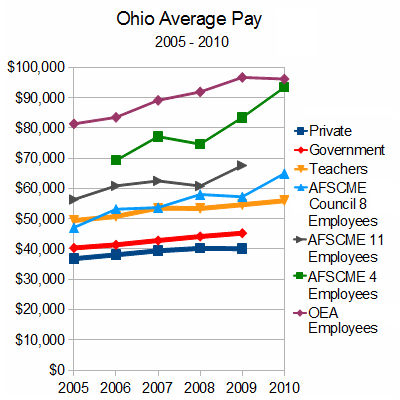
Even under the reforms of State Issue 2, Ohio’s government employees will still receive better pay, better health care and better retirement benefits, on average, than the vast majority of Ohioans who work in the private sector.

There are a number of myths going around about Issue 2, and it’s important to set the record straight, so I’ll do that below.

Ohio Average Pay: Public vs. Private
Ohio Average Pay: Public Unions vs. Private

Myths and truths about Ohio State Issue 2

Here’s a common myth:

State Issue 2 would “cut salaries and benefits.”

The truth:

Issue 2 would not cut salaries or benefits for any government employee. Employees would simply be asked to pay a modest share of their benefits, just like employees in the private sector do. For health care coverage, they would pay at least 15% of their overall plan. (Many local government employees currently pay less than 9% of their health care premium, while the average private sector worker pays upwards of 30%.) In addition, employees would be required to pay their personal share of a retirement plan (only 10%), rather than asking taxpayers to pay that share. That’s not too much to ask at a time when many private sector workers get no retirement benefit at all. Finally, Issue 2 requires that benefits apply equally to all public employees, so no one gets special treatment.

And another common myth:

State Issue 2 will eliminate government employee pensions.

The truth:

Government employees will still get a very generous pension benefit – an annual payment that averages their three highest annual salaries. That’s a pretty nice deal, when many private sector workers get no retirement benefit at all. State Issue 2 only ends a practice where some government union contracts require taxpayers to pick up the tab for BOTH the employer AND employee shares of a required pension contribution. In this economy, it’s simply not right to ask struggling taxpayers to foot the bill so government employees can get a free retirement. Issue 2 simply says government employees should pay their required share (10 percent) and taxpayers will contribute the employer share (14 percent).

Another myth:

State Issue 2 will cut teacher salaries.

The truth:

That’s one of the scare tactics government unions are using to turn people against these reforms. Nothing in Issue 2 determines salary levels. It only ends the practice of handing out automatic pay raises, or “step” increases, and longevity pay – or bonuses just for holding the job for a certain period of time. Issue 2 also asks that performance be added as a factor in teacher compensation, a goal President Barack Obama set out in his national education policy in 2009.

And another myth:

State Issue 2 will cost jobs

The truth:

Just the opposite is true. Ohio’s state and local tax burden ranks among the top third in the nation. As a result, companies large and small have left our state in pursuit of better tax incentives elsewhere, taking hundreds of thousands of jobs with them. If Ohio hopes to compete for new job growth, we have to make our state a more affordable place to live, work and do business. That starts with getting the cost of government under control so we can direct more of our limited resources into economic development, community revitalization and better schools.

More myths are corrected on this page.

Newspaper endorsements

So far, Issue 2 has been endorsed by several Ohio newspapers, including the biggest ones.

The Cleveland Plain Dealer:

The fiscal picture of local governments and school districts, especially, will improve as they are able to right-size their work forces and their expenditures on services. That will happen over time, not overnight, as new contracts are established.

Repeal SB 5, though, and it’s going to be awfully hard for local governments to manage their payrolls without resorting to larger-scale layoffs than would otherwise be necessary. And local governments will continue to be hamstrung by anti-merit seniority rules that lead to worker complacency and protect dead weight and time-servers.

Voting YES on Issue 2 will prevent layoffs by keeping public sector wages and benefits in line with what the private sector can afford to pay.

The Columbus Dispatch:

Despite the insistence of opponents, the effort to reform Ohio’s out-of-balance collective-bargaining law is not an expression of disrespect for or dissatisfaction with Ohio teachers, police officers, firefighters and other government employees. It is a much-needed attempt to restore control over public spending to the public officials elected to exercise that control.

It does not assert that public employees are worth less than the compensation they’re receiving, only that the compensation has grown faster than the public’s ability to pay for it.

[…]With more ability to control the escalation of salary and benefit costs, governments won’t be forced as often to impose layoffs, and might be able to afford to keep even more police and firefighters on the streets.

Again, no one is saying that public sector workers don’t matter – the question is whether we can afford to give them better wages and benefits than the private sector workers who are their customers and their employers. Public sector workers work for the public, and the public can only afford to pay so much.

Conclusion

Government employees are paid 43% more than private sector employees, in salary and benefits:

I think that people who care about the long-term prosperity of Ohio should vote “YES” on Issue 2 to make public and private salaries and benefits MORE EQUAL. Ohio is facing enormous economic pressure from the global recession, and everyone has to make sacrifices. Now is not the time for public sector workers to insist on higher wages and benefits, especially when the private sector workers who pay their salaries don’t make as much money, nor do they get the pensions, nor do they get the better job security. Ohio voters can certainly go back and renegotiate union salaries and benefits when Ohio is out of the recession.

Click here to learn more about Ohio Issue 2.