Tag Archives: Health-care

Mitt Romney’s record as governor is pro-abortion and pro-socialized medicine

Byron York explains Mitt Romney’s liberal record as governor of Massachusetts.

Excerpt:

To win election as a Republican in Massachusetts, and then to govern effectively, Romney had to align himself with the left side of the GOP. And to do that, he adopted positions that haunt him still.

Perhaps the most fateful was on abortion. Romney’s reputation as a “perfectly lubricated weather vane” — to use the memorable phrase of former rival Jon Huntsman — comes from his decision to run for Senate in 1994 and governor in 2002 as a strongly pro-choice candidate, and then to run for president in 2008 as a strongly pro-life candidate.

According to a new book by Boston journalist Ron Scott, when Romney was planning that ’94 Senate run, he commissioned polling that showed a pro-life candidate could not win statewide election in Massachusetts. So Romney, who said he was personally pro-life, became politically pro-choice.

And not just pro-choice, but ardently pro-choice. “I am not going to change our pro-choice laws in Massachusetts in any way,” Romney said in an Oct. 29, 2002, debate. “I will preserve them. I will protect them. I will enforce them. I do not take the position of a pro-life candidate. I am in favor of preserving and protecting a woman’s right to choose.” When The Boston Globe said there was not a “paper’s width” of difference between Romney and his Democratic opponent on abortion, Romney proudly quoted the paper.

If Romney had chosen a less liberal state to live in, he would not have had to do that — and, of course, he would not have had to switch back to a pro-life position in 2004-2005, as he formed a political action committee and began working toward a run for the Republican nomination for president.

As a candidate for office in Massachusetts, Romney also had to take positions on guns, global warming and gay rights that later caused him difficulties in Republican presidential politics. He even had to renounce Ronald Reagan — an extremely unwise thing to do in today’s GOP. “Look, I was an independent during the time of Reagan-Bush,” Romney said in a 1994 debate with Sen. Ted Kennedy. “I’m not trying to return to Reagan-Bush.” Now, of course, Romney sings Reagan’s praises at nearly every campaign stop.

If he hadn’t run in Massachusetts, he wouldn’t have had to bash Reagan in the first place.

But, after abortion, the most devastating consequence of Romney’s choosing Massachusetts has been the issue of universal health care. In extending coverage to everyone in the state, Romney helped fulfill a long-time liberal goal; just look at the love-fest with Kennedy at the bill’s 2006 signing ceremony. But Romney did not effectively control rapidly rising health care costs. And he could not have anticipated how deeply unpopular universal coverage schemes would become with the Republican base after Obamacare.

In the campaign, Romney has blamed the Democratic Massachusetts legislature for Romneycare’s problems and denied vigorously that he believes his bill would be a good model for the nation. It’s a difficult position to take on his signature achievement in office. And it would not have happened had Romney not chosen to run in Massachusetts.

We can’t afford to run a moderate against Barack Obama – Obama is going to win because he will just point out that Romney agreed with him on everything when he was governor of Massachusetts. Republican voters are pro-life and we oppose government-run health care. we need to elect someone who has a Republican record.


Related posts

Why social conservatives should support free market capitalism

The free enterprise system should not be adopted simply because it is the best system for creating wealth. The best reason to support free market capitalism is a moral reason. Arthur Brooks, President of the American Enterprise Institute, and a Christian, describes the moral argument for free market capitalism.

Excerpt:

It might seem that the best case for free enterprise is the material one. Free enterprise lets people make more money, buy more and nicer stuff, and have a greater degree of comfort. The freer our economy is, the more competitive the US economy is vis-à-vis the rest of the world. And so on.

But these aren’t our best arguments. There is another reason, a transcendent reason, for which free enterprise matters most—and this is the case we all must be able to make today.

We all learned early on in school that the Declaration of Independence claimed for each of us the unalienable right to “life, liberty, and the pursuit of happiness.” Note that the founders didn’t assert a right to be happy; such is the domain of tinpots and crackpots, of 1984’s “Ministry of Plenty” and Josef Stalin’s aggrandizing self-description as the Soviet Union’s “Constructor of Happiness.” So what, in practice, does this right to pursue happiness mean?

It means the right to define and earn our happiness through our ideas, hard work, and gumption, to earn our success by creating value honestly, in our own lives and in the lives of others. It doesn’t mean the pursuit of a big lottery win or an inheritance. Those bring money, but not happiness. And a mountain of evidence shows that after a fairly low threshold, more money doesn’t make us happier. The best case for free enterprise has nothing at all to do with money or material goods or wealth. Those are just icing on the cake. We must stop talking about free enterprise as just an engine of wealth creation. It’s much more than that.

In short, the secret to the pursuit of happiness is earning our own success; creating value with our lives and in the lives of others. This earned success is the fruit of hard work and just rewards in a system built on merit. Only in a free enterprise system is effort and innovation rewarded over connections and predation. (And this means that we have to draw a distinction between free enterprise, which is based on opportunity and competition between ideas, and corporate cronyism, which is just another form of statism masquerading as free enterprise.)

Here are 3 reasons why I think that social conservatives should support free market capitalism.

1) Right to work

It’s very important for Christians to have an economic system in place that allows them to work without having to promote anti-Christians ideas. But when government gets too big, what happens is that Christians are no longer free to take any job they want, and still keep a clear conscience. In some states, you have to join a union which uses your union dues to elect Democrats, who very often are liberal on social issues. Or, you have big government forcing Christians to perform abortions against their consciences. Or, you have big government forcing Christian organizations to provide health insurance plans that cover abortions and contraceptives. That’s why Christians need to vote against big government regulations on employment – we need the freedom to work at a job that does not violate our consciences.

2) Right to earn

It’s very important for Christians to keep what they earn so that they have the maximum amount of money to make decisions that make sense for them, according to their consciences. Take the example of day care and education. The big government statist is constantly trying to to create more and more government-run day care and public schools. Why? They want to take money away from families so that they cannot afford individualized private and parochial schools, and lump them all into government run schools that are more “equal”. The problem is that this is bad for Christians who want more oversight into what their children learn. For example, what sense does it make for a Christian man to pay for day care and public schools when he marries a teacher who becomes a stay at home homeschooling mother for his children? He has to pay for day care and public schools he will never use, and it eats into the money he has to afford a stay-at-home homeschooling mom. Christians should oppose a day care and education system run by a secular leftist government. They will never reflect the values of Christian parents.

3) Right to spend

It’s very important for Christians to have the freedom to purchase products and services that make sense in their worldview. Take the example of health care. Secular leftists would love to force private medical insurance companies to cover things like abortion and contraception as health care. In some states, these things are specified as mandatory for every health care plan. That means that Christians who purchase health care are being forced to pay for services like abortion which they will never use themselves. This is nothing more than the redistribution of wealth in order to lower the cost of abortions for people, in order to encourage them to be sexually active before they are able to accommodate children. Christians need to oppose this – we do not want to have to pay for things that go against our consciences.

So, in addition to the reasons that Brooks mentioned (the happiness of earning your own way and serving others), it’s important for Christians to understand how free market capitalism fits into their plans. We do not want to support big government, especially when big government so often is not compatible with Judeo-Christian values. In the free market, it is much harder for ALL the businesses to conspire together to block Christians from working, earning and spending according to their consciences. We must resist top-down control of the free market so that we have the liberty to do what we ought to do in order to be virtuous.

Mitt Romney’s tax returns would make him lose the election to Obama

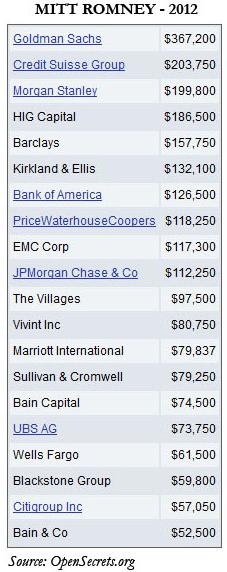
Wall Street Banks contributions to Mitt Romney
Wall Street banks make huge contributions to Mitt Romney

From The Hill. (H/T Riehl Worldview)

Excerpt:

It’s important not to overstate the perils Romney faces. He is still by far the best-funded candidate in the race. He has a state-by-state infrastructure that is the envy of his rivals. Even if he were to lose Saturday’s South Carolina primary, he would  likely remain the overall favorite to clinch the nomination.

But the procession of errors has been striking nonetheless — and it has raised concerns among many in the GOP about his vulnerabilities in a general election contest with President Obama.

Most of Romney’s awkwardness has revolved around questions about his wealth. During a heated exchange during a debate last month, he ill-advisedly offered to bet Perry $10,000 that his own account of what he had written in one of his books was correct. Perry declined, saying he was “not in the betting business,” but the episode heightened perceptions that Romney is out of touch with most Americans.

The same pattern keeps cropping up. Earlier this week, he was asked about the effective tax rate he pays on his income, and managed to injure himself twice in the space of a few sentences. First, he acknowledged that his tax rate was “probably closer to the 15 percent rate than anything.” He then added: “I get speaker’s fees from time to time, but not very much.”

The first claim was almost certainly true. Romney’s income is believed to come chiefly from long-term investments rather than earned income, and that would indeed make him liable for capital gains tax levied at a 15 percent rate. But it still places the multimillionaire in a more lightly taxed band than many voters — something which Newt Gingrich tried to take advantage of with his mocking proposal to introduce a “Mitt Romney 15 percent flat tax.”

Perhaps even worse was Romney’s “not very much” comment. His latest financial disclosure form, which covered the period from February 2010 to February 2011, revealed that he earned $374,327 for speeches. The sum is approximately seven times the median household income in the United States.

Those remarks had been preceded by a televised debate at which he gave a muddled response about whether he would release his tax returns.

Romney flubbed the tax-return question for a second time at a debate last Thursday, eliciting boos from the crowd when he said he would “maybe” follow the example of his late father, former Michigan Gov. George Romney, who released 12 years of tax returns when running for the presidency in 1968.

Romney’s mangled syntax on these occasions seems symptomatic of a wider personal unease in discussing his finances. GOP consultants say he needs to get over that discomfort if he is to prove an effective candidate.

Another concern that I have is that Mitt Romney has $20-100 million dollars in his retirement account.

Excerpt:

Like many Americans, Mitt Romney has an individual retirement account. Unlike most Americans, Mr. Romney has between $20.7 million and $101.6 million in it, a big chunk of his fortune.

Experts on estate planning said it is highly unusual to accumulate such a considerable sum in an IRA, an investment vehicle restricted by annual contribution limits. It appears that Mr. Romney’s grew so large mostly because it holds investments in Bain Capital, the private-equity firm he helped start.

[…]Mr. Romney is one of the richest presidential candidates in decades, and his GOP opponents increasingly are trying to turn wealth into a liability. President Barack Obama is expected to do the same if the former Massachusetts governor wraps up the nomination. Mr. Romney’s tax liability has emerged as a debating point in the GOP nominating contest, a proxy for a bigger argument over who should shoulder the nation’s tax burden.

In recent days, Mr. Romney’s rivals have pressed him to release his tax returns. They have attacked him for his role at Bain Capital, the source of his wealth. When Mr. Romney revealed Tuesday that his effective federal income-tax rate had been about 15% in recent years, both the White House and GOP candidates used the number as a cudgel.

[…]Michael Whitty, a lawyer at Vedder Price in Chicago who advises private-equity executives, said it is impossible to determine from Mr. Romney’s public disclosures how the IRA grew so large. Based on its listed holdings, which include many Bain Capital vehicles, Mr. Whitty theorizes Mr. Romney may have invested in Bain funds through a 401(k)-type plan, or directed some of his Bain holdings into such a plan, which he then rolled into an IRA.

How is he going to explain that? This might be one of the reasons why Romney is not releasing his tax returns. He needs to be pounded on this by Gingrich and Santorum until he drops out – we can’t afford to choose a nominee who has no hope of beating Barack Obama.

Related posts