
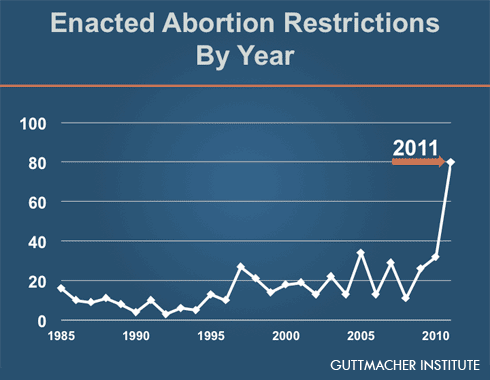
Great news from the Guttmacher Institute, a pro-abortion think tank. (H/T John from Truth in Religion & Politics)
Excerpt:
In the first six months of 2011, states enacted 162 new provisions related to reproductive health and rights. Fully 49% of these new laws seek to restrict access to abortion services, a sharp increase from 2010, when 26% of new laws restricted abortion. The 80 abortion restrictions enacted this year are more than double the previous record of 34 abortion restrictions enacted in 2005—and more than triple the 23 enacted in 2010. All of these new provisions were enacted in just 19 states.
The post breaks down the pro-life measures by category:
- Counseling and waiting periods
- Gestational bans
- “Heartbeat” bill
- Banning abortion coverage in new insurance exchanges
- Medication abortion
- Cuts to abortion subsidies
All of these bills were supported by Republicans, and opposed by Democrats.
Elections have consequences. We elected a massive number of Republicans in 2010, and now we are seeing the results of that effort. I could not be more proud of the Republicans who voted in these measures to protect the unborn.
Related posts
- Obama administration threatens Indiana for defunding Planned Parenthood
- Are the Girl Scouts linked to the abortion provider Planned Parenthood?
- 91% of Planned Parenthood clinics help hide statutory rapists
- What is Planned Parenthood and why do Democrats support them?
- Does Planned Parenthood really use taxpayer money to provide mammograms?
- Feminists push liberal sexual agenda at United Nations
- Planned Parenthood stung three more times by Live Action
- Planned Parenthood caught helping pimp to run underage sex-trafficking ring
- Planned Parenthood releases annual report – 324,008 babies aborted
- Undercover video of Planned Parenthood selling abortion with misinformation
- Susan G. Komen for the Cure charity funds Planned Parenthood
- Is Planned Parenthood overbilling state and local governments?
- Planned Parenthood conceals rape and breaks the law
- Undercover video of Planned Parenthood selling abortion with misinformation
- How much money does Planned Parenthood receive from taxpayers?
- How much profit does the non-profit Planned Parenthood make?
- Is Planned Parenthood overbilling state and local governments?
- Planned Parenthood conceals rape and breaks the law

