Tag Archives: GDP

Conservative Party of Canada on track to deliver budget surplus in 2015

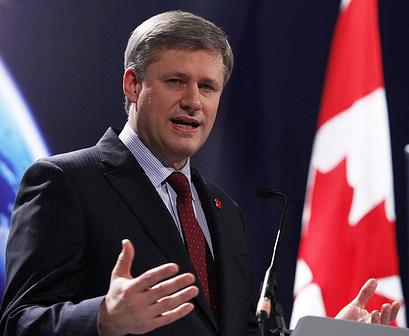
Prime Minister Stephen Harper
Prime Minister Stephen Harper (Conservative Party)

Story from Yahoo News about the results delivered by the Conservative Party of Canada.

Note: To understand the numbers in the article, simply multiple the numbers by 10 to compare with American numbers – Canada’s economy is about 1/10 the size of ours. For example, our GDP is $15.7 trillion and theirs is $1.8 trillion. Our national debt is $17 trillion, while their’s is $1.2 trillion.

Excerpt:

Canada’s Conservative government looks set to comfortably balance its books in 2015 or even sooner, its latest budget showed on Tuesday, with cuts in spending on the public service more than offsetting a series of modest new expenditures.

The low-key spending plan leaves Prime Minister Stephen Harper well-positioned to offer tax breaks and other initiatives in the runup to an election scheduled for October next year.

“Some people will say this budget is boring,” Finance Minister Jim Flaherty told reporters ahead of the budget speech. “Boring is good.”

The budget shows a deficit of C$2.9 billion ($2.63 billion)in the 2014-15 fiscal year, up from the previous estimate of C$5.5 billion. That balance includes a C$3 billion contingency fund, which in fact reveals an underlying surplus that year.

Flaherty acknowledged the budget would be narrowly balanced this coming year without the contingency fund, but said he preferred to have a “nice clean surplus next year”.

The government estimates a bigger-than-expected C$6.4 billion surplus in 2015-16. In the year ending March 31 of this year, the deficit is pegged at C$16.6 billion.

[…]Flaherty, who is 64 and battling a rare skin disease, has staked his reputation on eliminating Canada’ small deficit, equivalent to about 1 percent of gross domestic product (GDP), and restoring the reputation the country had before the global financial crisis as having the strongest fiscal record in the Group of Seven major economies.

Germany is currently the only G7 country running a surplus, but Canada’s ratio of debt to GDP is substantially less and it is one of a handful of countries with a triple-A rating from rating agencies.

Canada is beating us in debt to GDP:
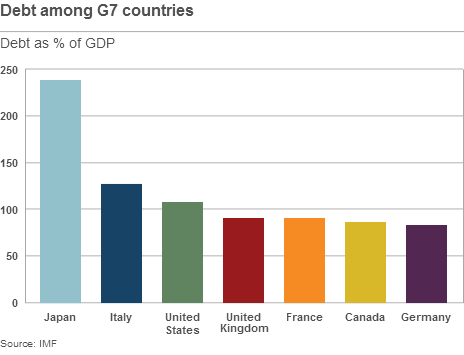
G7 Debt to GDP as of 2013
G7 % Debt to GDP as of 2012 (lower is better)

Canada is beating us in economic growth:
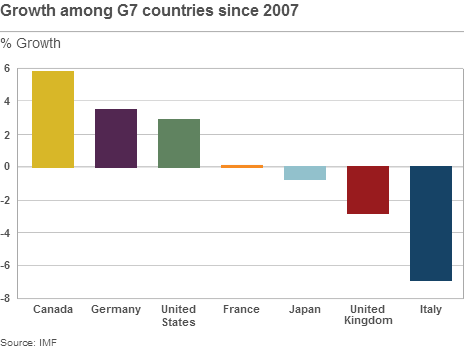
G7 GDP growth for 2013
G7 % GDP growth from 2007 to 2012 (higher is better)

Source: BBC Business

The next Canadian election is in 2015. I know that the Liberal Party is currently leading in the polls, but I found some good news. The Canadians just redistricted after their census, and there are 30 new electoral districts. If the same turnout occurs in 2015 which occurred in the 2011 election, then the Conservative Party of Canada would get 22 out of 30 of those new seats. However, I am concerned. I want Harper to keep his majority, as he and Tony Abbott (Australia) are two bright conservative stars who show people what conservatives can do. 

New study from the Federal Reserve finds that QE stimulus doesn’t grow the economy

Investors Business Daily reports on our incompetent government’s policies.

Excerpt:

For four years now, we’ve heard policymakers and pundits alike defend the Federal Reserve’s quantitative easing based on the idea that, without it, the nation’s economy would have imploded.

Now, a new study from the Fed itself suggests that’s not the case.

The study, by San Francisco Federal Reserve economist Vasco Curdia and New York Fed economist Andrea Ferrero, suggests that quantitative easing (QE) has done little to boost the economy’s trajectory.

“Asset purchase programs like QE2 appear to have, at best, moderate effects on economic growth and inflation,” the economists wrote in a special research note that was released last week.

In their study, Curdia and Ferrero looked specifically at the impact of the Fed’s QE2 program, which totaled $600 billion.

Assuming the $600 billion program lasts for five years — with the Fed buying bonds the first year, holding them for two, then selling them off for the remaining two — the spending turns out largely to have been a waste.

That level of QE stimulus, even when coupled with the Fed’s promise to hold interest rates at zero, likely boosted GDP by a mere 0.13 percentage point, the study found. It added just 0.03 percentage point to inflation.

Bottom line: $600 billion in QE2 spending boosted GDP by less than $200 billion.

[…]And even that minor amount of growth was due in large part to the Fed’s explicit vow to hold official interest rates at close to 0% until the unemployment rate reaches 6.5% or lower, Curdia and Ferrero said.

Take away that promise, and QE2 added just 0.04 percentage point to GDP and 0.02 percentage point to inflation.

What caused it?

With $17 trillion in total U.S. debt — an amount that’s now growing at a rate of $1 trillion a year — the authors argue that the Fed is essentially trapped into printing money through QE.

If QE — which now pushes $85 billion a month into U.S. Treasury and agency debt — stops, interest rates will soar, dragging the economy down.

Fed Chairman Ben Bernanke has been sanguine about this, suggesting this enormous pile of debt can all be sold off with little disruption.

We’re not so sure. Once the Fed begins selling off its massive $3.6 trillion in assets acquired under the QE program (see chart), it will send interest rates surging and tank the economy.

Even more troubling is what it says about current politics.

The White House and a Democrat-led Senate have boosted spending dramatically — outlays as a share of GDP rose initially by 25% under President Obama

The Fed, by buying up much of the newly issued federal debt, has become the No. 1 enabler of a spendthrift government that’s pushing us to the brink of fiscal disaster.

At $85 billion a month, QE2 spending is roughly equal to the amount of federal debt we add each month.

We elected a Keynesian who thought that government could create economic growth (jobs!) by borrowing money and printing money. The countries of the world largely cheered our decision to elect him. He failed to grow the economy and he failed to create jobs. Eventually, the money he’s been spending to keep a sinking ship afloat is going to run out.

Niall Ferguson argues that government is making it harder to run a business

In the Wall Street Journal.

Excerpt:

Seven years of data suggest that most of the world’s countries are successfully making it easier to do business: The total number of days it takes to carry out the seven procedures has come down, in some cases very substantially. In only around 20 countries has the total duration of dealing with “red tape” gone up. The sixth-worst case is none other than the U.S., where the total number of days has increased by 18% to 433. Other members of the bottom 10, using this metric, are Zimbabwe, Burundi and Yemen (though their absolute numbers are of course much higher).

Why is it getting harder to do business in America? Part of the answer is excessively complex legislation. A prime example is the 848-page Wall Street Reform and Consumer Protection Act of July 2010 (otherwise known as the Dodd-Frank Act), which, among other things, required that regulators create 243 rules, conduct 67 studies and issue 22 periodic reports. Comparable in its complexity is the Patient Protection and Affordable Care Act (906 pages), which is also in the process of spawning thousands of pages of regulation. You don’t have to be opposed to tighter financial regulation or universal health care to recognize that something is wrong with laws so elaborate that almost no one affected has the time or the will to read them.

[…]Each year, the World Economic Forum publishes its Global Competitiveness Index. Since it introduced its current methodology in 2004, the U.S. score has declined by 6%. (In the same period China’s score has improved by 12%.) An important component of the index is provided by 22 different measures of institutional quality, based on the WEF’s Executive Opinion Survey. Typical questions are “How would you characterize corporate governance by investors and boards of directors in your country?” and “In your country, how common is diversion of public funds to companies, individuals, or groups due to corruption?” The startling thing about this exercise is how poorly the U.S. fares.

In only one category out of 22 is the U.S. ranked in the global top 20 (the strength of investor protection). In seven categories it does not even make the top 50. For example, the WEF ranks the U.S. 87th in terms of the costs imposed on business by “organized crime (mafia-oriented racketeering, extortion).” In every single category, Hong Kong does better.

At the same time, the U.S. has seen a marked deterioration in its World Governance Indicators. In terms of “voice and accountability,” “government effectiveness,” “regulatory quality” and especially “control of corruption,” the U.S. scores have all gone down since the WGI project began in the mid-1990s. It would be tempting to say that America is turning Latin, were it not for the fact that a number of Latin American countries have been improving their governance scores over the same period.

Whatever the root causes of the deterioration of American institutions, smart people are starting to notice it. Last year Michael Porter of Harvard Business School published a report based on a large-scale survey of HBS alumni. Among the questions he asked was where the U.S. was “falling behind” relative to other countries. The top three lagging indicators named were: the effectiveness of the political system, the K-12 education system and the complexity of the tax code. Regulation came sixth, efficiency of the legal framework eighth.

Asked to name “the most problematic factors for doing business” in the U.S., respondents to the WEF’s most recent Executive Opinion Survey put “inefficient government bureaucracy” at the top, followed by tax rates and tax regulations.

The troubling thing to me is that the private sector has to make a profit in order to fund government, and I don’t see that the private sector will be able to producing the profits needed to fund our government’s lavish spending. Nothing that I see about the next generation causes me to believe that they understand economics enough to vote to improve the business climate. They seem to be very much anti-business. One wonders where they expect to find jobs.