
Tag Archives: Free Market Capitalism

Conservative Party MP Pierre Poilievre explains how Canada escaped the recession

Conservative M.P. Pierre Poilevre (Nepean-Carleton), a member of the majority government in Canada, explains how Canada embraced the free entreprise system that America has rejected, and the results they got.

Here is the speech that went viral on Youtube:

And here is his article in the liberal Huffington Post.

Excerpt:

In a few days the “fiscal cliff” deadline will arrive and potentially bring massive automatic spending cuts and tax increases. Even if Congress and the President agree to avoid the cliff, the next crisis awaits. Treasury Secretary, Timothy Geithner, wrote the Senate this week to report that the “statutory debt limit will be reached on December 31, 2012,” which will require extraordinary measures to prevent a mass default. These measures will give the government 60 days before it runs out of money and Uncle Sam’s head smashes into the so-called “debt ceiling.”

It has long been said that when the U.S. sneezes, Canada catches a cold. So why have these debt-related ailments in the U.S. not afflicted the Canadian government?

The answer is that Canada has been practicing what the U.S. always preached: free markets, low taxes and minimal state interference. And it is working.

For example, Canada avoided the interventionist policies that led the U.S. to the sub-prime crisis.

In an attempt to expand home ownership, administrations from Carter to Bush Jr. forced banks to offer mortgages to people who would otherwise not qualify for them. Washington then ordered government-sponsored enterprises such as Freddie Mac and Fannie Mae to insure these “sub-prime” mortgages.

According to a 2010 Report on the U.S. Financial Crisis by the World Bank’s Development Research Group, Freddie and Fannie bought an estimated 47 per cent of these toxic mortgages. Harvard financial historian Niall Ferguson indicates that the amount of mortgage debt backed by these government-sponsored enterprises grew from $200-million in 1980 to $4-trillion in 2007.(1) The government pumped so much air into the housing bubble that it burst in 2008. The resulting financial crisis led to government bailouts of the banking sector.

Big government caused the economic crisis. So we are told the solution is more big government. Funny how the problem becomes the solution.

Because the Canadian government did not impose sub-prime mortgages on the country’s charter banks, we avoided the crisis and did not bailout a single financial institution. To keep it that way, Canada’s Finance Minister has ended all government-backed insurance of low-down payment and long-amortization mortgages. In other words, if you want to take on risky debt, taxpayers will not insure you.

Governments must lead by example when managing their own debt and spending. Low debt is the result of low spending. Federal government spending as a share of the overall economy is 15 per cent in Canada (2) and 24 per cent in the U.S. (3). The numbers are not merely the result of prodigious U.S. military spending, though that is certainly a factor. Non-military federal government spending is 14 per cent of Canada’s economy (4), and 18 per cent of America’s (5).

Take a look at some of these graphs from earlier in the year about the Canadian 2012 budget. (This is straight from their government’s web site – they have new transparency/anti=corruption measures now, so the citizens know everything that government does). When comparing the deficit and debt of Canada to the United States, always multiply the Canadian number by 10 to get a benchmark to compare. For example, Canadian GDP is 1.7 trillion, and the US GDP is 15 trillion.

Canada’s budget deficit is around 30 billion, but ours is 1.2 trillion:
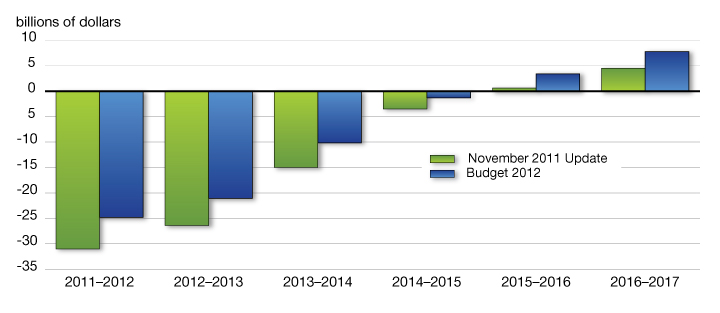
Canada Federal Budget Deficit / Surplus 2012

If we were doing as well as Canada, our deficit would be about $300 billion. But we have run up about 6 trillion in debt over 4 years! Not only that, but Canada’s national debt is only $600 billion. If we multiple that by 10, we would expect ours about $6 trillion. And it was that – during the Bush Presidency. But then the Democrats took over the House and Senate in 2007 and everything went wrong and we packed trillions and trillions onto the debt, including about $6 trillion during Obama’s first term.

Canada’s Debt to GDP ratio is 34%:
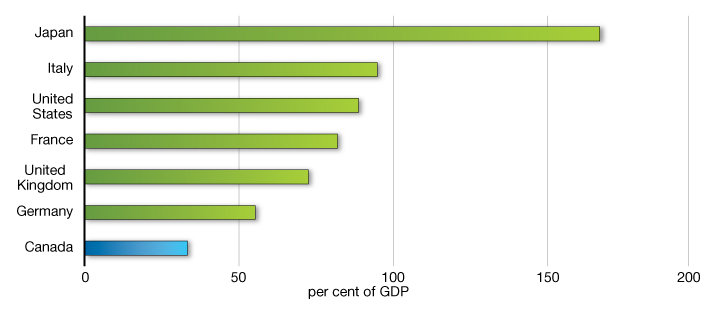
Canada vs US Debt to GDP

But things are even worse for the United States, now. The current United States Debt to GDP is 105%, according to official U.S. government figures. We are due for yet another credit downgrade, and should see Greece-like levels of Debt to GDP during Obama’s second term. We are spending too much, and we aren’t going to be able to make up trillion dollar deficits even if we confiscate every penny that rich people earn. (And they won’t be daft enough to keep working as hard if we did that – they would move, and probably to Canada)

What is happening to us here in the United States is self-inflicted. We are – and have been – voting to impoverish ourselves and generations of children born and unborn, by punishing those who work hard and play by the rules, and rewarding those who don’t work and don’t play by the rules. It didn’t have to be this way. We could have elected a President who actually knew something about business and economics. Knowledge matters. We can’t just choose a President who gives us the “tingles” and then expect him to perform the actual duties of being President. Competence is more important than confidence. Substance is more important than style.
Louisiana governor Bobby Jindal unveils education reform plan

Here are the details on Bobby Jindal’s new education plan, from New Orleans Online Access.

Excerpt:

 Gov. Bobby Jindal on Tuesday outlined a far-reaching set of proposals aimed at improving education in Louisiana, including a state-wide voucher program for low-income students, an expansion of autonomous charter schools and steps to link a teachers’ classroom performance to their job protections and their compensation. The governor has been promising for months now to make education reform the centerpiece of his second-term agenda.

[…]The voucher program may prove the most controversial aspect of the plan. Jindal is proposing to help pay tuition at private and parochial schools for any child of a low-income family who attends a school that receives a letter grade of C, D or F.

More than 70 percent of Louisiana’s public schools would fall into that category, opening up districts across the state to competition for public funding from private institutions. Parents who opt out of those public schools would be able to take the public funding set aside for their child with them to pay for tuition.

Voucher opponents argue that offering private school tuition siphons money away from public education, but the governor is framing the idea as a way to put decision-making in the hands of parents.

Also toward that end, Jindal is proposing to fast-track the approval of new charter schools for proven charter operators. Charters are publicly funded but privately managed and typically overseen by nonprofit boards. They compete with traditional public schools in their area for students.

Jindal is also proposing to end regular annual pay increases for teachers based on years in the classroom, ban the use of seniority in all personnel decisions and weaken the power that local school boards have in hiring and firing decisions in favor of superintendents.

Teachers coming into the classroom for the first time would also see major changes under Jindal’s plan: districts would have greater flexibility to establish their own pay scales for new teachers and tenure would be set aside only for those who earn high ratings on evaluations five years in a row.

I thought it might be helpful to also post this quick introduction to the issue of school choice, from the Cato Institute.

I don’t agree with the Cato Institute on everything, but they’re right on this issue. The Heritage Foundation also has 3 small videos explaining school choice – with cartoons!

There’s an even longer video narrated by John Stossel that you can watch, that really explains the why school reform matters – and why it’s a conservative issue. Like the sex-selection abortion issue that I blogged about here before, this is an issue that conservatives need to seize on. Here, we can really let our compassionate side show by helping the poorest students, especially those in visible minorities, who simply cannot get a quality education in a public school monopoly that is not responsive to the needs of parents, or their children. This is an issue where we can win – the only losers are the educational bureaucrats and the teacher unions. But the kids are more important.

Canada’s economic boom: low tariffs, low corporate tax and more oil drilling

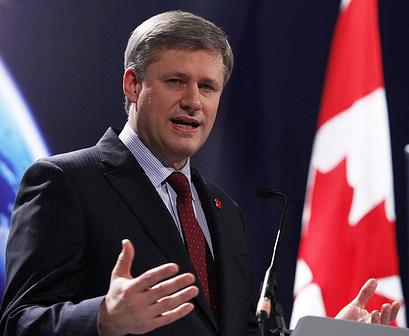
Prime Minister Stephen Harper

From Canoe.

Excerpt:

Finance Minister Jim Flaherty announced Sunday the government will scrap 70 tariff items to save Canadian businesses about $32 million a year.

“This builds on our government’s commitment in Budget 2010 to make Canada a tariff-free zone for industrial manufacturers,” Flaherty said in a statement. “By lowering costs for these businesses, we are enhancing their ability to compete in domestic and foreign markets and helping them invest and create jobs here at home.”

Various sectors — including food processing, apparel, electrical equipment and furniture — will benefit from the move.

The Conservatives had previously eliminated the duty on imported machinery and equipment in an attempt to make Canada a tariff-free zone for industrial manufacturers by 2015.

The Tories say that since 2009 they have eliminated more than 1,800 tariff items and have provided more than $435 million in annual tariff relief to Canadian businesses.

According to the leftist CTV news, Canada also has lower corporate taxes.

Excerpt:

The study released Wednesday by KPMG International found Canada’s corporate tax rate has dropped by more than 16 per cent over the last 11 years.

Canadian companies are actually paying less than their American counterparts.

On average, Canadian companies pay 28 per cent of their income in federal and provincial tax, well below the 40 per cent paid by American companies.

But Canada’s corporate tax rate is higher than Europe’s 20 per cent and the OECD average of 26 per cent.

Canadian corporate taxes fell three per cent in 2011, from 31 per cent in 2010.

“Canada’s corporate tax rate falls around the middle of the pack among the OECD countries,” said Elio Luongo, KPMG’s Canadian Managing Partner for Tax.

“But Canada’s general corporate tax rate is anticipated to continue to fall in 2012, when the federal tax rate will be 15 per cent, versus 16.5 per cent in 2011.”

I’ve written before about how Democrats oppose the job creation that would occur if the United States developed energy in Alaska, the Gulf of Mexico and the Ohio shale. Additionally, Obama has also opposed building the Keystone XL pipeline, which would have created 20,000 jobs paid for by a Canadian company. But Canada has no problems with developing their own energy resources, because their government operates independently of the environmentalist left.

Excerpt:

As world leaders gather in South Africa to discuss climate change this week and next, Canada’s environment minister says he plans to defend Alberta’s oilsands and is willing to argue they are an “ethical” and reliable energy source.

Heading into the 17th Conference of the Parties meeting, Environment Minister Peter Kent says he will not sign on to any deals that mandate some countries reduce greenhouse gas emissions while others don’t — as his government argues was the case under the Kyoto Protocol. He is also unequivocal in his defence of northern Alberta’s bitumen production, a position he expects will be supported by Alberta Environment Minister Diana McQueen when she joins him at the end of the week.

“We still need to — and the industry needs to and our provincial partners need to — be aggressive in ensuring international friends and neighbours and customers recognize Alberta’s heavy oil is no different from heavy oil produced in any number of other countries which don’t receive nearly the negative attention or criticism,” he says. “It is a legitimate resource.”

Kent has made headlines in the last year by arguing that Alberta’s oil is “ethical.”

“We talk about this on quite a regular basis,” Kent says. “I think it’s important we correct where we find … misunderstanding, misinformation or deliberate ignorance to demonize, to criticize and to attempt … to create a boycott.”

In January, on his second day as environment minister, Kent referred to Alberta’s oilsands product as “ethical oil” during an interview with a newspaper reporter.

Reports immediately linked Kent’s comments to the title of conservative activist Ezra Levant’s recent book, Ethical Oil: The Case for Canada’s Oil Sands.

The book essentially compares Canada’s human rights record to those of other oil-producing countries, and argues Canada’s “ethical oil” is preferable to “conflict oil” produced in countries with poor human rights records, such as Sudan, Venezuela, Saudi Arabia or Iran. The argument removes environmental issues, such as greenhouse gas emissions, from the equation, though Levant notes Alberta’s data on environmental issues is more transparent than information shared by other countries.

So in total I’ve presented three reasons why the Canadian economy is booming, while the American economy is stuck in neutral. Obama opposes free trade, lower corporate taxes and domestic energy production. When you elect a socialist lawyer, you get a Greece/Spain economy. When you elect a capitalist economist, you get Canada’s booming economy, and consequently, a lower unemployment rate. Recall that our recession began exactly when we elected Nancy Pelosi to the House leadership and Harry Reid to the Senate leadership in 2007. Democrats wreck economies. There is no reason why America cannot be more prosperous than Canada, but we have to not elect an abject buffoons as our leaders.