
Tag Archives: Free Enterprise

Jay Richards: what should Christians know about economics?

Here’s a good basic introduction to the free enterprise system by Dr. Jay Richards:

Here is the description:

In this edition of the Evangel Guest Lecture Series, Jay W. Richards discusses his book on the capitalist system within the context of the Christian faith and examine how enterprise based on hard work, honesty, and trust fosters creativity and growth.

Jay W. Richards, PhD, is author of many books including the New York Times bestseller Infiltrated (2013). Richards is a senior fellow at the Discovery Institute, and executive editor of The Stream. In recent years he has been a distinguished fellow at the Institute for Faith, Work & Economics, contributing editor of The American at the American Enterprise Institute, a visiting fellow at the Heritage Foundation, and research fellow and director of Acton Media at the Acton Institute.

It turns out that the best system for lifting the poor out of poverty – by work or charity – is the economic system that creates wealth through human ingenuity and hard work. That system is the free enterprise system.

Something to read?

If you can’t listen to the lecture and don’t want to buy the whole book “Money, Greed and God?” Then I have a series of posts on each chapter for you.

The index post is here.

Here are the posts in the series:

  • Part 1: The Eight Most Common Myths about Wealth, Poverty, and Free Enterprise
  • Part 2: Can’t We Build A Just Society?
  • Part 3: The Piety Myth
  • Part 4: The Myth of the Zero Sum Game
  • Part 5: Is Wealth Created or Transferred?
  • Part 6: Is Free Enterprise Based on Greed?
  • Part 7: Hasn’t Christianity Always Opposed Free Enterprise?
  • Part 8: Does Free Enterprise Lead to An Ugly Consumerist Culture?
  • Part 9: Will We Use Up All Our Resources?
  • Part 10: Are Markets An Example of Providence?

Parts 4 and 5 are my favorites. It’s so hard to choose one to excerpt, but I must. I will choose… Part 4.

Here’s the problem:

Myth #3: The Zero Sum Game Myth – believing that trade requires a winner and a loser. 

One reason people believe this myth is because they misunderstand how economic value is determined. Economic thinkers with views as diverse as Adam Smith and Karl Marx believed economic value was determined by the labor theory of value. This theory stipulates that the cost to produce an object determines its economic value.

According to this theory, if you build a house that costs you $500,000 to build, that house is worth $500,000. But what if no one can or wants to buy the house? Then what is it worth?

Medieval church scholars put forth a very different theory, one derived from human nature: economic value is in the eye of the beholder. The economic value of an object is determined by how much someone is willing to give up to get that object. This is the subjective theory of value.

And here’s an example of how to avoid the problem:

How you determine economic value affects whether you view free enterprise as a zero-sum game, or a win-win game in which both participants benefit.

Let’s return to the example of the $500,000 house. As the developer of the house, you hire workers to build the house. You then sell it for more than $500,000. According to the labor theory of value, you have taken more than the good is actually worth. You’ve exploited the buyer and your workers by taking this surplus value. You win, they lose.

Yet this situation looks different according to the subjective theory of value. Here, everybody wins. You market and sell the house for more than it cost to produce, but not more than customers will freely pay. The buyer is not forced to pay a cost he doesn’t agree to. You are rewarded for your entrepreneurial effort. Your workers benefit, because you paid them the wages they agreed to when you hired them.

This illustration brings up a couple important points about free enterprise that are often overlooked:

1. Free exchange is a win-win game.

In win-win games, some players may end up better off than others, but everyone ends up better off than they were at the beginning. As the developer, you might make more than your workers. Yet the workers determined they would be better off by freely exchanging their labor for wages, than if they didn’t have the job at all.

A free market doesn’t guarantee that everyone wins in every competition. Rather, it allows many more win-win encounters than any other alternative.

2. The game is win-win because of rules set-up beforehand. 

A free market is not a free-for-all in which everybody can do what they want. Any exchange must be free on both sides. Rule of law, contracts, and property rights are needed to ensure exchanges are conducted rightly. As the developer of the house, you’d be held accountable if you broke your contract and failed to pay workers what you promised.

An exchange that is free on both sides, in which no one is forced or tricked into participating, is a win-win game.

If you do get the book, be sure and skip the chapter on usury. It’s just not as engaging as the others, in my opinion.
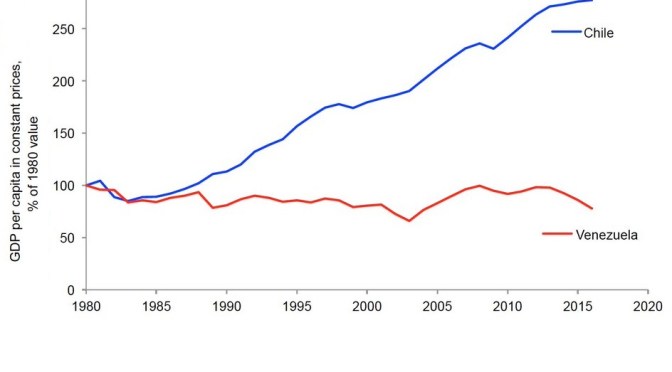
How a small, poor country became the top economy in Latin America

One way to learn about whether specific economic policies work or not is to look at different countries that have tried them. Believe it or not, patterns do emerge about what works and what doesn’t work, as you look across different times and places. I’ve been reading a book called “Money, Greed and God” with my friend Carla, which talks about what has worked to reduce poverty.

The author basically outlined two approaches. In the first approach, the government 1) confiscates the wealth of the most productive workers, 2) nationalizes (takes control of) the businesses of the most successful entrepreneurs, 3) restricts trading between citizens and with other countries, with minimum wage, price controls and tariffs. In the second approach, the government does the opposite: 1) lowers taxes on the most productive workers, and 2) lets entrepreneurs compete to provide goods and services to consumers, and 3) lowers restrictions on internal trading and trading with other countries, e.g. – eliminating minimum wage, tariffs and price controls.

Let’s take a look at two Latin American countries that went in opposite directions. Venezuela and Chile. Then we can finally find out which policies actually achieve results for the people.

Here is how Chile started out in 1973.

PROBLEM: Price controls and tariffs:

Prices for the majority of basic goods were fixed by the government in 1973. Even though Chile was and still is a small economy, the level of protection­ism was high. By the end of 1973, the nominal average tariff for imports was 105 percent, with a maximum of 750 percent. Non-tariff barriers also impeded the import of more than 3,000 out of 5,125 registered goods. Just as economic theory predicts, large queues in front of stores were usual in Santiago and other cities in Chile as a result of the scarcity caused by price controls.

PROBLEM: Government taking over private businesses:

The decline in GDP during 1973 reflected a shrinking productive sector in which the main assets were gradually falling under government control or ownership through expropriations and other government interventions in the economy.

PROBLEM: Deficit spending and government printing money:

The fiscal situation was chaotic. The deficit reached 55 percent of expenditures and 20 percent of GDP and was the main cause of inflation because the Central Bank was issuing money to finance the government deficit.

SOLUTION: lower or eliminate restrictions on trade:

The most important economic reform in Chile was to open trade, primarily through a flat, low tar­iff on imports. Much of the credit for Chilean eco­nomic reforms in the following 30 years should be given to the decision to open our economy to the rest of the world. The strength of Chilean firms, productive sectors, and institutions grew up thanks to that fundamental change.

SOLUTION: let competing entrepreneurs in the private sector provide goods and services to consumers:

A second fundamental reform was to allow the private sector to recover, adding dynamism to the economy. In fact, important sectors such as elec­tricity generation and distribution and telecommu­nications were still managed by state companies. After we implemented a massive privatization plan that included more than 50,000 new direct share­holders and several million indirect (through pen­sion funds) shareholders, these companies were managed by private entrepreneurs that carried out important expansion plans.

SOLUTION: let people take responsibility for their own lives instead of depending on government:

The 1981 reform of the Chilean pension fund system deserves special mention. Under the leader­ship of Minister José Piñera, an individual capitali­zation account program was designed with specific contributions, administered by private institutions selected by the workers. The Chilean Administra­doras de Fondos de Pension (Pension Fund Administrators or AFP) has been replicated in more than 20 countries, and more than 100 million workers in different parts of the world use these accounts to save for retirement.

SOLUTION: allow parents to choose the school that fits their needs from competing education providers, and push school administration down from the federal government to the municipal level, where it would be more responsive to voter’s needs:

In 1981, Chile introduced a universal educational voucher system for students in both its elementary and secondary schools. At the same time, the central government transferred the administration of public schools to municipal governments…  The financial value of the voucher did not depend on family income.

RESULTS: And I was able to find a nice short, description of how all that worked out for them on the far-left Wikipedia, of all places:

The economy of Chile is a high-income economy as ranked by the World Bank, and is considered one of South America’s most stable and prosperous nations, leading Latin American nations in competitiveness, income per capita, globalization, economic freedom, and low perception of corruption.

In 2006, Chile became the country with the highest nominal GDP per capita in Latin America. In May 2010 Chile became the first South American country to join the OECD. Tax revenues, all together 20.2% of GDP in 2013, were the second lowest among the 34 OECD countries, and the lowest in 2010. In 2017, only 0.7% of the population lived on less than US$1.90 a day.

According to the Heritage Foundation, Chile is ranked as the 18th freest economy in the world. The World Bank ranked Chile as the 50th highest GDP per capita for 2018, just below Hungary and above Poland.

Now, you can contrast those results with Venezuela. I have been blogging about Venezuela for years on this blog, and documenting how they raised taxes, banned guns, nationalized private sector companies, raised tariffs, and increased regulations. They are now ranked JUST ABOVE NORTH KOREA for economic freedom – #179 out of 180 countries measured. Basically, they did the opposite of everything that Chile did – transferring power away from parents, workers, business owners, churches and municipal governments to the powerful centralized federal government.

Wikipedia explains how Hugo Chavez took over in 1999 and enacted a communist revolution.

More:

Since the Bolivarian Revolution half-dismantled its PDVSA oil giant corporation in 2002 by firing most of its 20,000-strong dissident professional human capital and imposed stringent currency controls in 2003 in an attempt to prevent capital flight, there has been a steady decline in oil production and exports. Further yet, price controls, expropriation of numerous farmlands and various industries, among other government authoritarian policies… have resulted in severe shortages in Venezuela and steep price rises of all common goods, including food, water, household products, spare parts, tools and medical supplies; forcing many manufacturers to either cut production or close down, with many ultimately abandoning the country as has been the case with several technological firms and most automobile makers.

They confiscated private property, took over private sector businesses, implemented tariffs and price controls, redistributed wealth via massive welfare programs, and pushed all decision-making out of families and municipal governments up to the federal government. By depriving the producers of their earnings, the country caused massive shortages of goods and services, to the point where people are fleeing the country, consuming zoo animals, and selling their bodies as prostitutes in order to get food and water.

Application

In the next election, we are not picking a tribe because of how they make us feel about ourselves. We are not choosing in order to see ourselves as “nice” and “not nice”. We need to look at specific policies being proposed, and see what works and what doesn’t work. The examples of Chile (rags-to-riches) and Venezuela (riches-to-rags) are helpful for voters who want to get RESULTS instead of FEELINGS.

I’ll leave you with a list of links from previous posts so you can see how communism worked out for Venezuela.

Related posts

Why social conservatives should support free market capitalism

The free enterprise system should not be adopted simply because it is the best system for creating wealth. The best reason to support free market capitalism is a moral reason. Arthur Brooks, President of the American Enterprise Institute, and a Christian, describes the moral argument for free market capitalism.

Excerpt:

It might seem that the best case for free enterprise is the material one. Free enterprise lets people make more money, buy more and nicer stuff, and have a greater degree of comfort. The freer our economy is, the more competitive the US economy is vis-à-vis the rest of the world. And so on.

But these aren’t our best arguments. There is another reason, a transcendent reason, for which free enterprise matters most—and this is the case we all must be able to make today.

We all learned early on in school that the Declaration of Independence claimed for each of us the unalienable right to “life, liberty, and the pursuit of happiness.” Note that the founders didn’t assert a right to be happy; such is the domain of tinpots and crackpots, of 1984’s “Ministry of Plenty” and Josef Stalin’s aggrandizing self-description as the Soviet Union’s “Constructor of Happiness.” So what, in practice, does this right to pursue happiness mean?

It means the right to define and earn our happiness through our ideas, hard work, and gumption, to earn our success by creating value honestly, in our own lives and in the lives of others. It doesn’t mean the pursuit of a big lottery win or an inheritance. Those bring money, but not happiness. And a mountain of evidence shows that after a fairly low threshold, more money doesn’t make us happier. The best case for free enterprise has nothing at all to do with money or material goods or wealth. Those are just icing on the cake. We must stop talking about free enterprise as just an engine of wealth creation. It’s much more than that.

In short, the secret to the pursuit of happiness is earning our own success; creating value with our lives and in the lives of others. This earned success is the fruit of hard work and just rewards in a system built on merit. Only in a free enterprise system is effort and innovation rewarded over connections and predation. (And this means that we have to draw a distinction between free enterprise, which is based on opportunity and competition between ideas, and corporate cronyism, which is just another form of statism masquerading as free enterprise.)

Here are 3 reasons why I think that social conservatives should support free market capitalism.

1) Right to work

It’s very important for Christians to have an economic system in place that allows them to work without having to promote anti-Christians ideas. But when government gets too big, what happens is that Christians are no longer free to take any job they want, and still keep a clear conscience. In some states, you have to join a union which uses your union dues to elect Democrats, who very often are liberal on social issues. Or, you have big government forcing Christians to perform abortions against their consciences. Or, you have big government forcing Christian organizations to provide health insurance plans that cover abortions and contraceptives. That’s why Christians need to vote against big government regulations on employment – we need the freedom to work at a job that does not violate our consciences.

2) Right to earn

It’s very important for Christians to keep what they earn so that they have the maximum amount of money to make decisions that make sense for them, according to their consciences. Take the example of day care and education. The big government statist is constantly trying to to create more and more government-run day care and public schools. Why? They want to take money away from families so that they cannot afford individualized private and parochial schools, and lump them all into government run schools that are more “equal”. The problem is that this is bad for Christians who want more oversight into what their children learn. For example, what sense does it make for a Christian man to pay for day care and public schools when he marries a teacher who becomes a stay at home homeschooling mother for his children? He has to pay for day care and public schools he will never use, and it eats into the money he has to afford a stay-at-home homeschooling mom. Christians should oppose a day care and education system run by a secular leftist government. They will never reflect the values of Christian parents.

3) Right to spend

It’s very important for Christians to have the freedom to purchase products and services that make sense in their worldview. Take the example of health care. Secular leftists would love to force private medical insurance companies to cover things like abortion and contraception as health care. In some states, these things are specified as mandatory for every health care plan. That means that Christians who purchase health care are being forced to pay for services like abortion which they will never use themselves. This is nothing more than the redistribution of wealth in order to lower the cost of abortions for people, in order to encourage them to be sexually active before they are able to accommodate children. Christians need to oppose this – we do not want to have to pay for things that go against our consciences.

So, in addition to the reasons that Brooks mentioned (the happiness of earning your own way and serving others), it’s important for Christians to understand how free market capitalism fits into their plans. We do not want to support big government, especially when big government so often is not compatible with Judeo-Christian values. In the free market, it is much harder for ALL the businesses to conspire together to block Christians from working, earning and spending according to their consciences. We must resist top-down control of the free market so that we have the liberty to do what we ought to do in order to be virtuous.