
The Weekly Standard evaluates Mitt Romney’s claim that Rick Santorum is fiscally liberal. (H/T Shane)
Excerpt:
The National Taxpayers Union (NTU) has been rating members of Congress for 20 years. NTU is an independent, non-partisan organization that — per its mission statement — “mobilizes elected officials and the general public on behalf of tax relief and reform, lower and less wasteful spending, individual liberty, and free enterprise.” Steve Forbes serves on its board of directors.
For each session of Congress, NTU scores each member on an A-to-F scale. NTU weights members’ votes based on those votes’ perceived effect on both the immediate and future size of the federal budget. Those who get A’s are among “the strongest supporters of responsible tax and spending policies”; they receive NTU’s “Taxpayers’ Friend Award.” B’s are “good” scores, C’s are “minimally acceptable” scores, D’s are “poor” scores, and F’s earn their recipients membership in the “Big Spender” category. There is no grade inflation whatsoever, as we shall see.
NTU’s scoring paints a radically different picture of Santorum’s 12-year tenure in the Senate (1995 through 2006) than one would glean from the rhetoric of the Romney campaign. Fifty senators served throughout Santorum’s two terms: 25 Republicans, 24 Democrats, and 1 Republican/Independent. On a 4-point scale (awarding 4 for an A, 3.3 for a B+, 3 for a B, 2.7 for a B-, etc.), those 50 senators’ collective grade point average (GPA) across the 12 years was 1.69 — which amounts to a C-. Meanwhile, Santorum’s GPA was 3.66 — or an A-. Santorum’s GPA placed him in the top 10 percent of senators, as he ranked 5th out of 50.
Across the 12 years in question, only 6 of the 50 senators got A’s in more than half the years. Santorum was one of them. He was also one of only 7 senators who never got less than a B. (Jim Talent served only during Santorum’s final four years, but he always got less than a B, earning a B- every year and a GPA of 2.7.) Moreover, while much of the Republican party lost its fiscal footing after George W. Bush took office — although it would be erroneous to say that the Republicans were nearly as profligate as the Democrats — Santorum was the only senator who got A’s in every year of Bush’s first term. None of the other 49 senators could match Santorum’s 4.0 GPA over that span.
This much alone would paint an impressive portrait of fiscal conservatism on Santorum’s part. Yet it doesn’t even take into account a crucial point: Santorum was representing Pennsylvania.
Based on how each state voted in the three presidential elections over that period (1996, 2000, and 2004), nearly two-thirds of senators represented states that were to the right of Pennsylvania. In those three presidential elections, Pennsylvania was, on average, 3 points to the left of the nation as a whole. Pennsylvanians backed the Democratic presidential nominee each time, while the nation as a whole chose the Republican in two out of three contests.
Among the roughly one-third of senators (18 out of 50) who represented states that — based on this measure — were at least as far to the left as Pennsylvania, Santorum was the most fiscally conservative. Even more telling was the canyon between him and the rest. After Santorum’s overall 3.66 GPA, the runner-up GPA among this group was 2.07, registered by Olympia Snowe (R., Maine). Arlen Specter, Santorum’s fellow Pennsylvania Republican, was next, with a GPA of 1.98. The average GPA among senators who represented states at least as far left as Pennsylvania was 0.52 — or barely a D-.
But Santorum also crushed the senators in the other states. Those 32 senators, representing states that on average were 16 points to the right of Pennsylvania in the presidential elections, had an average GPA of 2.35 — a C+.
In fact, considering the state he was representing, one could certainly make the case that Santorum was the most fiscally conservative senator during his tenure. The only four senators whose GPAs beat Santorum’s represented states that were 2 points (Republican Judd Gregg of New Hampshire), 10 points (Republican Jon Kyl of Arizona), 25 points (Republican James Inhofe of Oklahoma), and 36 points (Republican Craig Thomas of Wyoming) to the right of Pennsylvania in the presidential elections. Moreover, of these four, only Kyl (with a GPA of 3.94) beat Santorum by as much as a tenth of a point. It’s an open question whether a 3.94 from Arizona is more impressive than a 3.66 from Pennsylvania.
Do you know who is a big tax and spend fiscal liberal, though? MITT ROMNEY.
So, why is liberal Mitt Romney telling lies about conservative Rick Santorum?
New national Rasmussen poll: Santorum leads Romney 39-27
From Newsmax. (H/T Doug)
Excerpt:
Building on his triple play of victories in Minnesota, Colorado and Missouri, former Sen. Rick Santorum has now surged to a 12-point lead over Mitt Romney in the race for the GOP presidential nomination heading into a key battle in Romney’s home state of Michigan.
Political analyst and Democratic pollster Doug Schoen tells Newsmax that Romney’s presidential bid is in “deep trouble” and his campaign badly needs a win in the Great Lakes State before heading into the do-or-die Super Tuesday contests on March 6, where voters in 10 states will pick their candidate to become the GOP presidential nominee.
“Romney is in deep trouble. He’s out of arguments. People don’t buy the central premise of his candidacy that he’s a businessman who can get things moving again,” Schoen said in an exclusive interview on Wednesday. “He’s entirely negative — whether it’s about President Obama, Newt Gingrich and now Rick Santorum. And Rick Santorum’s ad basically sums up the case against Mitt Romney: He’s a serial attacker who offers nothing other than negative ads, super PACs, bundlers and special interest money. It’s a recipe for failure.”
The latest Rasmussen Reports national telephone survey of likely Republican primary voters released on Wednesday shows Santorum leading with 39 percent support, compared with 27 percent for Romney nationwide.
The two latest polls in Michigan, a state where Mitt Romney grew up and where his father was governor, show Rick Santorum with a 10 point lead and a 9 point lead.
Mitt Romney
- Mitt Romney’s tax returns would make him lose the election to Obama
- Does Mitt Romney’s Romneycare health care plan fund abortion with taxpayer dollars?
- John Hawkins writes the most scathing anti-Romney column EVER
- Santorum and Gingrich expose Romney’s liberal record in Sunday’s NBC debate
- Mitt Romney raised taxes by $740 million while he was governor of Massachusetts
- Mitt Romney and Rick Santorum: who has the pro-life record on abortion?
- RINO Mitt Romney now open to European-style VAT tax
- Is Mitt Romney a flip-flopper? What are his flip-flops?
- RINO Mitt Romney deploys another RINO John Sununu to attack Newt Gingrich
- Mitt Romney supports the anti-Christian and anti-business ENDA law
- Mitt Romney gaffe: Romney fails miserably in interview with Bret Baier
- Jon Huntsman’s anti-Romney ads are awesome
- Mitt Romney’s political views on gay marriage, abortion and global warming
- Mitt Romney flip-flop videos: flat tax, abortion, health care, public sector unions, global warming
- Mitt Romney on global warming, climate change, environmental regulations
- Mitt Romney on abortion and stem cell research in his own words
- White House used Mitt Romney’s Romneycare as a blueprint for Obamacare
- Mitt Romney on the issues: Mitt Romney political views and positions in 2012
Rick Santorum
- Rick Santorum gets endorsements from James Dobson and John Stemberger
- Wall Street Journal: Rick Santorum is a supply-sider for the working man
- Rick Santorum would not stand idle while Iran develops nuclear weapons
- 150 evangelical leaders agree to endorse Rick Santorum after two-day conference
- Why Christians and social conservatives should vote for Rick Santorum
- Rick Santorum’s pro-family economic plan TRIPLES the child tax deduction
- Is Rick Santorum conservative or liberal? What are Rick Santorum’s political views?
- Rick Santorum helps liberal college students to understand the logic of marriage
- George Will: Rick Santorum connects with the working class
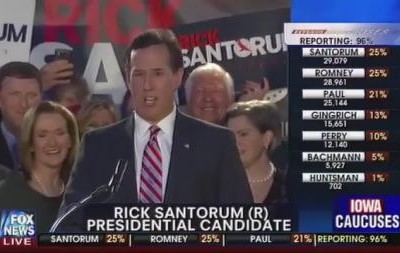
- Video and transcript of Rick Santorum’s inspiring Iowa victory speech
- Rick Santorum for President of the United States
- Mitt Romney and Rick Santorum: who has the pro-life record on abortion?
- Rick Santorum wins Fox News Republican primary debate (with video)
- Rick Santorum explains why socialism is hostile to the family

 WINTERY KNIGHT