Undeniable: How Biology Confirms Our Intuition That Life Is Designed
The host of the Cross Examined radio show Dr. Frank Turek talks with Stephen C. Meyer and Doug Axe about a recent conference of Royal Society scientists discussing the problems with the theory of macro-evolution.
the main topic was whether naturalistic mechanisms can produce new body plans and new organ types
no one disputes micro-evolution: beaks changing size, antibiotic resistance
many of the naturalistic scientists admitted the problems with current naturalistic theories, but they don’t want to embrace the need for a designer
none of the proposals that were debated solved the real problems with macro-evolution
Problem #1: the sudden origin of body plans in the fossil record
Problem #2: the origin of information (e.g. – in protein molecule)
Problem #3: need for favorable early mutations (for body plans)
Problem #4: the problem of epigenetics
Problem #5: the universality of the design intuition
Some of these problems have actually gotten worse for naturalistic evolution as our scientific knowledge has grown.
If you want the two best books on intelligent design, get Dr. Meyer’s “Signature in the Cell” and “Darwin’s Doubt”. I should note that Dr. Meyer is not a young Earth creationist, and has defended the Big Bang cosmology as a solid evidence for a Creator of the universe. Being in favor of an old universe and an old Earth is compatible with being opposed to evolution – because of scientific reasons.
British Spitfire and German Messerschmitt Me 109 locked in a dogfight
Evolution News reported on a 27-minute debate featuring Dr. Stephen C. Meyer – probably the best proponent of intelligent design there is.
Description:
We often say that Darwinists are reluctant to debate advocates of intelligent design, but here are two who deserve a tip of the hat. Keith Pannell is a chemist at the University of Texas at El Paso who hosts a program, Science Studio, on the NPR station there. He invited Stephen Meyer on to talk about the science of ID, pegged to the Dover anniversary.
Clearly Pannell is an ID critic so he gets kudos for being willing to have a civil and informative conversation. Perhaps feeling insecure about facing the author of Darwin’s Doubt by himself, Dr. Pannell invited a biologist colleague, Ricardo Bernal, to serve as “co-host.”
So it was two against one, but no worries. Meyer is, as always, superb, and the discussion sounds like it was an education for the two Texas scientists. Listen and enjoy.
What is intelligent design? (origin of life, fine-tuning)
What is creationism? (young Earth, different epistemology)
Who does Dr. Meyer think the intelligent designer is?
Finding the best explanation from multiple competing hypotheses
Critic: aren’t you arguing for a designer from ignorance, then?
The importance of naturalists acknowledging what they do and do not know about the origin of life
We do have experience with intelligent causation, whenever we sequence symbols to have meaning and purpose, e.g. – writing
Critic: information in DNA is not digital information, is it?
Information in the cell follows a 4-character alphabet
the sequences are composed of many parts / symbols
the sequences themselves are specified to have function
Critic: the complexity just emerges from change over time
the origin of the first life is immune to explanation of change over time, because there is no replication – this is the first replicator
Critic: but isn’t it just ignorance about the origin of life?
what we do is look at a number of competing hypothesis and what they are capable of, and see whether each cause is capable of generating the effects we observe in nature
Critic: where is the experimental verification of your theory?
well, in the appendices of Signature of the Cell, we predicted that the non-coding regions of DNA (junk DNA) would be found to have function, and that was later proven out
the Darwinists said that non-coding regions of the DNA was junk, but that’s not what has been proven experimentally
Critic: where was this prediction written up, who wrote it?
Critic: but we used the scientific method to disprove the Darwinian predictions, you don’t like the scientific method
intelligent design proponents love science, and the scientific method, and they do work in labs to confirm their hypotheses, (WK:for example, the probability of generating a protein by chance)
Critic: what about the Dover court case that you lost?
the Discovery Institute objected to actions taken by the Dover school board
Critic: what about the molecular machines, how are they related to intelligent design?
even in the simplest living organisms, there are tiny machines that are tightly integrated, and cannot be built up in a stepwise fashion
Critic: I’ve worked with the ATP-synthase and other molecular machines, but “you can kind of begin to tease how some of these molecular machines have come about” – pieces have multiple functions, and they are co-opted into larger systems
the problem with the co-option argument breaks down when you look at the specific details of different machines
for example – the type III secretory system cannot be an precursor to the bacterial flagellum, it is younger, not older than the bacterial flagellum
Critic: what would it take for your view to be falsified?
demonstrable undirected processes that are capable of creating functional information in DNA, or processes that can build up an irreducibly complex molecular machine within the time available with a decent probability
If you like this debate, check out Stephen C. Meyer’s two books: “Signature in the Cell” and “Darwin’s Doubt”. They are now out as audio books, too.
Can random mutation and natural selection create new functional information?
The video is here:
I have read and listened and watched a lot of material on intelligent design, but I have never seen so much value packed into such a short lecture. I really hope you’ll watch this and that it’s helpful to you.
Summary:
the big question when discussing the origin of life: where did the information in living systems come from?
Until 530 million years ago, the oceans were largely devoid of life
In a 10 million year period, many new forms of animal life emerged
New biological forms of life require new information
the discovery of DNA shows that living systems work because cells have information that allows them to build the components of molecular machines: cell types, proteins, etc.
can random mutation and natural selection create new functional information?
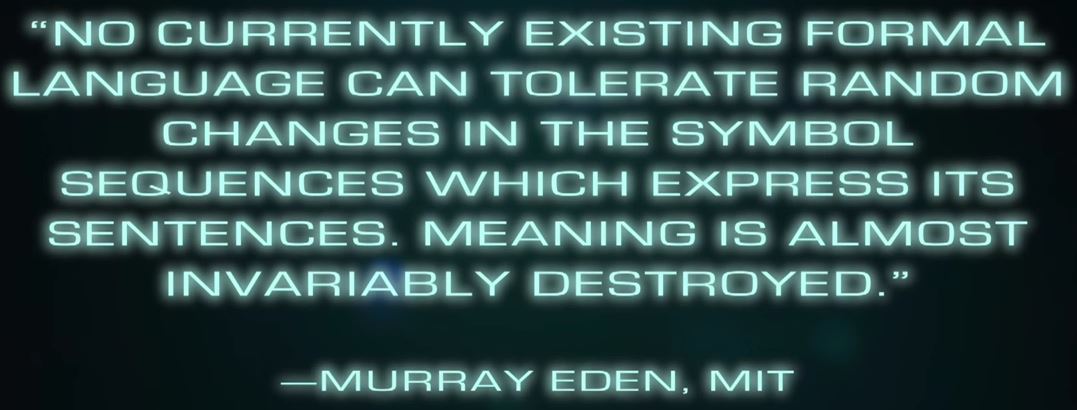
normally, random mutations tend to degrade the functionality of information, e.g. – randomly changing symbols in an applications code does not usually introduce useful new functions, it usually renders what is there non-functional
the majority of possible sequences will NOT have functions, so random mutations will more likely give you non-functional code, rather than functional code
example: a bicycle lock with 4 numbers has many possible sequences for the 4 numbers, and only one of them has unlock functionality, the rest have no functionality
if you have lots of time, then you might be able to guess the combination, but if the lock as has 10 billion numbers, and only one combination that unlocks, you can spend your whole life trying to unlock it and won’t succeed
how likely is it to arrive at a functional protein or gene by chance? Is it more like the 4-dial lock (can be done with lots of time) or the 10 billion dial lock (amount of time required exceeds the time available)?
the probability is LOW because there is only one sequence of numbers that has unlock function
consider a short protein of 150 amino acids has 10 to the 195th power possible sequences
if many of these sequences of amino acides had biological function, then it might be easier to get to one by random mutation and selection than it is with a lock that only unlocks for ONE sequence
how many of the possible sequences have biological function?
Thanks to research done by Douglas Axe, we now know that the number of functional amino acid sequences for even a short protein is incredibly small…
Axe found that the odds of getting a functional sequence of amino acids that will fold and have biological function is 1 in 10 to the 77th power
Is that number too improbable to reach by chance? well, there are 10 to 65th atoms in the entire Milky Way galaxy… so yes, this is a very improbable outcome
can random genetic mutations search through all the sequences in order to find the one in 10 to the 77th power one that has biological function? It depends on how much guessers we have and how many guesses we get in the time available
even with the entire 3.5 billion year history of life on Earth, only about 10 to the 40th organisms have ever lived, which far smaller fraction of the 10 to the 77th total sequences
even with a very fast mutation rate, you would not be able to reach a functional protein even with all that time, and even with all those organisms
I was once having a discussion with a woman about the research that Axe did at the Cambridge University lab. He published four articles in the Journal of Molecular Biology. I held out one of the papers to her and showed her the numbers. She said over and over “I hate the Discovery Institute! I hate the Discovery Institute!” Well, yeah, but you can’t make the Journal of Molecular Biology go away with hating the Discovery Institute. JMB is peer-reviewed, and this was experimental evidence – not a theory, not a hypothesis.
We have been blessed by the Creator and Designer of the universe in this time and place with overwhelming evidence – an abundance of riches. For those who have an open mind, this is what you’ve been waiting for to make your decision. For the naturalists who struggle so mightily to block out the progress of experimental science, they’ll need to shout louder and shut their eyes tighter and push harder to block their ears. Maybe if they keep screaming “Star Trek” and “Star Wars” over and over to themselves, they will be able to ignore the real science a little longer.


 WINTERY KNIGHT