Prior to certain scientific discoveries, most people thought that the universe had always been here, and no need to ask who or what may have caused it. But today, that’s all changed. Today, the standard model of the origin of the universe is that all the matter and energy in the universe came into being in an event scientists call “The Big Bang”. At the creation event, space and time themselves began to exist, and there is no material reality that preceded them.
So a couple of quotes to show that.
An initial cosmological singularity… forms a past temporal extremity to the universe. We cannot continue physical reasoning, or even the concept of spacetime, through such an extremity… On this view the big bang represents the creation event; the creation not only of all the matter and energy in the universe, but also of spacetime itself.
Source: P. C. W. Davies, “Spacetime Singularities in Cosmology,” in The Study of Time III, ed. J. T. Fraser (Berlin: Springer Verlag ).
And another quote:
[A]lmost everyone now believes that the universe, and time itself, had a beginning at the big bang.
Source: Stephen Hawking and Roger Penrose, The Nature of Space and Time, The Isaac Newton Institute Series of Lectures (Princeton, N. J.: Princeton University Press, 1996), p. 20.
So, there are several scientific discoveries that led scientists to accept the creation event, and one of the most interesting and famous is the discovery of how elements heavier than hydrogen were formed.
Nucleosynthesis: forming heavier elements by fusion
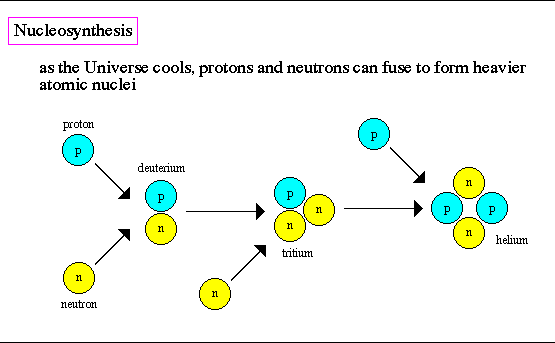
The term nucleosynthesis refers to the formation of heavier elements, atomic nuclei with many protons and neutrons, from the fusion of lighter elements. The Big Bang theory predicts that the early universe was a very hot place. One second after the Big Bang, the temperature of the universe was roughly 10 billion degrees and was filled with a sea of neutrons, protons, electrons, anti-electrons (positrons), photons and neutrinos. As the universe cooled, the neutrons either decayed into protons and electrons or combined with protons to make deuterium (an isotope of hydrogen). During the first three minutes of the universe, most of the deuterium combined to make helium. Trace amounts of lithium were also produced at this time. This process of light element formation in the early universe is called “Big Bang nucleosynthesis” (BBN).
The creation hypothesis predicts that there will be specific amounts of these light elements formed as the universe cools down. Do the predictions match with observations?
Yes they do:
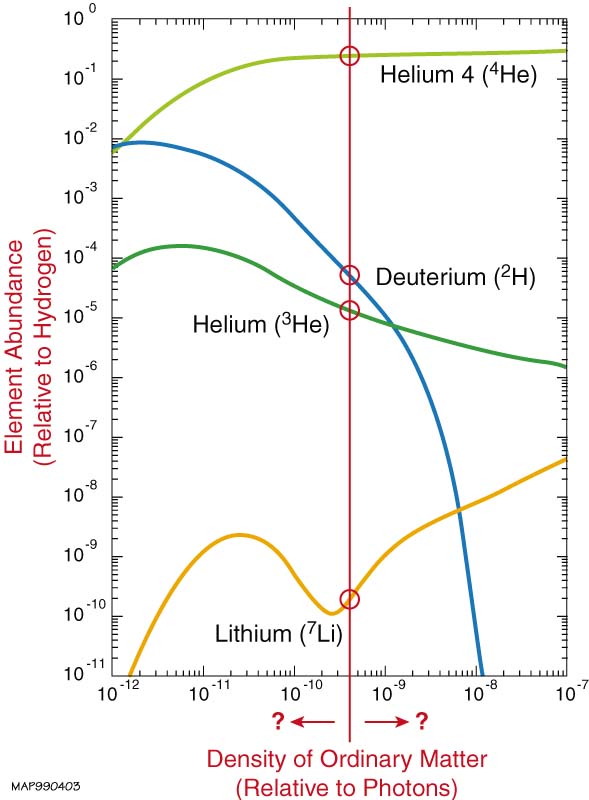
The predicted abundance of deuterium, helium and lithium depends on the density of ordinary matter in the early universe, as shown in the figure at left. These results indicate that the yield of helium is relatively insensitive to the abundance of ordinary matter, above a certain threshold. We generically expect about 24% of the ordinary matter in the universe to be helium produced in the Big Bang. This is in very good agreement with observations and is another major triumph for the Big Bang theory.
Moreover, WMAP satellite measurements of mass density agree with our observations of these light element abundances.
Here are the observations from the WMAP satellite:
And here is how those WMAP measurements confirm the Big Bang creation event:
However, the Big Bang model can be tested further. Given a precise measurement of the abundance of ordinary matter, the predicted abundances of the other light elements becomes highly constrained. The WMAP satellite is able to directly measure the ordinary matter density and finds a value of 4.6% (±0.2%), indicated by the vertical red line in the graph. This leads to predicted abundances shown by the circles in the graph, which are in good agreement with observed abundances. This is an important and detailed test of nucleosynthesis and is further evidence in support of the Big Bang theory.
“An important and detailed test”.
For completeness, we should learn how elements heavier than these light elements are formed:
Elements heavier than lithium are all synthesized in stars. During the late stages of stellar evolution, massive stars burn helium to carbon, oxygen, silicon, sulfur, and iron. Elements heavier than iron are produced in two ways: in the outer envelopes of super-giant stars and in the explosion of a supernovae. All carbon-based life on Earth is literally composed of stardust.
That’s a wonderful thing to tell a young lady when you are on a date: “your body is made of stardust”. In fact, as I have argued before, this star formation, which creates the elements necessary for intelligent life, can only be built if the fundamental constants and quantities in the universe are finely-tuned.
Now, you would think that atheists would be happy to find observations that confirm the origin of the universe out of nothing, but they are not. Actually, they are in denial.
Here’s a statement from the Secular Humanist Manifesto, which explains what atheists believe about the universe:
Religious humanists regard the universe as self-existing and not created.
For a couple of examples of how atheistic scientists respond to the evidence for a cosmic beginning, you can check out this post, where we get responses from cosmologist Lawrence Krauss, and physical chemist Peter Atkins.
You cannot have the creation of the universe be true AND a self-existing, eternal universe ALSO be true. Someone has to be wrong. Either the science is wrong, or the atheist manifesto is wrong. I know where I stand.
‘Atheism’ means the negation of theism, the denial of the existence of God.
Stanford University is one of the top 5 universities in the United States, so that’s a solid definition. To be an atheist is to be a person who makes the claim that, as a matter of FACT, there is no intelligent agent who created the universe. Atheists think that there is no God, and theists think that there is a God. Both claims are objective claims about the way the world is out there, and so both sides must furnish forth arguments and evidence as to how they are able to know what they are each claiming.
In my discussions with atheists, they are using the term that they “lack belief in God”. They claim that this is different from not believing in God or from saying that God does not exist. I’m not sure how to respond to this. It seems to me that its a silly word-play and is logically the same as saying that you do not believe in God.
What would be a good response to this?
Thank you for your time,
Steven
And here is Dr. Craig’s full response:
Your atheist friends are right that there is an important logical difference between believing that there is no God and not believing that there is a God. Compare my saying, “I believe that there is no gold on Mars” with my saying “I do not believe that there is gold on Mars.” If I have no opinion on the matter, then I do not believe that there is gold on Mars, and I do not believe that there is no gold on Mars. There’s a difference between saying, “I do not believe (p)” and “I believe (not-p).” Logically where you place the negation makes a world of difference.
But where your atheist friends err is in claiming that atheism involves only not believing that there is a God rather than believing that there is no God.
There’s a history behind this. Certain atheists in the mid-twentieth century were promoting the so-called “presumption of atheism.” At face value, this would appear to be the claim that in the absence of evidence for the existence of God, we should presume that God does not exist. Atheism is a sort of default position, and the theist bears a special burden of proof with regard to his belief that God exists.
So understood, such an alleged presumption is clearly mistaken. For the assertion that “There is no God” is just as much a claim to knowledge as is the assertion that “There is a God.” Therefore, the former assertion requires justification just as the latter does. It is the agnostic who makes no knowledge claim at all with respect to God’s existence. He confesses that he doesn’t know whether there is a God or whether there is no God.
But when you look more closely at how protagonists of the presumption of atheism used the term “atheist,” you discover that they were defining the word in a non-standard way, synonymous with “non-theist.” So understood the term would encompass agnostics and traditional atheists, along with those who think the question meaningless (verificationists). As Antony Flew confesses,
the word ‘atheist’ has in the present context to be construed in an unusual way. Nowadays it is normally taken to mean someone who explicitly denies the existence . . . of God . . . But here it has to be understood not positively but negatively, with the originally Greek prefix ‘a-’ being read in this same way in ‘atheist’ as it customarily is in . . . words as ‘amoral’ . . . . In this interpretation an atheist becomes not someone who positively asserts the non-existence of God, but someone who is simply not a theist. (A Companion to Philosophy of Religion, ed. Philip Quinn and Charles Taliaferro [Oxford: Blackwell, 1997], s.v. “The Presumption of Atheism,” by Antony Flew)
Such a re-definition of the word “atheist” trivializes the claim of the presumption of atheism, for on this definition, atheism ceases to be a view. It is merely a psychological state which is shared by people who hold various views or no view at all. On this re-definition, even babies, who hold no opinion at all on the matter, count as atheists! In fact, our cat Muff counts as an atheist on this definition, since she has (to my knowledge) no belief in God.
One would still require justification in order to know either that God exists or that He does not exist, which is the question we’re really interested in.
So why, you might wonder, would atheists be anxious to so trivialize their position? Here I agree with you that a deceptive game is being played by many atheists. If atheism is taken to be a view, namely the view that there is no God, then atheists must shoulder their share of the burden of proof to support this view. But many atheists admit freely that they cannot sustain such a burden of proof. So they try to shirk their epistemic responsibility by re-defining atheism so that it is no longer a view but just a psychological condition which as such makes no assertions. They are really closet agnostics who want to claim the mantle of atheism without shouldering its responsibilities.
This is disingenuous and still leaves us asking, “So is there a God or not?”
So there you have it. We are interested in what both sides know and what reasons and evidence they have to justify their claim to know. We are interested in talking to people who make claims about objective reality, not about themselves, and who then go on to give reasons and evidence to support their claims about objective reality. There are atheists out there that do make an objective claim that God does not exist, and then support that claim with arguments and evidence. Those are good atheists, and we should engage in rational conversations with them. But clearly there are some atheists who are not like that. How should we deal with these “subjective atheists”?
Well, my advice is to avoid them. They are approaching religion non-cognitively. When you engage in serious discussions with people about God’s existence, you only care about what people know and what they can show to be true.
Today’s interview is with Jim Wallace of PleaseConvinceMe.com and host of the PleaseConvinceMe Podcast. As a cold case detective, Jim brings a unique perspective to his approach to apologetics and a very down-to-earth logical style. In this interview, Jim talks about his approach to the evidence (inference to the best explanation), Tactics and apologetics, debate vs. dialogue, pitfalls to apologists, and more.
Topics:
Jim’s background as an Catholic-raised atheist, and cold-case detective
Jim believed in the progress of science to answer all the unresolved questions
How did Jim become an atheist?
Why didn’t Jim respond to Christians witnessing to him without evidence?
What approach worked to start him thinking about becoming a Christian?
What did Jim do to grow as a Christian?
How did Jim’s police training help him to investigate Christianity?
What investigative approach is used in his police work?
Does “abductive reasoning” also work for investigating Christianity?
What sort of activities did Jim get involved in in his community?
How Jim’s experience as a youth pastor convinced him of the value of apologetics
How young people learn best by training for engagement with opponents
How Jim takes his youth on mission trips to UC Berkeley to engage the students
Is it possible to run an apologetics ministry part-time while keeping a day job?
Do you have to be an expert in order to have an apologetics ministry?
What books would Jim recommend to beginning apologists?
How the popular apologist can have an even bigger impact than the scholar
How the tactical approach is different for debates and conversations
Jim’s advice for Christians who are interested in learning apologetics
How Christian apologist need to make sure they remain humble and open-minded
How your audience determines how much you need to know from study
Jim’s reason for becoming an atheist, (his mother was excluded from the Catholic church after her divorce), is one I have heard before. I like the way he eventually came back to Christianity. No big emotional crisis, just taking a sober second look at the evidence by himself, and talking with his Christian friends. I’m impressed with the way he has such a productive ministry, as well.




 and apologetics, debate vs. dialogue, pitfalls to apologists, and more.
 WINTERY KNIGHT