Tag Archives: Evidence

J. Warner Wallace: is the idea that you should only evangelize your friends Biblical?

Ratio Christi event at Ohio State University featuring Frank Turek

A recent post from the Please Convince Me blog analyzed whether it is normal for Christians to only evangelize their friends.

Excerpt:

We typically only share our faith with people we know, so it’s shouldn’t surprise us that these are the people who come to know something about our faith! But does it have to be this way, and more importantly, is this approach consistent with what the New Testament teaches?

In order to answer this question, we needn’t go further than the words of Jesus. During His earthly ministry, Jesus commissioned seventy-two of His followers to travel from town to town, announcing, “The Kingdom of God has come near” (Luke 10:9). Were these disciples told to engage only people they already knew? Hardly. In fact, Jesus warned these budding evangelists that they would be in unknown, often dangerous territory; He told the group they would be “lambs in the midst of wolves” (Luke 10:3). Later, after the Resurrection, Jesus commissioned His apostles with a more sweeping directive: “You shall be My witnesses both in Jerusalem, and in all Judea and Samaria, and even to the remotest part of the earth” (Acts 1:8). It’s clear that the expansive geographic parameters described by Jesus would require the apostles to move quickly beyond the limits of their friends and acquaintances.

And that’s exactly what the apostles proceeded to do. Paul repeatedly entered unfamiliar synagogues to announce the Good News to Jews who were strangers to Paul (i.e. Acts 13:13-42 and Acts 18:4-5), and he frequently evangelized “on the streets” from town to town to Jewish and Gentile groups he did not know (i.e. Acts 13:44-52 and Acts 17:16-21). In fact, there are very few examples of friendship evangelism on the pages of Scripture.

I gently reminded the students that they needed to see strict friendship evangelism for what it truly is: a natural, fallen, human response to the fear of discomfort and worldly judgment. Most of us are more concerned with how we will be perceived (and the discomfort we might feel) than our godly responsibility to share the Gospel.  Jesus has a message for us: Get over it. Get comfortable with discomfort. The more we talk about Jesus and reflect His nature and mission, the more likely the world will hate us (John 15:18-16:14). The more we stand up for the truth, the more likely the world will put us in a tough spot (Matthew 10:17-23). And the more we are ostracized by the fallen world around us, the more joy we ought to feel to have been given the opportunity to stand up for something more than our own immediate personal comfort (Luke 6:22-23).

See, I think the problem is that Christians, when they evangelize, are not equipped to do anything more than talk about their personal experiences and preferences when it comes to evangelism. The problem is that asserting that your experience/preference is better than someone else’s experience/preference is uncomfortable. Especially if their preference makes them happy and makes them act nicely. That’s why evangelizing people is so intimidating for us – because we’re never telling people about facts that are true or false out there in the real world. It’s not controversial to tell someone that their belief about the world out there is wrong. That’s why I prefer to talk about public, testable data – like whether the universe began, or how to make a protein, or where the Cambrian animals came from. That’s just like discussing anything else.

The publication of the new Darwin’s Doubt book that was on the New York Times non-fiction bestseller list is a good example of something to talk about safely. Although I might intimidated about trying to talk about feelings, sinfulness and religious experiences with people, I don’t mind talking about science with people. It’s much easier to talk about facts and evidence that about my personal experiences. People understand that and they aren’t intimidated by it, because they feel that they can disagree with factual claims and participate in the discussion.

For example, if I am talking to a Hindu, I’ll show him the papers that argue against the oscillating universe model which is part of the Hindu religion. I don’t even have to mention Hinduism, Christianity or religion. And then he has to come back to me on that factual claim. But it’s a lot easier for me to tell him he’s wrong about facts than to tell him he’s wrong about religious preference claims. Think about it – you disagree with strangers and acquaintances all the time about facts, and you’re not scared of that. I tell people they’re wrong about computer science stuff every day. Why is it any different to tell them that they’re wrong about facts that happen to be related to the claims of different religions? It’s the same thing! That’s why it’s so important to speak about facts with strangers. It’s normal. It’s not weird. It’s easy to say “You need to get your facts straight, because not knowing the facts is causing you to commit to the wrong religion”. That’s doable. Even with strangers.
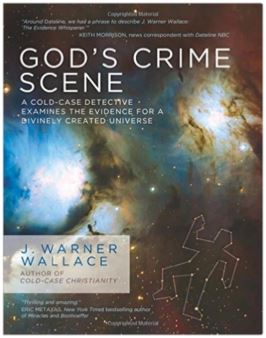

How good is Alexander Vilenkin’s no-God explanation for the origin of the universe?

God's Crime Scene: A Cold-Case Detective Examines the Evidence for a Divinely Created Universe
God’s Crime Scene: A Cold-Case Detective Examines the Evidence for a Divinely Created Universe

I’ve been spending some time going over J. Warner Wallace’s splendid book “God’s Crime Scene” with a friend of mine over Skype. Last week we did chapter 1 on the origin of the universe. We were both struck at Wallace’s statement about Alexander Vilenkin, a non-theist who thinks that the universe had a beginning out of nothing.

Wallace writes:

If you’re a bit confused by all the alternatives offered by those who deny the universe had a beginning, perhaps it’s time to call an expert witness. In this case, there’s no one better than Alexander Vilenkin, theoretical physicist, cosmologist, professor of physics, and director of the Institute of Cosmology at Tufts University. Partnering with mathematician Arvind Borde, cosmologist Alan Guth, and graduate researcher Audrey Mithani, Vilenkin has written several papers demonstrating demonstrating any model of the universe in which expansion is occurring, regardless of the early conditions of the cosmos, must have a beginning.[8] Vilenkin’s work addresses all the models we’ve already described, plus any future proposals in which the expansion of the universe is acknowledged. [9]Vilenkin is a critical expert witness because he simplifies and makes sense of the diverse, sometimes-confusing scientific data.’

This week, my friend asked me why Vilenkin was still not ready to become a theist. Well, Dr. William Lane Craig got asked that same question in his question of the week, and his answer was interesting.

Vilenkin’s view affirms the nothing that precedes the universe:

Modern physics can describe the emergence of the universe as a physical process that does not require a cause. Nothing can be created from nothing, says Lucretius, if only because the conservation of energy makes it impossible to create nothing [sic; something?] from nothing. . . .

There is a loophole in this reasoning. The energy of the gravitational field is negative; it is conceivable that this negative energy could compensate for the positive energy of matter, making the total energy of the cosmos equal to zero. In fact, this is precisely what happens in a closed universe, in which the space closes on itself, like the surface of a sphere. It follows from the laws of general relativity that the total energy of such a universe is necessarily equal to zero. . . .

If all the conserved numbers of a closed universe are equal to zero, then there is nothing to prevent such a universe from being spontaneously created out of nothing. And according to quantum mechanics, any process which is not strictly forbidden by the conservation laws will happen with some probability. . . .

What causes the universe to pop out of nothing? No cause is needed.[1]

Dr. Craig replies at length, here is the part I liked best:

Finally, Vilenkin’s inference that because the positive and negative energy in the universe sum to zero, therefore no cause of the universe’s coming into being is needed is hard to take seriously. This is like saying that if your debts balance your assets, then your net worth is zero, and so there is no cause of your financial situation! (Vilenkin would, I hope, not agree with Peter Atkins that because the positive and negative energy of the universe sum to zero, therefore nothing exists now, and so “Nothing did indeed come from nothing.”[2] For as Descartes taught us, I, at least, undeniably exist, and so something exists.) Christopher Isham, Britain’s premier quantum cosmologist, rightly points out that there still needs to be “ontic seeding” to create the positive and negative energy in the first place, even if on balance its sum is naught.[3]

Vilenkin’s interaction with the kalam cosmological argument is, as I say, fascinating because we see here so clearly how philosophical faux pas, not scientific mistakes, invalidate the objections of an eminent scientist to the argument. This should be an object lesson to all those who, like Stephen Hawking or Lawrence Krauss, naïvely think that philosophy is a sterile and irrelevant discipline compared to science. Philosophy can help all of us, including scientists, to avoid the logical mistakes and conceptual confusions that are all too prevalent in discussions taking place on the borderland of physics, metaphysics, and theology.

That’s a very simple refutation of a famous scientist’s speculative cosmology that anyone can understand. Christians are on very good ground when it comes to the science of origins.

You would think that more Christians would be aware of this evidence and the difficulties that naturalists have in accounting for the origin of the universe in their worldview. But, for some reason, it’s not a real hot topic in most churches. Nor is the fine-tuning or the origin of life or the Cambrian explosion. It’s really strange! If you haven’t yet picked up Wallace’s book, I highly recommend it. It’s the best book for blue collar workers who like evidence. The book touches on virtually every piece of evidence relevant to the God question, including some I had never seen before.

Positive arguments for Christian theism

Is the definition of atheism “a lack of belief in God”?

I have a key that will unlock a puzzling mystery

First, let’s see check with the Stanford University Encyclopedia of Philosophy:

‘Atheism’ means the negation of theism, the denial of the existence of God.

Stanford University is one of the top 5 universities in the United States, so that’s a solid definition. To be an atheist is to be a person who makes the claim that, as a matter of FACT, there is no intelligent agent who created the universe. Atheists think that there is no God, and theists think that there is a God. Both claims are objective claims about the way the world is out there, and so both sides must furnish forth arguments and evidence as to how they are able to know what they are each claiming.

Philosopher William Lane Craig has some thoughts on atheism, atheists and lacking belief in God in this reply to a questioner.

Question:

In my discussions with atheists, they  are using the term that they “lack belief in God”. They claim that this is different from not believing in God or from saying that God does not exist. I’m not sure how to respond to this. It seems to me that its a silly word-play and is logically the same as saying that you do not believe in God.
What would be a good response to this?
Thank you for your time,

Steven

And here is Dr. Craig’s full response:

Your atheist friends are right that there is an important logical difference between believing that there is no God and not believing that there is a God.  Compare my saying, “I believe that there is no gold on Mars” with my saying “I do not believe that there is gold on Mars.”   If I have no opinion on the matter, then I do not believe that there is gold on Mars, and I do not believe that there is no gold on Mars.  There’s a difference between saying, “I do not believe (p)” and “I believe (not-p).”   Logically where you place the negation makes a world of difference.

But where your atheist friends err is in claiming that atheism involves only not believing that there is a God rather than believing that there is no God.

There’s a history behind this.  Certain atheists in the mid-twentieth century were promoting the so-called “presumption of atheism.” At face value, this would appear to be the claim that in the absence of evidence for the existence of God, we should presume that God does not exist.  Atheism is a sort of default position, and the theist bears a special burden of proof with regard to his belief that God exists.

So understood, such an alleged presumption is clearly mistaken.  For the assertion that “There is no God” is just as much a claim to knowledge as is the assertion that “There is a God.”  Therefore, the former assertion requires justification just as the latter does.  It is the agnostic who makes no knowledge claim at all with respect to God’s existence.  He confesses that he doesn’t know whether there is a God or whether there is no God.

But when you look more closely at how protagonists of the presumption of atheism used the term “atheist,” you discover that they were defining the word in a non-standard way, synonymous with “non-theist.”  So understood the term would encompass agnostics and traditional atheists, along with those who think the question meaningless (verificationists).  As Antony Flew confesses,

the word ‘atheist’ has in the present context to be construed in an unusual way.  Nowadays it is normally taken to mean someone who explicitly denies the existence . . . of God . . . But here it has to be understood not positively but negatively, with the originally Greek prefix ‘a-’ being read in this same way in ‘atheist’ as it customarily is in . . . words as ‘amoral’ . . . . In this interpretation an atheist becomes not someone who positively asserts the non-existence of God, but someone who is simply not a theist. (A Companion to Philosophy of Religion, ed. Philip Quinn and Charles Taliaferro [Oxford:  Blackwell, 1997], s.v. “The Presumption of Atheism,” by Antony Flew)

Such a re-definition of the word “atheist” trivializes the claim of the presumption of atheism, for on this definition, atheism ceases to be a view.  It is merely a psychological state which is shared by people who hold various views or no view at all.  On this re-definition, even babies, who hold no opinion at all on the matter, count as atheists!  In fact, our cat Muff counts as an atheist on this definition, since she has (to my knowledge) no belief in God.

One would still require justification in order to know either that God exists or that He does not exist, which is the question we’re really interested in.

So why, you might wonder, would atheists be anxious to so trivialize their position?  Here I agree with you that a deceptive game is being played by many atheists.  If atheism is taken to be a view, namely the view that there is no God, then atheists must shoulder their share of the burden of proof to support this view.  But many atheists admit freely that they cannot sustain such a burden of proof.  So they try to shirk their epistemic responsibility by re-defining atheism so that it is no longer a view but just a psychological condition which as such makes no assertions.  They are really closet agnostics who want to claim the mantle of atheism without shouldering its responsibilities.

This is disingenuous and still leaves us asking, “So is there a God or not?”

So there you have it. We are interested in what both sides know and what reasons and evidence they have to justify their claim to know. We are interested in talking to people who make claims about objective reality, not about themselves, and who then go on to give reasons and evidence to support their claims about objective reality. There are atheists out there that do make an objective claim that God does not exist, and then support that claim with arguments and evidence. Those are good atheists, and we should engage in rational conversations with them. But clearly there are some atheists who are not like that. How should we deal with these “subjective atheists”?

Dealing with subjective atheists

How should theists respond to people who just want to talk about their psychological state? Well, my advice is to avoid them. They are approaching religion irrationally and non-cognitively – like the person who enters a physics class and says “I lack a belief in the gravitational force!”.  When you engage in serious discussions with people about God’s existence, you only care about what people know and what they can show to be true. We don’t care about a person’s psychology.

Dealing with persistent subjective atheists

What happens when you explain all of that to a subjective atheist who continues to insist that you listen to them repeat over and over “I lack a belief in God, I lack a belief in God”? What if you tell them to make the claim that God does not exist, and then support it with arguments and evidence, but instead they keep leaving comments on your blog telling you again and again about their subjective state of mind: “I lack a belief in cupcakes! I lack a belief in icebergs!” What if they keep e-mailing you and threatening to expose you on Twitter for refusing to listen to them, or denounce you via skywriting: “Wintery Knight won’t listen to me! I lack a belief in crickets!”. I think at this point you have to give up and stop talking to such a person.

And that’s why I moderate and filter comments on this blog. There are uneducated people out there with access to the Internet who want attention, but I am not obligated to give it to them. And neither are you. We are not obligated to listen to abusive people who don’t know what they are talking about. I do post comments from objective atheists who make factual claims about the objective world, and who support those claims with arguments and evidence. I am not obligated to post comments from people who refuse to make objective claims or who refuse to support objective claims with arguments and evidence. And I’m not obligated to engage in discussions with them, either.

Positive arguments for Christian theism