Tag Archives: Evidence

Why did Dan Barker leave Christianity for atheism?

A conflict of worldviews

Unbelievable’s  radio show featured a discussion with former Christian Dan Barker, the founder and co-President of the Freedom From Religion Foundation.

The MP3 file is here. (60 minutes)

I thought that I would make some general comments about why I think that many people leave the Christian faith, and what you should be careful of in order to avoid following in Dan Barker’s footsteps, specifically.

Basically, there are four major reasons why people leave Christianity.

  1. They want to do something immoral with impunity. This type of person wants to do something immoral that is forbidden by Christianity, like pre-marital sex or getting drunk in clubs with friends. They dump Christianity in order to have freedom to seek happiness in this life.
  2. They want to make decisions based on their emotions, rather than wisdom. This type of person thinks that God’s job is to save them when they act irresponsibly. When God disappoints them by not make their recklessness “work out”, they leave the faith.
  3. They want to be loved by people, not by God. This type of person thinks that Christianity is a tool that they can use to become popular. When they first try to articulate the gospel in public, they find that people don’t like them as much, and they feel bad about offending people with exclusive truth claims that they cannot back up using logic and evidence. So, they water down Christianity to get along with non-Christians. Finally, they jettison Christianity completely. This happens to a lot of young Christians the moment they hit college / university.
  4. They don’t want to learn to defend their faith. This type of person is asked questions by skeptics that they cannot answer. Usually this happens when people go to university after growing up in the shelter of the Church. The questions and peer pressure make them feel stupid. Rather than investigate Christianity to see if it’s true, they drop it, so they can be thought of as part of the “smart” crowd.

Now listen to the discussion and see if you can identify some of these factors from Barker’s own carefully-prepared words. He is trying very hard to make himself look honest and moderate, because he wants Christians to be sympathetic with his story and his motives for leaving Christianity. But I think that there is enough in his statements to construct a different hypothesis of why he left Christianity.

I’ve grouped the data by risk factor. Some of this is my interpretation of his real motivations, based on my experience dealing with former-Christians.

Non-rational, emotional approach to Christianity

  • he was raised in a devout Christian family where he probably wouldn’t have faced skeptical questions
  • he converted to Christianity at age 15 as a result of a religious experience, not a serious investigation
  • his idea of God was probably idealized and uninformed, e.g. – a loving God who wants us to be happy
  • he wandered around from church to church preaching, with no fixed address or source of income
  • he earned money by collecting “love offerings” from churches where he performed his music
  • he wrote Christian songs and Christian musicals, but nothing substantive on apologetics and theology
  • he worked in three churches known for being anti-intellectual and fundamentalist
  • there’s no evidence that of any deep study of philosophy, science and history during this time

Desire to gain acceptance from non-Christians

  • he began to notice that some people were uncomfortable with sin and Hell
  • he began to avoid preaching about sin and Hell in order to make these people comfortable
  • he watered-down the gospel to focus on helping people to be happy in this life
  • his manic approach to Christian ministry was challenged by the “real life” needs of his growing family
  • he met liberal pastors while performing his music in their churches
  • he found it difficult to disagree with them because they seemed to be “good” people
  • he watered down his message further in order to appeal to people across the theological spectrum

Ignorance of Christian apologetics

  • he began to think that if there are many different views of religion, then no view can be correct
  • he was not intellectually capable of using logic and evidence to test these competing claims to see which was true
  • he decided to instead re-interpret Christian truth claims as non-rational opinions, so they could all be “valid”
  • he became a theological liberal, abandoning theism for an impersonal “ground of being”
  • he embraced religious pluralism, the view that all religions are non-rational and make no testable truth claims
  • he began to see God as a “metaphor” whose purpose is to make people have a sense of meaning and purpose
  • he jettisoned God completely and focused more on helping people find meaning and morality apart from God
  • seems to think that religion is about having a “great life”, and felt that you can have a “great life” without religion
  • seems to think that religion is about being “good”, and felt that you can be “good” without religion
  • religion makes people feel bad by telling them what to do instead of letting them do anything they want
  • religion makes people feel bad by telling them what is true, instead of letting them believe whatever they want
  • religion makes people feel bad by telling them that God will hold them accountable for their beliefs and actions

So what do I think happened?

Barker was generating an income from donations from churches where he entertained them. Gradually, his family grew to the point where conservative churches were not enough to support him. He had to change his message to appeal to liberal churches in order to cast a wider net.

He seems to have thought that Christianity is about having his needs met and being liked by others. I think he wanted to feel good and to make people feel good with his preaching and singing. But Christianity is not a feel-good religion. It’s not a tool to make people like you. He seems to have become aware that the exclusive claims of Christianity made other people feel offended, so he cut them out. Christian apologists learn how to provide evidence for claims that non-Christians find offensive or hard to believe, but Dan hadn’t studied philosophy, science or history so he couldn’t defend it. It’s hard to speak unpopular truths when you have nothing to back it up except your music composing. Eventually, Dan just quit making the truth claims entirely.

I also think money was a factor. It seems to me that it would have hurt his career and reduced his invitations from liberal churches if he had kept up teaching biblical Christianity. In order to appeal to a wider audience, (like many Christian singers do – e.g. – Amy Grant, Jars of Clay, etc.), he would have felt pressured to water down the unpleasant parts of his preaching and singing. Lacking apologetics skill, he instead abandoned his message. He needed to account for his family’s needs and “real life”, and exclusive truth claims and Hell-talk would have reduced his ability to do that. It seems to me that he should have scaled back his extreme schedule of preaching and singing, and instead gotten a steady job so that he could afford “real life” and a family without being pressured into altering his message. The Christian life requires a certain amount of wisdom that Dan did not have.

Life isn’t a fairy tale. God isn’t there to reward risky behavior. We need to be more shrewd about financial matters so that we have the ability to not care about what people think of us. Look at this blog. I work all day as a senior software engineer with two degrees in computer science, so that I don’t have to rely on donations. Additionally, I save most of what I make in case a tragedy strikes. Since I am financially secure, I can say what I think, and disregard anyone who wants me to change my message because they are offended. Becoming a Christian isn’t a license to behave irrationally and immaturely with money. For some people, (like William Lane Craig), stepping out in faith works. But if it doesn’t work, it’s better to retreat and re-trench, rather than to compromise your message for money.

I actually met someone like Dan Barker recently. She grew up in an anti-intellectual hippy Christian home. Her mother came from a good family, and decided on a whim to marry a non-Christian. Like Barker, the family exalted feelings and irrational expectations of miracles from God for “fearless” acts. She got herself into trouble with alcohol and promiscuity in her 20s, by making emotional decisions and mixing with the wrong crowd. Her way of fixing this was to fly off on a one-year missions trip, wrecking her resume and finances. Now, she is in her late 30s, unmarried, and literally blaming Jesus for putting too many demands on her that she doesn’t have time for, e.g – morning quiet time. This causes her to feel guilty, and make her want to reject Christianity. She had no intellectual conception of basic core doctrines like God’s existence or Jesus’ resurrection, which might have acted as a bulwark against her emotions. When I explained to her how I had structured my education and career so that I could have an influence without testing God, she seemed bored and said that I was too “fearful”.

This is apparently widespread, especially among anti-intellectual denominations. Another ex-Pentecostal atheist woman I heard about from people who knew her when she was young decided to drop out of college to travel around North America doing pro-life work. When she found herself penniless, unmarried and without children in her mid-30s, she decided to have a baby out of wedlock. The government will pay for it, she said. Rather than trying to justify this decision as a Christian, she blamed God for not making her madness “work out”. She is now an atheist, because God did not reward her decision to live fearlessly for him with a husband and children. It was all God’s fault. There is a whole subculture within Christianity, where the pursuit of fun and thrills can be masked with pious language, and all talk of prudence and restraint is seen as cowardice and lack of faith.

The Christian life requires a certain level of intelligence, a certain level of practical wisdom, and a certain level of self-control and discipline. Make sure that you don’t walk away from God because of your own bad choices.

Are feminists right to think that gender-neutral marriage makes women happier?

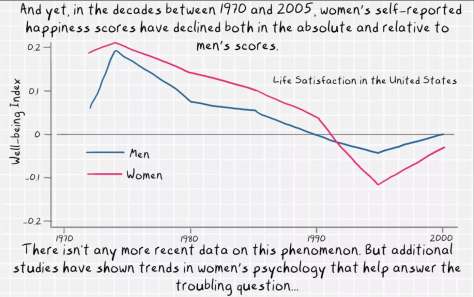
Male And Female Happiness After Feminism And Socialism
Male and female happiness throughout America’s adoption of radical feminism

I was reading this article by a feminist fiction writer on Vox, where she explains that although feminists have gotten what they wanted (careers, contraceptives, promiscuity, abortion, no-fault-divorce, daycare, etc. it hasn’t made them happier. So, what does this feminist fiction writer think would make feminists happier?

She gives two reasons why women women are still unhappy after feminism has been adopted by our society:

  • men don’t do enough housework
  • women are not as successful as men because they are discriminated against, the so-called “glass ceiling”

I think those complaints are pretty popular among feminists. Let’s take a look at some studies to see if her opinions are supported by peer-reviewed studies.

First study:

COUPLES who share housework duties run a higher risk of divorce than couples where the woman does most of the chores, a study has found.

The divorce rate among couples who shared housework equally was around 50 per cent higher than among those where the woman did most of the work.

“The more a man does in the home, the higher the divorce rate,” Thomas Hansen, co-author of the study entitled Equality in the Home, said.

Second study:

Researchers at the University of Illinois examined data on nearly 1,500 men and 1,800 women, aged between 52 and 60. Their well-being was evaluated through surveys.

The researchers first found that men’s well-being decreased once they had exited the workforce to become home-makers.

Meanwhile, the inverse was not so for women: Women’s psychological well-being was not affected by leaving their jobs to become stay-at-home mothers.

Third study:

A study called “Egalitarianism, Housework and Sexual Frequency in Marriage,” which appeared in The American Sociological Review last year, surprised many, precisely because it went against the logical assumption that as marriages improve by becoming more equal, the sex in these marriages will improve, too. Instead, it found that when men did certain kinds of chores around the house, couples had less sex. Specifically, if men did all of what the researchers characterized as feminine chores like folding laundry, cooking or vacuuming — the kinds of things many women say they want their husbands to do — then couples had sex 1.5 fewer times per month than those with husbands who did what were considered masculine chores, like taking out the trash or fixing the car. It wasn’t just the frequency that was affected, either — at least for the wives. The more traditional the division of labor, meaning the greater the husband’s share of masculine chores compared with feminine ones, the greater his wife’s reported sexual satisfaction.

Regarding the pay gap, that is entirely caused by women’s own choices. E.g. – the choice to study creative writing instead of petroleum engineering, the choice to work 35 hour weeks instead of 70 hour weeks, etc.

Fourth study:  (summarized by AEI economist)

When the [Bureau of Labor Statistics] reports that women working full-time in 2018 earned 81.4% of what men earned working full-time, that is very much different from saying that women earned 81.4% of what men earned for doing exactly the same work while working the exact same number of hours in the same occupation, with exactly the same educational background and exactly the same years of continuous, uninterrupted work experience, and with exactly the same marital and family (e.g., number of children) status. As shown above, once we start controlling individually for the many relevant factors that affect earnings, e.g., hours worked, age, marital status, and having children, most of the raw earnings differential disappears.

Fifth study:

This study leads to the unambiguous conclusion that the differences in the compensation of men and women are the result of a multitude of factors and that the raw wage gap should not be used as the basis to justify corrective action. Indeed, there may be nothing to correct. The differences in raw wages may be almost entirely the result of the individual choices being made by both male and female workers.

I think that women are entitled to make their own decisions, but they aren’t allowed to force the rest of us to subsidize their failures and celebrate their destructive outcomes.

I could go on, but I think enough has been said to show that research is very much at odds with feminist rhetoric. They feel they know what will make them happy and we gave them everything they asked for. They eliminated shaming of promiscuity with sex education. They get preferential treatment in the schools in a female-dominated education system.They are hired because of affirmative action quotas. They get expensive daycare, government schools, welfare and other programs. Taxes are raised to equalize outcomes for divorced women who choose men for feelings, and then nuke their own marriage enterprise. We have been on a long experiment of giving feminists everything they felt they wanted, at the expense of men’s rights and children’s rights, and it hasn’t even produced the results that feminists felt it would.

The social costs of feelings-based decision-making

Let’s look at two examples of policies that feminists asked for in the past, which didn’t work out the way they wanted.

I can understand why feminists would introduce sex education. They felt that “if everyone is having sex, then I won’t be the only one chasing attention from hot no-commitment bad boys by giving them recreational sex before marriage”.  They wanted to eliminate the standards of chastity and marriage-focused dating and normalize fun-focused drunken promiscuity. And they got that. But since they didn’t consult any research and evidence about how that would affect their future marriage stability and marriage happiness, they are even more unhappy than before.

How about no-fault divorce? No-fault divorce was brought in by a coalition of feminists, Marxists and trial lawyers. The Marxists want to destroy the family in order to increase dependence on the state. The trial lawyers wanted to make money. And the feminists thought that the standard approach to courting and marriage was just too much work. They didn’t want to be chaste. They didn’t want to be sober. They didn’t want to evaluate a man for traditional husband and father roles. The no-fault divorce laws gave them an escape from the messes caused by their own feelings-driven choices. But divorce just makes makes men and women much poorer, and passes the costs of supporting single mothers onto taxpayers.

And the costs of the failures of feminism are passed onto taxpayers.

Consider this study:

This paper examines the growth of government during this century as a result of giving women the right to vote. Using cross-sectional time-series data for 1870–1940, we examine state government expenditures and revenue as well as voting by U.S. House and Senate state delegations and the passage of a wide range of different state laws. Suffrage coincided with immediate increases in state government expenditures and revenue and more liberal voting patterns for federal representatives, and these effects continued growing over time as more women took advantage of the franchise. Contrary to many recent suggestions, the gender gap is not something that has arisen since the 1970s, and it helps explain why American government started growing when it did.

We are already $22 trillion in debt, partly because of feminism’s replacement of husbands and families with higher taxes and big government. Every time we transfer money from tax-paying men to feminists to fix their mistakes, it leaves less money in the hands of the men who actually want to get married. The declining value of marriage after feminism for men explains why marriage is being delayed, and why marriage rates are plunging.

The Christian view of marriage

In other places, I have written about the evidence for a Christian worldview:

If Christianity is true, then we have inherited a design for marriage and family which includes male and female roles.

Here is what Jesus says about marriage and divorce in Matthew 19:4:

“Haven’t you read,” he replied, “that at the beginning the Creator ‘made them male and female,’ and said, ‘For this reason a man will leave his father and mother and be united to his wife, and the two will become one flesh’? So they are no longer two, but one flesh. Therefore what God has joined together, let no one separate.”

Jesus does not approve of no-fault divorce.

And here’s what Jesus said about premarital sex (“fornication”) in Mark 7:20-23:

20 He went on: “What comes out of a person is what defiles them. 21 For it is from within, out of a person’s heart, that evil thoughts come—sexual immorality, theft, murder, 22 adultery, greed, malice, deceit, lewdness, envy, slander, arrogance and folly. 23 All these evils come from inside and defile a person.

Jesus does not approve of premarital sex.

Christians should not show even a hint of sexual immorality, (premarital sex and no-fault divorce), nor should they partner with those who approve of sexual immorality and no-fault divorce, according to Ephesians 5:

But among you there must not be even a hint of sexual immorality, or of any kind of impurity, or of greed, because these are improper for God’s holy people. Nor should there be obscenity, foolish talk or coarse joking, which are out of place, but rather thanksgiving. For of this you can be sure: No immoral, impure or greedy person—such a person is an idolater—has any inheritance in the kingdom of Christ and of God.[a] Let no one deceive you with empty words, for because of such things God’s wrath comes on those who are disobedient. Therefore do not be partners with them.

Christians should not partner with feminists.

And this is one of the most famous passages on male and female roles in the Bible, also from Ephesians 5:

22 Wives, submit yourselves to your own husbands as you do to the Lord. 23 For the husband is the head of the wife as Christ is the head of the church, his body, of which he is the Savior. 24 Now as the church submits to Christ, so also wives should submit to their husbands in everything.

25 Husbands, love your wives, just as Christ loved the church and gave himself up for her 26 to make her holy, cleansing[b] her by the washing with water through the word, 27 and to present her to himself as a radiant church, without stain or wrinkle or any other blemish, but holy and blameless. 28 In this same way, husbands ought to love their wives as their own bodies. He who loves his wife loves himself. 29 After all, no one ever hated their own body, but they feed and care for their body, just as Christ does the church— 30 for we are members of his body. 31 “For this reason a man will leave his father and mother and be united to his wife, and the two will become one flesh.” 32 This is a profound mystery—but I am talking about Christ and the church. 33 However, each one of you also must love his wife as he loves himself, and the wife must respect her husband.

Christians do not approve of egalitarian marriage which erases sex differences in husband and wife roles.

Most women in the church, and most of their “conservative” pastors, don’t believe that Jesus is an authority about chastity, marriage and male headship. They agree with feminists about premarital sex and no-fault divorce and egalitarian marriage. But the feminist design for women isn’t working out for women – that’s undeniable. Should we really be surprised that feminist’s feelings were not better for women than the Creator’s own design?

Bible study: Was the resurrection body of Jesus spiritual or physical?

Sherlock Holmes and John Watson are going to take a look at the data

So, everyone from left to right accepts the early creed in 1 Corinthians 15:3-7 being dated to 1-3 years after the death of Jesus, even atheists like Crossley, Ludemann and Crossan. The thing is, some people are not sure that the appearances of Jesus to individuals, groups, and skeptics really were physical appearances. They say “well, Paul’s appearance was non-physical, so the other ones must have been, too”.

Let’s take a look.

Here’s a paragraph from my friend Eric Chabot, from his blog Think Apologetics. He explains why Paul’s use of the word “resurrection” to describe what the other witnesses saw means bodily resurrection.

He writes:

If Paul did have a vision then the term “vision” is vague and must be defined. As Licona points out, visions are either objective (i.e., something that is seen without the use of our natural senses) or subjective (i.e., a  product of our minds). The real  problem is with the vision hypothesis is that it doesn’t explain Paul’s use of resurrection to explain what had happened to Jesus.  The two words are used for resurrection in the New Testament “anastasis” (rising up) and “egersis” (waking up), both imply a physical body. Furthermore, the use of the word “opethe” (the Greek word for appeared) shows the Gospel writers did believe that Jesus appeared physically. “There you will see (opethe) him” (Matt. 28:7); “The Lord has risen and has appeared (opethe) to Simon” (Luke 24:24). When they used “opethe” here, it means that He appeared physically to them.

So when Paul gives his list of appearances in 1 Cor. 15, the issues becomes whether the appearance to him is the same as it was to the disciples. There is no doubt the post resurrection body of Jesus (after the ascension) had to be somewhat different than the body the disciples saw. Also, whenever the New Testament mentions the word body, in the context of referring to an individual human being, the Greek word “soma” always refers to a literal, physical body.Greek specialist Robert Gundry says “the consistent and exclusive use of soma for the physical body in anthropological contexts resists dematerialization of the resurrection, whether by idealism or by existentialism.” [9] Furthermore, in N.T. Wright’s  The Resurrection of the Son of God shows that the Greek word for resurrection which is “anastasis” was used by ancient Jews, pagans, and Christians as bodily in nature.

Now, I think my view on this, and I’m not sure if Eric would correct me, is that Paul got an objective but non-physical vision of Jesus. There was something there that everyone else could see and hear, in my view. But in my view Paul’s “veridical” vision was post-ascension, and so non-physical. Paul uses the word resurrection to describe what the other eyewitnesses saw (and he met them at least twice, according to Gal 1 and Gal 2), and that means physical resurrected body.

Eric Chabot writes this in another place:

Acts 9- Paul’s Damascus Road Experience

Here we see whatever happened,  this was after the ascension. Hence, to say Paul saw the exact same Jesus before he ascended is hard to infer from the text. There simply isn’t enough information here.  The Bible says, “they heard” the same voice Paul did ” (Acts 9: 7). But they “did not see anyone ” (Acts 9: 7). Notice  Paul was physically blinded by the brightness of the light.  One way or the other, the experience involved something that was external to Paul. It wasn’t something that was the same thing as a vision that Paul talks about in 2 Cor. 12:1.  Furthermore, the phrase “he let himself be seen’” (ōphthē , aorist passive, ), is the word Paul uses  in 1 Cor. 15:7 to describe of his own resurrection appearance as the other ones in the creed. As Paul Barnett says:

“It is sometimes claimed that the word appeared (ōphthē) means a mystical seeing, as of a vision, and that since this was what Paul “saw” it was what the other apostles “saw.” In other words, after death, Jesus was taken directly to heaven whence he “appeared” to various people, mystically, as it were. This however, is not all the meaning of Paul’s words. First, the word ōphthē, “appeared” is not limited to visionary seeing it is also used for physical seeing. Moreover, the verb raise used in the phrase ‘raised on the third day” is used elsewhere in combination with the words “from the dead” which literally means “from among the corpses.” Thus raised preceding  appeared gives the latter a physical not a mystical meaning. Christ, as “raised from the dead” ….appeared.”  Furthermore, when Paul asks “ Am I not free? Am I not an apostle? Have I not seen Jesus our Lord?”(1 Cor. 9: 1), he is using the ordinary word horan, “to see” for physical sight. If “seeing” the Lord “raised from the dead” qualified others to be apostles, then Paul is, indeed, an apostle. It was no mere subjective vision that arrested Paul en route to Damascus. (8) .

In the end, word studies can’t entirely resolve this issue. We need to remember the etymological fallacy as well. We  would have to look at all the texts that speak of resurrection (including the entire 1 Cor. 15 chapter in their entire context as well as the anthropology of the New Testament. We also need to study the resurrection in light of the Second Temple Jewish period. See our reading list here for some resources that may help.

But conservative ancient historian Gary Habermas seems to think that Paul got the physical body as well.

He says:

Now, I said before in 1 Corinthians 15, Paul could have chosen to only use the word pneuma. He doesn’t. He does say “spiritual,” but he’s got an adjective there. He also says, soma, “body.” What did Paul mean?

Philippians Chapter 3. It’s a short chapter. There are 21 verses, but Paul says three things in one chapter that indicate he’s talking about a physical resurrection. In the opening verses he says, “I was a Hebrew of the Hebrews” and “as touching the law,” he says, “I was a Pharisee.” Now, it’s very well known that the Pharisee believed in a bodily resurrection. In fact, according to Acts 23, as Paul was being taken captive by the Romans to prevent his being killed, he shouted out to the group of people and said, “Why are you taking me? Because I believe in the resurrec­tion of the dead?” He meant a literal resurrection.
When the Pharisees heard that, they said there’s nothing wrong with this guy. But the Sadducees [who didn’t believe in the Resurrection] didn’t like it. So as a Pharisee, he’s agreeing with the Pharisees.
So, the first evidence is from Philippians 3. As a Pharisee, Paul believes in a physical resur­rection.
Secondly, in verse 11 he says, “That I may attain the resurrection of the dead.” Now, the normal Greek word for resurrection is anastasis, but in this passage, Philippians 3:11, he puts a prefix on there, ek anastasis. Ekanastasis, according to all Greek scholars that I know of, is translated in this passage: “The out resurrection from among the dead.” Paul said, “I want to attain the out resurrection.”
Now, to a Jew, “out resurrection” means “what goes down is what comes up.” You come out from death. And then just a few verses later, Philippians 3:20,21, he said, “From Heaven, we look for Jesus who will change our vile soma (body) to be like unto His glorious soma (or body),” when he should have said pneuma, according to this other view.
So he’s a Pharisee who believes in a physical resurrection. Ek anastasis—“resurrection from out among the dead ones.”
Thirdly, Paul says, “He Jesus will change my body to be like His body.”

So right there in Philippians 3 alone, I think the picture of Jesus being some wispy spirit that appeared to him on the road to Damascus doesn’t fit Paul’s own data.

Yes, that’s why Philippians is my favorite book. You can get so much useful theology out of it. Something about the resurrection in Phil 3, something about Jesus’ divinity in Phil 2, and loads of practical advice on stewardship, charity, fellowship, endurance and practical love for others throughout. Some of it takes a little digging, but that’s what commentaries are for, am I right? But I digress.

If you want to read something a little more challenging, I found a paper from the Evangelical Theological Society (ETS) from their journal, where it talks more about soma and anastasis. If you want a bit of a challenge, download the PDF and read it. It’s by Kirk R. MacGregor and the title is “1 Corinthians 15:3B–6A, 7 And The Bodily Resurrection Of Jesus”.