
Tag Archives: Evidence

Is the New York Times a reliable news source or leftist agitprop?

From the New York Times.

Excerpt:

In state after state, guns are being allowed in places once off-limits, like bars, college campuses and houses of worship. And gun rights advocates are seeking to expand the map still further, pushing federal legislation that would require states to honor other states’ concealed weapons permits. The House approved the bill last month; the Senate is expected to take it up next year.

The bedrock argument for this movement is that permit holders are law-abiding citizens who should be able to carry guns in public to protect themselves. “These are people who have proven themselves to be among the most responsible and safe members of our community,” the federal legislation’s author, Representative Cliff Stearns, Republican of Florida, said on the House floor.

To assess that claim, The New York Times examined the permit program in North Carolina, one of a dwindling number of states where the identities of permit holders remain public. The review, encompassing the last five years, offers a rare, detailed look at how a liberalized concealed weapons law has played out in one state. And while it does not provide answers, it does raise questions.

More than 2,400 permit holders were convicted of felonies or misdemeanors, excluding traffic-related crimes, over the five-year period, The Times found when it compared databases of recent criminal court cases and licensees. While the figure represents a small percentage of those with permits, more than 200 were convicted of felonies, including at least 10 who committed murder or manslaughter. All but two of the killers used a gun.

National Review explains what’s wrong with this analysis.

Excerpt:

All of these numbers are completely meaningless; in any large population, there will be some crime. The only way to see what these numbers mean is to compare concealed-carry holders to the general population. Fortunately, state-level murder data are easy to find.

North Carolina has a statewide murder rate of about 5 per 100,000. Even without counting manslaughter, that’s 25 murders committed per 100,000 North Carolinians every five years. There are about 230,000 valid concealed-carry permits in North Carolina, so by pure chance, you’d expect these folks to be responsible for nearly 60 murders over five years. And yet only ten of them committed murder or manslaughter. Instead of “rais[ing] questions,” the Times has demonstrated yet again that permit holders are more peaceful than the general population.

And do you know what else is missing from the New York Times analysis? Any investigation into the number of crimes prevented by defensive handgun usage by licensed concealed carry permit holders. After all, a good journalist would want to weight the bad consequences of a policy together with the good consequences, right? That would be a fair and balanced approach that would inform the readers instead of misleading them.

Do gun control laws reduce violent crime?

Here’s what happened after gun laws changed in Washington, D.C. and Chicago.

Excerpt:

Murder and violent crime rates were supposed to soar after the Supreme Court struck down gun control laws in Chicago and Washington, D.C.

Politicians predicted disaster. “More handguns in the District of Columbia will only lead to more handgun violence,” Washington’s Mayor Adrian Fenty warned the day the court made its decision.

Chicago’s Mayor Daley predicted that we would “go back to the Old West, you have a gun and I have a gun and we’ll settle it in the streets…”

The New York Times even editorialized this month about the Supreme Court’s “unwise” decision that there is a right for people “to keep guns in the home.”

But Armageddon never happened. Newly released data for Chicago shows that, as in Washington, murder and gun crime rates didn’t rise after the bans were eliminated — they plummeted. They have fallen much more than the national crime rate.

Not surprisingly, the national media have been completely silent about this news.

One can only imagine the coverage if crime rates had risen. In the first six months of this year, there were 14% fewer murders in Chicago compared to the first six months of last year – back when owning handguns was illegal. It was the largest drop in Chicago’s murder rate since the handgun ban went into effect in 1982.

Meanwhile, the other four most populous cities saw a total drop at the same time of only 6 percent.

Similarly, in the year after the 2008 “Heller” decision, the murder rate fell two-and-a-half times faster in Washington than in the rest of the country.

It also fell more than three as fast as in other cities that are close to Washington’s size. And murders in Washington have continued to fall.

If you compare the first six months of this year to the first six months of 2008, the same time immediately preceding the Supreme Court’s late June “Heller” decision, murders have now fallen by thirty-four percent.

Gun crimes also fell more than non-gun crimes.

Robberies with guns fell by 25%, while robberies without guns have fallen by eight percent. Assaults with guns fell by 37%, while assaults without guns fell by 12%.

Just as with right-to-carry laws, when law-abiding citizens have guns some criminals stop carrying theirs.

And it’s not just in big cities. MSNBC explains how legal gun ownership reduces crime.

Excerpt:

Americans overall are far less likely to be killed with a firearm than they were when it was much more difficult to obtain a concealed-weapons permit, according to statistics collected by the federal Centers for Disease Control. But researchers have not been able to establish a cause-and-effect relationship.

In the 1980s and ’90s, as the concealed-carry movement gained steam, Americans were killed by others with guns at the rate of about 5.66 per 100,000 population. In this decade, the rate has fallen to just over 4.07 per 100,000, a 28 percent drop. The decline follows a fivefold increase in the number of “shall-issue” and unrestricted concealed-carry states from 1986 to 2006.The highest gun homicide rate is in Washington, D.C., which has had the nation’s strictest gun-control laws for years and bans concealed carry: 20.50 deaths per 100,000 population, five times the general rate. The lowest rate, 1.12, is in Utah, which has such a liberal concealed weapons policy that most American adults can get a permit to carry a gun in Utah without even visiting the state.

The decline in gun homicides also comes as U.S. firearm sales are skyrocketing, according to federal background checks that are required for most gun sales. After holding stable at 8.5 to 9 million checks from 1999 to 2005, the FBI reported a surge to 10 million in 2006, 11 million in 2007, nearly 13 million in 2008 and more than 14 million last year, a 55 percent increase in just four years.

If you ever need to debate this, I recommend buying these academic studies published by the University of Chicago Press and by Harvard University Press. The former shows how crime rates dropped in the USA when Americans rescinded gun control laws, and the latter shows how crime rates rose in the UK when the British strengthened their gun control laws. Sometimes is good to have the data handy.

Want both sides? Then watch a debate on gun control

This debate is in 13 parts, featuring the two of the best proponents of legal firearm ownership – John Lott and Gary Kleck. The real sparks fly during the Q&A, so don’t miss that. (If you can’t watch the debate, then you can read this post and this post instead).

Here’s part 1, which contains the introduction.

Here are the remaining speeches:

This is everything you need to know about whether legal ownership of firearms reduce crime. And you get both sides – unlike in the New York Times.

Here is my previous article exposing the ignorance of NYT executive editor Bill Keller.
Richard Dawkins, who claims to oppose genocide, vows to “destroy” Christianity

Rev. George Pitcher writes about an interview of Christopher Hitchens conducted by Richard Dawkins. (H/T Thinking Christian)

Excerpt:

But the centrepiece of this Christmas edition is the main coup for the New Statesman – an interview by Prof. Dawkins with Christopher Hitchens, the great polymath who today lost his fight against cancer. It’s a fascinating read over three double-page spreads. Not least because Prof. Dawkins reveals a charming humility, allowing Hitchens to show his intellectual superiority at his own expense. Hitchens is thoughtful about CS Lewis and Christianity and rather leaves Prof. Dawkins floundering in his wake, occasionally interjecting little assents to show that he’s still there, as he struggles to keep up.

But one of these interjections is most revealing. About half-way through, the Prof gets this in edgeways: ‘Do you ever worry that if we win and, so to speak, destroy Christianity, that vacuum would be filled by Islam?’

So, ‘if we win…and destroy Christianity’. True, there’s a ‘so to speak’ in there, but it doesn’t do much. Try ‘If we win and, so to speak, kill all the Jews’ as an alternative. Doesn’t really work, does it? And Prof Dawkins can hardly claim that he was misquoted or taken out of context. He was editing the magazine, after all – there’s even a picture of him doing so, pen poised masterfully over page proofs.

Now you might think that Dawkins intends to destroy Christianity in debates, and not in the wars and purges of atheism that occurred last century in North Korea, Cambodia, China, the Soviet Union, and so on. Those atheist regimes caused the deaths of 100 million people, according to Harvard University Press. But Dawkins has refused to debate William Lane Craig on more than one occasion. So whatever he means by “destroy Christianity”, he doesn’t mean “defeat them in rational debate, using superior arguments and evidence”. He had his chance to do that, and he passed on it. So, he must mean something else by “destroying Christianity” other than persuasion.

Let’s find out what Richard Dawkins thinks about morality. Dawkins has previously written this:

The total amount of suffering per year in the natural world is beyond all decent contemplation. During the minute that it takes me to compose this sentence, thousands of animals are being eaten alive, many others are running for their lives, whimpering with fear, others are slowly being devoured from within by rasping parasites, thousands of all kinds are dying of starvation, thirst, and disease. It must be so. If there ever is a time of plenty, this very fact will automatically lead to an increase in the population until the natural state of starvation and misery is restored. In a universe of electrons and selfish genes, blind physical forces and genetic replication, some people are going to get hurt, other people are going to get lucky, and you won’t find any rhyme or reason in it, nor any justice. The universe that we observe has precisely the properties we should expect if there is, at bottom, no design, no purpose, no evil, no good, nothing but pitiless indifference.

(“God’s Utility Function,” Scientific American, November, 1995, p. 85)

Dawkins’ view is that nothing is really good or bad objectively. Cultures just evolve certain conventions, and those conventions vary arbitrarily by time and place. I think we need to interpret his goal of destroying Christianity against the backdrop of his nihilism. 50 million unborn children have been killed in the United States since 1973 alone. That’s 50 million people with distinct genetic codes different from their mothers or their fathers, who will never grow up to achieve their potential.

Dawkins himself is in favor of infanticide:

So what might destroying Christianity look like to an atheist?

Here it what destroying Christianity means in North Korea, the most atheistic country on the planet.

Excerpt:

A Christian woman accused of distributing the Bible, a book banned in communist North Korea, was publicly executed last month for the crime, South Korean activists said Friday.

The 33-year-old mother of three, Ri Hyon Ok, also was accused of spying for South Korea and the United States, and of organizing dissidents, a rights group said in Seoul, citing documents obtained from the North.

The Investigative Commission on Crime Against Humanity report included a copy of Ri’s government-issued photo ID and said her husband, children and parents were sent to a political prison the day after her June 16 execution.

That’s what Kim Jong Il means by “destroy Christianity”. What does Dawkins mean by it?

FLASHBACK: American Atheists calls for the eradication of Christianity.

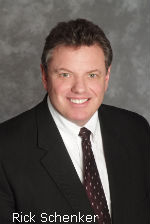
Meet Rick Schenker, head of Ratio Christi, a pro-apologetics campus ministry

Rick Schenker president of Ratio Christi

Here’s an interview with the founder of Ratio Christi, Rick Schenker.

About Rick:

Rick Schenker is president of Ratio Christi, a campus-based, Christian apologetics organization, which he joined in February, 2011. Rick has a visionary leadership style, and has experience in business, government, public and media relations, fundraising, and non-profit management. He has a bachelor’s degree in Bible from Central Bible College, and has done graduate work in public policy at Regent University, along with additional postgraduate work in leadership and public administration. Rick has extensive experience in grass-roots political organization and campaigns in the state of Pennsylvania. As the chief elected official of the County government in Erie, Pennsylvania, he oversaw 1,100 employees and a $300 million budget.

Excerpt:

TBS: Thank you for allowing us to interview you for TheBestSchools.org. Please give our readers an overview of Ratio Christi? What is it? How did it get started? What are its goals?

RSRatio Christi is a global movement that equips university students and faculty to give historical, philosophical, and scientific reasons for following Jesus Christ. Ratio Christi (Latin for “The Reason of Christ”) is placing Christian apologetics clubs at universities both nationally and internationally. Bringing together faith and reason in order to establish the intellectual voice of Christ in the University, Ratio Christi is engaging in the battle for the mind of Christians and skeptics alike. We unashamedly defend the veracity of God, the Bible, and Christ’s resurrection. Ratio Christ started three and a half years ago as a ministry of Southern Evangelical Seminary and became an independent non-profit organization in early 2011. Since that time, Ratio Christi has developed strong partnerships with many other seminaries and organizations, focusing on Christian apologetics and worldview issues. By working together, we now have approximately 60 clubs in various stages of development in universities across the country and around the world.

TBS: Please give us a bit of background about yourself. What were some of the things you were doing before assuming the helm of Ratio Christi? How did the opportunity to head up Ratio Christi present itself?

RS: I am a grass-roots political organizer. I was an elected official, and decided to leave politics to pursue work within Christian ministry. Unfortunately, even though I had run a few nonprofits, and a government with a $300 million budget, I couldn’t find a job. Sometime in 2010, I was considering getting a master’s degree in apologetics, and ran into the Ratio Christi web site. It was a student-run ministry at Southern Evangelical Seminary. In politics, I had become used to spotting trends that could turn into mass movements. As soon as I saw Ratio Christi, I knew it was a mass movement waiting to happen. I called them up and asked them to let me run it. Based on our 500% growth in the last six months, it is apparent that this is something that was not only needed, but ready and waiting to happen in God’s timing.

Here’s more:

TBS: One of the striking claims you make on your web site is that “you are not building an organization, you are building a movement”? Could you please expand on what you see as the difference between the two? What would a Ratio Christi movement look like?

RS: First, Ratio Christi is not the movement. We are simply a grass-roots organization for a greater movement. A movement is usually something that grows beyond the efforts or abilities of the leaders involved in starting it. Ratio Christi is involved in a movement in which apologetics is sweeping through the culture. Because of the rapid growth of neo-atheism in the university, Christian students are under attack. When confronted with intellectual challenges to Christianity, many Christian college students will abandon their faith. You can’t blame them. If the faith of their parents is irrational, then it should be abandoned. In many cases, Christian students are ridiculed and openly humiliated by fellow students and sometimes faculty, for believing in God, the Bible, and Jesus Christ. Then along comes some good apologetics training, and suddenly the students realize that their faith can stand up to intellectual scrutiny. They see that the scientific, historical, and philosophical evidence is on the side of Christianity. They get pumped up about that. The same is true for adults and high school students. Most people didn’t know there was so much evidence that supports the Christian worldview. Ratio Christi wants to help propogate the message that Christianity is not only good, it is true. We want to get the word out, organize cooperation with like-minded ministries, put people and resources in universities and communities, and generally help facilitate what we see as a broader work of God.

TBS: You also say on your web site that you are not in competition with other “full-service” campus ministries, because Ratio Christi is more narrowly focused on “the battle of ideas that permeates the university.” That seems like an admirable goal. But by placing so much emphasis on reasoned discourse, are you concerned at all that Ratio Christi may be raising the bar too high for a truly broad-based campus ministry? After all, you wouldn’t want it seem like undergraduates needed to be philosophy majors in order to participate effectively in their local Ratio Christi chapter, would you?

RS: We do exactly what we say. We go onto a campus to support other Christian ministries. A highly trained apologist is placed on a campus to meet weekly with a small group of students that want to go deeper into the study of the intellectual framework of the Christian faith. RC offers to do training for other student ministries and extends the offer to Christian faculty members. The bar is not too high; this is stuff high school students could and should be learning. Yes, it takes hard work, but loving God with all our mind is part of what it means to be a disciple of Jesus Christ. There is a full range of students involved, from those who have already studied these things deeply to those with no previous exposure. Atheists, agnostics, and those of other belief systems are encouraged to attend. This is a safe place where you can bring your questions. And we do encourage all students to get involved with other campus ministries that do more Bible studies, have worship services, and other fellowship opportunities. RC is simply there to help them deal with the tough questions. Does God exist? Doesn’t science disprove God? Did Jesus really rise from the dead? If God is good and all powerful, why is there evil and suffering? These are the hard questions, and that is what an apologist is trained to handle. Students love it. They love learning the critical-thinking skills necessary to analyze competing worldviews through logical discourse.

TBS: What has been your experience, so far, with the reception of your local Ratio Christi chapters on mainstream secular campuses? Has it been hard to get them recognized? Have there been any noteworthy cases of backlash against students on secular campuses for getting involved with their local Ratio Christi chapter?

RS: Actually it has been surprisingly easy. Since most universities are theoretically all about academic freedom, we approach it from this angle. They should welcome the opportunity to discuss these issues as long as it is done in a civil format. It helps that current case law supports the right of free association on campus. We have been blessed to have the expertise of the Alliance Defense Fund helping guide us in understanding the legal obligations that the universities are under. Since secular thought dominates most educational institutions, the backlash against Christianity is already there. We just try to even the playing field by giving a sound intellectual defense of the faith. Our arguments are appealing to those that are intellectually honest, so there is no need to back down in the face of opposition.

And more:

TBS: One of the most striking things you say on your web site is that you want to make your local Ratio Christi campus chapters welcoming to agnostics and atheists. We certainly see the point of trying to provide a structure for believers and nonbelievers to meet with each other and get to know each other as people, in a nonthreatening environment. But we wonder, given the tensions that exist on college campuses and in American culture generally today, how much success you’ve had so far in this endeavor. Have the chapters had much luck in really engaging with agnostic and atheist students in a constructive way? If not, do you have any thoughts about how you might achieve a better result with this distinctive and important dimension of your work?

RS: Actually, it is fairly normal for our chapters to engage with agnostic and atheist individuals, both in the meetings and around the campus. There has also been a lot of interaction with skeptic/atheist groups, such as co-sponsoring events or setting up discussion forums. Clubs representing other world religions have also been interested in engaging in discussion with our clubs. These interactions are very civil discussions, and our apologists teach Christian students to follow the advice of I Peter 3:15–16, to “always be prepared to give an answer to everyone who asks you to give the reason for the hope that you have. But do this with gentleness and respect, keeping a clear conscience, so that those who speak maliciously against your good behavior in Christ may be ashamed of their slander.” It is easier to do this with gentleness and respect when you are confident in your answers. We have found the reception to a reasoned approach to faith to be quite positive. On the other hand, there are many students among the neo-atheists that have picked up on the tactics of Dawkins and others by practicing a lot of ad hominem arguments against Christians. This is usually some kind of generalized attack like “All Christians are stupid because of X,” but the majority of the discourse on campus is usually quite civil.

Reading this interview was a real encouragement to me. I was very excited by what they are doing on these campuses.

I was in IVCF as an undergraduate and Campus Crusade as a graduate student, and we never did anything with apologetics. Not one thing in six years! They actually blocked every suggestion that the other students and I had to bring in speakers, show debate and lecture DVDs, and organize debates. I didn’t learn one useful thing in 6 years. Everything was always about people sharing their feelings, prayer walks and testimonies. And lots of singing. I know that other IVCF and Crusade groups are different, because I know that some of them do support apologetics, but the ones I attended were really dead set against apologetics.

If any of you are thinking about getting me a Christmas gift because you like the blog, just make a donation to Ratio Christi. Any amount would be great. They take PayPal! (At least – they took my donation through PayPal)

In case you are wondering what they do, here is a sample debate, featuring William Lane Craig and Michael Tooley:

That debate took place at the University of North Carolina.

You can watch another full debate they did (William Lane Craig vs Lawrence Krauss) with this Youtube playlist. That one occurred at North Carolina State University.

Here’s my snarky summary of that debate, in case you don’t want to watch it. The audio is not the best.