Tag Archives: Europe

Should young people vote for Barack Obama and Obamacare?

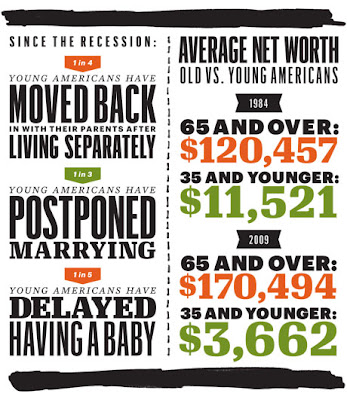
The real inequality: young America and old America

From Donald Sensing at Sense of Events blog.

Excerpt:

Shikha Dalmia, responds to Slate’s Dahlia Lithwick, who was so, “Shell shocked by the shellacking that the Solicitor General Donald Verrilli received at the hearing Tuesday, [that] she went into a deep sulk and threw the intellectual equivalent of a hissy fit.” Shikha observes:

In our current health care system, a mix of taxpayers; (rich) hospitals/providers and (even richer) private insurers are stuck with the tab for uncompensated care. There are many problems with this. But isn’t it at least more compassionate than ObamaCare that would force asset-poor young people – trying to pay off their college debt and hang on to some beer money – to subsidize the coverage of relatively wealthier prospective geezers? If maximizing compassion is the issue, shouldn’t we stick with what we’ve got?

In other words, under Obamacare the young overpay for health insurance in order to subsidize the old, whose medical costs are magnitudes higher than those of the young. That is a key feature of the “individual mandate” that makes it mandatory to buy health insurance under Obamacare. I remember reading during the SCOTUS hearings that men and women younger than 30 (or so) average using about $1,800 of health insurance per year, but will have to pay $5,400.

It’s very important to understand that when government gets involved with spending money on handing out goodies, that it is tempting for them to buy the votes of those who are politically informed with the money taken from those who don’t know a thing about real life.

Now consider these numbers from socialist Europe – where Obama’s plan is a little further along.

Excerpt:

Youth unemployment now exceeds 50pc in both Spain and Greece as the number of people out of work in the eurozone as a whole hit a 15-year high of 17.2m.

The unemployment rate among Spain’s under-25s rose to 50.5pc in January, and to 50.4pc in Greece in December, according to the latest available data from Eurostat, the European Union’s statistics office. It compared with an average eurozone youth unemployment rate of 21.6pc. One of the lowest rates of youth unemployment is in Germany, where it remained at 8.2pc in February.

The rise in Spain and Greece reflects the deep financial woes of both countries, which are in the midst of far-reaching and highly unpopular austerity programmes, considered necessary by the broader EU to reduce huge deficits.

Spain’s unemployment rate now stands at 23.6pc, compared with a eurozone average of 10.8pc. The extent of Spain’s problems are further underlined by a housing market in crisis, with prices expected to fall the most on record this year. One-in-four homeowners in the country owes more than their property is worth.

I find it so sad that kids are brainwashed by unionized public school teachers to support nonsense like global warming, while despising free market capitalism. And then they go out and vote for more and more government, so that their “teachers” can be paid more and more. They will never fix their worldviews until they get out into the real world, and by then it they will have voted in many elections.

New study shows that the medieval warming extended far and wide

From the UK Daily Mail.

Excerpt:

Current theories of the causes and impact of global warming have been thrown into question by a new study which shows that during medieval times the whole of the planet heated up.

It then cooled down naturally and there was even a ‘mini ice age’.

A team of scientists led by geochemist Zunli Lu from Syracuse University in New York state, has found that contrary to the ‘consensus’, the ‘Medieval Warm Period’ approximately 500 to 1,000 years ago wasn’t just confined to Europe.

In fact, it extended all the way down to Antarctica – which means that the Earth has already experience global warming without the aid of human CO2 emissions.

At present the Intergovernmental Panel on Climate Change (IPCC) argues that the Medieval Warm Period was confined to Europe – therefore that the warming we’re experiencing now is a man-made phenomenon.

However, Professor Lu has shown that this isn’t true – and the evidence lies with a rare mineral called ikaite, which forms in cold waters.

‘Ikaite is an icy version of limestone,’ said Lu. ‘The crystals are only stable under cold conditions and actually melt at room temperature.’

It turns out the water that holds the crystal structure together – called the hydration water – traps information about temperatures present when the crystals formed.

This finding by Lu’s research team establishes, for the first time, ikaite as a reliable way to study past climate conditions.

The scientists studied ikaite crystals from sediment cores drilled off the coast of Antarctica. The sediment layers were deposited over 2,000 years.

The scientists were particularly interested in crystals found in layers deposited during the ‘Little Ice Age,’ approximately 300 to 500 years ago, and during the Medieval Warm Period before it.

Both climate events have been documented in Northern Europe, but studies have been inconclusive as to whether the conditions in Northern Europe extended to Antarctica.

Lu’s team found that in fact, they did.

What that means is that the Medieval Warming Period was not local to Northern Europe, but extended all the way to Antarctica, as well. Now you might be asking yourself “how could medieval knights riding around on horseback cause global warming? Wouldn’t they have to be driving SUVs and drilling for oil and generally do nasty capitalist things like that?” Yes, they would. But they weren’t. And so this clearly shows that the warming and cooling of the Earth has nothing whatsoever to do with CO2 emissions. Whatever will the socialists do now to trick people into voting for higher gas prices?

Europe’s socialist debt crisis: who suffers most? Can bailouts fix it?

This is the most popular article on Investors Business Daily right now.

Excerpt:

Rational or not, Greece’s street riots and emigration rates signify one thing: Socialism offers very little to the young. So why is the EU’s $172 billion bailout geared toward saving so much of the failed socialist system?

As Europe prepares to deliver a historic $172 billion bailout to Greece in a deal announced Monday, it’s pretty much a given that the austerity conditions required, in the absence of a true free market, will hit youth hardest. Athens will be trashed by another youth rampage, as many youths blame the pain on something other than Greece’s deeply rooted socialism.

A bigger effect will come from Greeks who do recognize reality. They won’t riot. They’ll leave, voting with their feet just as Eastern Europe’s youth once did.

The young in both cases are victims of socialism, which claims to make people equal but, in reality, penalizes the young. For Greece, a country already gutted by a below-replacement birth rate and an aging population, that’s a disaster.

It’s not just Greece, but also every EU state with institutionalized socialism — where high government spending seeks to create a warm blanket insulating everyone from risk, but instead has led to bankruptcy.

[…]One out of five jobs in Greece is held by a bureaucrat, which is why unemployment among the under-24s runs at 42%. A 2010 poll shows that seven out of 10 Greek college graduates seek to leave.

Some 9% of Greek college graduates and at least 51% of Greece’s Ph.D.s are already gone, according to University of Macedonia demographer Lois Lambrianidis.

What jobs there are come from the bottom of a two-tier labor system that shields older workers in Greece’s rigid labor market. Young Greeks earn a 500-and-change euro monthly minimum wage as older workers doing the same work make 700.

In contrast, immigrant-magnet Australia holds packed job fairs at its Athens embassy. In 2011, it took in 249,000 immigrants. In 2012, a 20% rise is expected.

[…]Meanwhile, Spain’s EFE News reports that the Spanish Embassy in Santiago, Chile, has seen a 10% rise in registered nationals to 48,000, while Chile reports a 25% rise in work permits issued to Spanish citizens.

It’s not just jobs that are penalizing Europe’s young. Housing is stacked against youth, too. Eurostat reports that in 2008, 46% of young European adults ages 18-34 lived with their parents — 51 million people.

The two-tier job market, which leans heavily toward unstable contract employment, affects housing choices for the young. Other socialist measures designed to protect current owners against the market also shut out the young.

Perhaps most hostile of all to youth are the EU’s outdated state pension systems — which force the young to pay the pensions of the old as the population shrinks.

In Italy, 14% of all economic output goes to pensions. It’s no coincidence that states attracting Europe’s young, like Chile and Australia, have privatized their social security systems that give youth a real shot at building personal wealth and a credible pension through their own efforts, instead of political favoritism.

This is the direction that the United States is also headed in. What I find mystifying is why young people in the United States are voting for these policies. Young people here have a higher rate of unemployment, and they ought to know that all of these entitlement programs won’t be there for them when they retire. What possible reason could they have for voting for more and more government control?