Tag Archives: Employment

Do unemployment benefits discourage people from working?

I noticed that the latest jobs report showed that the percentage of work-eligible Americans working was at a 38-year-low.

CNS News reports:

A record 93,626,000 Americans 16 or older did not participate in the nation’s labor force in June, as the labor force participation rate dropped to 62.6 percent, a 38-year low, according to the Bureau of Labor Statistics.

In June, according to BLS, the nation’s civilian noninstitutional population, consisting of all people 16 or older who were not in the military or an institution, hit 250,663,000. Of those, 157,037,000 participated in the labor force by either holding a job or actively seeking one.

Now, let me ask you this. Does paying people to not work cause more people to not work? It seems to me that whatever you subsidize, you get more of, and whatever you tax, you get less of.

Now look at this article from the radically-leftist New York Times.

It says:

Before this recession, most economists probably thought that some amount of unemployment benefits were just and compassionate, and offered a sense of security even to people who were lucky enough to retain their jobs, despite the fact that the program would raise unemployment rates and reduce both employment and economic output.

In other words, unemployment benefits shrink the economy to some degree, but shrinking the economy a bit may be a price worth paying.

Unemployment benefits were thought to reduce employment and output because, by definition, working people were ineligible for the benefits. In particular, an unemployed person who finds and starts a new job, or returns to working at his previous job, is supposed to give up his unemployment benefits. Economists had found that a large fraction of unemployed people delay going back to work solely because the unemployment insurance program was paying them for not working.

Here’s a new study explaining how the “generosity” of the big government Democrat Party actually encourages people to avoid working, and to remain dependent on the government for their “income”.

A study published by two labor economists, Stepan Jurajda and Frederick J. Tannery, looked at employment histories for unemployment insurance recipients in Pittsburgh in the early 1980s. Unemployment rates got quite high in Pittsburgh in those days, reaching 16 percent at one point, and staying over 10 percent for two and a half years.

The chart below summarizes their findings for Pittsburgh.

The chart displays the fraction of persons (in Pittsburgh) receiving unemployment benefits who began working again, as a function of the number of weeks until their unemployment benefits were scheduled to be exhausted. For example, a “hazard” value of “0.04″ for week “-14″ means that, among unemployed persons with 14 weeks remaining until their benefit exhaustion date, 4 percent of them either began working a new job or returned to their previous job.

The chart:

Unemployment offers a disincentive to find work
Unemployment benefits offer a disincentive for Americans to find work

The most troubling thing about this is what is not said in the chart or the study – think about the children growing up in these households where their parents, especially the fathers, are not working. What are they learning about self-sufficiency and the role of government? They are the ones who we are going to task with paying for our lavish entitlement programs in the future. Are people who think that dependency on government is normal being trained to pay for the exploding costs of Social Security and Medicare?
JP Morgan Chase tells employees to celebrate gay rights or else

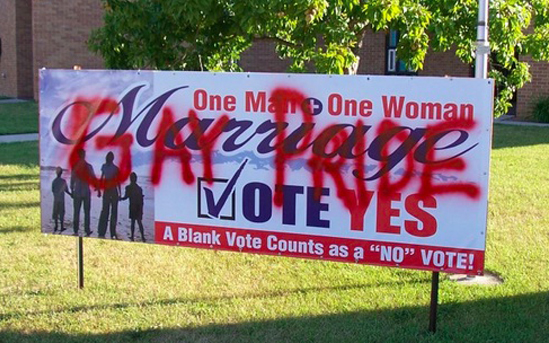
Gay activist vandalizes pro-marriage sign

This is from Breitbart News.

Excerpt:

A document provided to Breitbart News shows the investment banking behemoth JP Morgan Chase has joined a long line of major corporations in putting pressure on employees to sign up for the cause of gay rights. And they have not-so-subtly let each employee know not signing up will be noted.

Employees are being told “to help create an environment for open and honest dialogue.” The document notes descriptors such as “wife” and “boyfriend” are frowned upon, and “partner” is preferred. Not referring to your wife as your wife “offers up the opportunity for more inclusive conversations.”

[…]JP Morgan urges employees to “print and display your ally placard,” which implies the recalcitrant will be noticed.

The document tells employees to “explore your personal beliefs, use inclusive language, avoid making assumptions by asking conscientious questions, increase your awareness about issues impacting the gay community, include LGBT issues in your everyday life, attend events that celebrate diversity and inclusion, and speak out against hurtful comments.”

[…]Besides the gay pride placard each employee is supposed to display in their workspace, perhaps the most intrusive article in the documents calls upon employees to “include LGBT issues in your everyday life.” JP Morgan brass want employees to “include [LGBT issues] in your life and conversations, just as you would any other topic.”

Employees are urged to “take some time to listen to music, see movies or read books and magazines by and about gay people…there’s no substitute for knowledge.”

[…]This follows a controversy last year when JP Morgan Chase sent each employee a survey asking them if they were a “gay ally.” JP Morgan employees reached out anonymously to Breitbart News and other outlets about the pressure put on them to violate their own religious consciences.

Now imagine that you are working for this company or another like it and they are asking you to wear a symbol of the gay agenda on your desk. What exactly are you supposed to do, as an observant Christian, Muslim or Jew? Your Scriptures don’t condone you doing that, but your performance review or promotion may depend on being a “team player”. Should you violate your conscience for the sake of your career? Well, you might be tempted to do it if you were supporting a wife and several children, but maybe not if you were single. You might be tempted to do it if you had a lot of outstanding loans, like student loans . You’re more likely to have unpaid student loans if you chose to study something easy like English than if you studied petroleum engineering.  You might feel more obligated to violate your conscience if you had many children, instead of just a few or none.  You might feel more obligated to violate your conscience if you were making payments on an expensive house and/or an expensive car. You might feel more obligated to violate your conscience if you didn’t have a strong enough resume to get another job.

Do you see how all your life decisions fit in with this? Your freedom to honor your conscience or not depends on the decisions that you make. Your choice to do hard things instead of easy things will affect whether you have freedom to follow your conscience or not. The time is coming, and is now here, when your religious liberty will hinge on your seriousness about life decisions. Were you self-controlled? Were you self-disciplined? Were you self-sacrificial? Did you do things that you didn’t feel like doing in school, at work, and with money? If you were prudent and said no to fun, travel, spending, etc. then you can more easily afford to have religious liberty. Think about the threats before they happen, and make good decisions in your early life. Build yourself a castle with your decisions about education, work and money, so that you don’t have to care when non-Christians force you to choose between God and your belly.

Here are a few verses that were significant to me when I was in high school and college, and had to make the decisions that would either leave me with freedom or force me to comply with the JP Morgan Chase people in the world:

Eccl 12:1:

1 Remember also your Creator in the days of your youth, before the evil days come and the years draw near when you will say, “I have no delight in them”

Prov 25:28:

28 Like a city that is broken into and without walls
Is a man who has no control over his spirit

John 9:4:

4 We must work the works of Him who sent Me as long as it is day; night is coming when no one can work.

Luke 14:28:

28 For which one of you, when he wants to build a tower, does not first sit down and calculate the cost to see if he has enough to complete it?

I think it’s always a good idea to think “how will I make decisions that allow me to achieve the practical result of what these verses are saying?” We want to be obedient to what God says, not to what our feelings say. It may feel good to indulge our feelings, but that never works if we are trying to be serious about achieving real-world results. Feelings only work in the movies.

Economist Walter Williams explains how to not be poor

Economist Walter Williams

Here is his article on wealth and poverty on Creators.

First, there is no real poverty in the United States:

There is no material poverty in the U.S. Here are a few facts about people whom the Census Bureau labels as poor. Dr. Robert Rector and Rachel Sheffield, in their study “Understanding Poverty in the United States: Surprising Facts About America’s Poor”, report that 80 percent of poor households have air conditioning; nearly three-quarters have a car or truck, and 31 percent have two or more. Two-thirds have cable or satellite TV. Half have one or more computers. Forty-two percent own their homes. Poor Americans have more living space than the typical non-poor person in Sweden, France or the U.K. What we have in our nation are dependency and poverty of the spirit, with people making unwise choices and leading pathological lives aided and abetted by the welfare state.

Second, the “poverty” is not caused by racism, but by poor choices:

The Census Bureau pegs the poverty rate among blacks at 35 percent and among whites at 13 percent. The illegitimacy rate among blacks is 72 percent, and among whites it’s 30 percent. A statistic that one doesn’t hear much about is that the poverty rate among black married families has been in the single digits for more than two decades, currently at 8 percent. For married white families, it’s 5 percent. Now the politically incorrect questions: Whose fault is it to have children without the benefit of marriage and risk a life of dependency? Do people have free will, or are they governed by instincts?

There may be some pinhead sociologists who blame the weak black family structure on racial discrimination. But why was the black illegitimacy rate only 14 percent in 1940, and why, as Dr. Thomas Sowell reports, do we find that census data “going back a hundred years, when blacks were just one generation out of slavery … showed that a slightly higher percentage of black adults had married than white adults. This fact remained true in every census from 1890 to 1940”? Is anyone willing to advance the argument that the reason the illegitimacy rate among blacks was lower and marriage rates higher in earlier periods was there was less racial discrimination and greater opportunity?

Third, avoiding poverty is the result of good choices:

No one can blame a person if he starts out in life poor, because how one starts out is not his fault.

If he stays poor, he is to blame because it is his fault. Avoiding long-term poverty is not rocket science. First, graduate from high school. Second, get married before you have children, and stay married. Third, work at any kind of job, even one that starts out paying the minimum wage. And finally, avoid engaging in criminal behavior. It turns out that a married couple, each earning the minimum wage, would earn an annual combined income of $30,000. The Census Bureau poverty line for a family of two is $15,500, and for a family of four, it’s $23,000. By the way, no adult who starts out earning the minimum wage does so for very long.

Fourth, what stops people from making good choices is big government:

Since President Lyndon Johnson declared war on poverty, the nation has spent about $18 trillion at the federal, state and local levels of government on programs justified by the “need” to deal with some aspect of poverty. In a column of mine in 1995, I pointed out that at that time, the nation had spent $5.4 trillion on the War on Poverty, and with that princely sum, “you could purchase every U.S. factory, all manufacturing equipment, and every office building. With what’s left over, one could buy every airline, trucking company and our commercial maritime fleet. If you’re still in the shopping mood, you could also buy every television, radio and power company, plus every retail and wholesale store in the entire nation”. Today’s total of $18 trillion spent on poverty means you could purchase everything produced in our country each year and then some.

Walter Williams is one of my two favorite economists, the other being Thomas Sowell. By sheer coincidence, they both happen to have grown up poor, and they both happen to be black. They understand what causes poverty very well. I recommend their books to you if you want to understand poverty, too.