

Tag Archives: Emotions

Stop telling women that God will give them a husband later if they delay marriage now

Man helping a woman with proper handgun marksmanship

Dalrock blogged a splendid post about people who claim that there is a shortage of “good men”. He says that if there really were a shortage of good men, then people who want women to actually get married would be telling women not to delay marriage, but to instead get serious about marrying early, when their ability to attract a man is at its peak.

Dalrock writes:

We can see the same pattern in Dr. John Piper’s recent post Why Are Women More Eager Missionaries?*  Piper explains that missionary work has become a pink ghetto:

…the actual situation among most evangelical faith missions is that between 80–85% of all single missionaries are women. It is a rare thing, like two out of every ten, for a single man to make missions his life’s vocation, which results in the overall statistics being that one-third of those in evangelical world missions are married men, one-third are married women, and 80 percent of the last third are single women. Which means that something just less than two-thirds of the total missionary force are women.

Piper’s main concern with the post however is not that there aren’t enough single men doing missionary work, but that women who choose this field aren’t marrying as they would like.  Piper complains that the problem for husband hunting missionary women is really an exacerbated version of the same problem all Christian women have, and that is an overall lack of marriageable Christian men…

I’ll save you the quotation of Piper, but his reason why missionary women struggle to find husbands is – SHOCK! – that Christian men refuse to man up. I.e – Piper believes that there are not enough marriage-ready, marriage-minded men.

More:

But if Piper actually believed… that there was a severe shortage of husband material men, he would focus his attention on helping the women reading navigate this incredibly difficult situation.  Overseas mission work may feel empowering for young women, but (according to Piper) single women going into the mission field are greatly handicapping their prospects in an already bleak field.  His advice to young women would be to choose which was truly more important to them, being a missionary or finding a husband.

If Piper really believed that there were a shortage of marriage-minded, marriage-capable Christian men, then Piper would be counseling women who genuinely want to marry to make marriage a priority when they are younger, prettier and more fertile. Some women say that they want to get married “some day”, but the truth is that they want fun and thrills until they get tired of it, and they just expect a suitable man to show up right when they need one – even if the things a man wants in a woman are all gone.

So who is to blame if missionary women can’t find husbands?

Piper even tells a story which would be a perfect way to teach this lesson.  He describes a single woman named Gladys Aylward who went to a place where she found no marriageable men, and then blamed single men for not following her and proposing marriage:

“Miss Aylward talked to the Lord about her singleness. She was a no-nonsense woman in very direct and straightforward ways and she asked God to call a man from England, send him straight out to China, straight to where she was, and have him propose to me.” I can’t forget the next line. Elisabeth Elliot said, “With a look of even deeper intensity, she shook her little bony finger in my face and said, ‘Elisabeth, I believe God answers prayer. And he called him.’” And here there was a brief pause of intense whisper. She said, “‘He called him, and he never came.’”

Now, that experience, I would guess, is not unique to Gladys Aylward.

If Piper really believed that Christian husbands were scarce, he would be sharing this anecdote to warn young women of the foolishness of moving away from the pool of men they hope to choose a husband from and then expecting God to send the man of their choosing across the world to propose.  If we were in a culture of scarcity of good men, this would be the obvious lesson from this story.  But we live in an age with unshakable confidence that good men are not only available all around us, but will always be abundant.  If Piper believed that the husband Miss Aylward was praying for was surrounded by real life English women eager to win him as a husband, this story wouldn’t be complaining about why he didn’t drop everything, fly to China, and propose to a woman he had never met.  If Piper believed that the man was sought after as a husband in England, he would be pointing out the foolishness of Miss Aylward flying off to China and then wondering why a man she had never met didn’t show up to propose once she decided she wanted to marry.

Now to be fair, in Miss Aylward’s case, she almost certainly did a lot more good as a missionary than she would have achieved with a marriage. She was not pursuing fun and thrills, she really was making a difference. Still, it was neither rational nor prudent to think that the odds of meeting a Christian man were very good in China. She either needed to accept that being a missionary in a secular country meant not marrying, or she needed to focus on marriage first when she was attractive to men as a life partner. (Many women are propositioned for sex as they age, but few of them are asked to marry) As homeschooling mom “That Mom” points out on her blog, having an influence through marriage and parenting is not compatible with the irresponsible thrill-seeking hedonism championed by impractical pastors like Francis Chan.

But some missionaries really are delaying marriage for frivolous reasons. The 33-year-old missionary woman I know keeps telling all her advisers that she wants to get married “some day”. Her last two boyfriends were both penniless students in their late 20s, who had never worked a full-time job in their entire lives. She feels that there is no need to prepare herself for the roles of wife and mother, either. Her negative $20,000 net worth? No problem. The 5-year gap in her resume? No problem. Her chorus of advisers tell her that God will give her a husband right on cue. A husband who won’t insist that a wife have chastity, sobriety, self-control, financial responsibility, beauty or fertility.

What men want in a wife and mother apparently has no importance whatsoever to women today. And women have no appreciation of how investing in a husband early causes him to be loyal to her when she is older. Women think that a husband will show up when she is ready, and be loyal to her even though she was absent during the hardships of the first decade of his career. Fun and thrills in your 20s are more important than helping a man through the difficult battles of his early career. Just show up when you are 35 -unchaste, wrinkly and infertile – and reap the rewards of his unassisted earning and saving.

Why do men like John Piper mislead women about the feasibility of their emotion-driven plans? Answer: because they fear women’s reactions to disagreement. Men are easier to criticize than women, because men are trained to take it, and not to show their emotions. Practically speaking, whenever a woman anoints her emotions as God speaking to her, her plan almost never works out. But it takes courage to tell a woman to make plans with her mind, instead of with her feelings.

I expect women today to disrespect male advisers, even those with proven ability, because we live in an age of radical feminism where even Christian women who deny feminism act as if they were radical feminists. But it’s not just men who are disrespected. Many women don’t even respect older women with proven ability (See Titus 2:3-5). They just block experts out and find advisers with no proven ability, but who agree with them.

By the way, for an explanation of why men prefer not to be missionaries, read this post on Deeper Strength blog.
A lesson about men for marriage-minded women from the movie “High Noon”

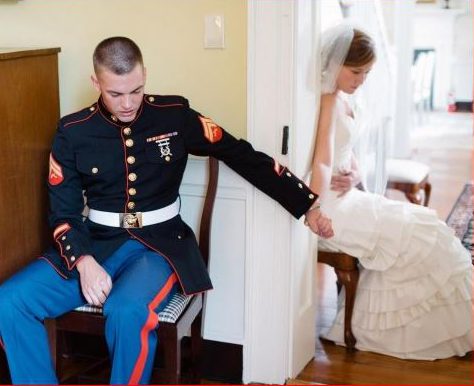
Marine prays with his wife on their wedding day

One of my favorite movies for explaining the differences between men and women is “High Noon” (1952).

Here’s the summary from IMDB:

Former marshal Will Kane (Gary Cooper) is preparing to leave the small town of Hadleyville, New Mexico, with his new bride, Amy (Grace Kelly), when he learns that local criminal Frank Miller has been set free and is coming to seek revenge on the marshal who turned him in. When he starts recruiting deputies to fight Miller, Kane is discouraged to find that the people of Hadleyville turn cowardly when the time comes for a showdown, and he must face Miller and his cronies alone.

The main theme of the film concerns Amy’s decision to break her wedding vows the very day that she makes them. She tells her new husband that he must bow to her will, and give up his male role as protector. When he explains his reasons for standing his ground to her practically (Miller will hunt them down) and morally (he has a duty protect the town), she dismisses both. She tells him that if he doesn’t run away from Miller and his gang with her, that she will get on the train and leave town by herself.

The intro of film shows the member’s of Miller’s gang assembling, and the words of the song explain the central conflict between husband and wife:

Here’s the part of the lyrics we care about:

The noonday train will bring Frank Miller.
If I’m a man I must be brave
And I must face that deadly killer
Or lie a coward, a craven coward,
Or lie a coward in my grave.

O to be torn ‘twixt love and duty!
S’posin’ I lose my fair-haired beauty!
Look at that big hand move along
Nearin’ high noon.

He made a vow while in State’s Prison,
Vow’d it would be my life or his’n
I’m not afraid of death, but O,
What will I do if you leave me?

Do not forsake me O my darlin’
You made that promise when we wed.
Do not forsake me O my darlin’
Although you’re grievin’, I can’t be leavin’
Until I shoot Frank Miller dead.

What’s interesting is that his new wife Amy apparently does not understand the meaning of wedding vows or the natural roles of good men as protectors of the weak, and fighters against evil. Although she vowed to stick by him and help him, the minute anything threatening appears that makes her feel unhappy, she abandons her vows and abandons her man. Let’s break down her mistakes now, using actual conversations from the movie.

First, she doesn’t understand or respect the man she married as a man:

Kane: [while riding out of town] It’s no good. I’ve got to go back, Amy.

Amy: Why?

Kane: This is crazy. I haven’t even got any guns.

Amy: Then let’s go on. Hurry.

Kane: No, that’s what I’ve been thinkin’. They’re making me run. I’ve never run from anybody before.

Amy: I don’t understand any of this.

Kane: [after looking at his vest watch] Well, I haven’t got time to tell ya.

Amy: Then don’t go back, Will.

Kane: I’ve got to. That’s the whole thing. [He turns the buggy around and rides back into town]

Her feelings and her desires for the world to be a happy place for her are so strong that they cloud her judgment.

Second, she doesn’t understand the threat posed by evil men:

More:

Kane: I sent a man up five years ago for murder. He was supposed to hang. But up North, they commuted it to life and now he’s free. I don’t know how. Anyway, it looks like he’s coming back.

Amy: I still don’t understand.

Kane: He was always wild and kind of crazy. He’ll probably make trouble.

Amy: But that’s no concern of yours, not anymore.

Kane: I’m the one who sent him up.

Amy: Well, that was part of your job. That’s finished now. They’ve got a new marshal.

Kane: He won’t be here until tomorrow. Seems to me I’ve got to stay. Anyway, I’m the same man with or without this. [He pins his badge on his vest]

Amy: Oh, that isn’t so.

Kane: I expect he’ll come lookin’ for me. Three of his old bunch are waiting at the depot.

Amy: That’s exactly why we ought to go.

Kane: They’ll just come after us, four of ’em, and we’d be all alone on the prairie.

Amy: We’ve got an hour.

Kane: What’s an hour?…What’s a hundred miles? We’d never be able to keep that store, Amy. They’d come after us and we’d have to run again, as long as we live.

Amy: No we wouldn’t, not if they didn’t know where to find us. Oh Will! Will, I’m begging you, please let’s go.

Kane: I can’t.

Amy: Don’t try to be a hero. You don’t have to be a hero, not for me.

Kane: I’m not trying to be a hero. If you think I like this, you’re crazy.

Instead of recognizing how her feelings are deceiving her about the threat and trusting her husband, she tries to force him to accept her mistaken view of reality by threatening to abandon him.

One of Kane’s ex-girlfriends has a talk with Amy, which helps her to understand who Kane is, and what is expected of her:

Amy: That man downstairs, the clerk, he said things about you and Will. I’ve been trying to understand why he wouldn’t go with me, and now all I can think of is that it’s got to be because of you…Let him go, he still has a chance. Let him go.

Helen: He isn’t staying for me. I haven’t spoken to him for a year – until today. I am leaving on the same train you are…What kind of woman are you? How can you leave him like this? Does the sound of guns frighten you that much?

Amy: I’ve heard guns. My father and my brother were killed by guns. They were on the right side but that didn’t help them any when the shooting started. My brother was nineteen. I watched him die. That’s when I became a Quaker. I don’t care who’s right or who’s wrong. There’s got to be some better way for people to live. Will knows how I feel about it.

Helen: I hate this town. I always hated it – to be a Mexican woman in a town like this.

Amy: I understand.

Helen: You do? That’s good. I don’t understand you. No matter what you say. If Kane was my man, I’d never leave him like this. I’d get a gun. I’d fight.

Amy: Why don’t you?

Helen: He is not my man. He’s yours.

Helen understands the need for a wife to stand by her man. But Amy’s response to evil is to shut her eyes and focus on feeling good and being happy. Notice that her “better way” is unspecified – it’s just a feeling she has that pacificism and no-violence will somehow “work” to stop evil. But in reality, pacifism is not a “better way” of dealing with evil – it does not work. Her pacifist response not only does not make evil go away, it actually encourages more evil. Weakness emboldens evildoers, and laying down your arms provokes them to do more evil. Will Kane knows this, but she won’t listen to him.

You can watch the final gunfight here, as well as Amy’s final decision:

So, this is why I really recommend this movie as a discussion-starter when you like a girl and are thinking of marrying her. It clarifies the essential problem with many young women today not being ready for marriage. To be fair, most women come around to respect their husbands and his different roles after they get married. However, the risk of divorce is so dangerous that it makes sense to bring it up for discussion before the marriage happens. Marriage is supposed to be an engine to serve God, and the success of that enterprise cannot be left to chance. You can’t just rely on the fact that she says the words of the vow, you have to check to see if she has a habit of keeping her promises when it goes against her own self-interest.

Ask yourself: Who are you, as a man? And does your woman accept that you have obligations to stand up to evil and do good ? Will she support you in your battle against evil, or will the marriage just be about her feelings and desires? I would especially beware of women who think that God is speaking to them through their feelings and desires. Look at her friends: are they practical and successful? Or are they irresponsible, unaccountable and reckless? Look at her father: does he have a plan for her, and does he lead her to be practical, frugal and hard-working? If you are not going to get an ally and a supporter in a wife, then you will not be able to serve God well, as a married man. Think about it.

New study: the majority (69%) of divorces are initiated by women

Is it OK to tell women they are wrong?
Is this “I’ll do what I want” attitude compatible with life-long married love?

This new report from Live Science gives us some numbers about who initiates divorces most frequently.

It says:

Women are more likely than men to initiate divorce in the United States, but they are no more likely than men to initiate breakups in a dating relationship, a new study finds.

“The breakups of nonmarital heterosexual relationships in the U.S. are quite gender-neutral and fairly egalitarian,” study author Michael Rosenfeld, an associate professor of sociology at Stanford University, said in a statement. “This was a surprise because the only prior research that had been done on who wanted the breakup was research on marital divorces.”

Previous research had found that women are more likely to initiate divorce, at least in the United States, Europe and Australia. In the new study, Rosenfeld compared divorces to nonmarital breakups, in an effort to understand the driving forces behind each type of breakup.

To investigate, he looked at data from the 2009 to 2015 waves of How Couples Meet and Stay Together, a nationally representative survey spearheaded by Rosenfeld and his colleagues. The new study includes 2,262 adults, ages 19 to 64, who reported having opposite-sex partners in 2009. By 2015, 371 of the participants had broken up or gotten divorced.

Women initiated 69 percent of the 92 divorces, Rosenfeld found. But there was no statistically significant difference between women and men when it came to nonmarital breakups, regardless of whether they were living together, he said.

The Ruth Institute reports on a few studies:

Female unions seem to have the highest divorce rates, followed by male unions, followed by opposite sex unions.

“For Sweden, the divorce risk for partnerships of men is 50% higher than the risk for heterosexual marriages, and that the divorce risk for female partnerships is nearly double that for men.”

“For Norway, divorce risks are 77% higher in lesbian partnerships than in those of gay men.”  (The Norwegian data did not include a comparison with opposite sex couples.)

In California, the data is collected a little differently. The study looks at couples who describe themselves as partners, whether same sex or opposite sex. The study asks the question, how likely is it that these couples live in the same household five years later. Male couples were only 30% as likely, while female couples were less that 25% as likely, as heterosexual married couples, to be residing in the same household for five years.

It really seems as if there is something about women in particular that causes them to be unable to keep to commitments in their actions, despite what they might say with their words.

So I am seeing a couple of problems in young, unmarried women that might explain this.

Feminism is bad

First, there is the feminism. Feminism was the driving force behind no-fault divorce. Today, young unmarried women are being taught to view marriage as stifling to their freedom. So if they do get married, they are often resolved that marriage should not affect their freedom in any way. That is just not the way marriage works, though – both spouses need to be equally ready to have their freedom infringed upon by things that HAVE TO GET DONE. Lots of things that have to get done will not be fun, thrilling or amusing – and that’s why it’s good to be prepared to do them before you marry.

My friend Dina says that she only knows one happily married couple from among her friends. The most frequent case she sees is wife is working in order to pay for big house, two cars, etc. and wife is denying husband sex, which makes him disengage from the marriage. A working wife tends to not be as responsive to the needs of husband and kids as a non-working wife, probably in part due to work stress. There is an epidemic of sex-withholding by women, and it causes men to disengage from marriage because they feel unloved. Although women tend to rebel against the idea that the man’s bad behavior is their fault, and that there is a “contractual” nature to marriage, that is how marriage works. You cannot stay married, women, by just doing whatever you feel like, and NOT doing whatever you DON’T feel like. Men will disengage when their needs are not supplied, and that’s no fault of theirs. It’s your fault. Denying relationship obligations causes men to underperform.

Feminism is often linked closely to “independence”. There is a lot of confusion over what the word independence means among young, unmarried women. A man uses that word to mean “lack of financial dependence on parents, the state, etc. because of good decisions in education, career and finances”. But a woman means “not having to care about the needs of a man and the leadership of a man, or the needs of children while still getting what I want from men and children”. That attitude is not compatible with life-long married love.

Emotions are bad

Second, emotions. In my experience, young, unmarried women are less likely to have reasoned out their own life plan in a practical step-by-step manner. Instead, they tend to do whatever makes them feel good moment-by-moment without any realistic plan. One Christian woman was recently telling me how attracted she was to an atheist moral relativist who had been promiscuous from the age of 15. She explained that her emotions were kindled by his GQ looks, 6-pack abs, mysterious European accent, seductive manner and witty conversations. Although she is apparently a Christian, she doesn’t take Christianity seriously in her decisions about relationships and marriage.

Peer-approval and culture play a large part in determining what women think is attractive in a man, as well as their life goals, and women are driven by these cultural standards more than men who focus on honoring their commitments regardless of their emotions. In my experience, women struggle to make their day-to-day actions match their socially-acceptable goal of getting married “some day”. Marriage is for “some day” for today’s busy women, but fun and thrills is for today. “Live in the moment”, they often tell me. If you try to talk to them about roles and responsibilities in a marriage, they will withdraw and rebel. But marriage is about each spouse doing his or her job, and feeling content about what the couple is building together. You can’t make life-long married love from emotional craziness and pursuing fun and thrills with seductive promiscuous moral relativist atheists.

How to pick a woman who won’t divorce you

Young men, I advise you to choose wives who have had to do things that they did not feel like doing. That can involve things like getting a STEM degree, getting a job in STEM, moving out of her parents’ house, getting a “boring” job that helps her pay off her debts, keeping commitments when she doesn’t feel like it, and caring for other people and even animals.

Basically, the more the woman has ground down any narcissism and hedonism she may have, by having to do nasty calculus and horrid lab work, the better. The more accustomed she is to constraints, responsibilities, expectations and obligations, the less likely it is that she’ll divorce you for unhappiness. And all of this goes for men, as well. STEM degree, STEM job, save money, serve others, give to charity.

Marriage is not the time for people to be carried away by their emotions. It’s an enterprise, and it works when both people are rational, practical, hard-working and self-controlled.