
Note: this post has a twin! Its companion post on a secular case against gay marriage is here.
Now, you may think that the view that the unborn deserve protection during pregnancy is something that you either take on faith or not. But I want to explain how you can make a case for the right to life of the unborn, just by using reason and evidence.
To defend the pro-life position, I think you need to sustain 3 arguments:
- The unborn is a living being with human DNA, and is therefore human.
- There is no morally-relevant difference between an unborn baby, and one already born.
- None of the justifications given for terminating an unborn baby are morally adequate.
Now, the pro-abortion debater may object to point 1, perhaps by claiming that the unborn baby is either not living, or not human, or not distinct from the mother.
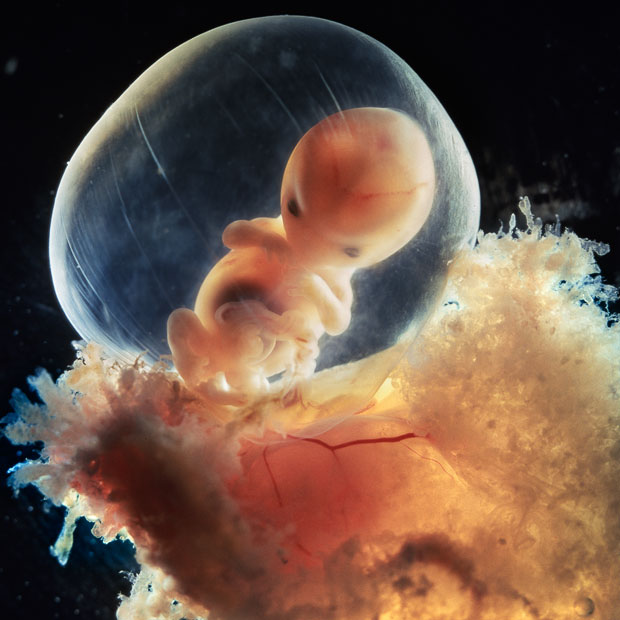
Defending point 1: Well, it is pretty obvious that the unborn child is not inanimate matter. It is definitely living and growing through all 9 months of pregnancy. (Click here for a video that shows what a baby looks like through all 9 months of pregnancy). Since it has human DNA, that makes it a human. And its DNA is different from either its mother or father, so it clearly not just a tissue growth of the father or the mother. More on this point at Christian Cadre, here. An unborn child cannot be the woman’s own body, because then the woman would have four arms, four legs, two heads, four eyes and two different DNA signatures. When you have two different human DNA signatures, you have two different humans.
Secondly, the pro-abortion debater may try to identify a characteristic of the unborn that is not yet present or developed while it is still in the womb, and then argue that because the unborn does not have that characteristic, it does not deserve the protection of the law.
Defending point 2: You need to show that the unborn are not different from the already-born in any meaningful way. The main differences between them are: size, level of development, environment and degree of dependence. Once these characteristics are identified, you can explain that none of these differences provide moral justification for terminating a life. For example, babies inside and outside the womb have the same value, because location does not change a human’s intrinsic value. More at Stand to Reason, here.
Additionally, the pro-abortion debater may try to identify a characteristic of the already-born that is not yet present or developed in the unborn, and then argue that because the unborn does not have that characteristic, that it does not deserve protection, (e.g. – sentience). Most of the these objections that you may encounter are refuted in this essay by Francis Beckwith. Usually these objections fall apart because they assume the thing they are trying to prove, namely, that the unborn deserves less protection than the already born.
Finally, the pro-abortion debater may conceded your points 1 and 2, and admit that the unborn is fully human. But they may then try to provide a moral justification for terminating the life of the unborn, regardless.
Defending point 3: I fully grant that it is sometimes justifiable to terminate an innocent human life, if there is a moral justification. One of the best known justifications is Judith Jarvis Thomson’s “violinist” argument. This argument is summarized by Paul Manata, one of the experts over at Triablogue:
Briefly, this argument goes like this: Say a world-famous violinist developed a fatal kidney ailment and the Society of Music Lovers found that only you had the right blood-type to help. So, they therefore have you kidnapped and then attach you to the violinist’s circulatory system so that your kidneys can be used to extract the poison from his. To unplug yourself from the violinist would be to kill him; therefore, pro-lifers would say a person has to stay attached against her will to the violinist for 9 months. Thompson says that it would be morally virtuous to stay plugged-in. But she asks, “Do you have to?” She appeals to our intuitions and answers, “No.”
Manata then goes on to defeat Thomson’s proposal here, with a short, memorable illustration, which I highly recommend that you check out. More info on how to respond to similar arguments is here.
The best book for beginners on the pro-life view is this book:

For those looking for advanced resources, Francis Beckwith, a professor at Baylor University, published the book Defending Life, with Cambridge University Press, 2007.
Learn about the pro-life case
- How to take an incremental approach to the abortion problem
- Videos from academic debate on abortion at the University of Victoria
- Audio: Scott Klusendorf’s 35-minute case for the pro-life position
- Audio: A 55-minute discussion featuring Greg Koukl and Scott Klusendorf
- A comparison of embryonic and adult stem cell research
- Video: 12-year old girl makes the pro-life case in a short speech
- Video:10-year old girl makes the pro-life case in a short speech
- Objective truth in the abortion debate – a pro-life training video
- Alan Shlemon explains a classification system for pro-abortion arguments
- What is the best single book on the pro-life position?
And some posts motivating Christians and conservatives to take abortion seriously:
- Why Christians should focus on cultural issues as well as evangelism
- Republicans introduce House and Senate bills to establish that life begins at conception
- House Republicans introduce ban on taxpayer funding of abortion
- Are Christians too involved in politics?
- What did the early church fathers think about abortion?
- Scott Klusendorf confronts a “pro-life” nun who voted for Obama
 WINTERY KNIGHT