Tag Archives: Embryonic Stem Cells

Two more adult stem cell treatments discovered

There are two kinds of stem-cell research. The first kind is called embryonic stem-cell research (ESCR). This kind is opposed by pro-lifers because it kills unborn persons by extracting their stem cells for use in medical research. The second kind is called adult stem-cell research (ASCR). This kind is supported by pro-lifers.

Which kind produces more scientific discoveries and new treatments?

Well, consider this article from Yahoo News which describes a new treatment made possible by ethical adult stem cell research.

Excerpt:

Scientists have for the first time succeeded in taking skin cells from patients with heart failure and transforming them into healthy, beating heart tissue that could one day be used to treat the condition.

The researchers, based in Haifa, Israel, said there were still many years of testing and refining ahead. But the results meant they might eventually be able to reprogram patients’ cells to repair their own damaged hearts.

“We have shown that it’s possible to take skin cells from an elderly patient with advanced heart failure and end up with his own beating cells in a laboratory dish that are healthy and young – the equivalent to the stage of his heart cells when he was just born,” said Lior Gepstein from the Technion-Israel Institute of Technology, who led the work.

The researchers, whose study was published in the European Heart Journal on Wednesday, said clinical trials of the technique could begin within 10 years.

Last month, Science Daily had another article on adult stem cells.

Excerpt:

Organ replacement regenerative therapy is purported to enable the replacement of organs damaged by disease, injury or aging in the foreseeable future. A research group led by Professor Takashi Tsuji (Professor in the Research Institute for Science and Technology, Tokyo University of Science, and Director of Organ Technologies Inc.) has provided a proof-of-concept for bioengineered organ replacement as a next stage of regenerative therapy.

Reporting in Nature Communications the group demonstrate that bioengineered hair follicle germ reconstructed from adult epithelial stem cells and dermal papilla cells can regenerate fully functional hair follicle and hair growth. Their bioengineered follicles showed restored hair cycles and piloerection through the rearrangement of follicular stem cells and their niches. The bioengineered hair follicle also developed the correct structures and formed proper connections with surrounding host tissues such as the epidermis, arrector pili muscle and nerve fibers.

This study thus reveals the potential applications of adult tissue-derived follicular stem cells as a bioengineered organ replacement therapy.

These individual cases show the overall trend in stem cell research. ESCR is supported by Democrats, but it is ineffective – which is why biotech companies like Geron have abandoned it. Nevertheless, Obama has pushed millions of taxpayer dollars into embryonic stem cell research, and is still pushing for more ESCR. The politics is driving the science – just like with his global warming alarmism and alternative energy funding.


Related posts

A secular case against legalized abortion

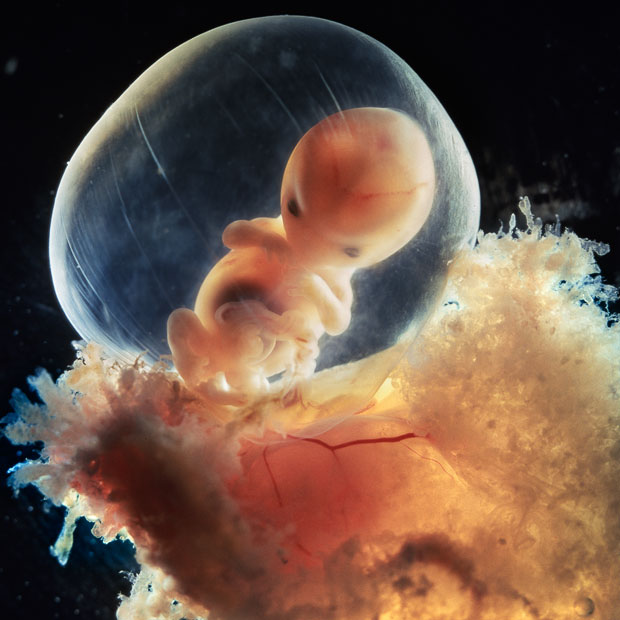
Unborn baby scheming about being only two months old

Note: this post has a twin! Its companion post on a secular case against gay marriage is here.

Now, you may think that the view that the unborn deserve protection during pregnancy is something that you either take on faith or not. But I want to explain how you can make a case for the right to life of the unborn, just by using reason and evidence.

To defend the pro-life position, I think you need to sustain 3 arguments:

  1. The unborn is a living being with human DNA, and is therefore human.
  2. There is no morally-relevant difference between an unborn baby, and one already born.
  3. None of the justifications given for terminating an unborn baby are morally adequate.

Now, the pro-abortion debater may object to point 1, perhaps by claiming that the unborn baby is either not living, or not human, or not distinct from the mother.

Defending point 1: Well, it is pretty obvious that the unborn child is not inanimate matter. It is definitely living and growing through all 9 months of pregnancy. (Click here for a video that shows what a baby looks like through all 9 months of pregnancy). Since it has human DNA, that makes it a human. And its DNA is different from either its mother or father, so it clearly not just a tissue growth of the father or the mother. More on this point at Christian Cadre, here. An unborn child cannot be the woman’s own body, because then the woman would have four arms, four legs, two heads, four eyes and two different DNA signatures. When you have two different human DNA signatures, you have two different humans.

Secondly, the pro-abortion debater may try to identify a characteristic of the unborn that is not yet present or developed while it is still in the womb, and then argue that because the unborn does not have that characteristic, it does not deserve the protection of the law.

Defending point 2: You need to show that the unborn are not different from the already-born in any meaningful way. The main differences between them are: size, level of development, environment and degree of dependence. Once these characteristics are identified, you can explain that none of these differences provide moral justification for terminating a life. For example, babies inside and outside the womb have the same value, because location does not change a human’s intrinsic value. More at Stand to Reason, here.

Additionally, the pro-abortion debater may try to identify a characteristic of the already-born that is not yet present or developed in the unborn, and then argue that because the unborn does not have that characteristic, that it does not deserve protection, (e.g. – sentience). Most of the these objections that you may encounter are refuted in this essay by Francis Beckwith. Usually these objections fall apart because they assume the thing they are trying to prove, namely, that the unborn deserves less protection than the already born.

Finally, the pro-abortion debater may conceded your points 1 and 2, and admit that the unborn is fully human. But they may then try to provide a moral justification for terminating the life of the unborn, regardless.

Defending point 3: I fully grant that it is sometimes justifiable to terminate an innocent human life, if there is a moral justification. Is there such a justification for abortion? One of the best known attempts to justify abortion is Judith Jarvis Thomson’s “violinist” argument. This argument is summarized by Paul Manata, one of the experts over at Triablogue:

Briefly, this argument goes like this: Say a world-famous violinist developed a fatal kidney ailment and the Society of Music Lovers found that only you had the right blood-type to help. So, they therefore have you kidnapped and then attach you to the violinist’s circulatory system so that your kidneys can be used to extract the poison from his. To unplug yourself from the violinist would be to kill him; therefore, pro-lifers would say a person has to stay attached against her will to the violinist for 9 months. Thompson says that it would be morally virtuous to stay plugged-in. But she asks, “Do you have to?” She appeals to our intuitions and answers, “No.”

Manata then goes on to defeat Thomson’s proposal here, with a short, memorable illustration, which I highly recommend that you check out. More info on how to respond to similar arguments is here.

The best book for beginners on the pro-life view is this book:

For those looking for advanced resources, Francis Beckwith, a professor at Baylor University, published the book Defending Life, with Cambridge University Press, 2007.

Learn about the pro-life case

And some posts motivating Christians and conservatives to take abortion seriously:

Adult stem cells therapy can fix a broken heart?

Mary sent me this article from the Irish Times.

Excerpt:

A new US study in which patients had their hearts repaired with stem cells has brought regenerative treatments for heart attacks a step closer.

The therapy, reported today in the Lancet  medical journal, halved the extent of normally permanent scarring on the heart, and led to the growth of new heart muscle.

However, the treatment produced no significant change in “ejection fraction” – a measure of the heart’s pumping capacity.

The Caduceus trial recruited a total of 25 patients with an average age of 53 who had all suffered a heart attack in the previous month.

Some 17 patients received coronary artery infusions of 12 to 25 million stem cells derived from healthy tissue taken from their own hearts. The remaining eight underwent standard post-heart attack care.

A year later, the proportion of the heart left scarred in the stem cell-treated patients had been reduced from 24 per cent to 12 per cent. No change was seen in patients who did not receive the treatment.

Professor Eduardo Marban, director of the Cedars-Sinai Heart Institute in Los Angeles, who led the US team, said: “The effects are substantial, and surprisingly larger in humans than they were in animal tests.

“This discovery challenges the conventional wisdom that, once established, scar is permanent and that, once lost, healthy heart muscle cannot be restored.”

The Phase I study, which was chiefly conducted to evaluate safety, was published today in an online edition of the Lancet.  It follows a similar trial by US scientists at Harvard Medical School and the University of Louisville whose findings were reported last year, also in the Lancet.

That study, which used a different kind of heart stem cell, produced a 12 per cent average increase in ejection fraction.

Yet another breakthrough for ethical adult stem cells.

Related posts