Republican presidential candidates Newt Gingrich and Rick Perry should drop out of the race before South Carolina’s Saturday primary, prominent conservative author Eric Metaxas said at a Sunday prayer breakfast.
Mr. Metaxas said he was optimistic some of the candidates competing for the state’s conservative voters would take themselves out of contention to allow South Carolinians to coalesce around an alternative to former Massachusetts Gov. Mitt Romney.
“It’s more likely that some of these wonderful men that are running will hear God’s voice and get out of the race before Saturday for the good of this country,” Mr. Metaxas, who has endorsed former Pennsylvania Sen. Rick Santorum, said Sunday at a weekend gathering of the South Carolina Republican Party – a day after Mr. Santorum picked up strong support from conservative Christian groups. To be effective, the candidates must drop out before next Saturday’s contest, he said.
“This is the last exit before the bridge,” Mr. Metaxas said in an interview later. “They’ve been dividing the vote and so if they don’t do this now, they will harm the country because they can’t hang on to the bitter end.” Other presidential hopefuls, Texas Rep.Ron Paul and former Utah Gov. Jon Huntsman, are less relevant, Mr. Metaxas said.
Mr. Santorum, who spoke at the breakfast after Mr. Metaxas, did not explicitly urge other candidates to drop out, but appealed to voters to gather behind him, regardless of his perceived shot at seizing the White House.
“Will the people of South Carolina vote their conscience or will they let people…. tell you who’s the one you should choose because we have to win?” he asked.
Just to refresh everyone, a proponent of supply-side economics is someone who believes that economic growth is driven more by innovation and entrepreneurship, and less by consumer spending and government stimulus spending. Supply-siders are all about creating wealth – by letting creative people have the money invent something valuable that consumers will want to buy – like an iPhone or a Kindle. Demand-siders are all about redistributing wealth – by having the government take from one group of people to give it to another group of people – like a Solyndra loan or a Chevy Volt subsidy.
‘I’m someone who believes that making things creates wealth,” says Rick Santorum. It is primary day in New Hampshire, and the former Pennsylvania senator and current presidential candidate is describing his plan to slash corporate tax rates. To encourage companies to make things, he would completely eliminate the federal income tax on manufacturers. For all other businesses, the rate would be cut in half, to 17.5% from 35%.
[…]I ask if his corporate tax plan opens him up to criticism that he and President Obama are both favoring particular sectors of the economy, with Mr. Santorum picking manufacturing while Mr. Obama anoints green energy. “Oh, green energy is not a sector, I mean, come on. It’s like a half-dozen companies,” says Mr. Santorum.
Does this mean the Obama policy would be more legitimate if the president were favoring a larger group of Solyndras?
“He’s talking about handing out tax-free grants and loans,” says Mr. Santorum, who adds that his own plan “is a conservative approach. It’s supply-side. It’s cutting rates. Why are we cutting the corporate rate to 17.5% and making it simple? . . . Because we think it’s what’s necessary to grow the economy. . . . So if what’s necessary to grow the economy in one sector of the economy is different from another, then why should we have the same tax rate?” He argues that manufacturing has been hit particularly hard by the costs of regulation and litigation.
That’s pro-growth – we’re all going to have multiple job offers if he executes this plan – back to 4% unemployment like under Bush.
But what about his economic plan for taxpayers?
Mr. Santorum also believes that making babies creates wealth. It’s very difficult to grow an economy with a shrinking population, he says, pointing to the “demographic winter in Europe” as a cause of that region’s troubles. To help avoid that fate in the U.S., he wants to triple the per-child tax credit and also cut individual tax rates.
[…]On the personal tax side, rewarding child-rearing is consistent with the pro-life views of Mr. Santorum, who has seven children. But the case he makes seems to echo the analysis of some Wall Street economists, who view population growth as a critical advantage the United States will enjoy over China and the euro zone.
Mr. Santorum argues that the cost of Europe’s massive welfare states made it too expensive for young people to have families. He notes that with plummeting birth rates, many European countries have resorted to “baby bonuses” to try to reverse the tide, but the demographic picture remains bleak, while the costs of entitlement programs have exploded.
“Who are benefits promised to, overwhelmingly? Well, they’re promised to older people. And if you have a society like Europe that is upside down where there are a lot more older people than younger people, you have economic calamity,” he says. Asked if giving generous per-child credits will result in an even larger number of households exempt from the income tax and therefore amenable to more spending, he says his plan will drive growth and that, in turn, will bring more people on to the tax rolls. Elimination of deductions might also keep some people paying income taxes. He aims to balance overall taxes and spending at 18% of GDP. Spending has soared to 24% in the Obama era.
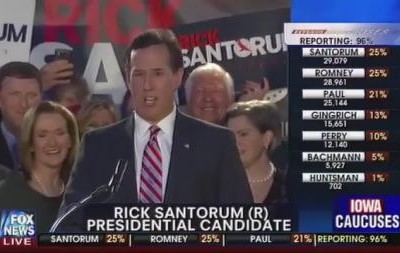
In a still-crowded field of non-Romneys trying to compete for the Republican nomination, Mr. Santorum could emerge in the Jan. 21 South Carolina primary as the man who can bring together the old Reagan coalition. A champion of cultural conservatives with a blue-collar background, he is also making the case for deep cuts in federal spending. His credibility on this last issue derives from the political price he paid for being an early promoter of entitlement reform.
And what about his plan for entitlement reform?
To prevent an economic calamity on this side of the Atlantic, he also proposes to cut $5 trillion from federal spending in five years. He calls the plan advanced by House Budget Chairman Paul Ryan “a good starting point,” but he notes that few of the spending cuts happen in the first decade of the plan. Also, Mr. Santorum says that he wants to reform Social Security, not just Medicare and Medicaid. “I like the Ryan plan on the Medicare side. I don’t like waiting 10 years. I don’t like waiting 10 years on anything. I’ve also talked about Social Security.”
Has he ever, going back at least to the 1990s. Says Mr. Santorum, “Some guy just walked up to me at the [New Hampshire campaign] headquarters with a picture of me standing at the presidential podium in Kansas City, Missouri, in April 1998 when I went with Bill Clinton to talk about Social Security reform. I was the Republican lead on the issue,” he recounts, a dangerous proposition for someone representing Pennsylvania, a state with one of the oldest populations in the country. “And I won re-election after that, I might add.”
But after winning that 2000 election—his second Senate victory and his fourth straight win in Democratic territory—Mr. Santorum aggressively backed President George W. Bush’s call for allowing younger workers to own personal accounts.
It’s much easier to contemplate marriage when you 1) have multiple job offers and 2) you are keeping more of what you earn and 3) children are less of a burden on your income and 4) the government is not going to bankrupt those children with out of control entitlements. Marriage-minded men who want to start families will love this plan. It is a signal to men to start working, start marrying and start having children. Men think about these things, you know – losing our jobs, whether our children will be better off than we were, and so on. Santorum gets it – he has a pro-marriage, pro-family economic plan.
After a Friday-Saturday meeting with more than 150 leaders and representatives of evangelical, pro-family and pro-life groups, the organizations have declared consensus support for Rick Santorum’s Republican presidential campaign.
Tony Perkins, the president of the Family Research Council and a participant in last night’s private meeting, addressed a press conference call today to provide additional information about the decision and expected endorsements from some of those attending.
Perkins said the leaders of the evangelical groups came to the meeting each supporting the various different GOP candidates seeking to replace pro-abortion President Barack Obama. Participants engaged in a question and answer session with representatives of each of the campaigns, except for former Utah Governor Jon Huntsman, who did not send a spokesman to the event.
After the session, the leaders discussed the presidential race amongst themselves and then undertook a three-round ballot process. Perkins said the discussion culminated in an agreement that the groups and leaders each have “an overriding passion and desire to defeat Barack Obama” this November. Although the leaders of the various organizations strongly support various candidates, they eventually decided to support Santorum.
“I think it was vigorous discussion of who they felt best represented the conservative movement and who they think had the best chance of succeeding,” he said, but adding that there would not be a “coordinated effort” amongst the groups and leaders to endorse Santorum.
“There is a hope and expectation that those represented by the constituency will make a difference in South Carolina,” he said, adding that some in attendance threw their support behind Santorum to avoid having a repeat of 2008 where conservative candidates split the vote.
Perkins indicated Santorum, Newt Gingrich and Rick Perry but only Gingrich and Santorum made the final ballot. There were 114 votes on the final ballot, as some leaders had to catch returning flights home, and Santorum emerged with a majority (85) of those voting, the FRC president said.
[…]The names and groups participating were not released, but Perkins mentioned former Republican presidential candidate Gary Bauer as another organizer of the private meeting. He said the names of organizations and leaders participating will become public as they begin making endorsements.
Bauer has already endorsed Santorum. I agree that Gingrich is definitely the runner-up, and would be a fine choice for conservatives, but Santorum really is the best overall. My biggest concern about this is how younger evangelicals are so apathetic when it comes to politics and have no idea how to think carefully about things like free market capitalism, abortion, marriage and peace through strength. The young evangelicals are largely illiterate, making their decisions based on emotions and intuitions, because they think that Christianity is about being “nice” so that more people like them. Oh well.
What I find interesting is when even moderate conservative bloggers – ones who are not evangelical – are beginning to notice that there is an integrity argument for Rick Santorum.
Look at this comment from Jeff Goldstein – he’s replying to some Ron Paul person, I guess:
BMoe –
We’ve talked at length about this here, so if you haven’t already done so, I’d say go back and look at the various riffs on how Santorum’s ideas of family as the unit of individual autonomy is tied to his Catholicism / Thomism. Also, how family communitarianism is not at all like collectivism.
My own belief — and James Pethokoukis took this up, as well (I believe I did a post on it), is that Santorum is reacting in the excerpt on individualism you cite, to the Objectivists — those whose ideological foundation is Rand. That is, the libertarians. You may disagree with Santorum — and there’s plenty of room to do so — but it does no good to caricature the belief. Santorum is not a collectivist. And his ideas about the family — and government’s role in nurturing that unit — amount to things like increased tax credits for producing new citizens, or increased credit for charitable giving, so that charity is taken away from the state.
And he tries to balance his own views with the constraints placed on elected officials by the Constitution, which for Santorum includes the 9th and 10th Amendments.
These are often difficult waters to traverse. But with Santorum, he tells you what he thinks and believes. For me, that’s a net positive.
Romney mouths platitudes about limited government, and yet it’s clear he doesn’t believe a word of it. Santorum believes in a social safety net for the truly disadvantaged and indigent, but he tempers that with an animus toward those who would game the system — and toward programs that have the net impact of institutionalizing dependence on government.
What I liked about Cain — he didn’t have all the answers, because he hasn’t studied every question — I like about Santorum. You can see his thinking. He shows his work.
Also, BMoe, I think it pretty obvious by now I’m not a social conservative. I’m just far less bothered by them then I used to be back when I was given to accepting the caricature of such creatures.
Nowadays I see that it is the “liberal” secularists who are far more dangerous, because their God is the State, and they therefore serve their God by granting that ever more power comes from the State.
The religious folk simply want the state to leave them the f**k alone, often times. And me and my spaghetti bulbs tend to commiserate.
I think that’s right. I am not thrilled with Santorum’s blue-collar worker economic plan. I’m an investor and a white collar software engineer. I’m chaste and have no children and no plans to marry, so Santorum’s tripling of the tax deduction for children won’t help me. But what is appealing about the man is his vision: he wants more working families and he wants them to face less financial pressure if they have more children, and more choice in education. I get that. It’s not applicable to me, but I get it. I get what his vision is.
Rick Santorum at the Values Voters Summit
Here’s a 3-part speech by Rick Santorum at the Family Research Council:
Part 1:
Part 2:
Part 3:
The Family Research Council is my third favorite think tank, behind the Heritage Foundation and the American Enterprise Institute.

 WINTERY KNIGHT