
Tag Archives: Economy

We can’t wait: the do-nothing Democrat Senate is blocking 15 bipartisan jobs bills

Have you heard about “The Forgotten 15“? Here’s a news article by the Washington Times that explains it.

Excerpt:

Last week, the House passed a strongly bipartisan bill which would prevent a job-killing 3 percent withholding tax on all government contractors from going into effect. Even though the White House supports the measure, Mr. Reid, a Nevada Democrat, has chosen instead to bring another “small bite” from the president’s failed American Jobs Act to the floor. He wants to hike taxes on business owners so he can blow $60 billion in more stimulus for bike paths, choo-choo trains and bus stops.

Mr. Reid can’t even round up all the Democrats behind his partisan plan, but he continues to drag his feet on items that could pass because the last thing he wants to do is adopt legislation that gives the GOP the chance to take some credit with the public.

The Senate has not been this inactive in at least a quarter-century. As of Tuesday, the Senate had held 194 votes for the year, 54 fewer than at this time last year.

The intransigence has real-world implications. In March, the House passed a strongly bipartisan bill which would have stopped a court order from imposing duplicate and expensive regulations on farmers and ranchers. The Senate never brought the bill up for a vote, and on Monday a key deadline passed, allowing new regulations on pesticide applications to go into effect. That’s bad for jobs.

House Republican leaders want the public to know that they aren’t to blame for the stalemate on Capitol Hill. Speaker John A. Boehner produced a card listing the “forgotten 15” jobs bills that have passed the House but not the Senate. The Ohio Republican gave the card to members, telling them to carry it with them, hold it up at events at home, and flash it during interviews to remind Americans that Republicans are doing everything they can to address the employment situation.

The Democratic strategy is to set up Republicans as a foil for their 2012 re-election bids. Even though the congressional approval rating is down in the single-digits, Mr. Reid wants to draw a distinction between his party and the GOP by only bringing up bills that Republicans will oppose so his caucus can send out accusatory press releases.

The messaging is carefully crafted to fit with Mr. Obama’s latest campaign trail slogans about how “we can’t wait” for Congress to act. He showed his true motives on Tuesday when the president invited congressional Democrats to the White House to ostensibly talk about the jobs agenda. He has no plans to invite Republicans over to chat.

You can print a PDF of the The Forgotten 15 card right here.

Remember, Democrats are great at spending money – not so good at creating jobs.
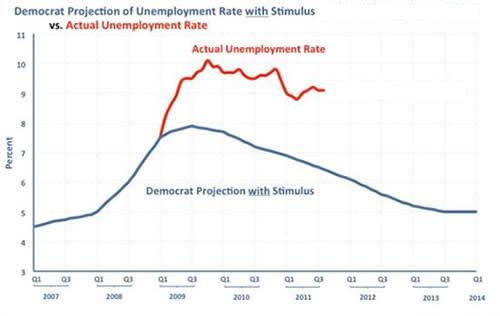
Projected vs Actual Unemployment With Stimulus 2011

Back in 2007, when the Republicans controlled the House and Senate, the unemployment rate was near 4%. FOUR PERCENT. And we had a deficit of $160 billion – NOT 1.6 TRILLION.

Let’s take a closer look at the Forgotten 15 from an article on John Boehner’s web site.

Excerpt:

Campaigning for another failed stimulus and more job destroying taxes, President Obama has repeatedly—and falsely—asserted that “Congress isn’t willing to move” legislation to facilitate job growth. While the president plays politics, House Republicans have been working and approving legislation to promote economic growth and job creation. The House has approved more than 15 bills that, if enacted, would immediately help to grow the economy without more failed stimulus spending. These bills are currently stalled in the Democrat-controlled Senate and the president has not encouraged the Senate to act.

Here is a sample:

4)  H.R. 1230—Restarting American Offshore Leasing Now Act: H.R. 1230 would require the Department of the Interior (DOI) to auction offshore oil and gas leases in the Central and Western Gulf of Mexico, as well as in an area off the coast of Virginia. The bill would help to reduce energy prices and promote job creation by expediting offshore oil and natural gas exploration in the Gulf of Mexico and the Virginia coast.

6) H.R. 1231—Reversing President Obama’s Offshore Moratorium Act:  H.R. 1231 would require that each five-year offshore oil and gas leasing program offer leasing in the areas with the most prospective oil and gas resources, and would establish a domestic oil and natural gas production goal.  The bill would essentially lift the President’s ban on new offshore drilling by requiring the Administration to move forward on American energy production in areas estimated to contain the most oil and natural gas resources.

7) H.R. 2021—The Jobs and Energy Permitting Act of 2011:  H.R. 2021 would eliminate needless permitting delays that have stalled important energy production opportunities off the coast of Alaska.  The bill would also eliminate the permitting back-and-forth that occurs between the EPA and its Environmental Appeals Board.  Rather than having exploration air permits repeatedly approved and rescinded by the agency and its review board, the EPA will be required to take final action – granting or denying a permit—within six months.

10) H.R. 1938— North American-Made Energy Security Act:  H.R. 1938 would direct the President, acting through the Secretary of Energy, to coordinate with all federal agencies responsible for an aspect of the President’s National Interest Determination and Presidential Permit decision regarding construction and operation of Keystone XL, to ensure that all necessary actions are taken on an expedited schedule.  The bill would promote job creation and energy security by ending the needless delay of the construction and operation of the Keystone XL pipeline.

11) H.R. 2587—Protecting Jobs From Government Interference Act:  H.R. 2587 would prohibit the National Labor Relations Board (NRLB) from ordering any employer to close, relocate, or transfer employment under any circumstance.

16)  H.R. 2433—Veterans Opportunity to Work Act:  H.R. 2433 would create or modify programs that provide employment and training services to veterans and service members separating from active duty.  The bill would also make changes to programs that offer home loan guarantees, ambulance services, and pension payments to qualifying individuals. Among other things, the bill would provide up to 12 months of Veterans Retraining Assistance to no more than 100,000 unemployed veterans that enter education or training programs at community colleges or technical schools to prepare them for employment in an occupational field that is determined by Department of Labor to have significant employment opportunities.

17) H.R. 674—To amend the Internal Revenue Code of 1986 to repeal the imposition of 3 percent withholding on certain payments made to vendors by government entities:   H.R. 674 would permanently repeal the imposition of 3 percent withholding on certain payments made to vendors by government entities. Currently, the imposition of the 3 percent withholding is set to take effect on January 1, 2013. If the 3 percent withholding tax were implemented as scheduled, government entities would be required to withhold 3 percent of payments to persons providing property or services to the government.  For example, on an invoice for $20,000 the government would pay the business $19,400 and withhold $600 as a preemptive tax.  These added costs would almost certainly translate into fewer private-sector jobs and higher costs for the government and taxpayers.

They are actually up to 17 jobs bills now.

And finally, I have to post this funny John Boehner clip:

We need more of that Mr. Boehner. I think that was a good opportunity to say “freaking” as well. Because he should be pissed off with this Solyndra-bailout President.
Budget guru Paul Ryan discusses the economy at the Heritage Foundation

My favorite GOP ideas-man speaking at my favorite think tank. Here’s the full transcript courtesy of National Review.

Excerpt:

The Treasury Department’s latest study on income mobility in America found that during the ten-year period starting in 1996, roughly half of the taxpayers who started in the bottom 20 percent had moved up to a higher income group by 2005.Meanwhile, half of all taxpayers ended up in a different income group at the end of ten years. Many moved up, and some moved down, but economic growth resulted in rising incomes for most people over this period.

Another recent survey of over 500 successful entrepreneurs found that 93 percent came from middle-class or lower-class backgrounds. The majority were the first in their families to launch a business.

Their stories are the American story: Millions of immigrants fled from the closed societies of the Old World to the security of equal rights in this land of upward mobility.

Telling Americans they are stuck in their current station in life, that they are victims of circumstances beyond their control, and that government’s role is to help them cope with it – well, that’s not who we are. That’s not what we do.

Our Founding Fathers rejected this mentality. In societies marked by class structure, an elite class made up of rich and powerful patrons supplies the needs of a large client underclass that toils, but cannot own. The unfairness of closed societies is the kindling for class warfare, where the interests of “capital” and “labor” are perpetually in conflict. What one class wins, the other loses.

The legacy of this tradition can still be seen in Europe today: Top-heavy welfare states have replaced the traditional aristocracies, and masses of the long-term unemployed are locked into the new lower class.

The United States was destined to break out of this bleak history. Our future would not be staked on traditional class structures, but on civic solidarity. Gone would be the struggle of class against class.

Instead, Americans would work, compete, and co-operate in an open market, climb the ladder of opportunity, and keep the fruits of their efforts.

Self-government and the rule of law would secure our equal, God-given rights. Our political and economic systems – rooted in freedom and responsibility – would reward, and thus cultivate, traditional virtues.

Given that the President’s policies have moved us closer to the European model, I suppose we shouldn’t be surprised that his class-based rhetoric has followed suit.

We shouldn’t be surprised… but we have every right to be disappointed. Instead of appealing to the hope and optimism that were hallmarks of his first campaign, he has launched his second campaign by preying on the emotions of fear, envy, and resentment.

This has the potential to be just as damaging as his misguided policies. Sowing social unrest and class resentment makes America weaker, not stronger. Pitting one group against another only distracts us from the true sources of inequity in this country – corporate welfare that enriches the powerful, and empty promises that betray the powerless.

Ironically, equality of outcome is a form of inequality – one that is based on political influence and bureaucratic favoritism.

That’s the real class warfare that threatens us: A class of bureaucrats and connected crony capitalists trying to rise above the rest of us, call the shots, rig the rules, and preserve their place atop society. And their gains will come at the expense of working Americans, entrepreneurs, and that small businesswoman who has the gall to take on the corporate chieftain.

It’s disappointing that this President’s actions have exacerbated this form of class warfare in so many ways:

While the EPA is busy punishing commercially competitive sources of energy, a class of bureaucrats at the Department of Energy has been acting like the world’s worst venture capital fund, spending recklessly on politically favored alternatives. While the unemployment rate remains stuck above 9 percent, a class of bureaucrats at the National Labor Relations Board is threatening hundreds of jobs by suing an American employer for politically motivated reasons. And while millions of Americans are left wondering whether their employers will drop their health insurance because of the new health care law, a class of bureaucrats at HHS has handed out over 1,400 waivers to those firms and unions with the political connections to lobby for them.

These actions starkly highlight the difference between the two parties that lies at the heart of the matter: Whether we are a nation that still believes in equality of opportunity, or whether we are moving away from that, and towards an insistence on equality of outcome.

If you believe in the former, you follow the American Idea that justice is done when we level the playing field at the starting line, and rewards are proportionate to merit and effort.

If you believe in the latter kind of equality, you think most differences in wealth and rewards are matters of luck or exploitation, and that few really deserve what they have.

That’s the moral basis of class warfare – a false morality that confuses fairness with redistribution, and promotes class envy instead of social mobility.

When you think of talented Republicans who will one day be President, you think of people like Paul Ryan, Marco Rubio, Bobby Jindal, Ted Cruz and Josh Mandel. It’s to take a look at these guys before they become famous. Paul Ryan is the best we have on the budget – he is universally respected. And, he is also 100% pro-life and 100% solid on foreign policy. You don’t have to pick and choose with Paul Ryan – you get everything. All of the above.

Related posts

Economists: Jobs outlook the worst since January 2010

Unemployment Rate (Not seasonally adusted)

From Bloomberg Businessweek.

Excerpt:

U.S. companies’ hiring plans reflect the worst employment outlook since January 2010 as demand slows in the world’s largest economy, a private survey showed.

Fewer companies project payrolls to rise in the next six months compared with a July survey, while more plan to cut workers, the National Association for Business Economics said today in Washington. The share of firms planning to raise prices was the smallest in almost two years.

Businesses are concerned about the European debt crisis, with 30 percent of participants anticipating it will cause a decline in sales through early 2012, the survey showed. While companies said they expect the U.S. will keep expanding, they trimmed projections for the pace of growth and pared capital spending plans, helping explain why the recovery has failed to gain momentum.

“Expectations are muted,” Shawn DuBravac, chief economist at the Consumer Electronics Association in Arlington, Virginia, who analyzed the results, said in a statement. The latest survey’s “respondents remain cautiously confident.”

Within the employment outlook, 29 percent of companies said they would increase hiring, down from 43 percent in July, while 59 percent reported they plan no change in staff, a 10-point jump.

[…]The dimming outlook for employment and investment stems from the slowdown in growth. Eighty-five percent of companies surveyed said that the economy may expand 2 percent or less in the period ending this quarter compared with the final three months of 2010. In the prior survey, just one of every five economists polled predicted growth would be that slow.

The debt crisis in Europe already is hurting U.S. firms and is likely to continue, according to a special question in the latest survey, conducted between Sept. 20 and Oct. 5. Twenty percent of participants reported developments in Europe have led to as much as a 10 percent drop in sales so far this year.

This is not a surprise. Aside from signing the three free trade deals with Colombia, Panama and South Korea, the Obama administration has done everything wrong with respect to stimulating economic growth – the necessary precursor for private sector job creation.