CNBC’s Jim Cramer: “This is — look, I think the debate is a fabulous one to have, but it has completely taken away from the fact that we are really going to have a hard time hiring once this plan is put in place. I’ve had a couple of CEOs come on just in the last few weeks. When you talk about whether they want to hire, this is what they bring up. Chipotle, look, use this as maybe one of the great job creators in this country and they pay a lot for their people. This is a company that is very forward. When I ask them, what does ObamaCare do for you? They just say well, nothing we hope because the Supreme Court has got to say no to it. I mean, this is at the front and center of what could derail the economy.”
MSNBC’s Joe Scarbarough: “You’re talking about health care reform?”
CNBC’s Jim Cramer: “I’m just saying, look, the issue the Catholic charities issue, front and center, I want church and state separation, but whatever I want doesn’t matter as much as what I’m telling you. Business leaders fear this more than anything, they don’t want to hire, this is part of the underground economy. It’s gonna develop because no one wants people on the books because of ObamaCare and people have to recognize that this is a front and center issue for every CEO I deal with and another reason why they don’t want to hire here, they want to hire there. They want to put the jobs in Asia, they want to put the jobs in Mexico because they don’t want to think about how much more it’s going to cost to hire a new person. Don’t lose that debate. That is a major debate for the economy.”
What will New York look like a year from now? The answer: bad and probably worse, and perhaps downright catastrophic. Three degrees of awful. The first step was passing the bank-bailout legislation. Now that it’s done—and if it didn’t get done we would have been looking at a guaranteed economic collapse—the critical issue will be presidential leadership. And while any president will be an improvement over the current one, there is a growing belief on Wall Street that Barack Obama has the capacity to lead us out of this wilderness while John McCain does not. I’ll go a step further: Obama is a recession. McCain is a depression.
Cramer back Barack Obama for President and is a well-known Democrat.
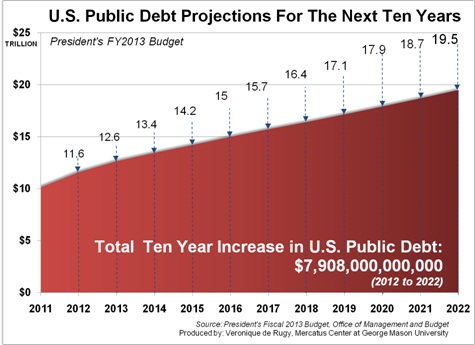
Taking a pass on reining in government growth, President Obama unveiled a record $3.8 trillion election-year budget plan Monday, calling for stimulus-style spending on roads and schools and tax hikes on the wealthy to help pay the costs. The ideas landed with a thud on Capitol Hill.
Though the Pentagon and a number of Cabinet agencies would get squeezed, Obama would leave the spiraling growth of health care programs for the elderly and the poor largely unchecked. The plan claims $4 trillion in deficit savings over the coming decade, but most of it would be through tax increases Republicans oppose, lower war costs already in motion and budget cuts enacted last year in a debt pact with GOP lawmakers.
[…]By the administration’s reckoning, the deficit would drop to $901 billion next year – still requiring the government to borrow 24 cents of every dollar it spends – and would settle in the $600 billion-plus range by 2015.The deficit for the current budget year, which ends Sept. 30, would hit $1.3 trillion, a near record and the fourth straight year of trillion-plus red ink.
Obama’s budget blueprint reprises a long roster of prior proposals: raising taxes on couples making more than $250,000 a year; eliminating numerous tax breaks for oil and gas companies and approving a series of smaller tax and fee proposals. Similar proposals failed even when the Democrats controlled Congress.
The Pentagon would cut purchases of Navy ships and F-35 Joint Strike Fighters – and trim 100,000 troops from its rolls over coming years – while NASA would scrap two missions to Mars.
But there are spending increases, too: The Obama plan seeks $476 billion for transportation projects including roads, bridges and a much-criticized high-speed rail initiative.
Spending in the President’s budget rises inexorably from today’s $3.8 trillion to $5.8 trillion in 2022. Throughout the decade, outlays hold stubbornly above 22 percent of gross domestic product (GDP), more than twice the New Deal’s share of the economy in its peak years. In constant dollars, outlays are more than three times the peak of World War II.
In 2012, his budget results deliver a fourth consecutive annual deficit exceeding $1 trillion and then make it worse with another round of not-so-shovel-ready construction projects and government “investments” totaling $178 billion. Among these are the typical road, bridge, and school construction, but then they go alarmingly beyond the usual “infrastructure” arguments to fund teachers’ pay.
Obama’s future deficit reduction comes mainly from Budget Control Act cuts already in place, $848 billion in discredited phantom “savings” from the wind-down of operations in Iraq and Afghanistan, taking credit for reductions in 2011 appropriations, and roughly $1.8 trillion in unnecessary tax increases on those earning above $250,000 and the oil and gas industry.
Yet even with the hefty tax increases and illusory savings, the President’s deficits over the next decade never fall below $575 billion (in 2018) and climb back to $704 billion (in 2022)—but again only assuming the tax increases and mystical savings cited above.
Debt held by the public in the President’s budget rises from 74.2 percent of GDP today to an economically hazardous 76.5 percent of GDP in 2022. These are historically high debt levels: the post–World War II average is just 43 percent. Moreover, the President’s debt estimates are low because of the unreal nature of much of his proposed deficit reduction.
Regarding the most critical fiscal challenge of the day—the need to restructure Medicare, Medicaid, and Social Security—the President has once again taken a pass. By the middle of this century, these three programs and Obamacare will consume about 18 percent of GDP, soaking up all the historical average of federal tax revenue. The notion of “protecting” them through benign neglect only ensures their collapse, and the longer Congress and the President wait to address the problem, the more wrenching will be the consequences. But the President merely reruns previous ideas, such as more cuts to medical providers, ignoring the need for fundamental reform.
For other entitlements, the President repeats a range of mere chipping-around-the-edges proposals from last year’s budget, many of which are really tax or fee increases, not spending reductions.
In short, the President’s budget is the same worn-out collection of higher spending and higher taxes he has offered three times before—with the same inevitable result of more spending, higher taxes, and still more government debt.
Here’s a Republican reaction from Senator Bob Corker:
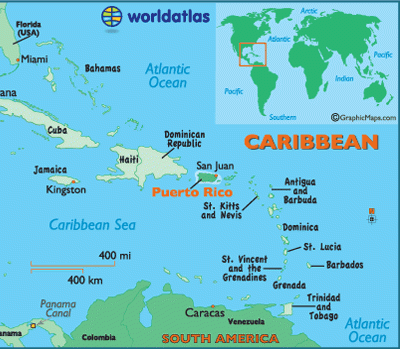
Here’s a story from Mary Anastasia O’Grady at the Wall Street Journal. She interviewed Puerto Rican Gov. Luis Fortuño and learned about his plan to boost the island’s economic growth.
Excerpt:
If [Luis Fortuño’s] plan to boost the island’s competitiveness by switching electricity generation from oil to natural gas is to succeed, he’s going to need relief from the pernicious 1920 Jones Act. It prohibits any ship not made in the U.S. from carrying cargo between U.S. ports. There are no liquefied-natural-gas (LNG) tankers made in the U.S. Unless Puerto Rico gets a Jones Act exemption, it cannot take advantage of the U.S. natural gas bonanza to make itself more competitive.
The Jones Act is good if you are a union shipbuilder who doesn’t like competition, or a member of Congress who takes political contributions from the maritime lobby. But it’s bad if you are a low-income Puerto Rican who needs a job. And there are plenty of those.
Puerto Ricans are American citizens but they are significantly poorer than the rest of the country. Per capita income on the island in 2010 was roughly $16,300 compared to just over $47,000 for the nation as a whole.
Life on the island is also expensive, in part because of the high price of electricity, 68% of which is produced using imported oil. The governor’s office says that the price of electricity here went up 100% from 2001 to 2011.
[…][B]ringing down high energy costs remains a fundamental challenge, and one that is exacerbated by new costly federal regulations on emissions that would require the installation of scrubbers on oil-fired electricity plants. To meet those regulations affordably, Mr. Fortuño wants to convert the island’s oil-fired plants to cheaper, cleaner natural gas. To that end, he proposes a pipeline from the southern LNG terminal at Punta Guayanilla across the island to San Juan. The U.S. Army Corps of Engineers has assessed the proposal and said it would produce no significant environmental impact.
It sounds like a plan to help the poor and unemployed. There are only two problems. First, the Sierra Club and local environmentalists have ginned up fears about the project and promised to sue to stop construction. Second, the Jones Act is still in the way.
The governor admits that his administration could have done a better job communicating the pipeline plan to Puerto Ricans, but he also points out that “some of the same groups that have opposed the pipeline have also opposed wind-power and solar projects. They are opposing everything, including waste-to-energy” projects which he maintains are less polluting than landfills.
Mr. Fortuño says that he expects Washington to give him a carve-out for LNG tankers, but he doesn’t have it yet. He also says that a large part of the environmentalist push-back is political, suggesting to me that he ought to be more worried than he is. This kind of politics needs to preserve the status quo of the welfare state. And that implies blocking Mr. Fortuño’s development agenda no matter what it means to the poor.
I thought this article was a neat little way to see how groups of people who understand economics try to pull themselves up out of messes, and who stands in their way. It’s something to think about when you think about poverty – what will really work to lift people out of poverty? And what is the real effect of labor unions and environmentalists on economies?

 WINTERY KNIGHT