
Tag Archives: Economics

Number of Americans not in labor force hits record high of 87,897,000

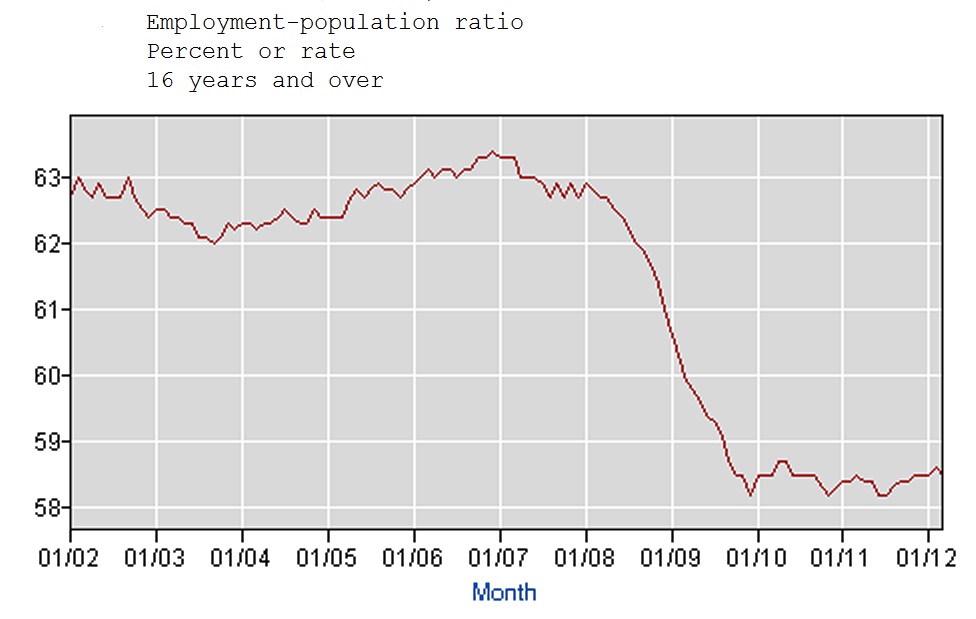
Employment to population ratio down 4.5% since Democrats took the House and Senate in January 2007
Employment to population ratio down 4.5% since Democrats took control of the House and Senate in January 2007

The Obama administration has pursued an economic policy of raising taxes on job creators, imposing regulatory burdens on businesses and shoveling mountains of taxpayer money into the hands of green energy firms which are often linked to Democrat fundraisers. Does it work to create jobs? Let’s see.

A record number of Americans are unemployed

From Breitbart.

Excerpt:

Amid disappointing unemployment numbers that fell 80,000 jobs short of projections, another number is raising eyebrows: the number of Americans not in the labor force has hit a record high 87,897,000.

This figure explains why overall unemployment dropped from 8.3% to 8.2%, as the Department of Labor’s unemployment figure does not include people who have given up hope and are not actively seeking employment.

When the number of individuals who have stopped looking for a job and/or who are working part-time but desire full-time employment is included–a figure known as the “underemployment rate”–real unemployment stands at 19.1%.

If you want to know if the President is doing a good job of creating jobs, just count the number of people who are unemployed. If the number of people who are unemployed is at a RECORD HIGH, then you need to elect a new President. Preferably someone who understands basic economics.

The real unemployment rate is 14.5%

From the American Enterprise Institute.

Excerpt:

Recall that back in 2009, White House economists Jared Bernstein and Christina Romer used their old-fashioned Keynesian model to predict how the $800 billion stimulus would affect employment. According to their model—as displayed in the above chart, updated—unemployment should be around 5.8% today.

But the true measure of U.S. unemployment is far worse:

1. If the size of the U.S. labor force as a share of the total population was the same as it was when Barack Obama took office—65.7% then vs. 63.8% today down from last month—the U-3 unemployment rate would be 10.9%.

2. But what if you take into the account the aging of the Baby Boomers, which means the labor force participation (LFP) rate should be trending lower. Indeed, it has been doing just that since 2000. Before the Great Recession, the Congressional Budget Office predicted what the LFP would be in 2012, assuming such demographic changes. Using that number, the real unemployment rate would be 10.5%.

3. Of course, the LFP rate usually falls during recessions. Yet even if you discount for that and the aging issue, the real unemployment rate would be 9.4%.

4. Then there’s the broader, U-6 measure of unemployment which includes the discouraged plus part-timers who wish they had full time work. That unemployment rate, perhaps the truest measure of the labor market’s health, is still a sky-high 14.5%.

5. The employment-population ratio dipped to 58.5% vs. 61% in December 2008. An historically low level of the U.S. population is actually working.

People keep talking about intelligent Barack Obama is. But shouldn’t we judge a person’s intelligence based on what they can produce? If you measure Obama’s intelligence based on his results – adding trillions and trillions of dollars to the debt while lowering the number of people who have jobs to a record low – then a fair-minded observer would say that Barack Obama is a person of low intelligence. He simply is out of his league. He would be out of his league if he tried to run a lemonade stand. If no one – Republican or Democrat – would hire this man to work in a private business that they owned, why would we ever elect him to be President?
Should young people vote for Barack Obama and Obamacare?

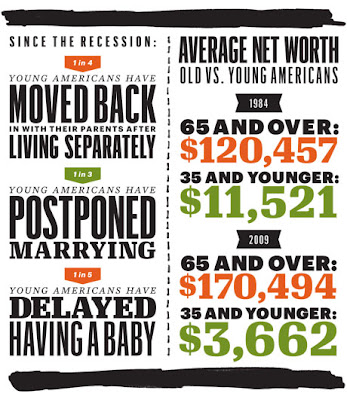
The real inequality: young America and old America

From Donald Sensing at Sense of Events blog.

Excerpt:

Shikha Dalmia, responds to Slate’s Dahlia Lithwick, who was so, “Shell shocked by the shellacking that the Solicitor General Donald Verrilli received at the hearing Tuesday, [that] she went into a deep sulk and threw the intellectual equivalent of a hissy fit.” Shikha observes:

In our current health care system, a mix of taxpayers; (rich) hospitals/providers and (even richer) private insurers are stuck with the tab for uncompensated care. There are many problems with this. But isn’t it at least more compassionate than ObamaCare that would force asset-poor young people – trying to pay off their college debt and hang on to some beer money – to subsidize the coverage of relatively wealthier prospective geezers? If maximizing compassion is the issue, shouldn’t we stick with what we’ve got?

In other words, under Obamacare the young overpay for health insurance in order to subsidize the old, whose medical costs are magnitudes higher than those of the young. That is a key feature of the “individual mandate” that makes it mandatory to buy health insurance under Obamacare. I remember reading during the SCOTUS hearings that men and women younger than 30 (or so) average using about $1,800 of health insurance per year, but will have to pay $5,400.

It’s very important to understand that when government gets involved with spending money on handing out goodies, that it is tempting for them to buy the votes of those who are politically informed with the money taken from those who don’t know a thing about real life.

Now consider these numbers from socialist Europe – where Obama’s plan is a little further along.

Excerpt:

Youth unemployment now exceeds 50pc in both Spain and Greece as the number of people out of work in the eurozone as a whole hit a 15-year high of 17.2m.

The unemployment rate among Spain’s under-25s rose to 50.5pc in January, and to 50.4pc in Greece in December, according to the latest available data from Eurostat, the European Union’s statistics office. It compared with an average eurozone youth unemployment rate of 21.6pc. One of the lowest rates of youth unemployment is in Germany, where it remained at 8.2pc in February.

The rise in Spain and Greece reflects the deep financial woes of both countries, which are in the midst of far-reaching and highly unpopular austerity programmes, considered necessary by the broader EU to reduce huge deficits.

Spain’s unemployment rate now stands at 23.6pc, compared with a eurozone average of 10.8pc. The extent of Spain’s problems are further underlined by a housing market in crisis, with prices expected to fall the most on record this year. One-in-four homeowners in the country owes more than their property is worth.

I find it so sad that kids are brainwashed by unionized public school teachers to support nonsense like global warming, while despising free market capitalism. And then they go out and vote for more and more government, so that their “teachers” can be paid more and more. They will never fix their worldviews until they get out into the real world, and by then it they will have voted in many elections.

Canada’s tax revenues steady as they lowered corporate tax rates

Canada: Corporate tax cuts, not stimulus spending

From the Daily Caller.

Excerpt:

The chart shows Canada’s federal corporate tax revenues as a share of gross domestic product (GDP) and the federal corporate tax rate. The tax rate plunged from 38 percent in 1980 to just 15 percent by 2012. Amazingly, there has been no obvious drop in tax revenues over the period.

Canadian corporate tax revenues have fluctuated, but the changes are correlated with economic growth, not the tax rate. In the late 1980s, a tax rate cut was followed by three years of stable revenues. In the early 1990s, a plunge in revenues was caused by a recession, and then in the late 1990s revenues soared as the economy grew.

In 2000, Canadian policymakers enacted another round of corporate tax rate cuts, which were phased in gradually. Corporate tax revenues initially dipped, but then they rebounded strongly in the late 2000s.

The rate cuts enacted in 2000 were projected to cause substantial revenue losses to the Canadian government. That projection indicates that the reform didn’t have much in the way of legislated loophole closing. But the chart shows that the positive taxpayer response to the rate cut was apparently so large that the government did not lose much, if any, revenue at all.

In 2009, Canada was dragged into a recession by the elephant economy next door, and that knocked the wind out of corporate tax revenues. However, it is remarkable that even with a recession and a tax rate under 20 percent, tax revenues as a share of GDP have been roughly as high in recent years as they were during the 1980s, when there was a much higher rate. Jason Clemens of the Macdonald-Laurier Institute notes that Canadian corporate tax revenues have been correlated with corporate profits, not the tax rate.

If a corporate tax rate is high, there is a “Laffer effect” when the rate is cut, meaning that the tax base expands so much that the government doesn’t lose any money. Estimates from Jack Mintz and other tax experts show that cutting corporate tax rates when they are above about 25 percent won’t lose governments any revenues over the long run.

This data is no surprise to supply siders – we expect this because of past experience with tax cuts.

Tax cuts: do they work?

Consider this article by the Cato Institute discusses how the Reagan tax cuts affected the unemployment rate.

Excerpt:

In 1980, President Carter and his supporters in the Congress and news media asked, “how can we afford” presidential candidate Ronald Reagan’s proposed tax cuts?

Mr. Reagan’s critics claimed the tax cuts would lead to more inflation and higher interest rates, while Mr. Reagan said tax cuts would lead to more economic growth and higher living standards. What happened? Inflation fell from 12.5 percent in 1980 to 3.9 percent in 1984, interest rates fell, and economic growth went from minus 0.2 percent in 1980 to plus 7.3 percent in 1984, and Mr. Reagan was re-elected in a landslide.

[…]Despite the fact that federal revenues have varied little (as a percentage of GDP) over the last 40 years, there has been an enormous variation in top tax rates. When Ronald Reagan took office, the top individual tax rate was 70 percent and by 1986 it was down to only 28 percent. All Americans received at least a 30 percent tax rate cut; yet federal tax revenues as a percent of GDP were almost unchanged during the Reagan presidency (from 18.9 percent in 1980 to 18.1 percent in 1988).

What did change, however, was the rate of economic growth, which was more than 50 percent higher for the seven years after the Reagan tax cuts compared with the previous seven years. This increase in economic growth, plus some reductions in tax credits and deductions, almost entirely offset the effect of the rate reductions. Rapid economic growth, unlike government spending programs, proved to be the most effective way to reduce unemployment and poverty, and create opportunity for the disadvantaged.

The federal revenues as a % of GDP were steady.

The conservative Heritage Foundation describes the effects of the Bush tax cuts.

Excerpt:

President Bush signed the first wave of tax cuts in 2001, cutting rates and providing tax relief for families by, for example, doubling of the child tax credit to $1,000.

At Congress’ insistence, the tax relief was initially phased in over many years, so the economy continued to lose jobs. In 2003, realizing its error, Congress made the earlier tax relief effective immediately. Congress also lowered tax rates on capital gains and dividends to encourage business investment, which had been lagging.

It was the then that the economy turned around. Within months of enactment, job growth shot up, eventually creating 8.1 million jobs through 2007. Tax revenues also increased after the Bush tax cuts, due to economic growth.

In 2003, capital gains tax rates were reduced. Rather than expand by 36% as the Congressional Budget Office projected before the tax cut, capital gains revenues more than doubled to $103 billion.

The CBO incorrectly calculated that the post-March 2003 tax cuts would lower 2006 revenues by $75 billion. Revenues for 2006 came in $47 billion above the pre-tax cut baseline.

Here’s what else happened after the 2003 tax cuts lowered the rates on income, capital gains and dividend taxes:

  • GDP grew at an annual rate of just 1.7% in the six quarters before the 2003 tax cuts. In the six quarters following the tax cuts, the growth rate was 4.1%.
  • The S&P 500 dropped 18% in the six quarters before the 2003 tax cuts but increased by 32% over the next six quarters.
  • The economy lost 267,000 jobs in the six quarters before the 2003 tax cuts. In the next six quarters, it added 307,000 jobs, followed by 5 million jobs in the next seven quarters.

The timing of the lower tax rates coincides almost exactly with the stark acceleration in the economy. Nor was this experience unique. The famous Clinton economic boom began when Congress passed legislation cutting spending and cutting the capital gains tax rate.

Tax revenues increased after the Bush tax cuts – due economic growth.

Those are the facts. That’s not what you hear in the media, but they are the facts.