Tag Archives: Economics

Polls show voters swinging to Romney after decisive debate victory

Robert Stacy McCain reports on the latest post-debate polls, but urges us to be cautious about believing them now, just because they are in our favor.

He writes: (links removed)

Nevertheless, for several months, I had been saying that I thought the outcome of the election would hinge on the debates, and the one-sided ass-whupping Romney put on Obama may have triggered a decisive shift that the polls are already beginning to detect.

If you check the Real Clear Politics national average, you see that Sept. 26/Oct. 1, Obama held a lead of four or more points after having been tied with Romney just a month earlier. According to Gallup’s tracking poll, Obama had led by 6 points most of the way from Sept. 19/Oct. 2. Both of these key indicators now show a trend toward Romney, who has closed the gap to 3 points in Gallup and 1.6 points in the RCP, which is mirrored in recent state-by-state results for Florida, Ohio, Colorado andWisconsin.

However, to emphasize again, polls are a lagging indicator. What is important in studying election polls is to follow the trendline, and we don’t yet have enough results from different firms to be able to say (on Oct. 7) that Romney’s looking like a definite winner for Nov. 6.

And McCain also links to this story about one of the bluest counties in the United States: (links removed)

You’d have to reckon that our president’s handlers thought that he would be safe visiting Cleveland, Ohio, a place that helped him win Ohio four years ago. Cuyahoga County yields the majority of Democratic votes from our state. But there’s trouble for Team Obama there today, in a dearth of Democrat registrations.

Here was how Mr. Obama was greeted at a local market:

An Ohio market vendor told President Barack Obama on Friday that his business has been going “terrible” since the president’s arrival, according to media reports.

Obama was greeting different vendors at Cleveland’s West Side Market when he came upon the proprietor of Rolston Poultry.

According to the White House pool report, Obama asked the man how business was going.

“Terrible since you got here,” he replied.

[…]That small business owner summed up the sentiments of many Ohioans, reflected in the new Rasmussen poll, also cited in the PJ Media piece on Obama’s Buckeye state woes.

So, there’s a problem with registering Dems in Cuyahoga County? That’s according to analysis by Clinton Cooper of Election Insights, who has been involved in local and regional government and politics for the last 10 years, including at The Ohio State University and in a policy advisory role for several government agencies and consulting firms in Ohio. Mr. Cooper claims that his data shows that the changes in voter registration in Cuyahoga County have made it extremely difficult for Obama to win Ohio.

Remember, the Paul Ryan vs Joe Biden VP debate is on Thursday night this week.
A critical evaluation of Obama’s economic narrative, using evidence

This article is currently the most popular one on Investors Business Daily.

Excerpt:

In making his case for re-election in the face of historically high unemployment and sluggish growth, President Obama has a simple and straightforward argument.

Things were terrible when I arrived, he says, thanks to Bush-era policies of tax cuts and deregulation. We stopped the decline, but the ditch was so deep that it will take time to get out. Still, we are making progress, even if it isn’t as fast as everyone would like.

So the last thing we want to do is return to the failed Bush policies that, he says, drove us into the ditch.

That argument appears to be working. More people continue to blame Bush than Obama for the current poor state of affairs, and some surveys show that consumer confidence has recently increased.

But each part of Obama’s argument is based on claims that are not accurate…

The article lists 5 claims made by Obama, and assesses each claim against the evidence.

Here are the 5 claims:

  1. Bush tax cuts and deregulation caused the recession.
  2. I stopped a second Great Depression.
  3. My policies are working.
  4. A slow recovery was inevitable.
  5. Nobody could have done any better.

And here’s the critique of point number one: (links removed)

At a campaign rally, Obama said Romney is “just churning out the same ideas that we saw in the decade before I took office . . . the same tax cuts and deregulation agenda that helped get us into this mess in the first place.”

It’s a standard Obama talking point. But it’s not true. Bush’s tax cuts did not cause the last recession.

In fact, once they were fully in effect in 2003, they sparked stronger growth — generating more than 8 million new jobs over the next four years, and GDP growth averaging close to 3%.

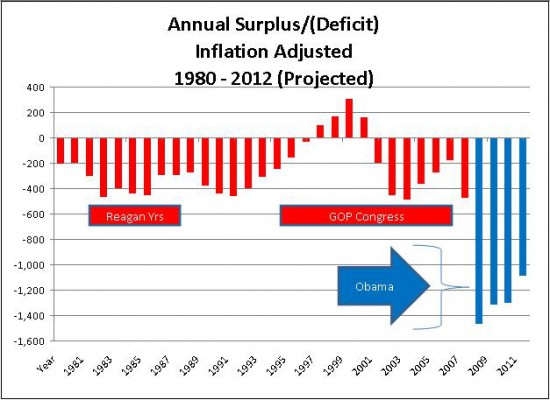
Those tax cuts didn’t explode the deficit, either, as Obama frequently claims. Deficits steadily declined after 2003, until the recession hit.

Nor was Bush a deregulator. Conservative Heritage Foundation’s regulation expert James Gattuso concluded, after reviewing Bush’s record, that “regulation grew substantially during the Bush years.”

Even the Washington Post’s fact-checker, Glenn Kessler, gave Obama’s claim three out of four “Pinocchios,” saying “it is time for the Obama campaign to retire this talking point, no matter how much it seems to resonate with voters.”

What did cause the economic crisis? The housing bubble. And that, in turn, was the result of a determined federal effort to boost homeownership by, among other things, pressuring banks to lower lending standards.

Now I know that some people (like Jerry) who get their policy news from the Comedy Channel think that the Bush tax cuts made the deficits explode, but of course, deficits were shrinking until the two spendthrifts Nancy Pelosi and Harry Reid got hold of the purse strings after taking the House and Senate in 2007.

Look:

Barack Obama: Budget Deficits
Barack Obama: Budget Deficits – last GOP budget was 2007

Similarly, Obama clowns on the Comedy Channel and MSNBC also think that the Bush tax cuts made revenues go down.

Ooops:

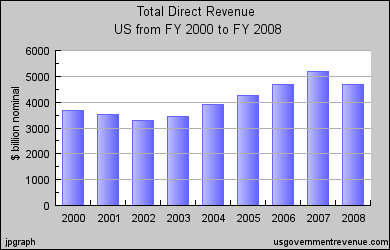
Did the Bush tax cuts make revenues decrease? No!

You can tune into MSNBC and the Comedy Channel on any given night and see the clowns there claiming that Bush’s $160 billion deficit in 2007 is actually higher than the $450 billion deficit in 2004, after the 2.2 trillion of tax cuts were passed.

Read the whole thing, it will help you to be persuasive when discussing Obama’s rhetoric. People aren’t saying that Romney won the debate because he had “zingers”. People are saying that Romney won the debate because he had facts and evidence. 

My prescription for voters in this election is more economics, and cut back on the Comedy Channel. Democrats must all buy Thomas Sowell’s “Basic Economics” and read that all the way through. I know that graphs aren’t as entertaining as Rachel Madclown, but we all must make an effort for the sake of the prosperity of our children, and our children’s children.

New study: women economists more likely to support higher taxes and bigger government

From liberal USA Today.

Excerpt:

A lot depends on whether the economist is a man or a woman. A new study shows a large gender gap on economic policy among the nation’s professional economists, a divide similar — and in some cases bigger — than the gender divide found in the general public.

[…]Female economists tend to favor a bigger role for government while male economists have greater faith in business and the marketplace. Is the U.S. economy excessively regulated? Sixty-five percent of female economists said “no” — 24 percentage points higher than male economists.

[…]The genders are most divorced from each other on the question of equality for women. Male economists overwhelmingly think the wage gap between men and women is largely the result of individuals’ skills, experience and voluntary choices. Female economists overwhelmingly disagree by a margin of 4-to-1.

More findings:

  • Health insurance. Female economists thought employers should be required to provide health insurance for full-time workers: 40% in favor to 37% against, with the rest offering no opinion. By contrast, men were strongly against the idea: 21% in favor and 52% against.
  • Education. Females narrowly opposed taxpayer-funded vouchers that parents could use for tuition at a public or private school of their choice. Male economists love the idea: 61% to 14%.
  • Labor standards. Females believe 48% to 33% that trade policy should be linked to labor standards in foreign counties. Males disagreed: 60% to 23%.

According to a recent research paper, single women tend to vote for bigger government in order to have security.

Excerpt:

Giving women the right to vote significantly changed American politics from the very beginning. Despite claims to the contrary, the gender gap is not something that has arisen since the 1970s. Suffrage coincided with immediate increases in state government expenditures and revenue, and these effects continued growing as more women took advantage of the franchise. Similar changes occurred at the federal level as female suffrage led to more liberal voting records for the state’s U.S. House and Senate delegations. In the Senate, suffrage changed voting behavior by an amount equal to almost 20 percent of the difference between Republican and Democratic senators. Suffrage also coincided with changes in the probability that prohibition would be enacted and changes in divorce laws.

[…]More work remains to be done on why women vote so differently, but our initial work provides scant evidence that it is due to self-interest arising from their employment by government.The only evidence that we found indicated that the gender gap in part arises from women’s fear that they are being left to raise children on their own (Lott and Kenny 1997). If this result is true, the continued breakdown of the family and higher divorce rates imply growing political conflicts between the sexes. 19

A recent New York Times poll found that Obama led Romney by 29 points among single women, whereas Romney has a slight edge with married women.

I think one of the reasons why single women are so willing to look to big government as a substitute for a husband is because lately they seem to be struggling with 1) the ability to choose a good man by evaluating him rationally and objectively, and 2) the willingness to sacrifice and compromise in order to keep a good man. In my experience, single women today seem to be concerned that men might somehow place obligations on them that might limit their automomy with respect to the pursuit of happiness. That is why they often (but not always!) delay marriage and focus on their careers, and often vote for bigger government to provide them with a safety net. I think that women spend their 20s trying to drift into marriage by working on their careers and by having a good time with the wrong sort of men – men who don’t perform the traditional male roles. Single women vote for bigger government because deep down they know that the binge drinking and the hook-up sex are not likely to find a good man and produce a lasting marriage. But they just can’t stop themselves from having “fun” – big government is their safety net for their own choices with men.

I was having a conversation with a Christian woman on the weekend about Christian women and the men they choose to pursue.  She said that divorce was not something that she was worried about because she had undertaken a careful study of men and marriage and she knew how to choose the right man for the job. She said that she was very clear on what men are supposed to do in a marriage, and that she had confidence in her ability to assess men for those duties. Secondly, she said that she knew what her responsibilities were as a woman in a marriage towards a man, and that she had complete confidence in her ability to perform those duties, based on careful, study, planning and training.  I was impressed because she was taking responsibility to make good decisions and to perform her duties, and she had confidence that this would reduce and even eliminate the risk of divorce. But I doubt that she would say that she learned these things from the secular culture, and probably not even in the church.